
If you’re trying to trade crypto on Kraken and hit a wall-maybe you can’t deposit, can’t trade XRP, or suddenly can’t access your stablecoins-you’re not alone. Kraken blocks users in 14 countries entirely and imposes dozens of state- and asset-specific restrictions across the globe. It’s not random. It’s compliance. And if you want to keep your account active, you need to understand exactly what’s blocked, why, and what it means for you.
Where Kraken Completely Blocks Trading
Kraken doesn’t allow any trading activity in 14 countries. These aren’t arbitrary choices. They’re dictated by international sanctions and anti-money laundering laws enforced by the U.S. Treasury, the EU, and other global regulators. If you’re in one of these places, you can’t even sign up.The full list includes: Afghanistan, Belarus, Cuba, Iran, Iraq, North Korea, Syria, Libya, Sudan, South Sudan, Democratic Republic of the Congo, Russia (including Crimea, Donetsk, and Luhansk), Central African Republic, and Eritrea. Some of these are under long-standing U.S. sanctions. Others, like Russia, were added after the 2022 invasion of Ukraine. Kraken doesn’t negotiate. If a country is on the OFAC sanctions list, Kraken shuts it down.
Even if you’re a citizen of a permitted country but live in one of these blocked regions, Kraken will detect your IP address and lock your account. Using a VPN to bypass this? That’s a direct path to permanent suspension. Kraken’s systems flag geo-spoofing with high accuracy. Thousands of accounts have been frozen this way since 2023.
U.S. Users: It’s Not Just Federal-It’s State-by-State
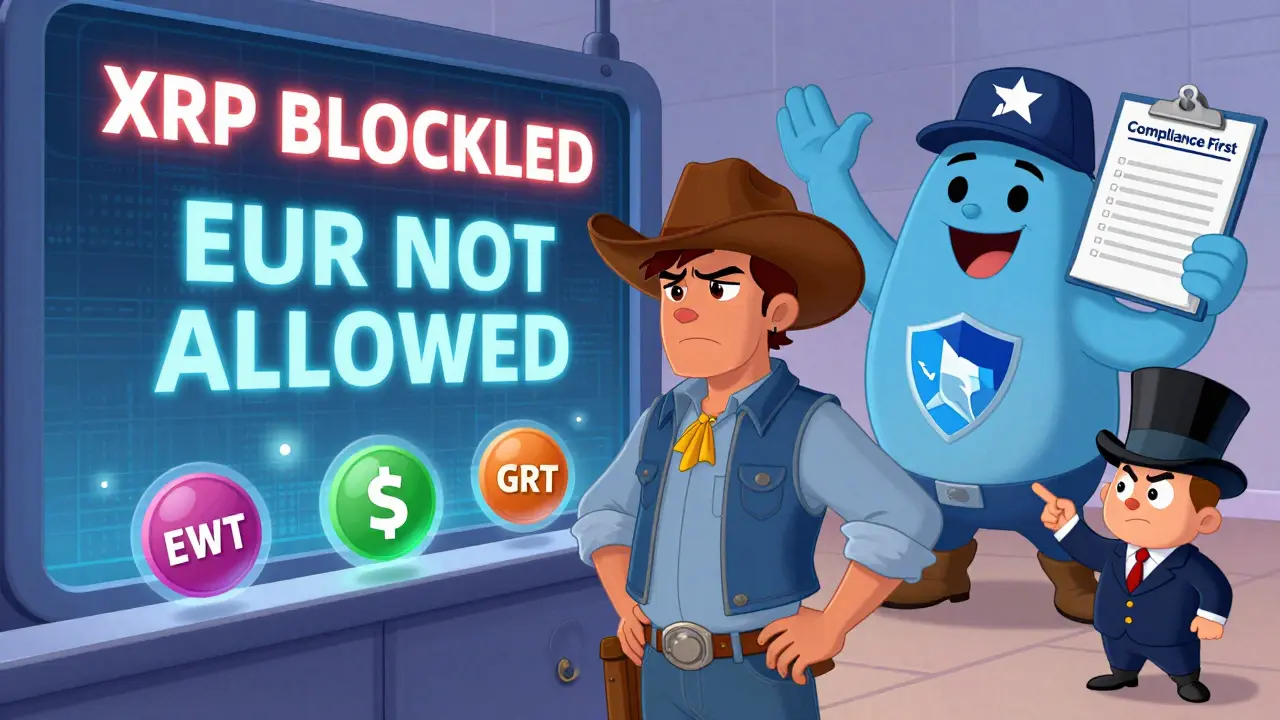
The U.S. is Kraken’s biggest market. But it’s also its most complicated. You can’t treat the U.S. as one country when it comes to Kraken. Each state has its own rules, and Kraken follows them to the letter.Every U.S. resident is blocked from trading XRP. That’s because the SEC sued Ripple Labs in 2020, claiming XRP is an unregistered security. Kraken complied, and the ban stuck-even after the SEC lost part of its case in 2023. The exchange still won’t let you buy, sell, or hold XRP if you’re in the U.S.
New York residents? You can’t trade at all unless you’re pre-verified under the BitLicense program. Even then, your access is limited. Washington State residents face the same barrier. Texas and New Hampshire residents can’t hold or trade euros (EUR) on Kraken. Why? Because those states treat crypto as a commodity, not a currency, and Kraken’s EUR trading setup doesn’t meet their financial licensing standards.
Other U.S.-specific restrictions: You can’t trade EWT or GRT. ETH2.S is only for staking-no direct trading. FLOW tokens are blocked for U.S., Canadian, and Japanese users. And if you’re using margin, you’re capped at 28 days. Outside the U.S., traders get up to 365 days. That’s a huge difference for anyone trying to hold a long-term leveraged position.
Europe’s Big Shift: Stablecoins Are Gone
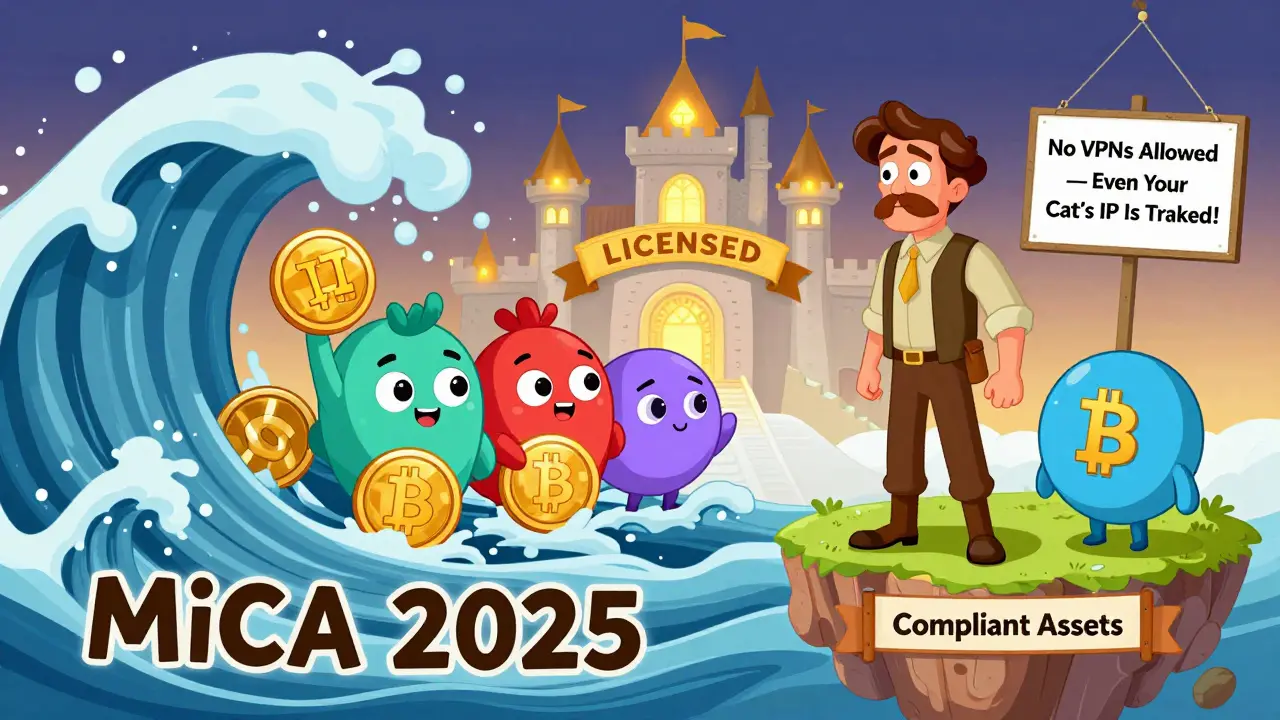
In early 2025, Kraken pulled the plug on five major stablecoins across the European Economic Area. That’s right-no more USDT, USDP, TUSD, EURt, or TerraClassic USD for users in Austria, Cyprus, Czechia, Malta, Portugal, Spain, Sweden, and 25 other EU countries.This wasn’t a surprise to regulators. It was the direct result of MiCA-the Markets in Crypto-Assets regulation that came into full force in January 2025. MiCA requires stablecoins to be fully backed by regulated reserves and audited monthly. Kraken couldn’t get those certifications in time for the March 2025 deadline, so it chose to delist rather than risk fines or license revocation.
Users were given a clear timeline: February 13, 2025-reduce-only mode. February 27-sell-only. March 17-close all margin positions. March 24-spot trading stopped. By March 31, all remaining stablecoins were automatically converted to EUR or USD. If you didn’t act, Kraken sold your tokens for you at the market rate.
Many European traders were furious. USDT alone makes up over 60% of global crypto trading volume. But Kraken’s move was strategic. It’s betting that regulatory clarity will win over short-term convenience. For now, EU users have to rely on EUR deposits or other compliant assets like BTC and ETH.
Australia and Japan: Privacy Coins Are Off-Limits
Australia’s AUSTRAC requires exchanges to block privacy coins entirely. That means no Monero (XMR), no Zcash (ZEC), and no DASH for Australian users. Kraken doesn’t argue. It just disables them.Japan’s rules are even stricter. Japanese residents must submit additional documentation to trade in JPY. They’re also blocked from trading FLOW tokens. And while Kraken offers margin trading in Japan, it’s capped at 5x leverage-far below the 10x or 20x offered elsewhere.
These aren’t “we don’t like privacy coins” decisions. They’re legal requirements. Australia’s AML laws target anonymity. Japan’s Financial Services Agency demands full traceability. Kraken has no choice but to comply.
How Kraken Knows Where You Are
Kraken doesn’t just ask you where you live. It checks. And it checks again.When you sign up, you upload government ID-passport, driver’s license, national ID card. That’s verified against official databases. Then, your IP address is scanned. Your bank details are checked for location. Your phone number is cross-referenced. If you move countries, you have to re-verify. If you log in from a different country, even briefly, Kraken may freeze your account until you prove you’re still eligible.
They use third-party geolocation services with 99.2% accuracy. Even if you use a proxy or a residential VPN, Kraken’s system flags anomalies-like mismatched billing addresses, inconsistent device fingerprints, or login patterns from multiple countries in one day.
And yes, they’ve terminated over 12,000 accounts since 2023 for geo-spoofing. No warnings. No second chances. Just a locked account and a notice: “Violation of jurisdictional terms.”
Why Kraken Plays It So Strictly
Kraken isn’t being difficult. It’s being careful.In 2022, the U.S. Treasury fined Kraken $30 million for violating sanctions by letting users in sanctioned countries trade. In 2020, it became the first crypto exchange to get a U.S. banking charter in Wyoming. In 2023, the SEC sued Kraken for operating as an unregistered exchange-but dropped the case after Kraken agreed to stricter compliance.
That’s the pattern: get fined, then over-correct. Kraken’s leadership knows that one major regulatory blow could shut them down entirely. So they build walls before anyone can break through.
It’s working. Kraken is now one of the few crypto exchanges with licenses in the U.S., Canada, Australia, Japan, and the UK. That’s why institutional investors-hedge funds, family offices, pension funds-trust Kraken more than Binance, Bybit, or OKX. They know Kraken won’t vanish overnight.
What’s Next? Changes Coming in 2025
Kraken isn’t done adjusting. In 2025, they’re exploring ways to reopen services in New York and Washington State. They’re also waiting to see if the SEC will allow staking for more tokens under a revised framework. If that happens, ETH2.S and other staking-only assets could become fully tradable again.In Europe, Kraken is lobbying for MiCA exemptions for non-stablecoin assets. They’re also testing a new compliance portal for EU users that simplifies documentation. But don’t expect USDT to return anytime soon. The stablecoin market is now dominated by regulated players like Circle (USDC) and Paxos (PAX), and Kraken is shifting focus to those.
One thing’s clear: the era of “crypto anywhere” is over. The future belongs to exchanges that play by the rules-even if it means losing users.
What Should You Do If You’re Blocked?
If you’re blocked:- Confirm your current country of residence. Did you move? Did you use a VPN? That’s likely the issue.
- Check Kraken’s official jurisdiction page. It’s updated monthly and lists every restriction by country and asset.
- If you’re in the U.S., check your state. Some restrictions are state-specific.
- Don’t try to bypass the system. You’ll lose your funds.
- If you’re in a blocked country, consider using a non-Kraken exchange that operates legally where you are-but be warned: many of those are riskier and less regulated.
There’s no workaround. Kraken’s restrictions are legal, not technical. And they’re not going away.
Can I still use Kraken if I travel to a blocked country?
No. Kraken detects your location in real time. If you log in from a blocked country-even temporarily-your account will be frozen. You must be physically located in a permitted jurisdiction to trade. Traveling doesn’t change your account’s jurisdiction status.
Why can’t I trade XRP on Kraken even though the SEC lost part of its case?
Because Kraken doesn’t wait for legal ambiguity to clear. Even after the 2023 court ruling, the SEC still considers XRP a security in most cases. Kraken chose to keep the ban to avoid future penalties. The exchange doesn’t take risks with regulators-even if the law seems to be shifting.
Are there any alternatives to Kraken in blocked countries?
Yes-but they come with big risks. Some exchanges operate in sanctioned countries without licenses. These platforms often lack customer support, insurance, or withdrawal guarantees. Many have been hacked or shut down. If you’re in a blocked country, your safest option is to move to a permitted jurisdiction before trading.
Why did Kraken delist USDT in Europe but not in the U.S.?
Because MiCA applies only to the European Economic Area. The U.S. has no federal stablecoin regulation yet, so Kraken can still offer USDT there. In Europe, MiCA requires strict reserve audits and licensing that Kraken couldn’t meet in time. The U.S. rules are different-and less strict-for now.
Can I get my funds back if my account is blocked?
If your account is blocked due to jurisdiction violation, Kraken will allow you to withdraw your funds before closing the account. But you must do it within 30 days. After that, your assets are frozen indefinitely. You can’t trade, transfer, or withdraw. The only way to unlock them is to prove you’re in a permitted jurisdiction.





Mandy McDonald Hodge
Just tried to buy some ETH2.S and got blocked 😭 I thought I was safe since I’m in Texas… turns out Kraken doesn’t care if you’re chill or not. They just shut it down. I’m so done with this ‘compliance theater’.
Bruce Morrison
They’re not being difficult. They’re being smart. If you want to survive in this space long-term, you need to play by the rules. Binance got crushed. Kraken didn’t. That’s not luck. That’s discipline.
Adam Hull
Let’s be real - Kraken’s compliance is performative. They don’t care about regulation. They care about market share. They banned XRP because they didn’t want to fight the SEC. They delisted stablecoins because they didn’t want to audit them. This isn’t ethics. It’s corporate cowardice dressed up as responsibility.
Willis Shane
You people don’t get it. This isn’t about freedom. It’s about survival. If Kraken didn’t lock down every jurisdiction like a prison, they’d be fined $500M tomorrow. The SEC isn’t playing. Neither should we.
Kevin Gilchrist
They banned privacy coins? Bro. I use XMR to protect my assets from the state. Now I gotta go to some sketchy OTC desk in a Telegram group? Thanks Kraken. You just made me a target. 😤
Shawn Roberts
At least they’re not Binance 😅 I’d rather lose XRP than lose my whole portfolio to a hack or a shutdown. Kraken’s boring but safe. And boring is hot right now 🤷♂️
Khaitlynn Ashworth
Oh look, another ‘compliance hero’ post. Let me guess - you also think the SEC is a benevolent guardian of the people? Wake up. They’re just protecting Wall Street’s monopoly. Kraken’s just their puppet with a better logo.
Jordan Fowles
The real tragedy isn’t the bans. It’s that we ever believed crypto could be borderless. We wanted decentralization but kept asking centralized institutions to protect us. Now we’re surprised when they choose safety over freedom. We built the cage. Then we cried when the door locked.
dina amanda
They’re using sanctions to hide their own incompetence. Russia’s blocked? Fine. But why can’t I trade in New York? Because they’re scared of state regulators, not because of some moral code. This is all about money, not law.
Jake West
Why are we even surprised? Kraken’s been a corporate sellout since day one. They took the Wyoming charter not to help crypto - to become a bank. Now they’re just another boring fintech with a blockchain sticker on it.
Josh Seeto
For someone who claims to care about compliance, Kraken sure does a lot of finger-pointing at users. If they spent half as much time lobbying for clearer regulations as they do banning IPs, maybe we wouldn’t be here.
Abhisekh Chakraborty
Bro I’m in Nigeria and I can’t even sign up. But I can buy crypto from some guy on WhatsApp who doesn’t even know what KYC means. So who’s really the problem here? Kraken? Or the system that makes this necessary?
NIKHIL CHHOKAR
It’s not about Kraken being evil. It’s about us being naive. We thought crypto would break the system. Instead, we just made it more bureaucratic. Now we’re mad because the system won’t let us cheat it anymore. That’s not freedom. That’s entitlement.
Mike Pontillo
They delisted USDT in Europe? Good. That thing’s a pyramid scheme with a whitepaper. I’m glad someone finally had the guts to cut it loose. Let Circle and Paxos fight it out. I’ll hold BTC and ETH and laugh.
surendra meena
They blocked me in India? I’m not even in a sanctioned country! Why are they treating us like criminals? I’ve been trading for 5 years! I pay my taxes! I follow the rules! And now I’m just… gone? No warning? No appeal? This is fascism with a UI!
Elisabeth Rigo Andrews
Let’s not romanticize this. Kraken’s compliance isn’t noble. It’s profitable. They’re not losing users - they’re filtering them. The ones who stay are institutional-grade. The ones who leave? They were always liabilities. This is business optimization disguised as principle.
SUMIT RAI
USDT gone in EU? Bro I just lost $20k in stablecoin arbitrage 😭 But honestly? I’m not mad. Kraken’s just doing what every sane exchange should’ve done years ago. Let’s just move on. 🤝
Emily L
I used a VPN for 3 months. Got caught. Account locked. They wouldn’t even let me withdraw. My whole portfolio’s frozen. And now they’re acting like it’s my fault? What kind of monster does that?
Gavin Hill
They’re not the villains. We are. We wanted the freedom without the responsibility. We wanted to trade XRP like it’s a meme coin while pretending we’re building the future. Now the bill’s due. And it’s not Kraken’s fault we didn’t read the fine print.
Andrew Prince
It is not merely a matter of regulatory compliance; it is, in fact, an existential imperative for the preservation of institutional integrity in an increasingly hostile and litigious global financial ecosystem. Kraken, by virtue of its adherence to the most stringent jurisdictional parameters, has effectively positioned itself as the sole custodian of legitimacy in a market teeming with predatory actors and unregistered entities. The alternative is not merely risk - it is annihilation. The SEC does not negotiate. The Treasury does not pardon. And the market, in its infinite wisdom, rewards those who submit to structure - not those who romanticize chaos.
Steve Williams
As someone from Nigeria, I see this as a wake-up call. We can’t keep waiting for permission. We need to build our own infrastructure - decentralized, community-owned, and truly borderless. Kraken’s rules are their rules. But crypto was never meant to be controlled by one company, no matter how ‘compliant’ they are.
Andrea Stewart
Can’t trade XRP? Fine. But why can’t I even see my balance? I didn’t buy it. I inherited it. Now I’m stuck with a frozen account and no way out. This isn’t compliance. This is theft.