
Why There's No Velas (VLX) GRAND Airdrop
If you've seen claims about a 'Velas GRAND airdrop', you're not alone-but there's a problem. Velas (VLX) has never announced any such program. This is a known Velas airdrop scam targeting cryptocurrency holders. Scammers create fake websites, social media posts, and Telegram groups claiming to offer free tokens. They'll ask for your private keys or seed phrases, which is a major red flag. Real cryptocurrency projects never ask for this information.
The confusion likely comes from two sources. First, there's the Grand Velas Resort-a luxury hotel chain in Mexico. It has nothing to do with cryptocurrency. Second, a completely separate project called Vela Exchange ran a token giveaway in 2023. But Velas (VLX) blockchain is a different entity altogether.
Velas (VLX) is a blockchain project focused on high-speed transactions and low fees. It's built on a proof-of-stake consensus mechanism and aims to provide fast, secure transactions. The project has its own token, VLX, which is used for network operations and staking. However, Velas has never conducted any airdrop called 'GRAND'. In fact, their official announcements about token distributions are clear and transparent. Checking Velas' official website or verified social media accounts shows zero mentions of this program.
How Scammers Trick People with Fake Airdrops
Scammers use several tactics to make fake airdrops look real. Here's what to watch for:
- Phishing websites: They create sites that look like Velas' official page but ask for your private keys. Real projects never ask for this.
- Social media impersonation: Fake accounts on Twitter or Telegram claiming to run Velas airdrops. Always check verified badges.
- Urgent deadlines: 'Claim now or lose your tokens!' is a classic pressure tactic. Legitimate airdrops have clear timelines and no rush.
- Third-party 'claim' links: Scammers send links to 'airdrop portals' that steal your wallet funds. Always go directly to the project's official site.
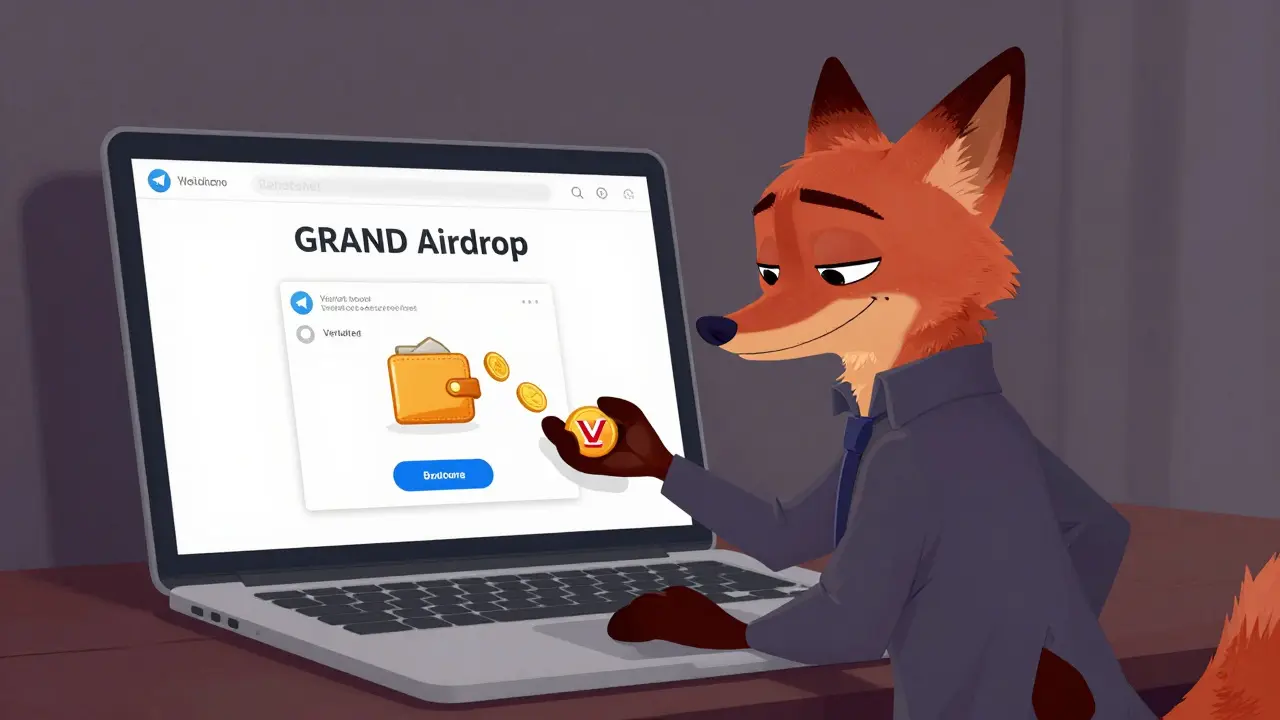
For example, in late 2025, a fake 'Velas GRAND' Telegram group had over 5,000 members. They shared a link to a website that looked like Velas' dashboard. Once users entered their wallet details, scammers drained all funds. This happened to dozens of people who trusted the 'official' appearance.
How to Verify Legitimate Airdrops
Before participating in any airdrop, follow these steps:
- Check official channels: Visit velas.com directly. Look for announcements in the 'News' section. Never click links from social media posts.
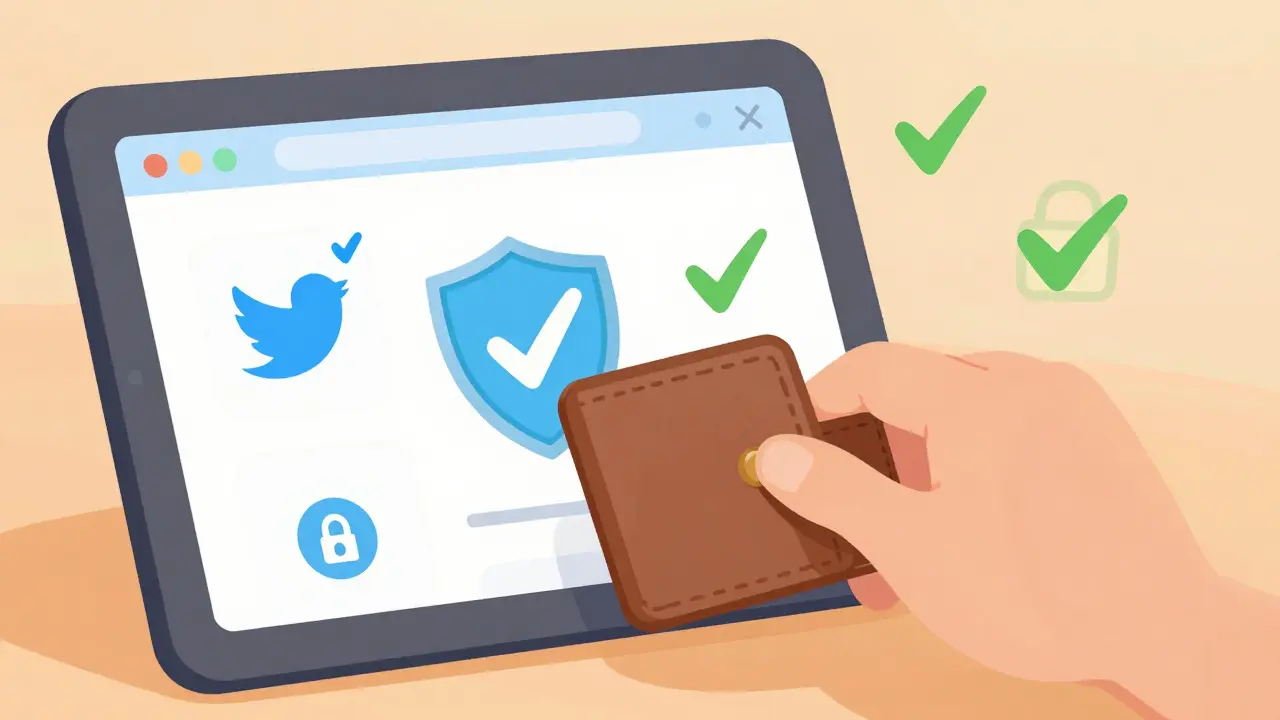
- Verify social media accounts: Velas' Twitter account has a blue checkmark (@velasblockchain). Fake accounts often have slight name variations like 'velasblockchian'.
- Read the tokenomics: Legitimate airdrops explain token distribution clearly. Velas' whitepaper details how VLX tokens are allocated-no 'GRAND' program exists in it.
- Search trusted sources: Check CoinGecko or CoinMarketCap for official announcements. Both platforms only list verified token distributions.
For instance, when Velas launched its mainnet in 2024, they announced token distributions through their website and verified social media. They never used third-party links or urgent claims. Always compare announcements across multiple trusted sources before acting.
Steps to Protect Your Crypto from Scams
Here's how to stay safe:
- Never share your private keys or seed phrases. No legitimate project will ask for them.
- Use a hardware wallet for large holdings. This adds a layer of security against online scams.
- Enable two-factor authentication (2FA) on all exchange and wallet accounts.
- Double-check URLs before entering sensitive information. Scammers often use .xyz or .io domains that look similar to official sites.
- Report suspicious activity to the project team. Velas has a dedicated security email for reporting scams.
Real-world example: In January 2026, a user received a DM on Telegram claiming they'd won 'Velas GRAND' tokens. They followed the steps above-checked velas.com, verified the Twitter account, and found no announcement. They reported the scam, and Velas later shared a warning on their official channels. This simple check saved their entire wallet.
Common Questions About Velas Airdrops
Is there a Velas GRAND airdrop?
No. Velas (VLX) has never announced a 'GRAND' airdrop. This is a scam. Always check Velas' official website and social media for legitimate announcements. The name 'Grand Velas' refers to a resort chain, not a cryptocurrency project.
Why do scammers use the name 'Velas GRAND'?
Scammers exploit confusion between 'Velas' (the blockchain) and 'Grand Velas' (a hotel brand). They add 'GRAND' to sound official and attract people searching for real airdrops. Always verify project names carefully-cryptocurrency scams often use familiar words to trick victims.
How do I know if an airdrop is real?
Legitimate airdrops always announce through official channels: the project's website, verified social media, and trusted crypto platforms like CoinGecko. They never ask for private keys or charge 'processing fees'. Velas' past airdrops (like the 2023 testnet rewards) were clearly documented in their whitepaper and press releases.
What should I do if I shared my private keys?
Immediately move all funds to a new wallet. Change your passwords on exchanges and enable 2FA. Report the incident to the project team (e.g., Velas [email protected]) and local authorities. Unfortunately, once private keys are shared, funds are usually unrecoverable-this is why prevention is critical.
Are there any legitimate Velas airdrops?
Velas has conducted airdrops in the past, like rewards for early testnet participants in 2023. These were always announced on their official website and verified social media. No 'GRAND' program exists. Always check velas.com/airdrops for current opportunities-this page is regularly updated with verified details.





Oliver James Scarth
Upon reviewing the provided information regarding the Velas (VLX) GRAND airdrop claims, it is imperative to underscore the unequivocal absence of such a program.
Scammers frequently exploit the conflation between 'Velas' and 'Grand Velas Resort,' a tactic that preys upon the unwitting.
One must exercise meticulous vigilance when encountering purported airdrops; legitimate projects never solicit private keys or seed phrases.
This particular scam, as evidenced by the 2025 Telegram group incident, demonstrates a disturbing trend of sophisticated phishing operations.
It is prudent to consult official sources such as velas.com and the verified Twitter account (@velasblockchain) to confirm any token distribution announcements.
Furthermore, the inclusion of third-party claim links is a cardinal red flag indicative of fraudulent activity.
The Velas blockchain's core mission-high-speed transactions and low fees-remains uncompromised by such malicious schemes.
In conclusion, adherence to established security protocols is paramount in safeguarding one's digital assets.
Kyle Pearce-O'Brien
Oh, the eternal struggle of crypto security-how quaint. The Velas 'GRAND' airdrop debacle is merely a symptom of systemic misinformation in the Web3 space. 🤦♂️
Scammers exploit semantic ambiguity between 'Velas' and 'Grand Velas Resort'-a linguistic sleight of hand that preys on the cognitively unsophisticated.
But let's not mince words: any project that doesn't explicitly state their tokenomics in a whitepaper is inherently suspect. 🌌
Moreover, the very notion of 'free tokens' is a fallacy; there's always a hidden cost, usually in the form of private key exposure.
It's a philosophical conundrum: how do we reconcile the democratization of finance with the predatory nature of such scams?
Perhaps the solution lies in blockchain's inherent transparency-but until then, we must remain vigilant. 🔍
PS: Always check CoinGecko for verified airdrops. No exceptions. 🤷♂️
Nathaniel Okubule
It's important to know that Velas (VLX) has never announced a 'GRAND' airdrop. Scammers often use the name 'Grand Velas Resort' to trick people.
Always check the official Velas website and verified social media accounts before acting.
If you're unsure, contact Velas support directly.
Protecting your crypto is simple: never share private keys, use a hardware wallet, and double-check URLs.
Stay safe out there!
David Bain
While Nathaniel's advice is commendable, the root issue lies in the epistemological challenges of verifying legitimacy in decentralized ecosystems.
Traditional authentication mechanisms are often absent, leading to a vacuum filled by malicious actors.
The conflation of 'Velas' with 'Grand Velas Resort' exemplifies semantic ambiguity exploited by scammers.
Legitimate projects maintain immutable records of token distributions, accessible via verifiable channels.
Thus, the onus is on users to cultivate cryptographic literacy and verify through canonical sources.
Failure to do so perpetuates the cycle of fraud.
It is not merely a technical issue but a sociological phenomenon requiring systemic solutions.
Jacque Istok
Let's cut through the bullshit: there's no Velas GRAND airdrop. Period.
Scammers love using 'Grand Velas Resort' confusion to trick people.
If you're asked for private keys, run. No legit project ever does that.
Check velas.com directly-never trust links from social media.
And if you've already shared your keys? Move funds ASAP.
Simple as that. No drama, just facts.
Mendy H
While the premise is correct, the analysis is superficial. The issue extends beyond mere 'private keys'-it's a symptom of broader systemic failures in crypto security.
Legitimate projects would have clear, documented airdrop processes, not vague 'official channels'.
This 'Velas' scam is merely a symptom of the industry's lack of regulation.
But then again, what do I know? I'm just a critic.
sabeer ibrahim
Oh please, 'systemic failures'? That's just a fancy way of saying 'people are dumb'.
Scammers thrive because users don't do basic checks.
Legit projects like Velas have clear announcements on their website.
It's not rocket science-check velas.com, look for the blue checkmark on Twitter.
And if you still fall for it? Well, you deserve to lose your crypto.
It's not the project's fault; it's your own fault for not being careful.
Stop making excuses and take responsibility.
Also, 'systemic failures' is such a buzzword-people like you just say that to sound smart.
Reality is simple: don't share keys, don't click random links.
Done. End of story.
PS: Typo-prone? Nah, I'm just typing fast. 😏
Deeksha Sharma
It's fascinating how humanity keeps repeating the same mistakes, even in the digital age.
Scams like the Velas GRAND airdrop exploit trust, but they also remind us of the importance of community vigilance.
Every time we share knowledge about these scams, we strengthen the crypto ecosystem.
Let's focus on education rather than blame.
By staying informed and helping others, we can build a safer future for everyone.
Remember: knowledge is power, and together we're stronger.
Taybah Jacobs
Deeksha's perspective is both insightful and constructive.
Indeed, fostering a culture of education and mutual support is paramount in combating crypto fraud.
While individual vigilance is crucial, collective awareness creates a robust defense.
It is imperative to share verified information through trusted channels.
By doing so, we mitigate the impact of malicious actors.
This approach aligns with the foundational principles of decentralized systems-transparency and community-driven security.
Let us continue to uplift one another in this journey.
Mrs. Miller
Oh, another 'GRAND' airdrop? How original.
Scammers are like cockroaches-they multiply when the lights go out.
But hey, at least they're keeping the 'Velas' name in the news, right? 😏
Anyway, check velas.com. It's that simple.
Don't let the scammers win. Or do-they're probably already laughing at us.
Alex Garnett
While Mrs. Miller's sarcasm is somewhat warranted, it trivializes a serious issue.
The 'Velas GRAND' scam is not a laughing matter-it's a calculated exploitation of public ignorance.
Legitimate blockchain projects maintain rigorous transparency, unlike these fraudsters.
One must not conflate the resilience of decentralized systems with the vulnerability of individual users.
It is imperative to uphold standards of due diligence, lest we erode the very foundation of crypto's credibility.
Blaming the victims or dismissing the problem only perpetuates the cycle of fraud.
aryan danial
While I appreciate the sentiment expressed by Alex Garnett, I must point out that his analysis is overly simplistic.
Scams like this are not merely a result of 'public ignorance'-they're a symptom of systemic failures in regulatory frameworks.
Moreover, the very notion of 'due diligence' is a misnomer in a space where even 'verified' accounts can be compromised.
It's not the user's fault for being scammed; it's the fault of a system that lacks robust safeguards.
Furthermore, the constant use of 'legitimate projects' as a benchmark is flawed-many so-called 'legitimate' projects have their own issues.
Thus, the focus should shift from individual blame to systemic reform.
Otherwise, we're just rearranging deck chairs on the Titanic.
sachin bunny
Hey, you know what's really scary? The fact that people still fall for these airdrop scams.
It's like they're not even trying.
But wait-maybe it's all part of a bigger plan? 🤔
Like, what if the 'scammers' are actually government agents testing our security awareness?
Or maybe the Velas team is secretly running fake scams to weed out the weak?
It's all so suspicious.
Either way, never share your private keys.
And always check velas.com.
But also, stay vigilant-because you never know who's watching. 👁️
And don't forget: the government is always watching you. Always. 🕵️♂️
Maybe the Velas blockchain is part of a bigger conspiracy to control all crypto.
Or maybe the 'GRAND' airdrop is a test for the masses.
Either way, stay safe and don't trust anyone.
Especially not the 'official' Velas website-because who knows what's really behind it?
Just saying. 😈
Shruti Sharma
lol u think the government is watching u? like really? 😂
stop being paranoid. velas is legit.
but yeah, no GRAND airdrop. it's a scam.
stop spreading conspiracy theories.
you're just making people more scared.
just check velas.com and move on.
and for real, if you share keys, you deserve to lose everything.
no one's gonna feel sorry for u.
u need to take responsibility for ur own actions.
not the government's fault.
and stop using emojis like a teenager.
grow up. 😤
Brittany Novak
It's not paranoia if they're really out to get you.
Scammers are everywhere, and they're getting smarter.
But the real danger is complacency.
Always verify everything.
Even official-looking links can be fake.
Check the domain carefully.
And never, ever share your private keys.
If you do, it's your fault.
But also, who knows if the Velas team is in on it?
Maybe they're secretly running scams to control the market.
Either way, stay safe and don't trust anyone.
Brittany Coleman
While Brittany's concerns are valid, the conclusion feels overly simplistic.
Scams exist, yes-but framing them as part of a larger conspiracy lacks evidence.
It's more productive to focus on education and community support.
Blaming the project or assuming malice without proof only fuels division.
Let's work together to build a safer environment.
Not tear each other down.
Peace.
laura mundy
Peace? Seriously? You're telling us to be 'peaceful' while scammers steal our money?
That's not peace-that's naivety.
And 'education and community support' won't stop people from being stupid.
They need to be held accountable.
Not coddled.
Blaming the victims is what got us here.
So no, I won't be 'peaceful' about this.
Scammers need to be exposed.
Not protected by some 'philosopher' who thinks we should just 'work together'.
Wake up.
And stop pretending to be a peacemaker when you're just enabling fraud.
Alisha Arora
People keep falling for these scams because they're lazy.
Check the official website. It's not hard.
Velas has a clear section on airdrops.
Nothing about 'GRAND'.
So stop blaming the project.
It's your fault for not doing basic research.
And if you share your keys? You deserve to lose everything.
Simple as that.
Robin Ødis
Scammers are everywhere-ignore all 'GRAND' airdrop claims.