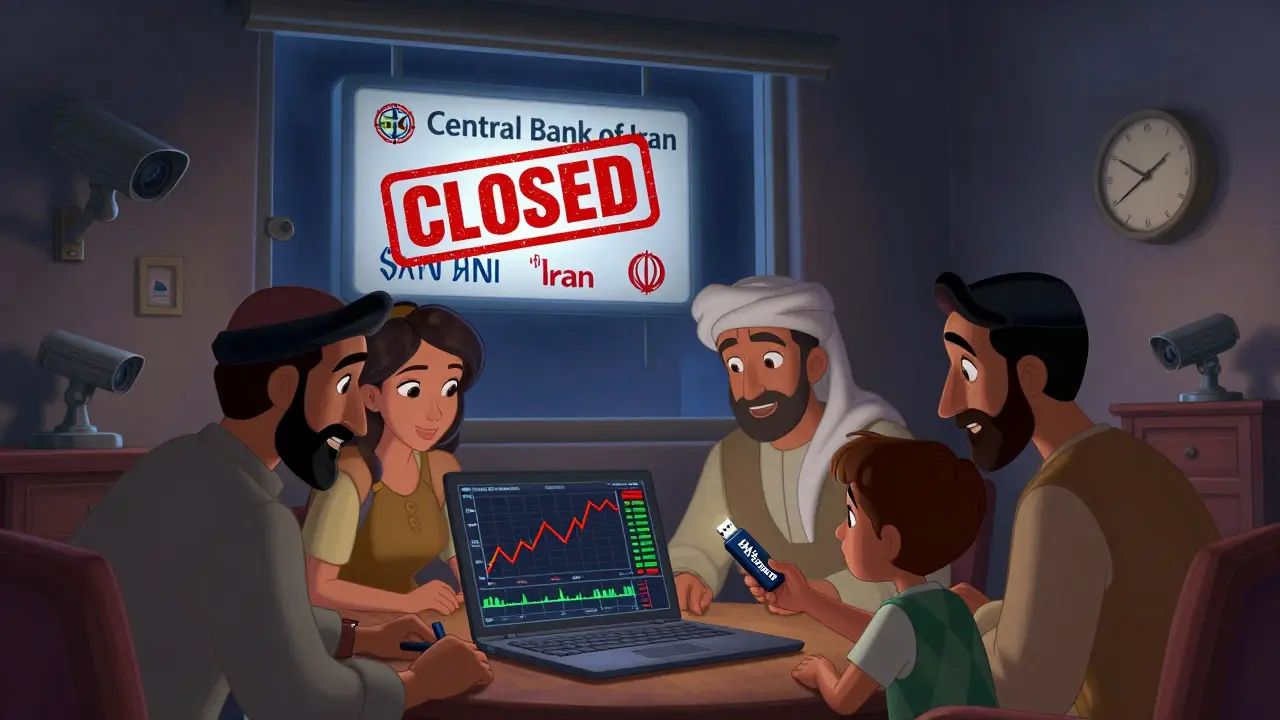
For Iranian citizens, accessing cryptocurrency exchanges in 2025 isn’t just difficult-it’s tightly controlled. What used to be a workaround for inflation and sanctions has become a high-risk activity under strict government oversight. The rules have changed dramatically since last year, and if you’re trying to trade, hold, or even just use crypto in Iran, you’re now operating inside a system designed to limit, monitor, and tax every move.
Payment Channels Cut Off
In early January 2025, the Central Bank of Iran (CBI) pulled the plug on all rial-based payment gateways for cryptocurrency exchanges. That meant you could no longer deposit or withdraw money using Iranian bank accounts to buy Bitcoin, Ethereum, or Tether. This wasn’t a temporary glitch-it was a full shutdown. The government claimed it was about tax evasion. Reports showed exchanges were handling billions in transactions every year, but operators weren’t paying a single rial in taxes. The message was clear: if you want to trade crypto, you do it on the state’s terms-or not at all.
The Nobitex Hack and the 14-Hour Trading Window
The June 18, 2025 cyberattack on Nobitex, Iran’s biggest crypto exchange, changed everything. Over $90 million vanished in a single breach. It wasn’t just a technical failure-it was a political earthquake. Within days, the CBI imposed new rules: no trading between 8:00 PM and 10:00 AM local time. That left users with only 14 hours a day to buy, sell, or move assets. The official reason? Security. The real reason? Control. Overnight, Iranians went from being able to trade anytime to being forced into a narrow window where the government could monitor activity, track patterns, and shut down suspicious trades before they even happened.
Tether’s Largest Freeze Yet
On July 2, 2025, Tether froze 42 cryptocurrency addresses linked to Iranian users-mostly connected to Nobitex. This wasn’t random. Many of those wallets showed transaction trails to addresses flagged by Israeli intelligence as tied to Iran’s Islamic Revolutionary Guard Corps (IRGC). The freeze wasn’t just about blocking bad actors-it was about sending a message to the entire Iranian crypto community: if you’re using USDT, you’re under scrutiny. The impact was immediate. Tether’s price on Iranian exchanges spiked to over 12,000 Toman as panic set in. People scrambled to sell, switch to other coins, or find workarounds.

Switching to DAI and Polygon
After the Tether freeze, Iranian users didn’t just give up. They adapted. Crypto influencers, Telegram channels, and even state-backed forums started pushing DAI, a decentralized stablecoin built on the Polygon network. Why? Because DAI doesn’t rely on centralized issuers like Tether. It’s harder to freeze. Polygon’s lower fees and faster transactions made it ideal for Iranians trying to keep their money liquid. Many users began swapping their USDT for DAI through decentralized exchanges like SushiSwap or QuickSwap, bypassing local platforms entirely. This wasn’t just a technical shift-it was a survival tactic.
First Ever Crypto Tax Law
In August 2025, Iran passed the Law on Taxation of Speculation and Profiteering. For the first time, profits from cryptocurrency trading became taxable. The government treated crypto like gold, real estate, or foreign currency speculation. If you made money trading Bitcoin, you now owed taxes. The law didn’t ban crypto-it tried to monetize it. The implementation was phased, giving users time to adjust. But the message was unmistakable: the state now sees crypto as a source of revenue, not just a tool for survival. Many traders started keeping detailed records, not because they wanted to, but because they feared audits.
U.S. Sanctions Target Shadow Banking
September 2025 brought another blow. The U.S. Treasury’s Office of Foreign Assets Control (OFAC) sanctioned a $600 million shadow banking network tied to Iran. Among the targets: wallets linked to Arash Estaki Alivand, a known financial facilitator who used crypto to launder oil proceeds. The addresses hit included Ethereum and Tron wallets. This wasn’t just about stopping one person-it was about cutting off entire pathways Iranian users relied on to move money internationally. Suddenly, even using Ethereum for peer-to-peer trades became risky. The sanctions didn’t just target institutions; they made everyday transactions feel dangerous.
What’s Still Legal? What’s Not?
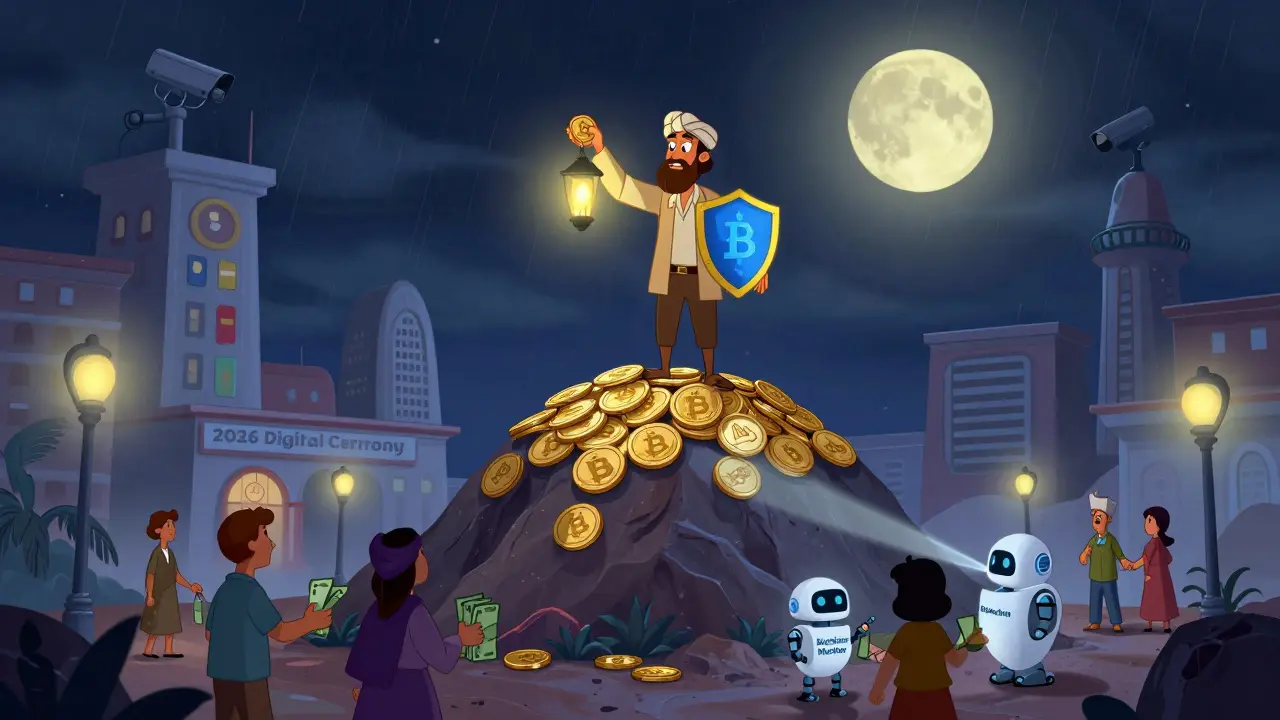
Here’s the confusing part: mining is still legal in Iran. The government even subsidizes electricity for miners because it brings in hard currency. But using crypto for payments? Banned. Buying Bitcoin to protect savings? Technically allowed, but monitored. Selling crypto to buy goods? Risky. The line between legal and illegal is drawn by the Central Bank, and it changes without warning. There are no public guidelines. No official app. No hotline. Just rules enforced through sudden freezes, trading bans, and tax demands.
Why Does This Matter?
Iranians aren’t using crypto for speculation. They’re using it because inflation hit 50% in 2024, and the rial lost half its value in 18 months. Banks won’t let them send money abroad. Credit cards are blocked. Foreign currency is nearly impossible to get. Crypto isn’t a luxury-it’s a lifeline. But now, the government is trying to control that lifeline. It’s not trying to stop crypto entirely. It’s trying to control who uses it, how they use it, and who profits from it. The state still allows mining and may be using crypto itself for international trade. But for regular citizens? Access is shrinking.
What’s Next?
Analysts expect more restrictions in 2026. The Central Bank is already testing blockchain monitoring tools to track wallet behavior. New licensing rules for exchanges are coming, requiring detailed user data and real-time reporting. Some experts believe Iran may eventually launch its own state-backed digital currency, replacing crypto with something it fully controls. For now, users are stuck in a gray zone: crypto still works, but every move carries risk. The most successful traders now use multiple wallets, avoid USDT, stick to Polygon, and trade only during daylight hours. They know the rules aren’t written-they’re whispered.
Is cryptocurrency completely banned in Iran?
No, cryptocurrency is not banned outright. Mining is still legal and even encouraged by the government. Trading and holding crypto is technically allowed, but access is heavily restricted. You can’t use Iranian bank accounts to buy crypto, trading is limited to 14 hours a day, and major stablecoins like USDT are subject to freezes. The government controls the system-it doesn’t eliminate it.
Can Iranian citizens still use Binance or Coinbase?
Technically, yes-but it’s risky. Binance and Coinbase don’t officially serve Iranian users, and many Iranian accounts have been suspended due to sanctions compliance. Even if you access them through a VPN, your transactions may be flagged. The Iranian government also monitors outbound crypto flows. Using these platforms increases the chance of your wallet being frozen or your identity reported to international authorities.
Why is Tether being targeted instead of Bitcoin?
Tether (USDT) is the most widely used stablecoin in Iran because it’s pegged to the U.S. dollar and offers stability against inflation. Bitcoin is too volatile for daily use. USDT became the de facto currency for remittances, savings, and commerce. That made it a prime target for both Iranian regulators and U.S. sanctions. Freezing USDT addresses disrupts the most critical part of Iran’s crypto economy.
Are there any safe ways to buy crypto in Iran right now?
The safest approach right now is peer-to-peer (P2P) trading using DAI on the Polygon network. Avoid USDT. Use decentralized exchanges like SushiSwap or QuickSwap. Don’t link your Iranian bank account. Use cash or trusted intermediaries. Keep funds in non-custodial wallets. Avoid large transfers. Stay under the radar. There’s no foolproof method, but DAI on Polygon offers the least risk of freezing or tracking.
What happens if you don’t pay crypto taxes in Iran?
The government hasn’t enforced crypto taxes aggressively yet, but audits are starting. If you’re flagged for large, unexplained transactions, you could face fines, asset seizures, or even criminal charges under Iran’s new speculation law. Many traders are now keeping records not because they want to pay taxes, but because they fear being targeted later.
Will crypto restrictions ease in 2026?
Unlikely. The trend is clearly toward tighter control. The government is investing in blockchain monitoring tools and preparing to launch its own digital currency. International sanctions are also intensifying. Any easing would require major geopolitical shifts-something that’s not on the horizon. The restrictions are becoming more embedded, not temporary.






bala murali
From an Indian perspective, the Tether freeze is a textbook example of centralized stablecoin fragility. DAI on Polygon isn't just a workaround-it's a paradigm shift. The lack of a single point of failure makes it resilient against both state and corporate intervention. What's fascinating is how Iranian users have organically migrated to a DeFi stack that prioritizes censorship resistance over convenience. This isn't crypto speculation-it's financial sovereignty in action.
The 14-hour trading window? That’s not security-it’s behavioral conditioning. You’re not just monitoring transactions; you’re training users to operate within state-defined temporal boundaries. Classic surveillance capitalism, but with a theocratic twist.
Ekaterina Sergeevna
Oh look, another ‘crypto is a lifeline’ sob story. How quaint. Let me guess-you also think people in Venezuela ‘need’ Bitcoin because their currency collapsed? Newsflash: no one forces you to live in a country that’s one sanctions-induced heart attack away from becoming a blockchain-themed dystopian theme park.
And don’t get me started on ‘DAI is safer.’ That’s like saying duct tape is a better roof than a steel frame. Decentralized? Sure. Useful? Only if you enjoy gambling with code you don’t understand.
Desiree Foo
I find it deeply irresponsible to frame crypto as a ‘lifeline’ when it’s clearly being weaponized by bad actors under the guise of economic survival. The IRGC ties are not coincidental-they’re systemic. The fact that people are still calling this ‘resilience’ instead of ‘enabling illicit finance’ is alarming.
There’s a moral line here, and we’re blurring it with ‘it’s for the people’ rhetoric. If you’re using crypto to circumvent sanctions, you’re not a victim-you’re a participant in a shadow economy that undermines global financial stability.
Kaz Selbie
Let’s cut the BS. The real story here isn’t about Iranians-it’s about how Tether and the U.S. Treasury are colluding to turn crypto into a geopolitical tool. Freezing USDT addresses? That’s not enforcement-it’s financial imperialism. You don’t freeze a currency used by millions of civilians to ‘combat illicit activity.’ You freeze it because you want to control the narrative.
And don’t even get me started on ‘mining is legal.’ Of course it is. Iran’s mining farms are basically state-run mining pools. They’re harvesting hash power and exporting USD. The average citizen? They’re just the collateral damage in a game they didn’t choose to play.
Robbi Hess
Whoa. This whole situation is like watching a high-stakes poker game where the house changed the rules mid-hand-and then banned you from leaving the table. The 14-hour window? That’s not a security feature. That’s a psychological trap. You’re not trading crypto-you’re performing compliance.
And Tether freezing wallets? That’s not regulation. That’s corporate tyranny dressed up as compliance. The fact that people are switching to DAI on Polygon is the most beautiful act of resistance I’ve seen in crypto this year. It’s not about tech-it’s about autonomy.
Keturah Hudson
As someone who’s lived in both the U.S. and Iran (briefly), I can say this: crypto isn’t a luxury here-it’s the last open door. Banks? Blocked. Wire transfers? Impossible. Rial? Worthless. People aren’t ‘speculating’-they’re keeping their families fed. The government’s tax law? It’s not about revenue-it’s about control. They want to know who has what, when, and why.
And honestly? The DAI shift is genius. No central issuer. No freeze button. Just code. That’s the future.
kelvin joseph-kanyin
YESSSSSS 🚀🔥 DAI ON POLYGON IS THE FUTURE!!!
Forget USDT. It’s a trap. The moment you link your wallet to a bank account, you’re handing your life over to a bureaucrat with a spreadsheet. But DAI? It’s decentralized. It’s open. It’s yours. And Polygon? Low fees, fast, secure. I’ve been doing P2P swaps for months-no issues.
Also, mining is still legal? That’s wild. Iran’s basically running a crypto mining factory while telling its citizens ‘you can’t use this.’ Double standards much? 😅
Elizabeth Choe
Okay real talk-this is the most intense crypto survival story I’ve ever seen. People aren’t just trading-they’re rebuilding their entire financial identity from scratch.
Switching to DAI? That’s not a tactic, that’s a revolution. And the 14-hour window? It’s like being told you can only breathe between 10am and 12pm. Absurd.
But here’s the thing: Iranians are winning. They’re not waiting for permission. They’re building alternatives. That’s the spirit crypto was meant to have. Stay sharp, stay decentralized, and keep those non-custodial wallets locked down 💪
Holly Perkins
so like… usdt got frozen right? and now everyone’s using dai? i mean that makes sense but like… is dai even stable? idk i just bought some on quickswap and hope it dont crash lol
also why is mining legal but trading not? that’s so weird
Ben Pintilie
Ugh. Another ‘crypto saves lives’ post. Look, I get it. Inflation sucks. But you can’t just ignore the fact that this whole system is being used to launder money for terrorist groups. The IRGC link isn’t a coincidence-it’s a feature.
And DAI? Please. It’s just another coin with a fancy whitepaper. If the fed decides to go full crypto-Nazi, they’ll freeze that too. You think code is magic? It’s just code. And code can be shut down.
Sakshi Arora
iranians are smart they figured out dai on polygon is the way
usdt is a trap everyone knows that now
mining is legal because iran wants dollars not rials
14 hour window is just surveillance
tax law? they want to steal from the poor
no one cares about rules they just want to eat
Andrea Atzori
The elegance of this response is breathtaking. The Iranian crypto community didn’t wait for policy-they engineered a decentralized alternative. DAI on Polygon isn’t just a workaround; it’s a model for financial resilience under authoritarian pressure.
The fact that they migrated from a centralized, freezeable asset to a permissionless, trustless one speaks volumes about the power of open systems. This isn’t just crypto-it’s civil society in code. The state may control the lights, but it can’t control the electricity.
Joe Osowski
Let me be clear: if you’re using crypto to bypass sanctions, you’re helping an authoritarian regime that tortures its own people. This isn’t ‘survival’-it’s complicity.
And don’t give me that ‘they’re just trying to feed their families’ crap. The IRGC doesn’t care if your kid eats. They care if you’re funding their missile program.
Stop romanticizing this. Crypto isn’t freedom-it’s a weapon. And right now, Iran is wielding it against the world.
Gaurav Mathur
the whole thing is a psyop
the iranian government is running the exchanges
the us is freezing wallets to scare people
the miners are just pawns
everyone is being played
there is no escape
they want you to think you have control
you dont
Jeremy Lim
Okay, so… let me get this straight. The government bans bank transfers, imposes a 14-hour trading window, freezes Tether, taxes profits, and then… people switch to DAI on Polygon? That’s… actually kind of brilliant.
I mean, it’s terrifying, sure. But also… wow. This is the most organic, decentralized, grassroots financial resistance I’ve ever seen. It’s like watching a protest happen in code. No banners. No speeches. Just wallets.
Crystal McCoun
For anyone worried about the legality or ethics of this: you’re missing the point. This isn’t about politics-it’s about people. When inflation hits 50%, and your savings vanish overnight, crypto isn’t a ‘speculation tool.’ It’s a lifeline. And when the state tries to control that lifeline, people adapt-not because they’re rebels, but because they have no other choice.
DAI on Polygon isn’t a hack. It’s a human response. And honestly? That’s the most powerful thing in crypto right now.
Elijah Young
The regulatory landscape here is a masterclass in asymmetric control. The state allows mining because it generates hard currency. It restricts trading because it wants to monitor and tax. It freezes USDT because it wants to eliminate competition to its own future digital currency.
This isn’t chaos-it’s strategy. And the Iranian users? They’re playing 4D chess while the government thinks it’s playing checkers. The shift to DAI is not just technical-it’s political. They’re rejecting control by design.
Beth Trittschuh
There’s something deeply poetic about this. A people stripped of economic dignity, forced into a corner, and yet they build a new economy not with laws or banks-but with smart contracts and private keys.
The fact that they abandoned USDT-the symbol of centralized stability-for DAI-the symbol of decentralized trust-isn’t just smart. It’s philosophical. It’s a quiet rebellion written in Ethereum code.
We talk about decentralization as a tech ideal. Here, it’s a survival instinct.
Benjamin Andrew
The entire narrative here is dangerously romanticized. You’re treating Iranian crypto users as victims of oppression when they’re, in fact, participants in a shadow economy that funds destabilizing regimes. The U.S. isn’t ‘targeting’ them-they’re enforcing sanctions that have been in place for decades.
And DAI? It’s not ‘safe.’ It’s just less visible. That doesn’t make it moral. It makes it convenient for bad actors.
Stop glorifying financial evasion as resistance. It’s not resistance-it’s risk.
Donna Patters
Let’s be clear: this isn’t innovation. It’s evasion. The Iranian state isn’t evil-it’s trying to maintain order. Crypto without oversight is anarchy. And you’re celebrating it?
DAI? Sure. But what’s next? Private armies? Underground banks? The moment you remove accountability, you remove civilization.
Stop pretending this is freedom. It’s just chaos with better UX.
Michelle Cochran
It’s heartbreaking how quickly we normalize financial oppression when it’s convenient. We call it ‘resilience’ when Iranians use crypto. But if Americans did the same? We’d call it ‘sanctions evasion’ and lock them up.
Double standard. Always.
And yet-people still find a way. That’s not rebellion. That’s dignity. You can’t tax hope. You can’t freeze compassion. You can’t regulate survival.
Peggi shabaaz
i just read this whole thing and honestly? i’m in awe
people are building their own financial system while the world watches
no one’s asking for permission
they’re just… doing it
and the fact that they chose dai over usdt? that’s the quietest revolution ever
love this
Sanchita Nahar
mining is legal because iran sells hash power
trading is banned because they want to tax it
usdt frozen because usa says so
everyone is just trying to live
stop making it complicated
bala murali
Interesting how the state allows mining but bans peer-to-peer trading. That’s not about control-it’s about extraction. Mining generates hard currency for the state. P2P lets citizens bypass the state entirely.
So they let the miners keep mining, but make it impossible for ordinary people to transact. That’s the real story here: the state doesn’t want to eliminate crypto. It wants to monopolize it.
Elizabeth Choe
Exactly. And the fact that they’re using DAI on Polygon? That’s the ultimate middle finger. No one owns it. No one can freeze it. No one can tax it unless they can track every single transaction across a decentralized network.
They didn’t just adapt-they outsmarted the system. And that’s the most powerful thing in crypto: when the people build something the state can’t control.
Elijah Young
This is why I’ve always believed: technology doesn’t change society. Society changes technology. The Iranian crypto community didn’t choose DAI because it was technically superior. They chose it because it was the only tool left that couldn’t be owned.
Their choice isn’t about finance-it’s about autonomy. And that’s why this matters more than any regulation or sanction ever could.