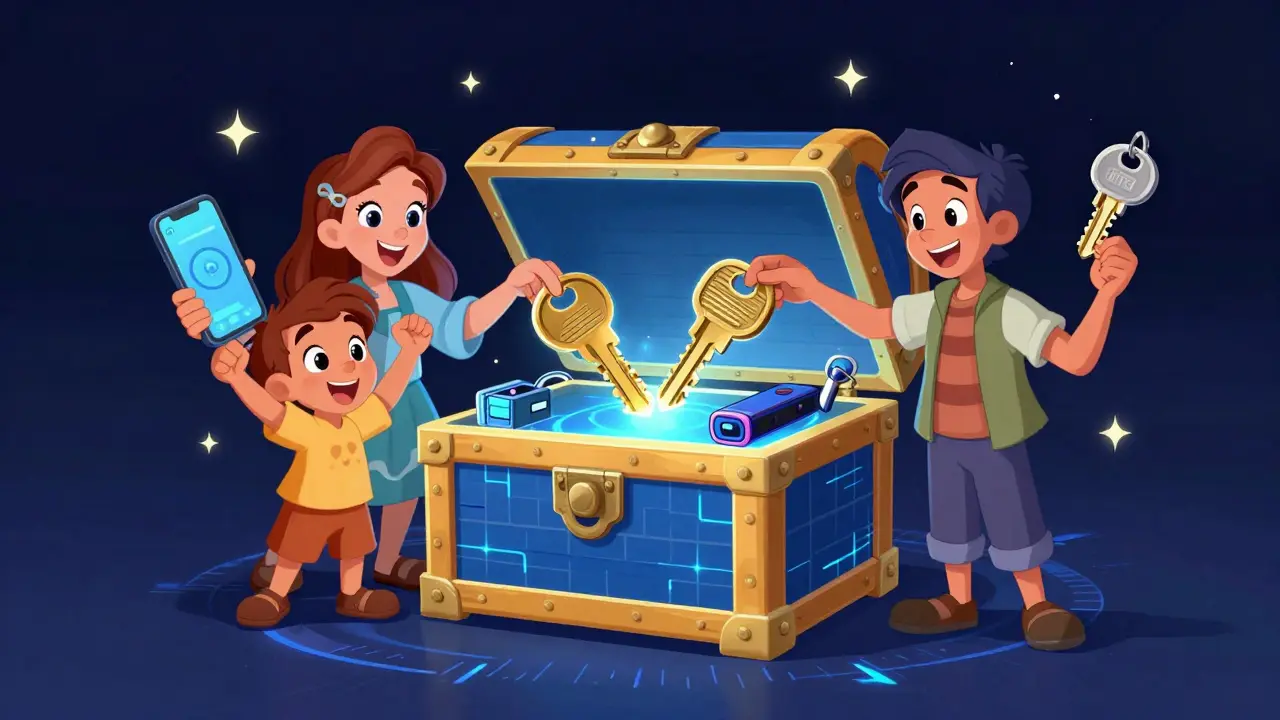
Imagine losing your crypto because one password got stolen. That’s what happens with a regular wallet-just one key, one point of failure. But what if you needed two or three people to agree before any money could move? That’s the idea behind multi-signature crypto wallets (multi-sig wallets)-a system where transactions need approval from multiple private keys before they’re finalized. This isn’t science fiction. It’s the standard for institutions holding millions, and it’s slowly making its way to serious individual users who want real protection.
How Multi-Signature Wallets Work
Unlike a standard wallet that uses one private key to sign every transaction, a multi-sig wallet requires a preset number of signatures from a group of keys. It works using an M-of-N setup. For example, a 2-of-3 wallet means you have three keys total, but only two are needed to approve a transaction. The third key is a backup-something you can use if one of the others is lost or compromised.
Here’s how it plays out in practice: You start a transaction from your phone. It doesn’t go through right away. Instead, it sits in a pending state until at least two authorized users sign off. Maybe one person signs from their laptop, another from a hardware wallet stored in a safe, and a third from a backup device kept in a different city. Once the threshold is met, the transaction goes live on the blockchain.
This isn’t just about having more keys-it’s about breaking the single point of failure that makes regular wallets so risky. If one device gets hacked, the thief still can’t move the funds. They’d need to compromise at least one more key, which is far harder if those keys are stored separately.
Why Businesses Use Multi-Sig (And Why They Won’t Use Anything Else)
Over 78% of cryptocurrency businesses managing more than $100,000 use multi-sig wallets, according to Coinbase’s 2023 data. Why? Because they can’t afford to lose funds to a single breach.
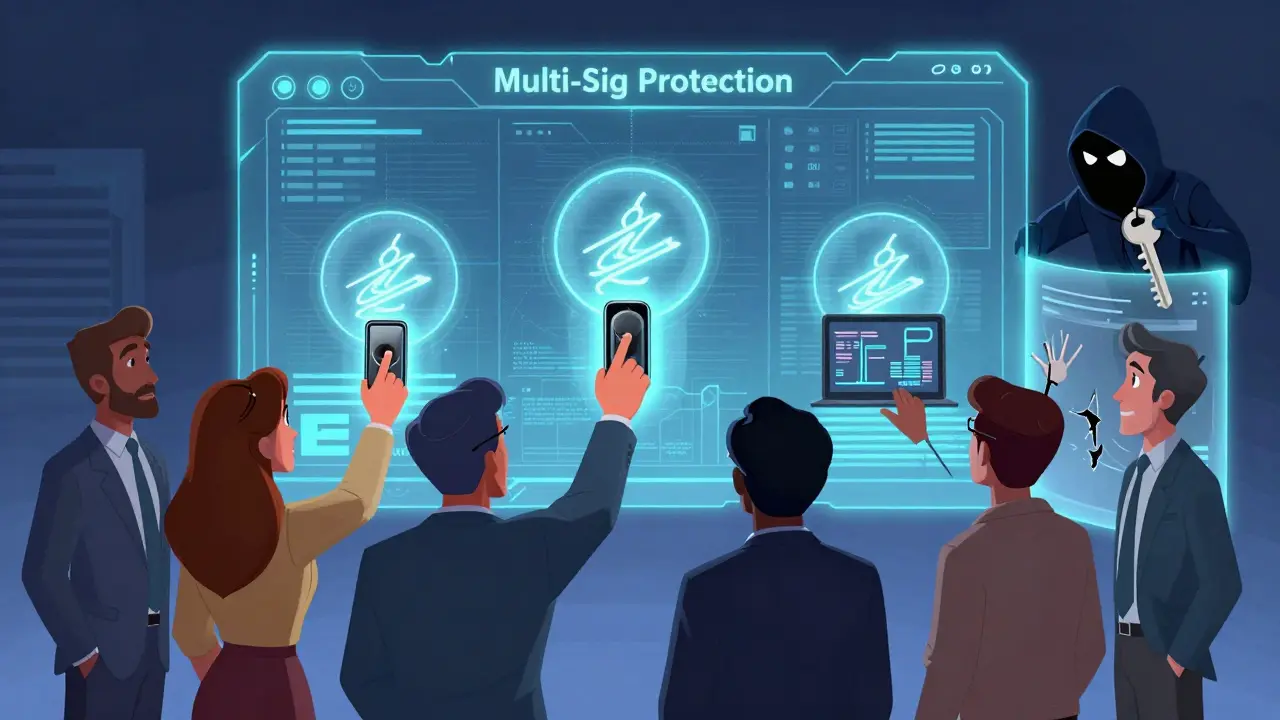
Think about it: in 2022, 98% of the exchanges that got hacked used single-key wallets. One employee clicked a phishing link. One server got compromised. And millions vanished. Multi-sig stops that. With a 3-of-5 setup, you’d need at least three different people to be tricked-or to collude-before any money moves. That’s a huge barrier.
Decentralized Autonomous Organizations (DAOs) rely on it too. As of Q2 2023, over $22 billion in DAO treasuries were secured with multi-sig. In Q1 of that year alone, 3-of-5 configurations blocked $4.7 million in attempted fraudulent transfers. One team member got phished. The other two didn’t approve. The attack failed.
Institutional players like Fidelity Digital Assets now require multi-sig for all client holdings over $500,000. That’s not a suggestion-it’s a policy. And it’s becoming mandatory across exchanges, hedge funds, and custody providers.
Real-World Configurations and Trade-Offs
Not all multi-sig setups are the same. The most common is 2-of-3. It’s simple, flexible, and gives you room to recover if one key is lost. A 3-of-5 setup adds more security but increases complexity. A 4-of-7 might be overkill unless you’re managing a national treasury.
Hardware wallets are almost always involved. Ledger reports that 89% of institutional multi-sig setups combine software triggers with physical devices like Ledger Nano or Trezor. That means even if someone hacks your laptop, they still can’t sign without the physical device sitting in a safe.
But there’s a catch: speed. A single-signature transaction takes about 1.1 minutes. A 2-of-3 multi-sig transaction? On average, 3.2 minutes. That’s because you have to wait for the other signers to respond. For urgent payments, that delay matters. But for long-term holdings? Most users say the trade-off is worth it.
And then there’s the human factor. Setting up a multi-sig wallet isn’t plug-and-play. BitGo says it takes 6 to 10 hours to properly configure a 2-of-3 institutional wallet. You need to generate keys securely, store them in different locations, test recovery procedures, and document everything. Coinbase found that 63% of new users needed extra training just to understand how to manage keys without losing access.
Who Should Use Multi-Sig? Who Should Avoid It
Multi-sig is perfect for:
- Teams managing shared funds (like DAOs or startup treasuries)
- Couples or family members wanting joint control over crypto assets
- Anyone holding more than $10,000 who wants enterprise-grade security
- People planning inheritance-keys can be distributed among trusted contacts
But it’s not for everyone. If you’re a casual user who just wants to buy Bitcoin, hold it, and sell it later? Stick with a single-key wallet. Multi-sig adds friction. Trezor’s data shows 68% of individual users abandoned their multi-sig setup because it was too complicated. One Reddit user wrote: “It took me eight hours just to set up my first multi-sig. I still don’t trust the recovery process.”
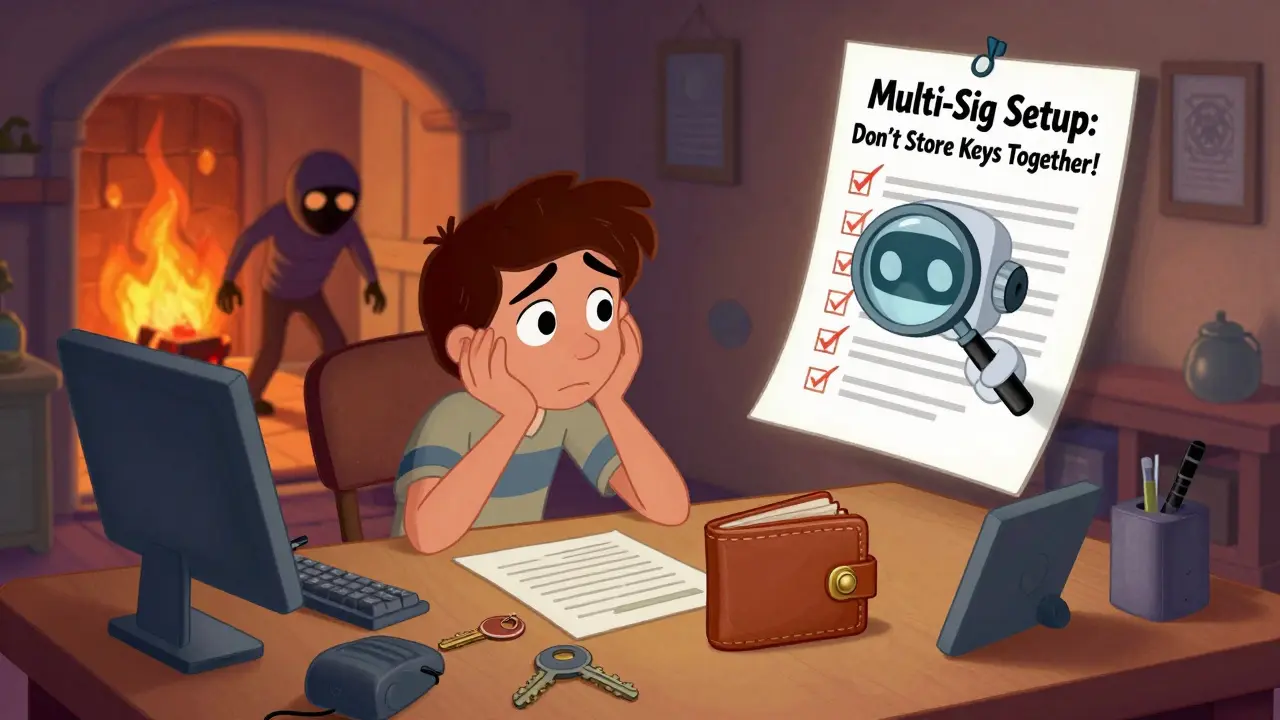
And if you mess up the setup? You’re in trouble. Andreas Antonopoulos warns in his 2023 book that poorly configured multi-sig-like keeping all keys on the same laptop-is worse than no multi-sig at all. It gives you a false sense of security while making recovery harder. Coinbase documented 14 multi-sig failures in 2022, all because all signatories were in the same physical location. One fire. One theft. All keys gone.
What’s Changing in 2025 and Beyond
Multi-sig is evolving fast. Safe (formerly Gnosis Safe) introduced “social guardians” in 2023-trusted friends or family members who can help recover funds without signing transactions directly. It’s like a backup human layer.
BitGo is working on quantum-resistant signatures, scheduled for late 2024. Ethereum’s EIP-3074 aims to build multi-sig directly into the protocol by 2025, making it as easy as sending ETH. That could change everything for retail users.
Right now, only 12% of multi-sig users are individuals. But that’s changing. As tools get simpler and mobile support improves (only 32% of services offer full mobile signing today), more everyday users will adopt it-not because they’re forced to, but because they finally understand how much safer it is.
Key Risks and How to Avoid Them
Multi-sig isn’t magic. It only works if you do it right. Here’s what goes wrong:
- Keys stored together → One breach takes everything. Always split keys across devices and locations.
- No recovery plan → If one signer dies or loses their device, can you still access funds? Test recovery before you lock in funds.
- Too many signers → 5-of-7 sounds secure, but if one person goes offline for a week, you’re stuck. Stick to 2-of-3 or 3-of-5 for balance.
- Ignoring documentation → Write down exactly how to sign, where keys are stored, and who has access. Share this with someone you trust.
Use well-documented tools. Safe (Gnosis Safe) scores 4.5/5 for clarity. Lesser-known wallets? Often 2.8/5. Stick with the ones that have active communities and clear guides.
The Bottom Line
Multi-signature wallets aren’t just a feature-they’re the backbone of secure crypto custody. They turn a single point of failure into a system of checks. They’ve stopped millions in theft. They’re used by institutions that can’t afford to lose a dime.
For most people, a single-key wallet is enough. But if you’re holding more than a few thousand dollars, or managing funds with others, multi-sig isn’t optional. It’s the difference between hoping your crypto stays safe and knowing it will.
The technology is maturing. The tools are getting better. And the cost of not using it? It’s getting harder to justify.
What does 2-of-3 mean in a multi-sig wallet?
It means you have three private keys, and any two of them are needed to approve a transaction. This setup gives you flexibility: if one key is lost or compromised, you can still access your funds using the other two. It’s the most common configuration for both individuals and businesses because it balances security and usability.
Can I use multi-sig on my phone?
Some apps support mobile signing, but full functionality is still limited. Only about 32% of multi-sig services offer complete mobile support. Most setups require at least one hardware wallet or desktop-based key. Mobile apps are improving, but for now, relying solely on your phone for multi-sig isn’t recommended for large holdings.
Is multi-sig safer than a hardware wallet alone?
Yes, if properly configured. A single hardware wallet still has one point of failure-if it’s stolen or damaged, you lose access. Multi-sig adds layers: even if one hardware device is compromised, you still need signatures from other keys. Most secure setups combine hardware wallets with multi-sig rules, like 2-of-3 using two hardware devices and one software key.
What happens if one of my signers disappears?
If you’re using a 2-of-3 wallet and one person loses their key or refuses to cooperate, you can still access your funds with the other two. That’s why 2-of-3 is preferred over 3-of-3. But if you use 3-of-3 and one person is unreachable, you’re locked out. Always choose a configuration with a recovery buffer.
Are multi-sig wallets only for Bitcoin?
No. While Bitcoin pioneered multi-sig, it’s now supported on Ethereum, Solana, Litecoin, and most major blockchains. Tools like Safe (Gnosis Safe) let you create multi-sig wallets on Ethereum for DeFi, NFTs, and DAOs. The underlying concept works on any blockchain that supports smart contracts.
Do I need a lawyer or notary to set up multi-sig?
No. Multi-sig is a technical setup, not a legal one. You don’t need a lawyer to configure it. But if you’re using it for inheritance or joint ownership, it’s smart to document your key distribution plan and share it with a trusted person. That way, your heirs won’t be locked out after you’re gone.
How much does it cost to use a multi-sig wallet?
Most multi-sig wallets are free to use. Platforms like Safe, BitGo, and Ledger don’t charge for setting up multi-sig. You only pay the standard blockchain transaction fees (gas fees) when you send funds. Some enterprise services charge for advanced features or 24/7 support, but basic multi-sig functionality is open and cost-free.
Can I change the number of signatures later?
It depends on the wallet. Some systems, like Safe, let you update the threshold and signers after setup. Others require you to create a new wallet and transfer funds. Always check the wallet’s documentation before locking in your configuration. Changing rules after funds are stored can be risky and expensive.
Is multi-sig regulated by governments?
Not directly. But regulators like the U.S. Office of the Comptroller of the Currency recognize properly structured multi-sig as meeting “dual control” standards for financial institutions. That means if you’re running a business that holds crypto, using multi-sig can help you comply with financial regulations around asset custody and segregation of duties.
What’s the biggest mistake people make with multi-sig?
Storing all keys in the same place. If your laptop, phone, and hardware wallet are all kept in your home office, and that office gets robbed or burned down, you lose everything. The whole point of multi-sig is to spread risk. If you don’t separate your keys geographically and by device type, you’re just making things more complicated without adding real security.






Gaurav Mathur
multi-sig is the only way. one key = one way to lose everything. i use 2of3. one phone one hardware one paper. if any one dies or gets hacked still got two. simple. no drama. no trust needed.
Jeremy Lim
Ugh. I tried multi-sig... it took me 3 days to set up. I still don't know if I can recover it. 😩 I just want to buy btc and forget about it. Why does everything have to be so complicated??
John Doyle
If you're holding more than $10k, multi-sig isn't optional-it's common sense. Seriously. Think of it like a bank vault with two locks. You don't need to be a tech wizard. Just use Safe or Ledger. It's worth the 20 minutes it takes to set up. Your future self will thank you. 💪
kelvin joseph-kanyin
Multi-sig = peace of mind 🛡️🔥 I switched from single-key to 2-of-3 last year. My wife has one key, my hardware wallet has another, and my offline paper backup has the third. No one can touch it without me knowing. And yeah, it takes 3 mins to send a transaction-but is your money worth 180 seconds? 🤔
Michelle Cochran
I find it alarming how casually people treat their crypto like it's just digital Monopoly money. If you're not using multi-sig, you're essentially leaving your front door open and hoping no one steals your TV. It's not just about security-it's about responsibility. And if you're too lazy to set it up? Then you shouldn't own any at all.
monique mannino
I helped my dad set up his 2-of-3 last month. He's 72. Thought he'd never get it. But we did it together-paper keys, printed instructions, video call walkthrough. Now he sleeps better. It's not about tech. It's about care. ❤️
bala murali
The operational complexity of multi-signature frameworks introduces non-trivial cognitive load on end-user security architectures. When key distribution vectors are not geographically and cryptographically orthogonal, the attack surface expands exponentially, rendering the system theoretically sound but practically vulnerable. One must rigorously audit the trust topology.
Ekaterina Sergeevna
Oh wow, a 2-of-3 wallet? How quaint. I guess you also brush your teeth with a toothbrush made of unicorn hair? The real elite use threshold signatures with MPC and hardware enclaves. This 2018-era multi-sig stuff is just a warm-up for people who think 'paper backup' is a real security layer. 😴
Desiree Foo
I'm sorry, but if you're not using a 3-of-5 multisig with geographically dispersed hardware wallets and encrypted air-gapped backups, you're not serious about security. You're just playing. And if you think a phone app can be trusted? That's not negligence-it's negligence with a side of arrogance.
Ace Crystal
I used to think multi-sig was overkill. Then my buddy got hacked. His whole portfolio-gone. He didn't even have a backup. I switched to 2-of-3 the next day. Took me 45 minutes. Now I sleep like a baby. If you're scared of setup? Just start with one extra key. Baby steps. You got this.
Brittany Meadows
Multi-sig? Yeah right. What's next? You're gonna make me sign a notarized affidavit every time I send 0.01 BTC? The real threat isn't hackers-it's the system. They want you to think security is complicated so you'll rely on them. Keep your coins on an exchange. At least they have insurance. 😏
SAKTHIVEL A
The implementation of multi-signature authentication protocols necessitates a hierarchical governance model predicated upon asymmetric key distribution and deterministic threshold validation. The operational efficacy of such frameworks is contingent upon the ontological separation of cryptographic authority vectors, thereby precluding monolithic vulnerability. Any deviation from this paradigm constitutes a fundamental breach of cryptographic integrity.
Christopher Wardle
I like how multi-sig forces you to think about trust. Not just tech. Who are you giving access to? That's the real question. I use 2-of-3 with my brother and my lawyer. One key on a USB, one on a Ledger, one on paper in a safety deposit box. Simple. But it means something. It's not just code-it's a relationship.
blake blackner
multi sig is fire 🔥 i set mine up last week. used my phone, my laptop, and my wife’s ipad. she doesn’t even know how it works but she’s got a key. now if i get hit by a bus she can still get the money. also i spelled ‘sign’ wrong 3 times in the setup. who cares? it works.
Andrea Atzori
I'm from Australia and we don't have the luxury of tech support for crypto. I spent three weeks reading guides, watching videos, and testing recovery on a testnet before I moved real funds. Multi-sig isn't magic. It's discipline. And if you're not willing to put in the work? Then don't complain when you lose everything. The blockchain doesn't care about your excuses.