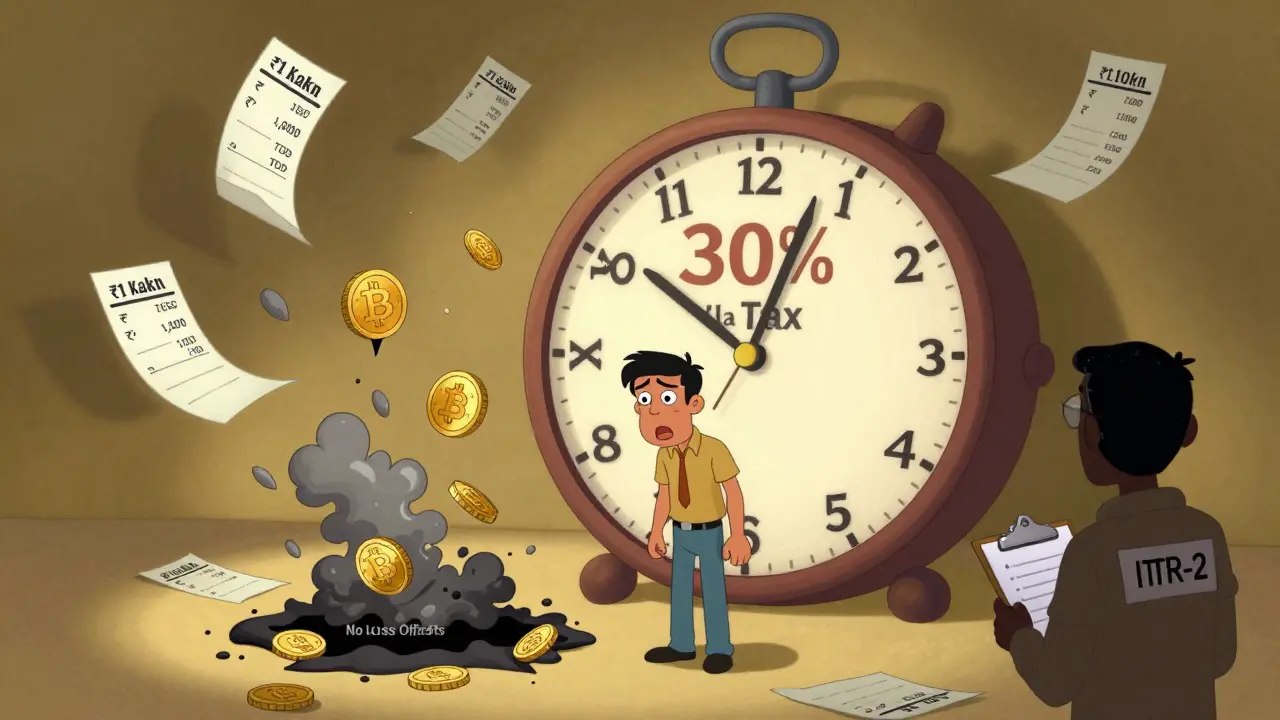
India’s crypto tax rules aren’t just complicated-they’re designed to make trading as painful as possible. If you’re buying, selling, or staking cryptocurrency in India, you’re not just dealing with price swings. You’re also navigating a tax system that treats your digital assets like a lottery ticket: high tax, no deductions, and zero mercy for losses.
30% Tax on Every Gain-No Loss Offsets
Since April 2022, India has taxed all cryptocurrency gains at a flat 30%. That’s not a marginal rate. That’s not a capital gains rate. That’s a flat tax, same as what you’d pay if you won the lottery. And here’s the kicker: you can’t offset losses. If you bought Bitcoin at ₹50 lakh and sold it at ₹30 lakh, you still owe tax on the ₹30 lakh you received-even though you lost ₹20 lakh. Same if you lost money on Ethereum but made a profit on Solana. The government doesn’t care. Losses don’t cancel out gains. They disappear.
This rule alone has pushed thousands of retail traders out of the market. Why report a loss if it doesn’t help? Why even bother tracking your trades if the system only punishes you for profits? Many are now using offshore exchanges to avoid the tax trap. And that’s exactly what the government didn’t want.
1% TDS on Every Trade-Even Small Ones
On top of the 30% tax, there’s a 1% Tax Deducted at Source (TDS) on every crypto transaction. That means if you sell ₹1 lakh worth of Dogecoin, ₹1,000 gets pulled out before you even see the money. This applies to every trade-whether it’s on CoinDCX, WazirX, or a peer-to-peer deal through Telegram. The buyer (or exchange) is legally required to withhold it.
But here’s the problem: TDS only works if the transaction goes through a registered platform. If you’re swapping crypto directly with a friend using TrustWallet or sending Bitcoin to a non-registered wallet, there’s no TDS. That’s a huge loophole. The government knows it. That’s why they’ve started asking exchanges: “Is 1% too high? Is it driving users away?” The answer? Yes. And they’re still figuring out what to do about it.
GST on Crypto Services-Now It’s Everywhere
Starting July 7, 2025, India slapped an 18% GST on almost every service related to crypto. Not the coins. Not the trading. The services. That includes:
- Trading fees on exchanges
- Withdrawal and deposit charges
- Staking rewards processing fees
- Wallet management
- KYC verification costs
Even if you’re just holding crypto, if you’re using an Indian platform to manage it, you’re paying GST. This rule forced every crypto exchange to register for GST-even if they made less than ₹20 lakh in revenue. That’s unheard of in India’s tax system. Normally, small businesses get a pass. Not here. Crypto platforms are classified as “Online Information and Database Access or Retrieval (OIDAR)” services, which means they’re treated like global tech giants. And now, they must issue GST invoices for every service, track every payment, and file monthly returns.

Reporting: ITR-2 or ITR-3? Schedule VDA Is Your New Best Friend
If you made crypto gains in FY 2024-25 (April 2024-March 2025), you had to file your income tax return using either ITR-2 or ITR-3. Both now include a brand-new section: “Schedule VDA” (Virtual Digital Assets). This is where you report every single sale, swap, or staking reward you made. No exceptions.
ITR-2 is for people treating crypto as an investment. ITR-3 is for traders who treat it like a business-like someone day-trading crypto full-time. The difference matters because business income can have different deductions (though crypto losses still can’t be offset). But both forms require you to list:
- Date of acquisition
- Cost price
- Date of sale
- Sale price
- Net gain or loss
And yes-you have to do this for every single transaction. No summaries. No averages. If you made 50 trades in a year, you need 50 entries. Most people use third-party tools like Koinly or CoinTracker to auto-generate this data. But even those tools can’t fix the core problem: the system doesn’t allow losses to reduce your tax bill.
What Happens If You Don’t Report?
Here’s the scary part: we don’t know exactly what penalties look like. There are no public cases of someone being fined ₹5 lakh for not reporting crypto. No headlines about a trader getting jailed. Why? Because the government hasn’t made enforcement public.
But that doesn’t mean there are no consequences. The tax department already has access to data from exchanges. Every 1% TDS deduction is recorded. Every GST invoice is tracked. Every platform is required to report user transactions to the Income Tax Department. If you didn’t report a ₹10 lakh gain but the exchange sent a TDS report showing you sold exactly that amount, the department will notice.
Penalties for underreporting income are already defined under the Income Tax Act. You could face:
- 200% of the tax evaded
- Interest at 1% per month
- Prosecution for willful evasion (if they prove intent)
And if you’re caught using fake documents or offshore wallets to hide income, the chances of a full audit skyrocket. The government doesn’t need to prove you stole money. They just need to prove you didn’t report it.
Why Enforcement Is Failing-And What’s Coming Next
India’s crypto tax system was built to scare people away, not to collect taxes. And it’s working… too well. Trading volumes have dropped 70% since 2022. Exchanges like CoinSwitch and ZebPay have laid off staff. Some have moved their servers to Dubai or Singapore. The 30% tax killed liquidity. The 1% TDS made small trades pointless. The GST on services pushed costs up for everyone.
In August 2025, the Central Board of Direct Taxes (CBDT) sent out questionnaires to every major Indian crypto platform. They asked:
- Should India create a full crypto law instead of just taxing it?
- Is 1% TDS too high?
- Does the 30% rate destroy market activity?
- Do offshore exchanges have an unfair advantage?
The answers? Yes. Yes. Yes. And yes.
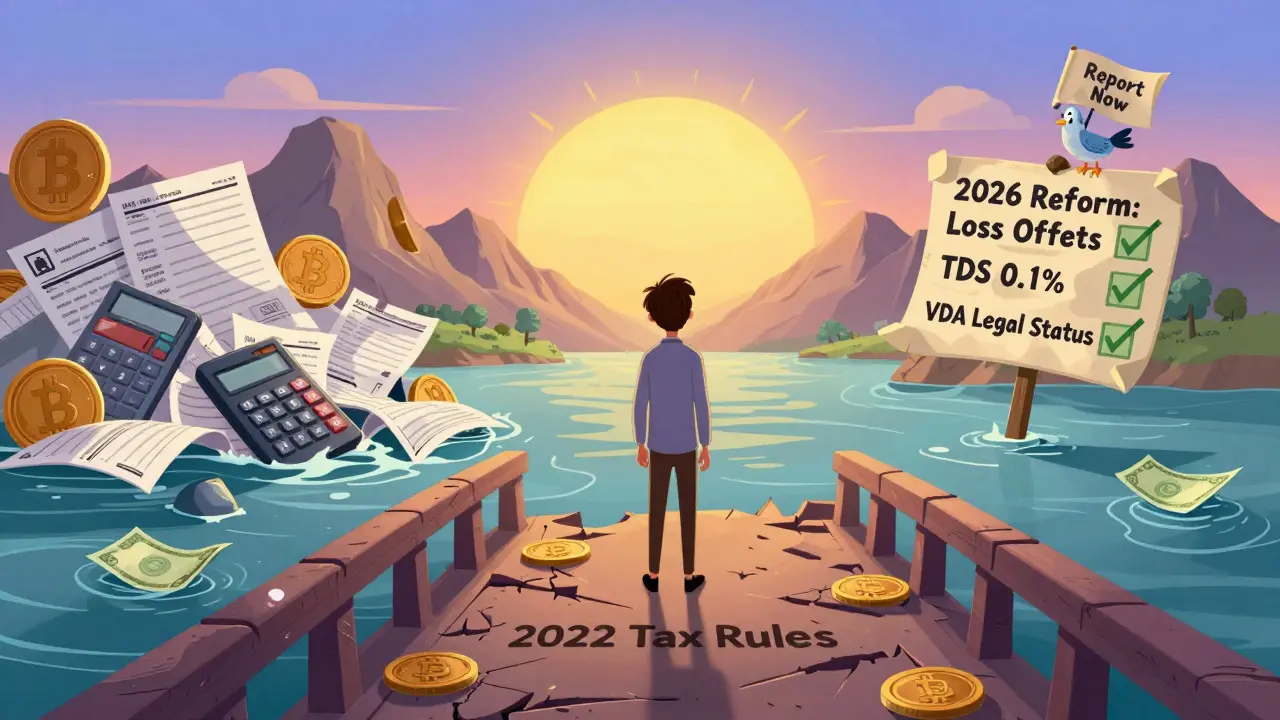
That means change is coming. Maybe not this year. But by late 2026, we could see:
- A reduction in TDS to 0.1%
- Loss offset rules introduced
- Exemptions for small transactions under ₹50,000
- Recognition of crypto as a legal asset class-not a gambling product
For now, though, you’re stuck with the rules as they are. And if you’re not reporting, you’re gambling-not with crypto, but with the taxman.
What Should You Do Right Now?
If you’ve traded crypto in India since 2022, here’s your checklist:
- Export all your transaction history from every exchange and wallet you used.
- Use a tax tool to calculate gains and losses (even if losses don’t help, you need the record).
- File ITR-2 or ITR-3 with Schedule VDA completed.
- Keep proof of all purchases, sales, and fees for at least 8 years.
- If you used offshore platforms, report any income you received in INR equivalent.
Don’t wait for a notice. Don’t hope the government forgets. They won’t. And when they come knocking, you’ll wish you’d acted sooner.
Is crypto legal in India?
Yes, but not as legal tender. You can buy, sell, and hold cryptocurrency legally. The Supreme Court lifted the banking ban in 2020. However, the government doesn’t recognize it as money. It’s treated as a Virtual Digital Asset (VDA) for tax purposes only.
Do I pay tax on crypto I hold but don’t sell?
No. You only pay tax when you sell, swap, or convert crypto into fiat (like INR) or another cryptocurrency. Holding Bitcoin or Ethereum without trading doesn’t trigger a tax event. But if you earn staking rewards or airdrops, those are taxable at their fair market value when received.
Can I claim losses from crypto against my salary or business income?
No. Under Section 115BBH, crypto losses cannot be offset against any other income. Not salary, not rental income, not business profits. They can’t even be used to reduce other crypto gains. Losses are completely disallowed. This is unique to India-most countries allow loss carryforwards.
What if I use an offshore exchange like Binance or Bybit?
You’re still required to report any income you earned from those exchanges. The Indian tax department can access transaction data from Indian banks linked to your wallet. If you withdrew INR from an offshore exchange into your Indian bank account, that’s a taxable event. Not reporting it is risky-especially since the government is now working with global regulators to track cross-border crypto flows.
Is mining cryptocurrency taxable in India?
Yes. If you mine crypto, the value of the coins you receive on the day they’re mined is treated as income. You must report it at fair market value using Rule 11UA of the Income Tax Rules. If you later sell those coins, you pay 30% tax on the gain between the mining value and the sale price. Mining equipment costs are not deductible.


Dominica Anderson
Let’s be real - India’s crypto tax regime isn’t punitive. It’s *philosophical*. It says: if you’re gambling with digital assets, you don’t get to play the game of loss mitigation. That’s not policy. That’s a moral stance disguised as fiscal law. The 30% isn’t a tax - it’s a purification ritual.
Losses aren’t erased because they’re irrelevant. The state doesn’t care about your portfolio’s emotional arc. It cares about revenue. And in a country where 80% of the population still uses cash, crypto gains are the only visible, traceable, taxable form of modern wealth creation. You think this is harsh? Try living in a society where your only financial identity is your salary.
Also - 1% TDS? Pathetic. That’s less than what you pay for a coffee in Manhattan. If you’re complaining about that, you’re not a trader. You’re a tourist with a Ledger.
And don’t get me started on GST on services. Of course they taxed it. Every service that touches crypto is now a digital infrastructure node. They’re not taxing coins. They’re taxing the *architecture* of decentralization. And that’s why this is genius.
It’s not about control. It’s about redefining value. You don’t tax Bitcoin. You tax the belief in it. And if you believe hard enough? You pay. Simple.
Stop whining. Start building. Or get out.
- The state doesn’t want your money. It wants your surrender.
sruthi magesh
Of course they don’t allow loss offsets. Because the same people who wrote this tax code also own 70% of the mining rigs in Gujarat.
They want you to *lose* so they can buy your BTC at 30% off. Then they report the gain. You pay 30%. They pocket the rest.
And the 1% TDS? That’s not revenue. That’s surveillance. Every transaction is logged. Every wallet linked. Your phone number. Your Aadhaar. Your mother’s maiden name.
They’re not collecting tax.
They’re building a blockchain of control.
Next stop: mandatory crypto KYC at the DMV.
And don’t tell me ‘it’s not illegal’ - it’s not *legal* either. It’s a gray zone with teeth. And they’re sharpening them right now.
Lisa Parker
I just cried reading this. I lost $12k last year and had to pay $3,600 in tax on the $10k I made on Solana. I’m not even mad. I’m just… tired.
Why does this feel like being punished for trying? I’m not a hedge fund. I’m a nurse who bought ETH in 2020 because I believed in it.
I don’t even want to trade anymore. I just want to hold. But even holding feels like a crime now.
Someone please tell me it’s okay to quit.
Scott McCrossan
30% tax on crypto gains? That’s not taxation. That’s a voluntary donation to the state’s ego.
Let me rephrase: India doesn’t want crypto. It wants to *kill* it. And it’s succeeding. Trading volumes down 70%? Good. That’s the goal.
The 1% TDS? A joke. You know how many people in India make under ₹50k/month? 95%. And now they’re being taxed on every swap? That’s not policy. That’s psychological warfare.
And GST on wallet services? You’re taxing the *infrastructure* of freedom. This isn’t fiscal policy. It’s digital authoritarianism wrapped in a spreadsheet.
And don’t tell me ‘it’s for revenue’. Revenue? India’s tax revenue from crypto is less than what they lose in forex outflow from offshore exchanges. This is about control. Not cash.
They’re not trying to regulate crypto.
They’re trying to erase it.
AJITH AERO
Bro, I made ₹2 lakh profit this year. Paid ₹60k tax. Lost ₹4 lakh on other trades. Zero offset. So I’m out ₹1.4 lakh net.
Meanwhile, my cousin in Dubai bought the same coins. Sold them. Paid 0 tax.
So yeah. The system works. Just not for us.
And the government? They’re sipping chai in Delhi, laughing.
Next time they change the law, I’m moving to Thailand. With my BTC.
And no, I won’t report it.
andy donnachie
Just to clarify - the 1% TDS applies only to transactions through registered exchanges. If you’re doing P2P via TrustWallet or Telegram, no TDS is deducted. But that doesn’t mean it’s legal to avoid reporting.
From a compliance standpoint, you’re still liable for the full 30% tax on gains, regardless of how you transacted. The TDS is just a withholding mechanism - not a tax obligation.
Also, GST on services is actually a global standard now. Even the EU taxes exchange fees. India’s just early to the party.
The real issue isn’t the tax rate - it’s the lack of loss offset. That’s the outlier. Most jurisdictions allow netting. India’s stance is an outlier - and frankly, economically irrational.
But hey - if you’re holding long-term, the volatility might still outpace the tax. Just keep records.
Chris Thomas
Let’s deconstruct this like a blockchain: The 30% flat tax is a *behavioral nudge*. Not a fiscal policy. It’s designed to discourage retail speculation - which is exactly what it’s doing. And that’s the point.
Loss offset? That’s for Wall Street. Not for a country where 80% of the population can’t afford a tax advisor.
1% TDS? That’s not a tax. It’s a *transactional fingerprint*. Every trade is now a data point in a surveillance matrix. And yes - they’re building a digital identity ledger. You think that’s paranoia? Look at how many Indian banks now require UPI linkage for crypto withdrawals.
GST on services? Of course. Because if you’re using a platform to interact with crypto, you’re using a *service*. And services are taxable. Even in the U.S.
And Schedule VDA? That’s not a form. That’s a confession booth.
They don’t want you to trade. They want you to *admit* you traded.
And that’s the real tax. The psychological one.
Andrew Edmark
If you’re reading this and you’re stressed about your crypto taxes - you’re not alone.
I’ve helped over 200 people file their ITR-2 with Schedule VDA. It’s overwhelming. But it’s doable.
Use Koinly. Export everything. Even if you lost money - document it. It matters for audit trails.
And if you used Binance or Bybit - yes, you still owe tax on the INR you withdrew. The tax department doesn’t care if the exchange is offshore. They care about your bank statement.
You don’t have to be perfect. Just consistent.
And please - don’t wait until they send a notice. That’s when the panic starts.
You’ve got time. Use it wisely.
george chehwane
Let’s be clear: India didn’t tax crypto to collect revenue.
They taxed it to *demonstrate power*.
The 30% rate? It’s not economic. It’s theological. It says: ‘You do not own your digital wealth. We do.’
The 1% TDS? A digital leash. Every trade is a bow to the state.
GST on services? They’re not taxing coins. They’re taxing the *idea* of decentralization.
And Schedule VDA? That’s not a form. It’s a confession.
They don’t want you to pay tax.
They want you to kneel.
Charrie VanVleet
I know it feels unfair. I really do.
But here’s the thing - you’re not alone in this. Millions of people in India are trying to make sense of this mess. You’re not failing. You’re just caught in a system that’s still figuring itself out.
Use tools. Ask for help. Talk to others. You’re not a criminal for wanting to hold crypto.
And if you’re thinking about quitting - that’s okay too.
Your worth isn’t tied to your portfolio.
Stay safe. Stay informed. And don’t let fear decide your next move.
💙
Rajib Hossaim
While the tax structure appears harsh, it is not without precedent. Many emerging economies impose flat taxes on speculative assets to prevent capital flight and ensure transparency.
The absence of loss offset is indeed unusual - but it reflects a deliberate policy choice to treat crypto as a high-risk, high-reward instrument, akin to gambling proceeds under fiscal law.
What’s critical is compliance. Reporting accurately, even when it feels punitive, builds institutional trust. Over time, this may lead to recalibration - as seen with the CBDT questionnaires.
India’s approach is not irrational. It is cautious. And caution, in a nation of 1.4 billion, is not a flaw - it is a necessity.
Jenn Estes
30% tax? Wow. So you’re telling me if I make ₹10 lakh, I pay ₹3 lakh - but if I lose ₹10 lakh? I just… lose?
That’s not tax policy. That’s emotional abuse.
And you call this a ‘financial system’?
It’s a trap. A beautifully documented, GST-invoiced, TDS-enforced trap.
And now they’re asking if they should lower the TDS?
Why? So they can catch more people?
It’s not about revenue.
It’s about control.
Angela Henderson
Okay so here’s what I did: I had like 12 trades this year. 5 were losses. 7 were gains. I used CoinTracker. It told me I owed ₹48,000 in tax. I paid it. No big deal.
But I also lost ₹2.3 lakh on other trades. Zero help. Zero offset. Just… gone.
So yeah. It sucks.
I’m not mad. Just… disappointed.
I thought crypto was about freedom.
Turns out, in India, it’s about paperwork.
And I’m still holding. Because I believe. Even if the system doesn’t.
James Breithaupt
India’s crypto tax policy is a fascinating case study in cultural asymmetry.
Western markets treat crypto as an asset class - with loss carryforwards, capital gains tiers, and audit exemptions.
India treats it as a *social transaction* - where every trade is a public act requiring state validation.
The 30% rate? It’s not about economics. It’s about signaling: ‘You are not part of the informal economy. You are part of the formal one. And the formal one has rules.’
1% TDS? It’s a behavioral nudge. A tiny friction. Enough to make you think twice.
GST on services? That’s the real innovation. They’re taxing the *platforms* - not the users - to force compliance upstream.
This isn’t chaos.
This is a slow, deliberate, cultural recalibration.
And it’s working.
Sarah Shergold
30% tax? Pfft. I’m just gonna move my coins to Panama and call it a day.
And don’t even get me started on TDS - like, who even tracks this? I swap via TrustWallet. No one knows. No one cares.
Also, GST on wallet fees? That’s just dumb. You’re taxing the *interface*.
Who designed this? A bureaucrat who thinks crypto is a cult?
Anyway. I’m out. Gonna buy a yacht with my ETH. And no, I won’t report it. 😘
Nova Meristiana
They say ‘losses don’t offset’ - but what if I just don’t sell? What if I hold forever?
Then I pay 0 tax.
So why are we even talking about this?
The real problem isn’t the tax.
It’s the FOMO.
You’re not being taxed for trading.
You’re being taxed for being greedy.
And guess what? Maybe that’s fair.
JJ White
Let me break this down like a forensic accountant: The 30% tax + 1% TDS + 18% GST creates a 49% effective friction on every crypto transaction.
That’s not a tax. That’s a death sentence for retail participation.
And the government knows it.
They’re not trying to collect revenue.
They’re trying to *eliminate* retail crypto participation - so they can later nationalize the infrastructure, buy up the illiquid assets at fire-sale prices, and reissue them as state-backed tokens.
This isn’t fiscal policy.
This is a hostile takeover - with receipts.
Nicole Stewart
30% tax
No loss offset
1% TDS
18% GST
50+ entries per year
And they wonder why people leave.
It’s not complicated.
It’s just cruel.
Alan Enfield
Interesting how the TDS applies only on registered platforms - but not on P2P. That’s a classic regulatory gap.
It means the state is trying to control the *visible* market - while ignoring the underground.
That’s not incompetence.
That’s strategy.
They want the exchanges to be compliant. The rest? Let it fester. Then, when the time is right - they’ll come for it.
For now, they’re building the infrastructure of surveillance - one TDS deduction at a time.
Jennifer Riddalls
Hey - if you’re reading this and you’re overwhelmed - breathe.
You don’t have to do this alone.
There are free templates. Community groups. Reddit threads. I’ve helped people file their Schedule VDA via DMs.
It’s messy.
But it’s not impossible.
You’re not failing.
You’re just early.
And that’s okay.
Kyle Tully
You think you’re being taxed?
You’re being *trained*.
Every time you file Schedule VDA - you’re internalizing state authority.
Every time you pay 1% TDS - you’re learning obedience.
Every time you report a loss and get nothing - you’re learning humility.
This isn’t tax policy.
This is behavioral conditioning.
And you’re the lab rat.
Wake up.
kieron reid
30% tax. No loss offset. 1% TDS. GST on everything.
And they wonder why trading volumes collapsed.
What a surprise.
Also - why are we still talking about this?
It’s over.
Game over.
Ian Plunkett
The real tragedy isn’t the tax.
It’s that people still believe they can win.
You think you’re trading crypto?
You’re playing a rigged game where the house takes 49% before you even see the dice.
And the government? They’re not the house.
They’re the dealer.
And they’ve already won.
Avantika Mann
I know it feels like the system is against you.
But here’s what I tell my students: compliance is power.
When you file Schedule VDA accurately - you’re not submitting. You’re documenting.
And documentation? That’s the first step toward change.
Every report you file adds data to the debate.
Every record you keep weakens the narrative that crypto is ‘untrackable’.
So yes - pay the tax.
But also - keep going.
Because the next policy won’t be written by the government.
It’ll be written by the people who showed up.
You’re not alone.
yogesh negi
Let’s remember: this isn’t about crypto.
This is about India’s transition into a digital economy.
The 30% tax? It’s a firewall. To keep retail speculation from destabilizing the system.
The 1% TDS? It’s a monitoring tool - to track capital flows in real time.
The GST on services? It’s the price of playing in the formal economy.
And Schedule VDA? It’s the first time the government has ever demanded *individual-level* transaction data from citizens.
This isn’t punishment.
This is infrastructure.
And yes - it’s painful.
But all great transitions are.
Stay patient.
Stay compliant.
And trust the process.
Change is coming. And you’re part of it.
Dominica Anderson
Wow. Someone actually said ‘change is coming.’
Let me guess - you’re the same person who thought the 1% TDS would be lowered.
It won’t.
And you won’t either.
Because the state doesn’t care about your ‘process’.
It cares about your silence.
Keep filing. Keep paying.
And keep believing you’re being heard.
That’s the real tax.
Chris Thomas
Exactly. The ‘process’ is the trap.
They don’t want your compliance.
They want your resignation.
And you’re giving it to them - one Schedule VDA at a time.
Well done.
Andrew Edmark
Hey - I get it.
It feels hopeless.
But I’ve seen people go from terrified to empowered - just by documenting everything.
It’s not about winning.
It’s about not disappearing.
And if you’re still here - you’re not alone.
Keep going.
One file at a time.