
India doesn’t just use cryptocurrency - it owns it. Despite one of the strictest crypto tax systems on the planet, India ranked #1 in the world for crypto adoption in 2025, beating the U.S., China, and every European country combined. Not just in one area. Not just retail. Not just institutions. All of it. Retail traders, students, small shop owners, DeFi builders, and even banks are using crypto - and they’re not waiting for permission.
Why India Leads the World in Crypto Use
Chainalysis’ 2025 Global Crypto Adoption Index didn’t just name India the top country - it showed India was the only nation to rank first in every single category: retail, centralized finance (CeFi), decentralized finance (DeFi), and institutional adoption. That’s not luck. It’s a system working exactly as designed - even when the government tries to slow it down. The numbers tell the story. Between July 2024 and June 2025, India accounted for over $2.36 trillion in on-chain crypto transactions across the entire Asia-Pacific region. That’s a 69% jump from the year before. Bitcoin alone saw $4.6 trillion in fiat on-ramps during that time - more than any other country, by double. Stablecoins like USDT and USDC moved through Indian wallets like water through a pipe. And it’s not just big players. A 19-year-old student in Jaipur is using a DeFi protocol to earn interest on her USDC. A street vendor in Kolkata accepts USDT for chai. A startup in Bengaluru is building a crypto-based payroll system for gig workers.The Hidden Engine: Digital Payments That Already Worked
India didn’t build crypto adoption from scratch. It piggybacked on something already massive: the Unified Payments Interface (UPI). Over 8 billion UPI transactions happen every month. People are used to paying with their phones. They trust digital wallets. They don’t need banks to move money - they just need an app. That’s why crypto took off so fast. Apps like CoinSwitch Kuber, WazirX, and ZebPay didn’t have to teach people how to send money. They just had to add Bitcoin and Ethereum to an interface people already understood. Add a QR code. Scan. Pay. Done. No paperwork. No waiting days for a bank transfer. Just instant value. The same goes for eRupi, India’s digital voucher system. It proved the government could launch a secure, scalable, digital financial tool that reached rural areas. Crypto didn’t need to convince people it was safe - it just had to be easier than what they already used.Grassroots Adoption: Students, Street Vendors, and Gig Workers
Forget institutional investors. The real story is in the villages, dorm rooms, and roadside stalls. In small towns, young people are learning blockchain development through free YouTube courses. They’re building simple DeFi apps to help local farmers hedge against rupee inflation. One group in Odisha created a peer-to-peer crypto lending circle where farmers borrow USDT against their harvest predictions - no bank, no collateral, just trust and code. Gig workers, especially in cities like Hyderabad and Pune, are being paid in crypto because it’s faster and cheaper than waiting for PayPal or bank transfers. A freelance designer in Chennai gets paid in USDC. She converts it to rupees on her phone in under 30 seconds. No fees. No delays. No middlemen. Even in rural areas, crypto is becoming a lifeline. Remittances from the Gulf to villages in Uttar Pradesh used to cost 8-10% in fees. Now, workers send crypto directly to family wallets. Fees drop to under 1%. The money arrives in minutes, not days.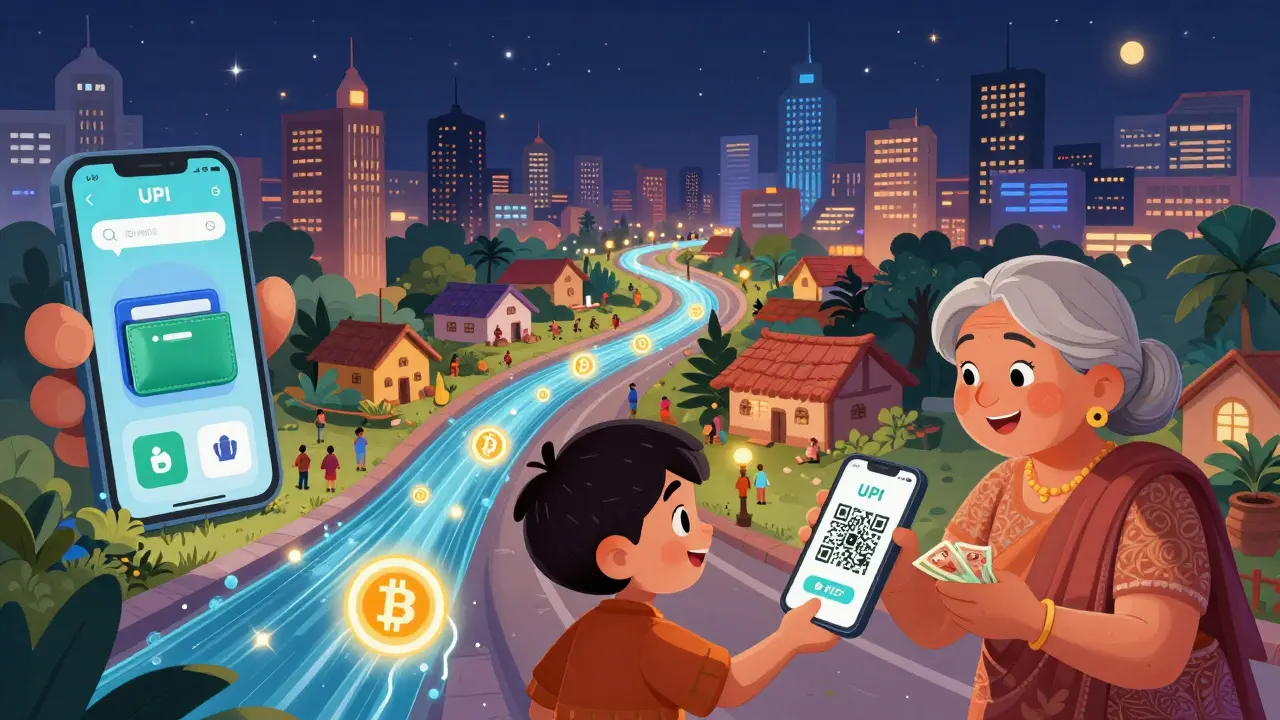
The Tax Paradox: How India Taxes Crypto Like a Crime - But Uses It Like a Currency
Here’s the twist: India taxes crypto at 30% on every trade - no deductions, no losses offset. Plus, a 1% TDS (tax deducted at source) on every transaction, whether you’re buying, selling, or swapping. That’s more than any other country. The U.S. taxes crypto as property, but allows losses to offset gains. India doesn’t. It treats every trade like a profit. And yet - adoption keeps rising. Why? Because people don’t care if the government taxes it. They care if it works. If you’re making $500 a month from freelance gigs and getting paid in crypto, you’re not going to stop because the government wants 30% of your income. You’ll just report it - or not. The system is too useful to ignore. The real impact of this tax policy? It pushed crypto into informal networks. People trade directly. They use peer-to-peer platforms. They avoid exchanges. They move crypto through wallets, not bank accounts. The government can track large exchange flows - but not the underground P2P networks where most of the real activity happens.Institutional Adoption: Banks, Startups, and the Quiet Shift
While retail users are trading on their phones, institutions are quietly building the infrastructure. Major Indian fintechs like Paytm and PhonePe have applied for crypto custody licenses. The Bharat Web3 Association - backed by top Indian tech founders - is working with regulators to create clear rules for tokenized assets. Even public sector banks are testing blockchain for cross-border settlements. The biggest signal? India is reportedly exploring the creation of a national Bitcoin reserve. Not for speculation. Not for trading. For stability. Think of it like a gold reserve - but digital. If India holds Bitcoin as a strategic asset, it’s no longer a fringe experiment. It’s policy. This isn’t about making money. It’s about control. If the rupee weakens, if inflation spikes, if capital flight happens - Bitcoin could act as a digital shock absorber. That’s why institutions are watching, not just participating.
The Tech Foundation: Why India Can Do This When Others Can’t
India’s crypto boom isn’t accidental. It’s built on decades of tech investment. The country has over 800 million smartphone users. Internet penetration hit 75% in 2024. Developers outnumber those in Germany and France combined. Indian engineers built the backend for half the world’s fintech apps. They know how to scale. That’s why Indian crypto startups are building tools no one else is: low-cost crypto wallets that work on 2G networks. DeFi interfaces that auto-convert USDT to rupees in the background. Smart contracts that pay gig workers in crypto but display amounts in rupees. This isn’t copying the U.S. or Europe. India is inventing its own version of crypto - one that’s mobile-first, cash-adjacent, and built for people who’ve never had a bank account.What’s Next? The Bitcoin Reserve and the Regulatory Tipping Point
The biggest question isn’t whether India will adopt crypto. It’s how fast the government will stop fighting it. A Bitcoin reserve would be a game-changer. It would mean the state acknowledges crypto as a legitimate store of value. It would open the door to regulated crypto ETFs. It would make banks comfortable lending against crypto assets. It would turn tax evasion into tax compliance. Right now, India’s crypto scene is a paradox: the most advanced market in the world, operating under the harshest tax regime. But that’s changing. The pressure from millions of users, thousands of startups, and billions in transactions is too loud to ignore. By 2027, India could be the first country to have a national crypto policy that balances control with innovation. Not by banning it. Not by taxing it into submission. But by embracing it - and using it to strengthen the rupee, not replace it.What This Means for the Rest of the World
India isn’t just a crypto success story. It’s a blueprint. Other countries think they need to wait for regulation before adoption can happen. India proves the opposite: adoption happens first. Regulation follows - or gets left behind. The U.S. has ETFs. Europe has MiCA. But neither has the grassroots energy, the digital infrastructure, or the scale of India. If you want to see where crypto is really going, look at a street vendor in Mumbai accepting USDT. Not Wall Street. Not Silicon Valley. That’s the future.Is cryptocurrency legal in India?
Yes, cryptocurrency is legal in India. There’s no ban on owning, trading, or using crypto. But the government taxes it heavily - 30% on profits and 1% TDS on every transaction. This makes it expensive to trade, but not illegal. Millions of Indians still use it every day.
Why is India #1 in crypto adoption despite high taxes?
Because the need for fast, cheap, borderless money outweighs the tax burden. India’s digital payment infrastructure - like UPI - made it easy for people to adopt crypto without banks. Students, gig workers, and small businesses use it because it works better than traditional options. Taxes don’t stop utility.
Do Indians use Bitcoin or altcoins more?
Bitcoin is the main entry point - over $4.6 trillion in fiat on-ramps went to Bitcoin between mid-2024 and mid-2025. But stablecoins like USDT and USDC dominate daily trading because they’re stable and easy to convert to rupees. Altcoins like Ethereum and Solana are popular among developers and DeFi users, but Bitcoin and stablecoins are what most people actually use.
Can I send crypto from India to another country?
Yes, but it’s not straightforward. Sending crypto internationally is legal, but banks and exchanges may flag large transfers. Many people use peer-to-peer platforms like Paxful or LocalBitcoins to send crypto directly to recipients abroad. This avoids bank interference and is often cheaper than traditional remittance services.
Is crypto mining allowed in India?
There’s no official ban on crypto mining, but it’s rare. High electricity costs and the 30% tax on mining rewards make it unprofitable for most individuals. Some small-scale miners operate in states with cheap power, like Chhattisgarh or Madhya Pradesh, but large mining farms are uncommon. Most Indians prefer buying crypto directly rather than mining it.
What’s the future of crypto regulation in India?
The future points toward regulation, not restriction. With growing institutional interest and rumors of a national Bitcoin reserve, India is moving toward recognizing crypto as a financial asset - not a threat. Expect clearer rules for exchanges, custody services, and tokenized assets by 2027. The goal won’t be to stop crypto - it’ll be to control it.





Akhil Mathew
Bro, I’m from Bangalore and I’ve seen this first hand. My cousin runs a small chai stall - he takes USDT, converts it to INR in seconds via CoinSwitch, and pays his supplier. No bank delays, no fees. The tax? He just ignores it. Who cares if the government takes 30% when you’re making 500% more than you would with UPI? This isn’t crypto adoption - it’s survival.
Dahlia Nurcahya
This is honestly one of the most hopeful things I’ve read all year. People aren’t waiting for permission to build a better system. They’re just building it. The fact that a 19-year-old in Jaipur is earning interest on USDC while her parents are stuck with 4% FD rates? That’s the future. And it’s already here.
William Hanson
Lmao. India ‘leads’ crypto adoption because they’re desperate. You tax something at 30% and people still use it? That’s not innovation - that’s a broken system. If you’re paying 1% fees to send money to your family in UP, you’re not choosing crypto - you’re escaping the ruins of your own banking system.
Steven Dilla
Bro, I’ve been tracking this for years. The real story isn’t Bitcoin. It’s stablecoins. USDT is the invisible rupee now. People don’t care about decentralization - they care about not losing 20% of their paycheck to inflation. And guess what? Crypto works. 🚀
josh gander
Let me tell you something - this isn’t about technology. It’s about dignity. For decades, India’s poor were told they weren’t ‘bankable.’ Now? A street vendor in Kolkata can hold value, send money across borders, and not beg for a loan. That’s not adoption. That’s liberation. And yeah, the tax is insane - but you don’t stop a revolution because the state doesn’t like the soundtrack.
Jeremy Dayde
I’ve lived in Hyderabad for 12 years and I’ve watched this shift. The UPI thing is real - people are already wired for instant payments. Crypto just added a new currency to the app. No one had to learn anything new. And honestly? Most people don’t even know what blockchain is. They just know it works. That’s all that matters.
Aaron Poole
India’s crypto boom isn’t an anomaly - it’s the natural result of digital infrastructure meeting real economic pain. The government taxed it like a crime because they didn’t understand it. But the people? They understood the utility. That’s why adoption exploded. It’s not about ideology - it’s about efficiency. And efficiency always wins.
Kevin Thomas
Y’all are missing the point. This isn’t about Bitcoin. It’s about the fact that a kid in rural Odisha can now lend money to another kid without a bank. No credit score. No paperwork. Just a phone and a smart contract. That’s the real revolution. The tax? A bureaucratic afterthought.
Will Pimblett
So India’s #1 in crypto adoption… because they’re forced to? The tax is so high it’s basically a penalty for using money. That’s not adoption - that’s rebellion. And rebellion doesn’t make a system sustainable. It just makes it loud.
Dylan Morrison
Imagine being told your money is illegal - but you use it anyway because it’s the only thing that works. That’s India. Not a tech miracle. Not a financial revolution. Just people being smart when the system fails them. 🌍🙏
Freddy Wiryadi
the tax thing is wild but honestly? if you’re getting paid in usdt and converting to rupees in 30 sec… who cares if the govt takes 30%? you still got more than you did before. also - p2p is where it’s at. no one uses exchanges anymore. just qr codes and whatsapp. 🤫
Edward Drawde
India’s crypto ‘boom’ is just tax evasion with a blockchain veneer. They’re not leading - they’re hiding. And one day, the IRS will come knocking.
Lori Quarles
Stop acting like this is a flaw. This is brilliance. A country with no banking access for 400 million people built its own financial system. No permission. No approval. Just code, phones, and grit. The world should be copying this - not mocking it.
Jack Petty
They’re not adopting crypto. They’re being forced into it because the rupee’s collapsing. This isn’t freedom - it’s desperation. And the government knows it. That’s why they’re quietly planning a Bitcoin reserve. They’re scared.
Elizabeth Jones
The deeper truth here is that regulation follows utility, not the other way around. India didn’t wait for the SEC to give permission. It built a system that worked for its people - and now the world is watching. That’s how innovation actually happens.
Elle M
Let’s be real - India’s ‘crypto revolution’ is just a symptom of corruption and failed policy. If your government taxes every transaction at 30%, you’re not a leader - you’re a mess. And now you’re trying to rebrand chaos as innovation.
Akhil Mathew
Wait - you think this is about tax evasion? Nah. My uncle in Lucknow sends crypto to his son in Dubai. Used to cost 8% in fees. Now? 0.8%. He saves $200 a month. That’s not evasion. That’s justice. The government can tax all it wants - it can’t tax away real value.
Devyn Ranere-Carleton
idk man i heard the indian govt is gonna make a bitcoin reserve? like… actualy hold it? that’s wild. if they do that then the whole ‘crypto is illegal’ thing is over. they’re just pretending to hate it to look tough.
Crystal Underwood
Oh please. The ‘Bitcoin reserve’ rumor is just a distraction. They’re not going to hold Bitcoin - they’re going to control it. This isn’t innovation. It’s centralization with a crypto brand. They want to turn crypto into another state-run surveillance tool. Don’t be fooled.
Meenal Sharma
While the world celebrates India’s crypto adoption, we must not ignore the social cost. The 30% tax disproportionately affects the poor, who cannot afford legal counsel to navigate compliance. This is not empowerment - it is economic coercion masked as progress.
josh gander
And here’s the kicker - the government doesn’t even understand how it’s happening. They track exchange flows, but the real activity? P2P. WhatsApp groups. QR codes on shop signs. No KYC. No paperwork. Just trust and code. That’s why they’re scared. They can’t control what they can’t see.
Rico Romano
India doesn’t lead crypto adoption - it leads in desperation. You don’t build a financial future on tax evasion and unstable stablecoins. You build it on regulation, transparency, and institutions. India has none of that. It has noise.
Nickole Fennell
My best friend’s sister runs a tiny shop in Varanasi. She accepts USDT. She doesn’t know what a blockchain is. She just knows she gets paid faster, and her customers are happier. That’s it. That’s the whole story. No ideology. No politics. Just… life.