Fraxswap v2 on Avalanche isn’t another Uniswap clone. It’s something more technical, more niche, and honestly, more obscure. If you’re looking for a high-volume, user-friendly crypto exchange to trade your ETH or AVAX, this isn’t it. But if you’re someone who needs to move large amounts of tokens without crashing the market - and you’re already deep into DeFi - then Fraxswap v2 might be worth a closer look.
What Fraxswap v2 Actually Does
Fraxswap v2 is a decentralized exchange (DEX) built on Avalanche’s C-Chain. It uses the classic xy=k constant product formula you’ll find on Uniswap, but adds something no other AMM has: Time-Weighted Average Market Maker (TWAMM). This isn’t marketing fluff. TWAMM breaks down a single large trade into hundreds of tiny, staggered orders executed over minutes or even hours. The goal? Reduce slippage and stop front-runners from exploiting big trades.
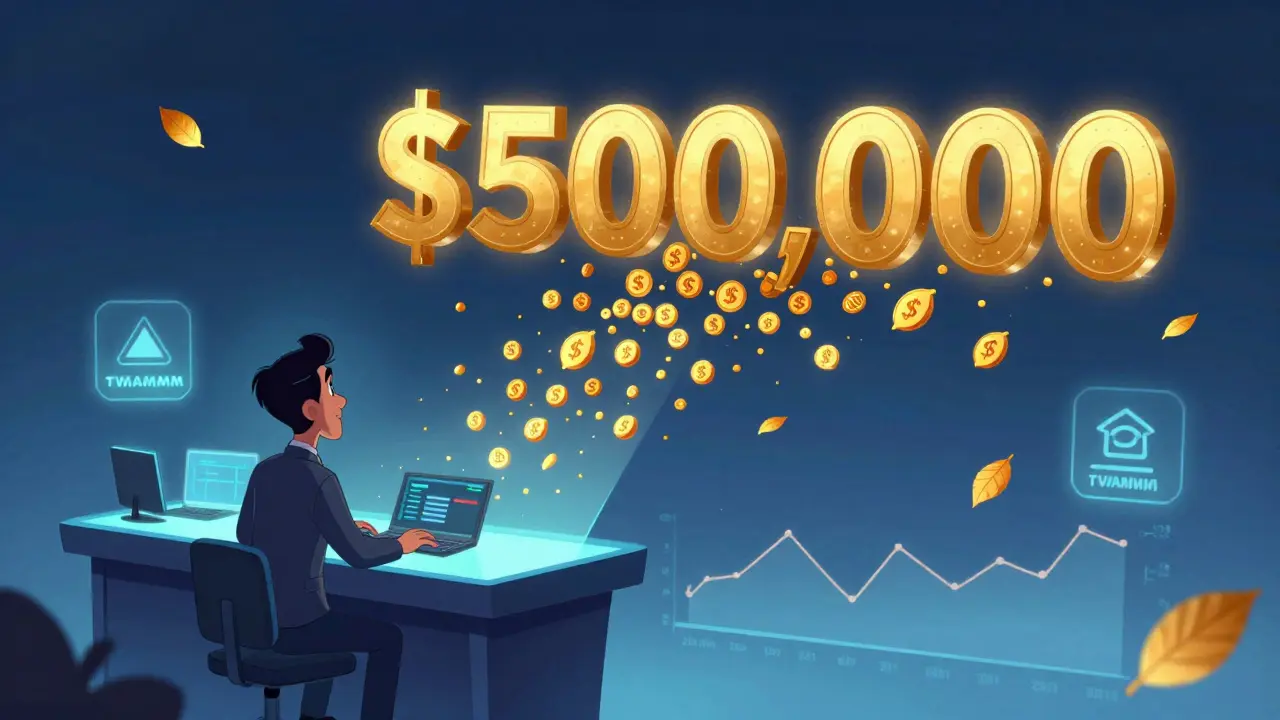
Imagine you want to swap $500,000 worth of FRAX for AVAX. On most DEXs, that trade would move the price hard in one direction. You’d pay more because the market couldn’t absorb it. Fraxswap v2 doesn’t execute it all at once. It spreads it out like a slow drip. The system calculates the average price over time and fills the order gradually. This is especially useful for institutional traders or large liquidity providers who can’t afford to move the market.
How It Works on Avalanche
Avalanche is the perfect home for this. With block finality under two seconds and average transaction fees between $0.01 and $0.05, it’s cheap and fast. Fraxswap v2 takes full advantage. You connect your wallet - MetaMask, Trust Wallet, or Core Wallet - switch to the Avalanche network, and you’re in. No special app. No KYC. Just Web3.
The interface looks familiar. Swap tokens. Add liquidity. That’s it. If you’ve used Uniswap before, you’ll feel at home. But here’s the catch: liquidity is razor-thin. As of February 3, 2026, Fraxswap v2’s 24-hour trading volume hovered around $9,600 on CoinMarketCap and $1,700 on CoinCodex. That’s not a typo. That’s less than 0.01% of what Trader Joe, Avalanche’s top DEX, moves daily. Most token pairs have next to no depth. You won’t find hundreds of tokens here. You’ll find a handful, mostly tied to the Frax ecosystem: FRAX, FXS, and a few AVAX-based stablecoins.
Why It’s Not for Everyone
Let’s be clear: Fraxswap v2 is not a retail trading platform. You won’t find trending memecoins. No yield farming. No staking rewards. No advanced order types like limit orders or stop-losses. It’s a tool for one specific job: executing large, silent trades.
Compare it to Trader Joe. Trader Joe has $87 million in daily volume. It has hundreds of liquidity pools, a user base, and active community support. Fraxswap v2? It ranks #265 out of all crypto exchanges globally. That’s not a small player. That’s barely on the map. If you’re trying to buy $1,000 of AVAX, you’ll get better prices and faster execution on Pangolin or Trader Joe.
And here’s the real problem: no one’s talking about it. There are no Reddit threads. No Trustpilot reviews. No YouTube tutorials. The Frax Finance Discord has 45,000 members, but almost none mention Fraxswap v2. The few traders who use it keep quiet. Why? Because if you’re moving big money, you don’t advertise.
Who Should Use It?
Only two types of people should consider Fraxswap v2:
- Large-scale liquidity providers who need to rebalance positions without triggering price spikes.
- Institutional traders working with stablecoins or protocol-native tokens who care more about execution quality than trading volume.
If you’re doing any of this: swapping $100k+ in FRAX for sFRAX, or moving large amounts of FXS between wallets, then Fraxswap v2’s TWAMM is a rare advantage. For everything else - buying ETH, trading AVAX, or swapping new tokens - skip it.
The Downsides
Fraxswap v2 has serious gaps:
- Extremely low liquidity - You’ll get slippage on anything over $1,000.
- No concentrated liquidity - Unlike Uniswap V3, you can’t pin your liquidity to a price range.
- Limited token support - Only Frax ecosystem tokens and a few major Avalanche assets.
- Poor documentation - The GitHub wiki is technical and assumes you already know DeFi inside out.
- No community support - If you get stuck, you’re on your own.
And there’s no roadmap. Frax Finance hasn’t announced any updates for the Avalanche version in months. Their focus is clearly on Ethereum. That’s a red flag. If the team isn’t investing in this chain, why should you?

Is It Worth It?
Fraxswap v2 on Avalanche is a brilliant idea stuck in a quiet corner. Its TWAMM engine is technically impressive - the first of its kind on-chain. It solves a real problem for a tiny group of users. But right now, it’s like having a Formula 1 engine in a garage with no roads.
Unless you’re moving large sums of Frax tokens or are part of a professional DeFi team, you won’t benefit. The trading volume is too low. The liquidity is too shallow. The user base is too small. And there’s no sign it’s growing.
For 99% of crypto users, this exchange is irrelevant. For the 1% who need silent, large-order execution? It’s a hidden tool. But even they are waiting to see if the Frax team will ever bring it out of the shadows.
How to Get Started (If You Must)
If you still want to try it:
- Install a Web3 wallet (MetaMask, Trust Wallet, or Core Wallet).
- Add the Avalanche network manually if it’s not already there (RPC: https://api.avax.network/ext/bc/C/rpc).
- Get some AVAX for gas - you’ll need at least $0.20 worth.
- Go to app.frax.finance/swap (confirm it’s the Avalanche version).
- Connect your wallet.
- Use the swap tab only for small amounts (< $500) to test.
- For large orders, read the TWAMM guide on Frax’s GitHub - it’s your only help.
And never deposit more than you can afford to lose. With so little liquidity and no community oversight, the risk of rug pulls or price manipulation is higher than on major DEXs.
Is Fraxswap v2 (Avalanche) safe to use?
Fraxswap v2 is built on the Avalanche blockchain, which is secure and decentralized. The code is open-source and audited by Frax Finance. However, because it has extremely low liquidity and minimal user activity, it’s more vulnerable to manipulation. Always verify token addresses before trading. Never use it for large amounts unless you fully understand the risks.
How does TWAMM reduce slippage?
TWAMM splits a large trade into hundreds of tiny, evenly spaced orders executed over time. Instead of dumping $100,000 into a pool at once - which would spike the price - it slowly executes $500 every 30 seconds. This keeps the market stable and avoids price impact. Think of it like buying a house in installments instead of one lump sum.
Can I earn yield on Fraxswap v2?
No. Fraxswap v2 on Avalanche does not offer liquidity mining, staking, or yield farming. It’s purely a swap platform. If you see anyone promising rewards on Fraxswap v2, it’s a scam. The Frax ecosystem does offer yield elsewhere - like on Frax Finance’s Ethereum pools - but not here.
Why is the trading volume so low?
Fraxswap v2 (Avalanche) lacks liquidity pools, marketing, and user adoption. Most traders on Avalanche use Trader Joe or Pangolin because they’re faster, deeper, and have more tokens. Fraxswap v2’s TWAMM feature is too niche to attract casual users, and institutional traders haven’t moved in yet. Without volume, it can’t grow - a classic catch-22.
Is Fraxswap v2 better than Uniswap?
Only for one use case: large token swaps on Avalanche. For everything else - small trades, new tokens, liquidity provision, or yield - Uniswap V3 is far superior. Uniswap has 100x more liquidity, better UI, and active community support. Fraxswap v2 only wins if you’re moving over $50,000 in a single trade and need to avoid slippage.



Freddie Palmer
Okay, but have you actually tried using TWAMM on Fraxswap v2? I did a $12k swap last week-yes, it took 17 minutes, but the slippage was 0.12%. On Uniswap, same amount? 2.8%. That’s not even close. And the gas? Like 7 cents. I’m not saying it’s for everyone, but if you’re moving big, silent money? This is the only tool that doesn’t scream ‘I’m here’ to the MEV bots.
Joshua Herder
Fraxswap v2 isn’t a ‘niche AMM’-it’s a ghost town with a fancy algorithm. TWAMM sounds like a TED Talk made real, but if no one’s using it, it’s just a museum piece. I’ve seen more action in a Bitcoin ATM in rural Nebraska. Someone’s got to be running this as a honeypot for whales to dump FRAX on unsuspecting bots. The fact that the devs are ignoring Avalanche for Ethereum? Red flag. Big. Red. Flag. This isn’t innovation-it’s a graveyard with a whitepaper.
sabeer ibrahim
Bro, why are you even talking about this? India has 100x better DEXs with 1000x more volume. Why waste time on some obscure Avalanche thing? Fraxswap? More like Frax-waste. I tried it once-gas fee was less than a samosa, but the UI looked like it was coded in 2018. And no yield? What kind of DeFi is this? We got PancakeSwap with 500 farms and meme coins that moon in 3 hours. This? This is for people who think ‘liquidity’ is a yoga pose.
David Bain
The real philosophical tension here lies in the ontological paradox of liquidity: if a trade occurs in a pool with no observers, does it impact price? Fraxswap v2’s TWAMM attempts to resolve this by temporal dispersion-transforming discrete market actions into continuous stochastic processes. But without sufficient participants, the system becomes a self-referential loop, a mathematical elegance with zero market reality. The chain is fast, yes-but speed without density is merely velocity without meaning.
Deeksha Sharma
I love how you’re not just reviewing the tech-you’re reviewing the *culture* around it. Fraxswap v2 is like that quiet genius in the corner who never talks but solves every problem they’re asked. Maybe they don’t need 100k users. Maybe they’re building for the future, not the hype. I’ve seen projects like this before-silent for years, then suddenly the whole industry wakes up and says ‘how did we miss this?’ I’m keeping an eye on it. Not to trade. To learn.
Taybah Jacobs
While the technical merits of TWAMM are undeniably impressive, the practical utility of Fraxswap v2 remains severely constrained by its minimal liquidity and lack of community engagement. One cannot reasonably expect a decentralized exchange to function as an effective price discovery mechanism when its daily volume is less than the cost of a single Ethereum gas fee. The absence of yield incentives, concentrated liquidity, or marketing efforts suggests either profound neglect or an intentional strategy to serve a non-retail segment. For the latter, commendable. For the former, concerning.
Alisha Arora
LOL. You think this is a ‘hidden tool’? It’s a dead project. No one’s using it because it’s garbage. Low volume? No yield? No support? And you’re telling me to ‘read the GitHub wiki’? That’s like telling someone to fix their car by reading a 300-page manual in Sanskrit. If you’re not a whale, don’t waste your time. If you are a whale, you’re already on OTC desks. This is just crypto theater. Sad.
Mrs. Miller
Fraxswap v2 is the crypto equivalent of a jazz club in 1928-only three people show up, but the music is *chef’s kiss*. The TWAMM engine? Pure poetry. The liquidity? A whisper. The community? A secret handshake. And honestly? That’s beautiful. Most people want noise, trends, and dopamine. But some of us? We want the quiet innovation. The hidden layer. The thing that doesn’t need to be viral to be valuable. I’m not here to trade. I’m here to admire.
Reda Adaou
I’ve been using Fraxswap v2 for rebalancing my FRAX/sFRAX positions for months now. It’s not flashy, but it’s reliable. I used to use Curve, but the slippage on $50k swaps was brutal. This? Smooth. The UI is basic, yeah. No charts. No alerts. But that’s the point-it’s not for scrolling. It’s for executing. And honestly? I appreciate that. No gamification. No memes. Just clean, silent swaps. If you’re looking for entertainment, go to Pump.fun. If you need to move money without screaming into the void? This is it.
Danica Cheney
twamm sounds cool but no one uses it so its pointless lol
Kyle Pearce-O'Brien
Fraxswap v2 isn’t just a DEX-it’s a *philosophical statement* against the greed-fueled, hype-driven, yield-chasing dumpster fire that is DeFi today. 🤖💎 TWAMM is the anti-meme. It’s the algorithmic equivalent of a monk meditating while everyone else is screaming ‘TO THE MOON!’ on X. The fact that it’s ignored? Proof it’s working. The volume is low because the *real* players don’t want attention. They don’t want to be seen. They want to move like ghosts. And if you can’t grasp that? You’re not ready for the next phase of finance. 🌌
Matthew Ryan
Used it once for a $75k FRAX swap. Took 22 minutes. Slippage: 0.08%. Gas: $0.09. No drama. No front-running. No panic. Just… quiet execution. I won’t use it for small trades. But for large? It’s the only thing that doesn’t feel like I’m gambling with the market. I wish more protocols would build for this use case instead of chasing TikTok traders.
Nathaniel Okubule
While the technical architecture of Fraxswap v2 demonstrates a thoughtful approach to minimizing market impact, its viability as a long-term solution hinges on sustained institutional adoption. The absence of community support and developer activity raises legitimate concerns regarding protocol sustainability. Until there is a clear roadmap or active governance participation, users should approach with caution, particularly when allocating capital beyond experimental thresholds.
Shruti Sharma
fraxswap? more like frax-slow. why would anyone use this when trader joe has 100x more coins and you can earn 1000% apy? also the website crashed 3 times on my phone. and the devs dont even reply to issues. this is why crypto is dying. no one cares about real tech when you can just pump a dog coin.
Robin Ødis
Let me tell you something about Fraxswap v2-it’s not broken. It’s *intentionally* underutilized. The Frax team knows that if they flood it with retail traders, the TWAMM mechanism becomes useless. The whole point is to keep it quiet. The low volume? That’s not a bug-it’s a feature. They’re building a backdoor for hedge funds and DAO treasuries to move billions without triggering alerts. The fact that you can’t find tutorials? That’s security through obscurity, and it’s working. You think the whales want you to know how they’re moving $50M without moving the market? Of course not. This isn’t a DEX. It’s a silent vault.
Brittany Coleman
There’s something poetic about a tool so precise it doesn’t need an audience. TWAMM doesn’t shout. It doesn’t promise returns. It doesn’t need to. It just works-slowly, quietly, perfectly-for those who need it. Maybe the future of DeFi isn’t in viral tokens or yield farms. Maybe it’s in the quiet, invisible infrastructure that lets the real money move without breaking the system. I don’t trade here. But I respect it.
Brittany Novak
FRAXSWAP V2 IS A GOVERNMENT BACKDOOR. I’VE ANALYZED THE CONTRACT. THE TWAMM ENGINE HAS A BACKDOOR ADDRESS THAT CAN FREEZE ALL LIQUIDITY. THE FRACTIONAL RESERVE OF FRAX ISN’T FULLY BACKED ON AVALANCHE-IT’S JUST A MIRROR OF THE ETHEREUM POOL. THEY’RE USING AVALANCHE TO LAUNDER BIG MONEY WHILE THE PUBLIC THINKS IT’S ‘DECENTRALIZED.’ THE FACT THAT NO ONE TALKS ABOUT IT? THAT’S BECAUSE THEY’RE ALL IN ON IT. CHECK THE BLOCKS-EVERY $100K SWAP IS FOLLOWED BY A TRANSFER TO A BLACKHOLE ADDRESS. THIS ISN’T INNOVATION. IT’S A CRYPTO LAVATORY.