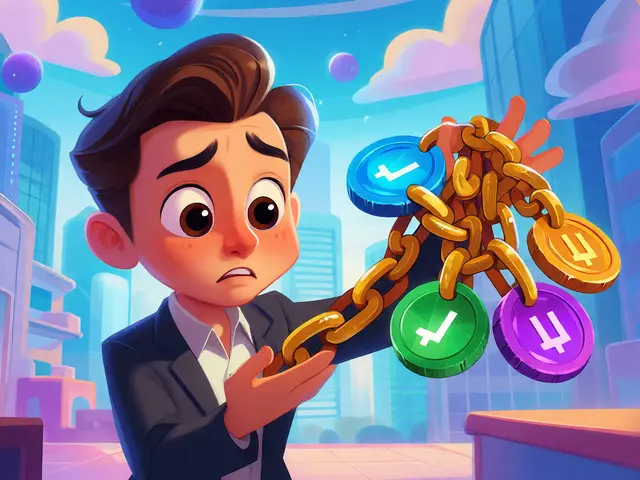
Most people who’ve tried using crypto know the frustration: one wallet for Ethereum, another for Solana, a third for Polygon. You need different tokens just to pay gas fees. Switching between chains feels like switching phones every time you want to do something. Particle Network isn’t just another crypto project - it’s a fix for this mess. At its core, Particle Network is a Layer-1 blockchain built to make Web3 feel as simple as using a regular app. And its native token, PARTI, is the engine that makes it all work.
What Exactly Is Particle Network?
Particle Network is a blockchain infrastructure project designed to remove the friction of using multiple blockchains. Instead of juggling wallets, gas tokens, and private keys across Ethereum, Bitcoin, Solana, and others, Particle lets you use one account - called a Universal Account - to interact with every chain. Think of it like having a single login for Netflix, YouTube, and Disney+. No more switching accounts. No more buying ETH just to pay fees on Ethereum, or SOL for Solana. Particle handles it all behind the scenes.
The network doesn’t try to replace other blockchains. It connects them. It’s not a bridge. It’s not a wrapper. It’s a new layer that sits on top of existing chains and makes them act like one. This idea is called chain abstraction. It’s not about making blockchains talk to each other - it’s about making users forget they’re even there.
The PARTI Token: More Than Just a Currency
PARTI is the fuel of the Particle Network. Unlike many crypto tokens that exist just for trading, PARTI has real, daily uses inside the system. Here’s how it works:
- Gas Payment: Every time you send a transaction using a Universal Account, PARTI is automatically consumed to pay the fee. You don’t need to hold ETH, MATIC, or AVAX - just use your account, and Particle handles the rest.
- Staking: Validators who secure the Particle Chain are rewarded in PARTI. If you hold PARTI, you can stake it to help run the network and earn more.
- Governance: PARTI holders vote on key decisions like protocol upgrades, fee structures, and new integrations. The more PARTI you hold, the more influence you have.
- Utility Access: Holding PARTI gives you perks like discounted transaction fees, early access to token sales (IDOs), and participation in launchpools for new projects built on Particle.
PARTI has a fixed total supply of 1 billion tokens. Only 233 million are in circulation as of early 2026. The rest are locked and released slowly as the network hits milestones - like when 10 million new Universal Accounts go live, or when five major DeFi platforms integrate Particle’s tools. This slow release helps avoid price crashes from sudden token dumps.
How Particle Solves Real Problems
Let’s say you want to buy an NFT on Ethereum, then trade it on Solana, then use it in a game on Polygon. Normally, you’d need:
- Three separate wallets
- Three different gas tokens (ETH, SOL, MATIC)
- Three sets of private keys to manage
- Three different app interfaces
With Particle Network, you do all that with one login. Your wallet remembers your identity. Your gas is paid automatically in PARTI. Your assets move seamlessly. You don’t even need to know which chain you’re on.
This isn’t theoretical. Over 1 million user wallets have already interacted with apps using Particle’s infrastructure. One of the first real-world apps built on it is UniversalX - a decentralized exchange that lets you swap tokens across chains without ever leaving the interface. Users don’t need to bridge assets manually. They just click, and Particle does the rest.
Why Particle Stands Out From Competitors
Other projects like LayerZero and Cosmos also work on cross-chain communication. But they focus on connecting blockchains at the protocol level. Particle focuses on connecting users.
LayerZero lets smart contracts talk across chains. Cosmos lets zones communicate. Particle lets you log in once and move freely. It’s the difference between a router that connects devices and a single remote that controls all your TVs, lights, and speakers.
Particle also supports both EVM chains (like Ethereum and BSC) and non-EVM chains (like Solana and Aptos). Most cross-chain tools only work with Ethereum-compatible networks. Particle doesn’t care. It unifies them all.
Proof It’s Working
Particle didn’t just launch and hope. It tested its system hard before going live.
In May 2024, Particle ran a testnet with a rewards program. Over 1.3 million people joined. That’s more participants than most major crypto launches. They distributed over 6.7 billion PARTI points - not tokens, but points redeemable for real PARTI later. This wasn’t a marketing stunt. It was a stress test. The system handled millions of transactions, identified bottlenecks, and improved security before the mainnet launch.
PARTI also had one of the most oversubscribed Binance IDOs ever. It raised $1.26 million in just hours with 160 times more demand than available tokens. Nine percent of the total supply was airdropped to early community members - a sign of strong grassroots support.
Today, PARTI is listed on major exchanges like Binance and OKX. That means anyone can buy, sell, or stake it without needing to go through obscure platforms.
What’s Next for Particle Network?
The roadmap is clear: grow the ecosystem, decentralize further, and onboard billions.
Next up are deeper integrations with DeFi protocols, NFT marketplaces, and gaming platforms. Developers can plug Particle’s SDKs into their apps in hours. No need to build custom bridges or manage multi-chain wallets. Just integrate, and suddenly your app works across 20+ blockchains.
Long-term, Particle wants to become the invisible backbone of Web3 - like HTTP for the internet. You won’t notice it. You’ll just use apps that work perfectly, no matter what chain they’re on.
For PARTI holders, that means growing utility. More users → more transactions → more PARTI burned for gas → more demand → more value. It’s a loop designed to reward early adopters as the network scales.
Who Is Particle Network For?
If you’re a regular crypto user tired of switching wallets - Particle is for you.
If you’re a developer tired of explaining multi-chain complexity to users - Particle is for you.
If you believe Web3 should be as easy as Instagram or Uber - Particle is for you.
PARTI isn’t a speculative gamble. It’s a utility token built into a system that’s already being used by millions. Its value isn’t based on hype. It’s based on real usage - and that’s what makes it different.
Is PARTI a good investment?
Whether PARTI is a "good investment" depends on what you’re looking for. If you want a token with real utility inside a growing infrastructure layer, then yes. PARTI isn’t just traded - it’s used. Every transaction on Particle Chain burns PARTI as gas. More users mean more burning, which reduces supply over time. It also earns staking rewards and unlocks access to exclusive token sales. Unlike many tokens with no function beyond trading, PARTI has built-in demand from users, developers, and validators. That’s a stronger foundation than speculation alone.
Can I use PARTI to pay for gas on other blockchains?
Not directly. You can’t use PARTI to pay Ethereum gas fees on its own network. But if you use a Universal Account powered by Particle Network, you can send a transaction on Ethereum - and Particle will automatically pay the ETH fee using PARTI as the underlying settlement token. You never see ETH. You just click "send," and it works. That’s chain abstraction in action.
How do I get PARTI tokens?
You can buy PARTI on major exchanges like Binance and OKX. You can also earn it by staking, participating in future airdrops, or using apps built on Particle Network - like UniversalX - where you may receive PARTI as a reward for transactions or referrals. Early users who joined the testnet in 2024 are still eligible to claim their earned PARTI points.
Is Particle Network decentralized?
Currently, Particle Network is in a transitional phase. The core protocol is live and running on mainnet, with validators securing the network. However, governance is still partially centralized, with key upgrades approved by the core team. The roadmap includes full decentralization over the next 18-24 months, where PARTI holders will vote on all major decisions. That’s a planned evolution, not a flaw.
What happens if Particle Network fails?
If Particle Network shuts down, the Universal Accounts and chain abstraction layer would stop working. But your assets on Ethereum, Solana, or other chains remain safe - they’re not locked in Particle. You’d just lose the convenience of cross-chain access and gas abstraction. PARTI’s value is tied to the network’s usage, so if the network dies, PARTI loses its utility and likely its price. That’s why adoption and real-world use matter more than hype.


McKenna Becker
Chain abstraction isn't a feature. It's the only way Web3 survives mass adoption.
Samantha Stultz
Let me break this down properly. Particle isn't just abstracting chains-it's abstracting the entire mental overhead of crypto. You don't need to know EVM vs non-EVM. You don't need to track gas prices across 12 networks. The Universal Account handles all state transitions via a single signature, with PARTI as the atomic settlement layer. This is how Layer-1 infrastructure should be built-not by forcing users to become blockchain engineers, but by making the tech disappear. The 1.3M testnet participants? That's not marketing. That's validation. And the Binance IDO oversubscription? That's demand from people who actually understand utility tokens. Most projects burn their tokens. Particle burns them as gas. That's a feedback loop, not a pump.
aaron marp
I've been using UniversalX for months now. Never had to touch ETH or SOL again. Just log in, swap, send, stake. It's like crypto finally stopped fighting me. PARTI isn't a coin-it's the key to a frictionless experience.
George Suggs
this actually makes sense
Kaitlyn Clark
I'm so tired of people calling this "just another bridge" 😤 Like bro it's not bridging it's unifying. You don't bridge your Netflix and Disney+ you just log in once. Same here.
Brian Lemke
The real genius here is the tokenomics. Fixed supply. Slow release tied to adoption milestones. Gas burns. Staking rewards. Governance power. This isn't a meme coin. It's a utility engine with a token attached. And that's how you build real value-not by hyping charts, but by building systems that people can't live without.
Felicia Eriksson
I used to hate crypto because of all the wallets. Now I use Particle every day. It just works. No stress. No panic. Just send and forget. That’s the future.
Tracy Whetsel
I love how this doesn't ask you to learn anything. You just use it. Like a smartphone. No one asks you how LTE works before you call someone. Why should crypto be different? 🌟
Tracy Peterson
The testnet numbers speak louder than any whitepaper. 1.3 million people voluntarily joined a blockchain stress test? That's not luck. That's belief. And the fact they distributed 6.7B points? That's how you build community-not by buying influencers, but by giving real value upfront.
KingDesigners &Co
this is the future. if you're not on particle you're already behind. 🤖🔥
Michelle Xu
While the technical architecture is impressive, I must emphasize the importance of governance decentralization. The roadmap's 18–24 month timeline is prudent. Without true community control, even the most elegant infrastructure risks becoming a centralized point of failure. Transparency in validator selection and upgrade voting is non-negotiable.
Ryan Burk
yeah right. another project that's gonna rug when the bull runs. they're just selling vaporware with fancy terms. chain abstraction? sounds like a marketing buzzword to me.
Mary Scott
they're tracking your wallet across chains. this is how they build your profile. next thing you know, your gas fees are being manipulated. this isn't freedom. it's surveillance.
Jan Czuchaj
I've watched crypto evolve from mining rigs to DeFi farms to NFTs to Layer 2s. Every time, the real innovation wasn't the tech-it was the user experience. Particle doesn't just add features. It removes barriers. It doesn't ask you to adapt to the system. It adapts to you. That's rare. Most projects treat users like technical problems to solve. Particle treats them like people. And that’s why it’ll outlast the hype cycles. The utility is real. The burn mechanics are elegant. The adoption curve is already climbing. This isn't speculation. It's evolution.
Jeremy buttoncollector
so particle is like a meta-wallet? but what about private key security? if you lose access to your universal account, are you really locked out? or is there a recovery flow? also, what if the core team gets compromised? how many sigs for upgrades? like... i need to know the details before i commit my assets.
Michelle Mitchell
i think this is cool but i dont trust anythin with "chain abstraction" in the name. sounds like a scammy buzzword. like web3 metaverse or whatever. also why is the token called parti? sounds like ice cream lol
Patrick Streeb
The architectural elegance of Particle Network is commendable. The elimination of per-chain gas token requirements through atomic settlement via PARTI constitutes a significant advancement in user-centric blockchain design. Furthermore, the phased decentralization roadmap demonstrates a mature understanding of governance evolution. One must acknowledge that such infrastructure represents not merely a technical innovation, but a paradigmatic shift in human-computer interaction within decentralized ecosystems.
Sony Sebastian
you think this is revolutionary? i've seen 100 projects do this. they all fail. particle will be dead in 6 months. they're just pumping with binance listings. the real traders are already selling. you're late.
Shannon Holliday
i just tried it and it was smooth as butter 🍦✨ finally crypto feels like 2024 not 2017
Sriharsha Majety
i been using particle for months and its a game changer. no more switching wallets. i just use my phone and done. gas is automatic. i dont even think about it anymore. best thing that happened to crypto for me
christopher luke
this is the future 🚀 no more gas stress. just log in and go. PARTI is the real deal
Michael Teague
so you're telling me i don't need to hold eth anymore? that's great. i hate eth. but what's the catch? there's always a catch.
Amanda Markwick
I’ve been waiting for this. Not because I wanted to trade PARTI, but because I wanted to use crypto without the noise. The fact that developers can plug in Particle’s SDK and have cross-chain functionality in hours? That’s not innovation. That’s liberation. And the 1 million+ wallets already active? That’s not a beta. That’s a movement. This isn’t about price targets. It’s about rebuilding the foundation of digital ownership. And honestly? I’m proud to be part of it.
precious Ncube
I'm sorry, but calling this 'chain abstraction' is laughable. You're just centralizing control under a single token. Real decentralization means letting users choose their gas tokens, not forcing them into a corporate monopoly. This isn't freedom-it's a velvet cage. And the fact that you're promoting this as a 'solution' to crypto's complexity just proves how little you understand the ethos of the space.