
Have you ever stumbled upon a cryptocurrency with a name that sounds like a country but acts like a governance tool? That is exactly what happens when you search for Angola (AGLA) crypto. It is easy to get confused. You might think it is the official digital currency of the nation of Angola, or perhaps a stablecoin pegged to the Angolan Kwanza. The reality is quite different. Angola (AGLA) is a blockchain-based infrastructure project focused on governance and profit distribution within its own specific ecosystem. It has nothing to do with the national economy of the African country.
If you are looking at this token because you saw it listed on major exchanges like Binance or Coinbase, you are probably asking two questions: What does it actually do? And is it safe to buy? This guide breaks down the facts about AGLA, separating the marketing hype from the hard data available as of mid-2026.
Understanding the AGLA Token Utility
To understand why AGLA exists, we have to look past the ticker symbol. In the world of decentralized finance (DeFi), tokens generally fall into three buckets: payment coins (like Bitcoin), platform fuels (like Ethereum's ETH), and governance tokens. AGLA sits firmly in the third category.
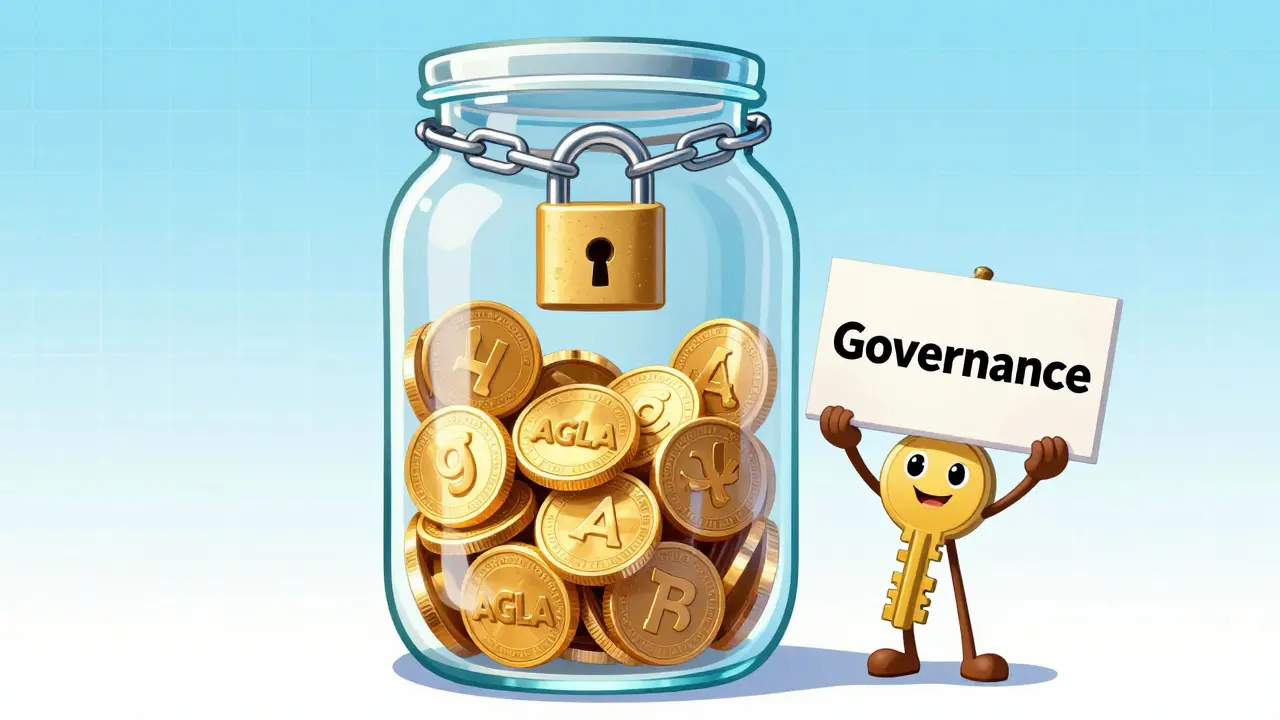
Angola (AGLA) is a governance instrument designed to address imbalances in profit distribution structures within the Angola blockchain infrastructure system.
Think of it like shares in a cooperative rather than cash in your pocket. When you hold AGLA, you are not just holding an asset that you hope goes up in value; you are holding a key that allows you to participate in decision-making processes for the protocol. The project’s stated goal is to fix how profits are shared among participants in its network. This means the token’s value is tied directly to the success and adoption of the underlying infrastructure, not to external market trends alone.
This distinction matters because governance tokens often behave differently than speculative meme coins. Their utility is functional. If the Angola ecosystem grows and more users join, the demand for governance rights-and thus the token-could theoretically increase. However, if the infrastructure remains unused, the token loses its primary purpose.
Market Data and Supply Mechanics
Let’s look at the numbers, because in crypto, supply mechanics dictate scarcity. As of May 2026, the data paints a picture of a token that is still circulating but has significant reserves left.
- Circulating Supply: 2 billion AGLA tokens.
- Maximum Total Supply: 3 billion AGLA tokens.
- Circulation Rate: Approximately 67% of the total supply is currently in the wild.
The fact that 33% of the tokens are still locked or unissued is a critical detail for investors. This remaining supply could be released over time through vesting schedules for developers, reserved for future partnerships, or allocated to community rewards. When new tokens enter the market, it creates selling pressure unless there is enough buying demand to absorb them. You need to watch for announcements regarding these unlock dates, as they can cause sudden price drops.
The price itself tells another story. Across multiple exchanges, AGLA trades at a fraction of a cent. On platforms like Gate.io and Crypto.com, the price hovered around $0.0000028 USD in May 2026. On Binance, the conversion tools sometimes show it as approximately $0 due to the extreme precision required to display such small values. This classifies AGLA as a "micro-cap" asset. While this low entry price might seem attractive because you can buy millions of tokens for a few dollars, remember that market cap-not share price-determines the true size and risk profile of the investment.
Where Can You Trade AGLA?
One of the most confusing aspects of AGLA is its presence on major exchange listings versus its actual tradability. Seeing a coin on Binance or Coinbase gives it a stamp of legitimacy, but it doesn’t always mean you can trade it freely.
| Exchange Platform | Listed? | Tradable? | Notes |
|---|---|---|---|
| Binance | Yes | Limited/Tracking Only | Price tracking available; active trading pairs may be restricted or low volume. |
| Coinbase | Yes | Informational | Listed for discovery; often not actively tradable without specific regional access. |
| Crypto.com | Yes | No | Explicitly marked as "not tradable yet" during initial listing phases. |
| Gate.io | Yes | Yes | Active price tracking and conversion tools available; higher liquidity relative to others. |
| Pluang | Yes | Yes | Popular in Indonesia; shows high historical volatility (ATH Rp7,240 vs ATL Rp1.61). |
The discrepancy here is important. If you try to buy AGLA on Crypto.com, you might find the button grayed out. This suggests the project is in a transitional phase, possibly dealing with regulatory compliance or technical integration. For most retail investors, Gate.io and Pluang have been the more accessible venues for actual transactions. Always check the current status on your specific exchange before attempting a trade, as these statuses change frequently.
Risks of Micro-Cap Governance Tokens
We need to talk about risk, because AGLA carries several red flags that experienced traders monitor closely. First, there is the issue of liquidity. Liquidity refers to how easily you can buy or sell an asset without affecting its price. With AGLA, many exchanges report trading volume as "N/A" (Not Available). This means there are very few buyers and sellers active at any given moment.
Imagine trying to sell a house where only one person in the entire city wants to buy homes. You would have to lower the price drastically to make a deal. The same applies to AGLA. If you decide to sell a large amount of tokens, you could crash the price yourself because there isn't enough depth in the order book to absorb your sale.
Second, consider the information asymmetry. While AGLA is listed on tier-1 exchanges, detailed public documentation-such as comprehensive whitepapers, transparent team identities, and clear roadmaps-is surprisingly scarce on major aggregators like CoinMarketCap. In the crypto world, transparency builds trust. When a project lacks detailed public records about its leadership and development progress, it increases the risk of being a "vaporware" project or one that is heavily dependent on anonymous developers.
Finally, there is the volatility factor. Historical data from Pluang shows AGLA swinging from an all-time low of Rp1.61 to an all-time high of Rp7,240.93. That is a massive percentage swing. For every dollar you put in, you could see it multiply quickly, or vanish just as fast. This is not an investment for savings; it is speculation.

How to Evaluate AGLA for Your Portfolio
If you are still interested in AGLA after reading the risks, how should you approach it? Here is a practical framework for evaluating micro-cap governance tokens.
- Check the Vesting Schedule: Look for any announcements regarding the release of the remaining 1 billion tokens. If a large chunk is set to unlock next month, expect downward pressure.
- Monitor Ecosystem Activity: Since AGLA is a governance token, its value depends on the usage of the Angola infrastructure. Are people using the platform? If the user base is stagnant, the token has no fundamental growth driver.
- Diversify Exposure: Never allocate more than 1-2% of your total crypto portfolio to a single micro-cap token. Given the illiquidity and lack of detailed info, treat AGLA as a high-risk lottery ticket, not a core holding.
- Use Limit Orders: Because liquidity is thin, market orders can result in terrible slippage (you get a much worse price than expected). Always use limit orders to control exactly what price you are willing to pay or accept.
Conclusion: Is AGLA Worth It?
Angola (AGLA) is a legitimate token in the sense that it exists on major blockchains and is listed by reputable exchanges. However, it operates in the shadowy corners of the micro-cap market. It offers governance utility within a niche infrastructure project, but it lacks the widespread adoption, deep liquidity, and transparent documentation that characterize mature cryptocurrencies.
If you are a seasoned trader who understands how to read order books and manage high-risk assets, AGLA might offer speculative opportunities. If you are a beginner looking for stable growth or clear utility, this token likely does not fit your needs. The gap between its listing on prestigious platforms and its actual trading activity suggests a project that is either in early development or struggling to gain mainstream traction. Proceed with caution, do your own research, and never invest money you cannot afford to lose.
Is Angola (AGLA) the official cryptocurrency of the country Angola?
No. Angola (AGLA) is a private blockchain-based governance token. It is not issued by the government of Angola, nor is it pegged to the Angolan Kwanza. The name is coincidental or thematic, but it has no legal tender status in the country.
Why is the price of AGLA so low?
The price is low because it is a micro-cap token with a high supply (3 billion max) and limited trading volume. Low liquidity and lack of widespread adoption keep the valuation minimal compared to major cryptocurrencies like Bitcoin or Ethereum.
Can I buy AGLA on Coinbase?
While AGLA is listed on Coinbase for informational purposes, it has historically been marked as "not tradable" or available only in specific regions. You should check the live status on the Coinbase app, but alternative exchanges like Gate.io or Pluang often provide better accessibility for trading.
What is the maximum supply of AGLA?
The maximum total supply of Angola (AGLA) is 3 billion tokens. As of mid-2026, approximately 2 billion tokens are in circulation, meaning about 33% of the supply is still reserved or locked.
Is AGLA a good investment for beginners?
Generally, no. AGLA is considered a high-risk, micro-cap asset with low liquidity and limited public documentation. Beginners are usually advised to stick to established cryptocurrencies with high liquidity and transparent teams until they gain more experience managing volatility.