
Swych isn’t another clone of PancakeSwap or Uniswap. It’s a Swych crypto exchange built for traders who want to go beyond spot trading-without leaving the Binance Smart Chain. Launched in late 2023, it’s not trying to be the biggest. It’s trying to be the most practical for perpetual trading in DeFi. But does it deliver? Or is it just another high-yield trap with a slick interface?
What Is Swych, Really?
Swych is a decentralized exchange ecosystem built on Binance Smart Chain. Its main product, Swych PDEX, lets you trade perpetual contracts-like futures with no expiry date-with leverage. You can go long or short on BTC, ETH, BNB, and a few other major tokens. No KYC. No account creation. Just connect your MetaMask or TrustWallet and start trading. It’s not just a DEX, though. Swych bundles staking, liquidity farming, a lottery system called SuperLotto, and a launchpad for new tokens-all under one roof. The whole thing runs on the SWYCH token, which you need to pay trading fees, earn rewards, and participate in governance. Unlike centralized exchanges like Binance or KuCoin, Swych doesn’t hold your coins. You control your wallet. That’s the whole point of DeFi. But that also means you’re on your own if you mess up a trade or set slippage too low.How Swych PDEX Works
Swych PDEX uses an Automated Market Maker (AMM) model, like most DEXs. But it’s built for leverage trading. Here’s what you can do:- Trade perpetuals with up to 10x leverage
- Set take profit and stop loss orders
- Add or remove collateral while a trade is open
- Use paper trading mode with live market data
- Track your full order and position history
Fees and Costs
Swych charges a flat 0.3% trading fee. That’s a bit higher than PancakeSwap’s 0.25% for spot trades, but you’re getting perpetual contracts, not just swapping tokens. Compared to GMX, which charges 0.1% plus a dynamic funding rate that can spike during volatility, Swych’s fee is simpler. Gas fees? They’re BSC gas fees. That means they’re usually under $0.10 per trade during normal times. But during network congestion, they can jump to $1-$2. That’s still cheaper than Ethereum, but it’s something to watch if you’re doing frequent trades. There’s also a 5% tax on SWYCH token transfers, which goes into the protocol’s emergency fund. That’s meant to cover losses if a smart contract gets hacked. It’s a smart move-but only if the fund grows fast enough to matter.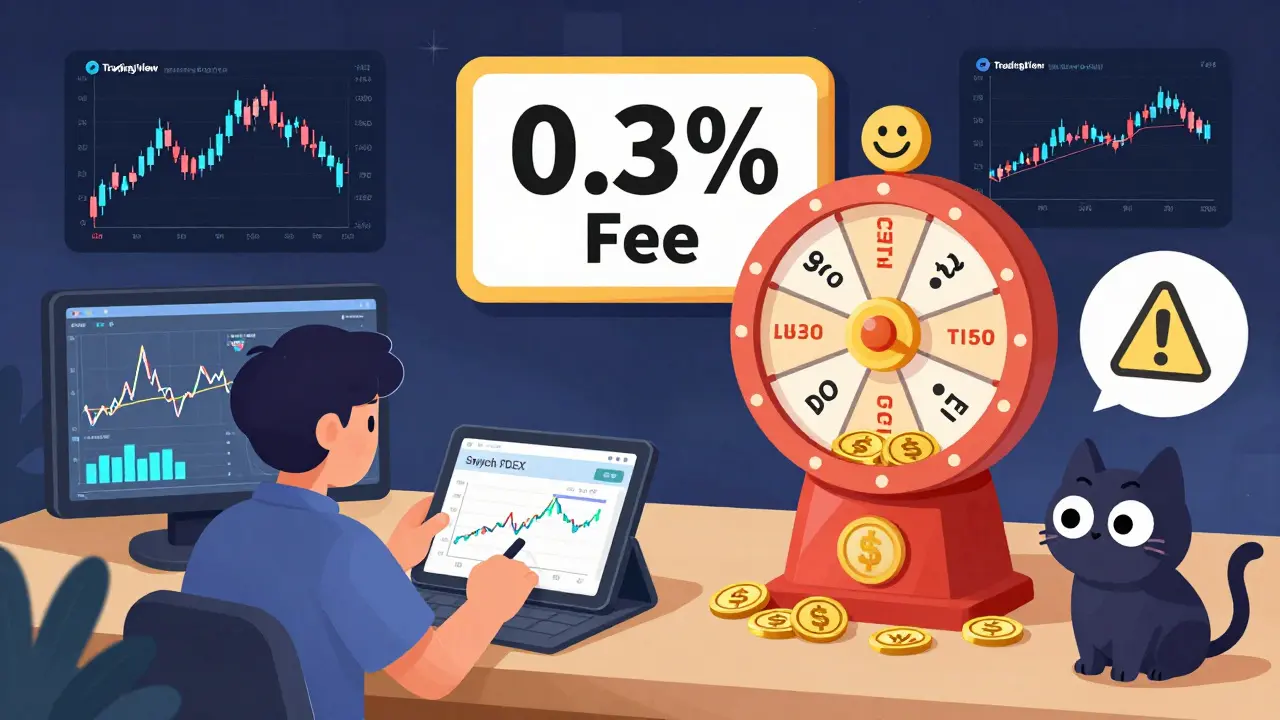
SWYCH Token: Utility and Risks
The SWYCH token is the engine of the ecosystem. You need it to pay fees, stake for rewards, and enter the SuperLotto. It’s also deflationary: 0.5% of every trade fee is burned. But here’s the catch: Swych’s staking APYs were hitting 200%+ in early 2024. That’s eye-catching-but unsustainable. High yields in DeFi usually mean the token supply is inflating to pay rewards. And if the price drops? Stakers get crushed. KuCoin users gave SWYCH a 3.8/5 rating as of late 2023. Positive reviews praised the paper trading and clean UI. Negative ones? They called out liquidity issues and gas spikes. One user lost $400 on a $5,000 ETH trade because of 8% slippage. That’s not the platform’s fault-it’s a liquidity problem. Swych doesn’t have a public audit report from CertiK or Hacken. That’s a red flag. Competitors like GMX and dYdX have multiple audits. Swych’s documentation says it’s secure-but without third-party proof, you’re trusting code you can’t verify.Performance and Liquidity
As of September 2023, Swych PDEX averaged $1.2 million in daily volume. That’s tiny compared to PancakeSwap’s $450 million or GMX’s $1.2 billion. Low liquidity means wide spreads and slippage on bigger trades. If you’re trading $100 or $500, you’ll be fine. But if you’re moving $2,000 or more? You’ll likely get worse fills than on a centralized exchange. That’s why many users switch to GMX for larger positions. The platform supports 18,742 unique wallet addresses. That’s a solid number for a new DeFi project-but it’s 1/20th of what GMX has. Growth is happening, but slowly.Pros and Cons
Pros
- Best-in-class paper trading for perpetuals
- Simple, TradingView-based interface
- No KYC, full self-custody
- Integrated staking, farming, and lottery
- Can adjust collateral mid-trade
- Low gas fees on BSC
Cons
- Low liquidity = high slippage on large trades
- No third-party smart contract audits
- High staking APYs may be unsustainable
- Documentation is sometimes outdated
- Trading fee (0.3%) is higher than some competitors
Who Is Swych For?
Swych isn’t for everyone. If you’re a beginner looking to swap ETH for USDT, use PancakeSwap. If you’re a whale trading $50,000 in BTC perps, go with GMX or dYdX. Swych is perfect for:- DeFi traders who want to practice leverage without risking real money
- Small to mid-sized traders ($500-$5,000 per trade) who want full control
- Users who like all-in-one platforms (staking + trading + lottery)
- People already on BSC and comfortable with wallet management
- You need high liquidity for large trades
- You demand audited smart contracts
- You’re chasing 300% APYs without understanding tokenomics
- You want 24/7 customer support
What’s Next for Swych?
The team has a roadmap. Phase one is about distributing SWYCH through staking and farming. Phase two, starting in 2024, aims to turn SWYCH into a “protocol-owned asset” that earns real yield from trading fees-not just inflation. Upcoming features:- Mobile app optimization (launched Q3 2023)
- NFT integration (Q1 2024)
- Cross-chain expansion to Ethereum and Arbitrum (Q2 2024)
Final Verdict
Swych crypto exchange isn’t the most liquid or the most audited. But it’s one of the few DeFi platforms that makes perpetual trading accessible to everyday users-with real educational tools like paper trading. The interface is clean, the features are thoughtful, and the team is pushing updates. The risks? High APYs could collapse. Low liquidity could ruin your trade. No audit means you’re trusting unverified code. If you’re a hands-on DeFi user who wants to learn leverage trading without risking your whole portfolio, Swych is one of the best places to start. Just keep your position sizes small. Use paper trading first. And never stake more than you’re willing to lose. It’s not perfect. But in a sea of DeFi clones, Swych actually feels like it was built for traders-not just speculators.Is Swych a centralized or decentralized exchange?
Swych is a decentralized exchange (DEX). You connect your own wallet-like MetaMask or TrustWallet-and trade directly from it. Swych never holds your funds. All trades happen on-chain using smart contracts on Binance Smart Chain. This means you’re in full control of your assets, but you’re also responsible for your own security.
Can I trade BTC and ETH on Swych?
Yes. Swych PDEX supports perpetual trading for major assets including BTC, ETH, and BNB. You can go long or short with up to 10x leverage. The platform uses real-time pricing data from trusted oracles, so your trades reflect current market conditions.
What’s the trading fee on Swych?
Swych charges a flat 0.3% fee on every trade. This is slightly higher than PancakeSwap’s 0.25% for spot trades, but Swych offers perpetual contracts with leverage, which most DEXs don’t. There are no hidden fees or funding rates-what you see is what you pay.
Does Swych have a mobile app?
Swych doesn’t have a standalone mobile app yet, but the web platform is fully mobile-responsive. You can access Swych PDEX from any smartphone browser using your wallet. The interface adapts to smaller screens, and all features-paper trading, orders, position tracking-work on mobile.
Are there audits for Swych’s smart contracts?
As of late 2023, Swych has not published any public smart contract audit reports from firms like CertiK or Hacken. This is a notable gap compared to competitors like GMX and dYdX, which have multiple audits. While Swych claims its code is secure, the lack of third-party verification means you’re taking on additional risk.
How does Swych’s paper trading work?
Swych’s paper trading mode lets you simulate perpetual trades using live market data-without spending any real money or paying gas fees. You can test leverage strategies, set stop losses, and practice position management. It’s ideal for beginners learning how perpetual contracts work before risking actual funds. The data is accurate within 0.3% of real exchange prices, according to user reports.
What’s the SWYCH token used for?
The SWYCH token is the backbone of the ecosystem. You need it to pay trading fees, stake for rewards, join the SuperLotto, and participate in future governance. A portion of every trade fee is burned, making it deflationary. Staking SWYCH offers high APYs, but these are not guaranteed and may drop if the token price falls or supply increases.
Is Swych safe to use?
Swych is as safe as your own wallet management. Since it’s non-custodial, your funds aren’t held by the platform. But the smart contracts haven’t been publicly audited, which is a risk. Swych has an emergency fund (5% of revenue) to cover losses from exploits, but it’s still early. Use small amounts at first, enable 2FA on your wallet, and never share your private key.





Janet Combs
man i just tried swych last week and wow the paper trading is actually helpful. i lost $20 on real trades before i used it, now i’m not scared to test leverage anymore. no audits? yeah but i’m only putting in what i can afford to lose. 🤷♀️
Radha Reddy
Thank you for this detailed review. As someone new to DeFi, I appreciate the clarity on liquidity and risk. The paper trading feature is indeed rare and valuable for beginners like myself.
Sarah Glaser
There’s something deeply poetic about building financial freedom on a chain that costs less than a cup of coffee. Swych doesn’t promise the moon-it just gives you the tools to reach for it. No KYC, no gatekeepers, just code and courage. That’s the soul of DeFi.
roxanne nott
0.3% fee? lol. GMX charges 0.1% and has 10x the liquidity. This is a toy for small fry. Also, no audit = no trust. Why are people still using this? 🤡
Rachel McDonald
OMG I CRIED WHEN I LOST MY $3K BECAUSE OF SLIPPAGE. WHY DOES NO ONE WARN PEOPLE? I THOUGHT IT WAS SAFE BECAUSE IT LOOKED PRETTY. NOW I’M BROKE AND TRAUMATIZED. 😭
Vijay n
This is a western capitalist trap disguised as decentralization. The SWYCH token is a pump and dump. The team is likely offshore. No audit? Of course not. They want your money and vanish when the rug is pulled. Beware
Alison Fenske
i love how the interface feels like home even though i dont know how to trade. the paper mode made me feel like i could breathe again. its not perfect but it made me feel like i was learning not just gambling. thank you for this
Collin Crawford
Swych is not a viable platform. The volume is microscopic. The tokenomics are a Ponzi in disguise. Anyone who claims this is 'practical' is either uninformed or being paid. The lack of audits alone disqualifies it from serious consideration.
Jayakanth Kesan
Been using Swych for 3 months now. Small trades, paper trading first, then real. Got burned once but learned. The team replies to Discord. Not perfect, but better than most. Keep it real, not hype.
Earlene Dollie
they said it was safe... they said the team was legit... they said the emergency fund would save us... and then... poof... my entire staking position vanished. i'm not crying... i'm just... so tired
Dusty Rogers
If you’re new to leverage, start with $50. Use paper trading. Learn the charts. Don’t chase APY. This isn’t a lottery. It’s a classroom. And you’re the student.
Kevin Karpiak
Why are Americans so gullible? This is a BSC meme coin with a fancy UI. Real traders use centralized exchanges. This is for people who think 'decentralized' means 'safe'.
Melissa Black
Swych’s protocol design exhibits a non-inflationary fee burn mechanism coupled with asymmetric liquidity constraints. The 5% transfer tax functions as a macroeconomic stabilizer, though its efficacy remains contingent on volume velocity. Paper trading is the only rational entry vector for non-whales.
Naman Modi
200% APY? Bro. That’s not yield. That’s suicide. I saw someone stake $10k and lose $8k in a week. Don’t be that guy.
Mmathapelo Ndlovu
❤️❤️❤️ this made me feel like i could actually learn something without getting scammed. paper trading saved me. i didn’t even know what leverage meant before. thank you for not being another scam
Tyler Porter
Remember: never trade more than you can afford to lose. Always use stop-loss. Always test in paper mode first. Always double-check slippage settings. And never, ever, ever trust a platform without an audit.
Rishav Ranjan
Too much text. Short answer: no audits, low volume, skip it.
Steve B
While the platform presents a compelling user interface, the absence of verifiable smart contract audits renders its operational integrity questionable. One must exercise extreme caution when engaging with non-custodial systems lacking third-party validation.
Sophia Wade
There’s beauty in the quiet rebellion of trading on your own terms-no bank, no boss, no bureaucracy. Swych doesn’t shout. It whispers: ‘Here’s the tool. You decide.’ And sometimes, that’s all you need.