
The Promise of Digital Democracy
Democracy relies on one core principle: trust. When citizens cast a ballot, they need to know that their choice is counted correctly and cannot be tampered with. In recent years, governments have struggled with outdated systems, long lines, and accusations of fraud. As we move through 2026, the conversation continues about whether online voting with blockchain technology can solve these age-old problems. The idea sounds perfect on paper. You vote securely from your phone, the results are instant, and nobody can cheat the count. However, the reality of implementing such a system is far more complicated than it appears.
Blockchain Voting is a decentralized method of electronic voting that uses distributed ledger technology to record and verify votes across multiple network nodes. Unlike traditional servers, this system distributes records so no single entity controls the entire dataset. Also known as Distributed Ledger Voting, it emerged from the broader cryptocurrency revolution to offer immutability and transparency. The technology was first conceptualized around the same time as Bitcoin, aiming to bring similar security guarantees to democratic processes.How the System Actually Works
Understanding the mechanics helps demystify the hype. Imagine a digital wallet on your smartphone. To vote, you receive a unique ballot token secured by cryptography. This token acts like a key proving you are eligible without revealing your personal identity. When you submit your choice, the transaction gets recorded in a block.
This process involves several distinct steps. First, the voter registers and verifies citizenship using a public key. Then, the blockchain encrypts credentials on the network. A ballot token enters the digital wallet for casting. Once you vote, the entry receives an identification number and is linked to the previous block through cryptographic hashing. This creates a chain where changing one vote would require altering every subsequent block, which is computationally impossible for attackers. Smart contracts handle the counting automatically, removing human error from tabulation.
There are two main ways organizations set this up:
- Multi-owner chain: Multiple independent groups act as peers. No central authority exists. They check each other, ensuring collective behavior remains trustworthy.
- Single-owner chain: One organization maintains full control over the infrastructure. This looks less decentralized but offers easier management.
| Feature | Multi-owner Chain | Single-owner Chain |
|---|---|---|
| Control | Distributed among peers | Centralized by one entity |
| Trust Model | Collective balance | Institutional reliance |
| Complexity | High coordination needed | Easier administration |
The Allure of Transparency and Speed
Why are people so excited about this? Proponents argue that the benefits are transformative. The Brookings Institution noted that blockchain voting could combat voter fraud significantly. With a transparent ledger, anyone can audit the results. If a politician claims their vote was dropped, voters can trace the transaction hash to prove otherwise. Furthermore, counting happens instantly. There is no waiting for absentee ballots to arrive by mail. Costs drop too, as physical polling stations become less necessary.
Accessibility also improves. Elderly voters or those abroad do not need to travel miles to vote. The system provides end-to-end verification advantages. Academics emphasize features like non-repudiation, meaning once you vote, you cannot claim you didn't, nor can someone else claim you did. Research published in PMC highlights that these properties offer solutions when extenuating circumstances require accessible environments. For a society increasingly digital, integrating voting into daily life seems logical.

The Critical Security Warning
Despite the excitement, experts remain deeply skeptical. The fundamental flaw lies not in the blockchain itself, but in the endpoints-the devices used to vote. David Jefferson from the U.S. Vote Foundation explains that serious vulnerabilities threaten integrity before ballots even reach the blockchain. If your computer has malware, the software knows your choice before you click 'submit'. The blockchain cannot fix a compromised device.
A specific threat looms large: Denial of Service attacks. These attacks flood servers with traffic, shutting down access. While blockchains use redundant servers, they offer no magic defense here. A nation-scale attack could disrupt the entire election day experience. MIT's Digital Currency Initiative reinforces these concerns. Their research states that Internet-based voting greatly increases the risk of undetectable failures. Imagine a scenario where thousands of voters attempt to cast ballots during a cyberattack. Without ironclad defenses, disenfranchisement could occur silently.
Furthermore, anonymity presents a paradox. To prevent coercion, votes must be secret. But to verify integrity, votes must be trackable. Blockchain requires public records. Balancing voter privacy with verifiable counts creates complex cryptographic challenges. Current proposals struggle to guarantee that the person verifying the count cannot identify who voted for whom. This tension remains unresolved in most systems developed by 2026.
Real-World Status and Limitations
Where does this leave us today? Most blockchain voting implementations remain in the pilot phase. Several organizations tested the technology for boardroom meetings or small-scale local councils. The BELEM technique showed adaptability for electronic vote boxes, suggesting integration with existing infrastructure is possible. However, public elections are different. They carry higher stakes and attract more sophisticated adversaries.
Universities continue researching the gap between theory and practice. The University of Minnesota Morris suggests hand-marked paper ballots remain the most secure way to cast votes currently. Blockchain technology offers potential solutions, but societies are not yet ready for full implementation. Technical literacy required to manage cryptographic keys poses another barrier. Voters who struggle with standard digital tools may find managing private keys for voting overwhelming. Infrastructure requirements include maintaining distributed networks of nodes during critical periods. If the internet goes down in a region, can people still vote?
Is It Safe Enough?
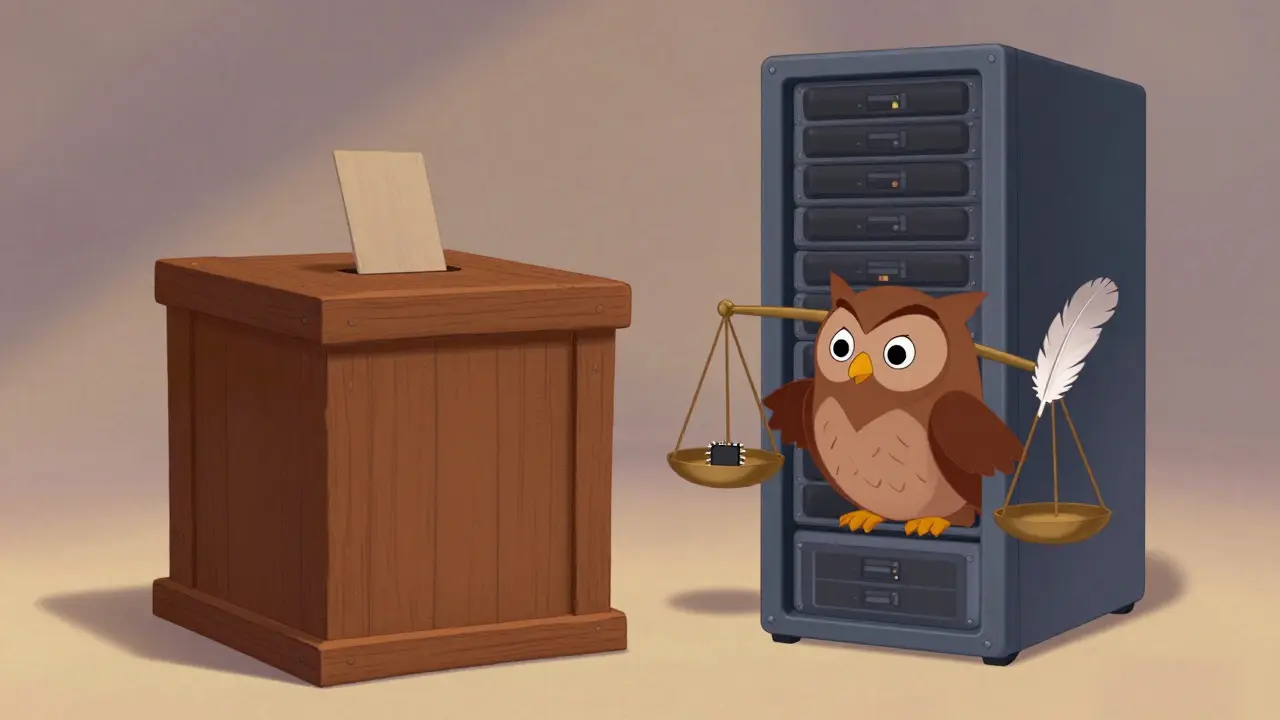
The consensus among election security specialists is cautious. The U.S. Vote Foundation categorically states that blockchain voting is not a security strategy. It does not solve the underlying problems of remote authentication. Studies have been inconclusive about turnout effects. Some evidence suggests online voting might increase disenfranchisement if technical barriers exclude marginalized populations. Any increase in participation must not come at the cost of election security. Given current computer security limitations, large-scale deployment remains inadvisable.
However, interest grows. Market development focuses on lower-stakes scenarios first. Private organizational voting, shareholder meetings, and corporate governance provide testing grounds. These environments have controlled IT setups and fewer malicious actors. Success here might build confidence for broader adoption later. Future prospects depend heavily on advances in cybersecurity and regulatory frameworks.
Frequently Asked Questions
Can blockchain voting stop fraud?
It can prevent tampering with results after voting, but it cannot stop fraud before the vote leaves a user's device. Malware on a personal computer remains a significant risk.
Is online voting anonymous?
Ideally, yes. Votes are linked to IDs but hidden via encryption. However, ensuring true anonymity while allowing public auditing is technically challenging and debated by experts.
What is the difference between a single-owner and multi-owner chain?
A single-owner chain is controlled by one organization, making it more centralized. A multi-owner chain spreads control across independent groups, relying on mutual distrust to ensure honesty.
Why don't we use blockchain voting now?
Security experts warn that current computer security limitations make large-scale deployment risky. Hand-marked paper ballots are currently considered safer for high-stakes elections.
Will blockchain voting increase voter turnout?
Research is inconclusive. While convenience could help, technical barriers and security risks might discourage some users, potentially leading to net neutral or negative effects on turnout.





Ronald Siggy
We need to embrace technology to secure our democracy for the next century. The idea of voting from anywhere removes huge barriers for working families. If we do nothing the systems will rot until nobody trusts them anymore. We can fix the endpoint security issues with verified devices at polling places. Trust is built when you see results come back instantly. I support trying this even if it has hurdles right now. People deserve tools that protect their voice effectively.
This is how we move forward.
Zackary Hogeboom
I totally get where you are coming from on the trust part. It is nice to think about speed too. Do we have good examples of hardware that stops malware completely though?
Samson Abraham
voting methods evolve over time paper ballots were once new things
we should not fear change just because it scares us now
security teams can manage the risks better than we think
Tiffany Selchow
America does not need crypto scams to decide who runs the show.
Addy Stearns
The philosophical underpinnings of blockchain voting suggest a fundamental shift in how we conceptualize the social contract. Democracy was originally designed for physical assembly but modern life demands digital integration. We must ask ourselves what constitutes true consent in an age of surveillance. The ledger provides transparency but does it truly guarantee privacy for the individual voter. If the device is compromised the vote is lost before it hits the chain. This paradox of privacy versus public verifiability defines the core tension of the debate. Historically societies feared machines taking human roles but we adapted to the automobile. We should adapt to the blockchain infrastructure similarly. The risk of centralized corruption outweighs the risk of distributed technical failure. Security experts worry about endpoints but engineers are already solving identity verification. Paper trails fail silently when workers miscount envelopes on purpose. Digital records leave immutable fingerprints for audit purposes later. We cannot remain static while the threat landscape evolves rapidly around us. Technology should serve the citizen not the bureaucracy controlling the vote box. We stand at a precipice between old fears and new possibilities. Ignoring this tool means accepting the status quo of declining participation rates. We must demand solutions that scale with population growth globally.
The future belongs to those who dare to implement it securely.
Jamie Riddell
it is good to think deeply about these changes
many people feel left behind by tech talk though
we need to listen to their fears first
Markus Church
The architectural differences between multi-owner and single-owner chains present significant challenges for governance structures. A centralized system offers administrative ease but concentrates power dangerously. Independent verification relies heavily on peer cooperation models. Technical literacy among voters remains a substantial barrier to widespread adoption. Network redundancy is critical to prevent denial of service attacks. The integrity of the initial registration process determines overall system safety.
Justin Garcia
Security is a joke here. Anyone with a script can crash a server. Don't trust it.
Liam Robertson
I think the main goal is making sure everyone feels heard. If people trust the result turnout goes up. Simple ideas work best sometimes.
athalia georgina
I dont think its ready yet tbh
my grandma cant figure out email let alone blocks
but maybe one day
joshua kutcher
It's great that we are exploring new ways to include everyone. Access matters more than speed sometimes though. We should help older voters learn tools slowly. Community centers could host secure voting stations.
Ashley Stump
They are lying about security. It is a trap. Wake up people.
Callis MacEwan
The latency implications for global consensus mechanisms in high-throughput voting environments are non-trivial. Byzantine fault tolerance becomes irrelevant if the input layer is infected. Smart contracts execute deterministically but garbage in means garbage out. Regulatory frameworks lag behind cryptographic advancements significantly. Governance token models for voting rights require deep structural legal analysis.
Sean Carr
Good point on the input layer issue. Experts agree endpoints are weak spots right now. We can focus on securing devices first before full rollout.
Jay Starr
Everyone is talking about the tech but nobody talks about the drama of losing votes. It would be a nightmare scenario nationally. The pressure on developers is immense.
Joy Crawford
:) i wish it was easier
Beverly Menezes
We should just keep improving what we have now. Small steps help the most people.
Michael Nadeau
The concept of digital sovereignty introduces complex layers of ethical responsibility for platform operators. Citizens lose agency when they cannot verify their own action without specialized knowledge. Transparency creates a false sense of security if the underlying protocol contains hidden flaws. We must question whether convenience justifies the erosion of traditional oversight methods. Privacy rights conflict with auditability requirements in ways current math does not resolve. Historical precedents suggest centralized systems eventually capture the attention of adversarial actors. Decentralization offers protection against single points of failure in infrastructure. Yet human error remains the weakest link regardless of ledger design. Education campaigns would cost more than the technology itself initially. Voter apathy might increase if errors occur despite promised improvements. We need robust disaster recovery plans before implementation begins seriously. Society must decide if trust is placed in code or community leaders. Both models have distinct historical failures to consider objectively. The path forward requires collaboration between technologists and political theorists. Balancing innovation with caution is the defining challenge of our era.
We proceed with open eyes and heavy hands.
Katrina Tate
The risk assessment models used by banks differ greatly from election security standards. Financial loss is recoverable while democratic legitimacy is not easily fixed. Experts warn against treating votes like transactions. The stakes are simply too different to ignore.
Disha Patil
What about the people who do not have phones? Why ignore them?
Elizabeth Akers
that is a fair question
maybe offline options stay open
Zackary Hogeboom
I really hope the pilots succeed in small towns first. Then we can expand gradually without risking national chaos.
Tiffany Selchow
Stop wasting taxpayer money on crypto nonsense.