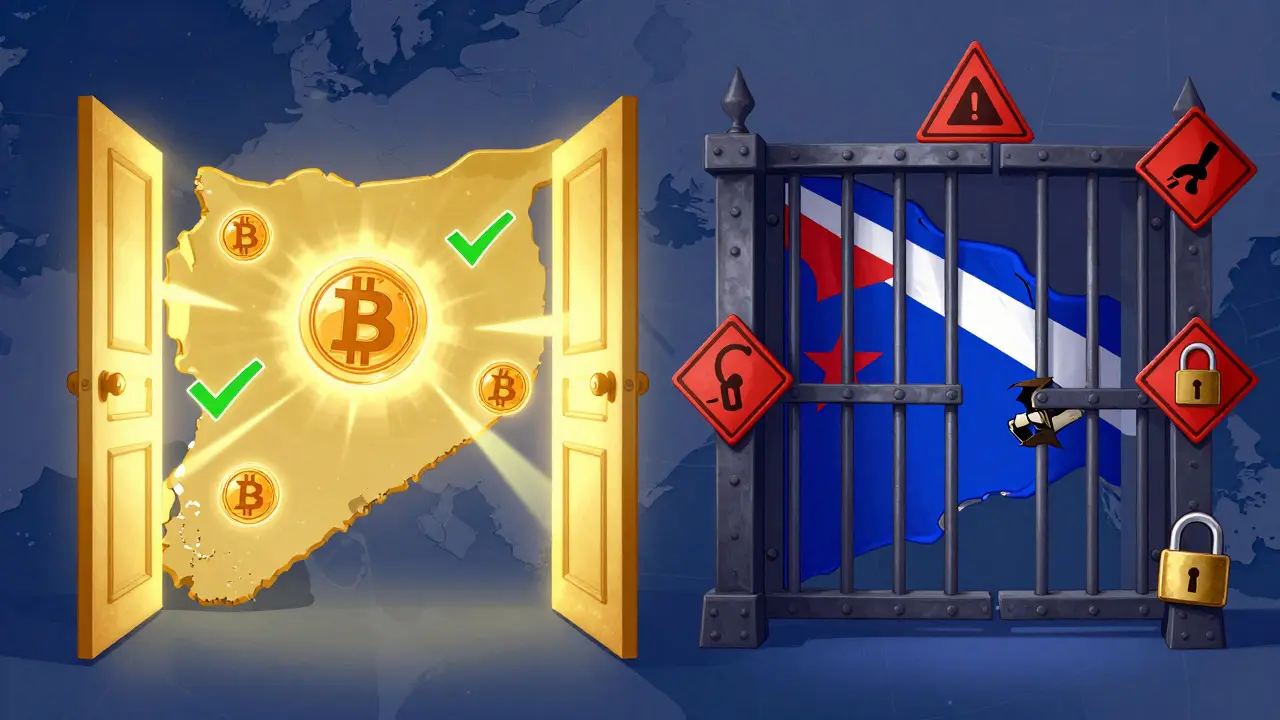
The rules of the game changed fast for anyone doing business with Syria and a country facing long-standing U.S. economic pressure. If you’ve been watching the headlines, you know that 2025 brought a massive split in how Washington treats these two nations. For Syria, the door swung wide open after years of being shut tight. For Cuba, it slammed even harder. This isn’t just political drama; it’s a direct hit to your ability to move money, invest, or use cryptocurrency as digital assets used for transactions and investment across borders.
I’m writing this from Bristol, where we see a lot of global finance discussions, but the reality on the ground is starkly different depending on which side of the Atlantic Ocean you’re looking at. The core problem? Confusion. You might think lifting sanctions means you can freely send Bitcoin to Damascus. You’d be wrong. And if you thought Cuba was getting easier to reach, you’re doubly wrong. Let’s cut through the noise and look at what actually works right now.
The Syria Reset: What Actually Changed in July 2025?
On June 30, 2025, President Trump signed Executive Order 14312 as a legal directive revoking previous sanctions on Syria. It went live on July 1, 2025. This wasn’t a small tweak. It wiped out six executive orders dating back to 2004. That’s two decades of comprehensive embargo gone in a single day.
Here’s the practical impact for you:
- Banking Unlocked: The Office of Foreign Assets Control (OFAC) removed Syrian financial institutions from the Specially Designated Nationals (SDN) List. This includes the Central Bank of Syria. U.S. banks can now open correspondent accounts with them. No more needing special licenses for basic banking services.
- Investment Green Light: You can now make new investments in Syria. Exporting services is legal again. Business involving the current Syrian government is no longer automatically prohibited.
- Crypto Accessibility: Major exchanges like Binance updated their compliance filters. Users reported smoother access to Syrian markets because the automated blocks based on IP addresses and broad sanctions lists were lifted.
But don’t pop the champagne yet. The relief is broad, not total. The government kept targeted sanctions on specific people. The Assad family, former officials from the old regime, and anyone involved in the illicit captagon drug trade are still banned. If your transaction touches these names, it’s dead on arrival.
Cuba: The Door Slams Shut
While Syria got a fresh start, Cuba got a boot to the head. The administration issued National Security Presidential Memorandum 5 (NSPM-5). This reversed any softening moves made by the previous administration and returned to a hardline stance.
The Cuba Assets Control Regime (CACR) as the set of U.S. regulations governing dealings with Cuba is fully intact and enforced more aggressively than before. Here’s why this matters for your wallet:
In July 2025, a company called Key Holding, LLC, paid $608,825 in penalties. They didn’t do anything malicious. Their subsidiary just managed logistics for 36 freight shipments from Colombia to Cuba. That’s it. But because they are a U.S.-linked entity, they violated the CACR. The message is clear: even accidental or minor violations carry heavy fines.
If you’re trying to send crypto to Cuba, you’re swimming against a tidal wave. Exchanges are tightening KYC (Know Your Customer) checks. Any hint of Cuban IP addresses or beneficiary details triggers immediate freezes. Unlike Syria, there is no "gray area" here. The path is blocked.

Crypto in Syria: Navigating the Legal Gray Zone
This is where things get tricky. Just because U.S. sanctions are lifted doesn’t mean Syria has a clear law book for digital assets. As of 2026, Syria has no specific laws that permit or forbid Bitcoin as the most widely recognized cryptocurrency or other tokens. It’s officially undefined.
So, how does it work? It runs on existing Anti-Money Laundering (AML) and Combating the Financing of Terrorism (CFT) frameworks. When you try to move money, banks look at the risk. Because the legal status is vague, many international banks still treat Syrian transactions with extreme caution. You might face delays or rejections simply because the bank doesn’t want to guess.
However, tech companies are stepping in. Firms like Lightspark have built infrastructure using the Lightning Network to settle cross-border fiat transfers. This allows businesses to move value without holding crypto directly, reducing exposure while bypassing traditional banking friction. It’s a workaround, but it’s working for some.
Comparison: Syria vs. Cuba Sanctions Landscape
| Feature | Syria | Cuba |
|---|---|---|
| U.S. Sanctions Status | Lifted (Broad) | Strengthened (Hardline) |
| Key Legal Change | Exec Order 14312 (July 2025) | NSPM-5 (2025) |
| Banking Access | Open (Correspondent accounts allowed) | Blocked (Strict enforcement) |
| Crypto Legal Status | Undefined / Gray Area | High Risk / Restricted |
| Exchange Access | Improved (e.g., Binance) | Deteriorating (Strict KYC) |
| Targeted Bans | Assad Family, Drug Traffickers | All Government Entities, Broad Scope |

How to Stay Compliant: A Practical Checklist
You can’t afford to guess. The penalty for error is frozen assets or hefty fines. Here is what you need to do before sending a single satoshi or dollar.
- Check the SDN List Daily: Even though Syria’s broad list was cleared, individuals remain. Use the official OFAC search tool every time you onboard a new partner.
- Enhanced Due Diligence (EDD): For Syria, standard checks aren’t enough. Verify the source of funds. Ensure no links to the captagon trade or former Assad regime officials.
- Avoid Cuba Completely: Unless you have a specific license from OFAC (which is rare), do not engage. The risk-to-reward ratio is terrible. The Key Holding case proves that even logistical support is penalized.
- Use Specialized Infrastructure: If dealing with Syria, consider partners who use regulated settlement layers like Lightning Network solutions that minimize direct crypto exposure.
- Document Everything: Keep records of your compliance checks. If a regulator asks why you sent money to Damascus, show them your due diligence trail.
What About Other Regions?
It’s worth noting that this shift isn’t isolated. Iran remains under "maximum pressure" via NSPM-2. Recent actions target oil smuggling networks disguised as Iraqi exports. Russia faces extended EU and U.S. packages. The pattern is clear: the U.S. is selectively relaxing ties where strategic interests align (like stabilizing Syria post-conflict) while doubling down on adversaries (Cuba, Iran, Russia).
For crypto users, this means regulatory arbitrage opportunities exist, but they come with high operational risk. Always assume that compliance teams at major exchanges will err on the side of caution. If a transaction looks even slightly risky, it will be rejected.
Can I legally send Bitcoin to Syria in 2026?
Yes, broadly speaking. With the lifting of U.S. sanctions via Executive Order 14312, there is no federal ban on sending crypto to Syria. However, Syria itself has no specific crypto laws, so you must ensure your recipient is not on the remaining targeted sanctions list (e.g., Assad family members or drug traffickers). Always perform enhanced due diligence.
Is it safe to do business with Cuba using cryptocurrency?
No. It is highly risky. The U.S. has strengthened its stance on Cuba with NSPM-5. The Cuba Assets Control Regime (CACR) strictly prohibits most transactions. Even minor logistical support can result in significant fines, as seen in the Key Holding LLC case. Avoid all unlicensed dealings.
Who is still sanctioned in Syria after July 2025?
While broad sanctions were lifted, targeted sanctions remain on the Assad family, former officials of the Assad regime, individuals involved in the illicit captagon trade, and those committing serious human rights abuses. You must check the OFAC SDN list for these specific entities.
Why did Binance allow Syrian users after 2025?
Binance and other major exchanges update their compliance algorithms based on U.S. Treasury directives. Once Executive Order 14312 revoked the broad national emergency designation for Syria, the automatic IP-based bans were removed, allowing users to register and trade, provided they pass individual identity checks.
What is the Lightning Network role in Syrian payments?
Companies like Lightspark use the Lightning Network as a settlement layer to facilitate cross-border fiat transfers. This allows businesses to move value quickly without holding volatile crypto assets directly, helping to navigate the regulatory ambiguity and banking friction in markets like Syria.