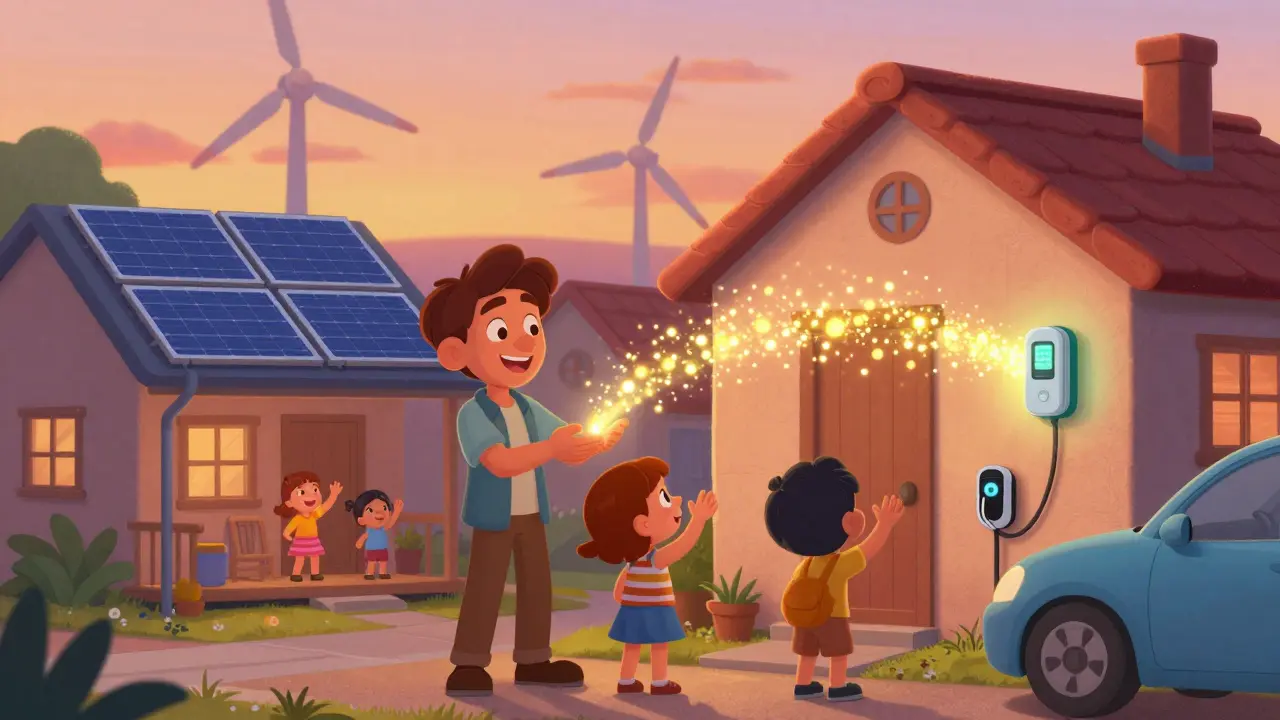
Imagine your neighbor sells excess solar power directly to you-no utility company, no middleman, no complicated bills. Just a simple, secure digital transaction recorded on a blockchain. This isn’t science fiction. It’s happening right now in neighborhoods across Europe, the U.S., and beyond. Blockchain is quietly rewriting how energy moves, who controls it, and how we pay for it.
What Blockchain Actually Does in Energy Markets
At its core, blockchain is a digital ledger that records transactions in a way that’s transparent, permanent, and doesn’t need a central authority to verify them. In energy markets, that means every kilowatt-hour produced, consumed, or traded gets logged on a shared, tamper-proof system. No more guesswork about where your electricity came from. No more manual tracking of renewable energy credits. No more delays in payments because of bureaucratic back-and-forth.
Instead of your local utility being the only gatekeeper, households with solar panels, wind turbines, or even battery storage can become energy suppliers. Smart meters connected to the blockchain track exactly how much energy you use and how much you send back to the grid. When your panels produce more than you need, that surplus becomes a digital asset. A smart contract-a self-executing piece of code-automatically matches you with a buyer nearby, processes the payment in real time, and updates the ledger. All of this happens in seconds, without any human intervention.
How Peer-to-Peer Energy Trading Works
Traditional energy systems are top-down: power plants → transmission lines → utilities → consumers. Blockchain flips that model. In a peer-to-peer (P2P) energy market, neighbors trade directly. A family in Bristol with rooftop solar might sell 5 kWh to another household across the street at 11 a.m. on a sunny Tuesday. The price? Set by supply and demand, not a fixed utility rate.
Platforms like PowerLedger in Australia and LO3 Energy’s Brooklyn Microgrid in the U.S. already run these systems. In Germany, over 12,000 households are part of community energy networks using blockchain to trade solar power. These aren’t pilot projects anymore-they’re live, scaling operations. The key? Trust. Because every transaction is recorded on the blockchain, no one can cheat the system. You can’t fake your solar production. You can’t claim energy you didn’t generate. The data is immutable.
Smart Contracts: The Automatic Middlemen
Forget calling your utility to set up a net metering agreement. Smart contracts automate everything. They’re coded rules that trigger actions when certain conditions are met. For example:
- If your solar panels produce more than 3 kWh between 10 a.m. and 2 p.m., and your home battery is full, the contract offers the surplus on the local grid.
- If a nearby home has low battery and high demand, the contract matches the two and sets a price based on real-time market rates.
- Payment is sent instantly in crypto or local currency, and the energy usage is logged.
These contracts run on platforms like Ethereum, which supports programmable transactions. They eliminate the need for billing departments, manual invoicing, and payment delays. In 2025, over 70% of blockchain investments in energy went into developing and auditing these smart contracts-because they’re the engine driving the whole system.
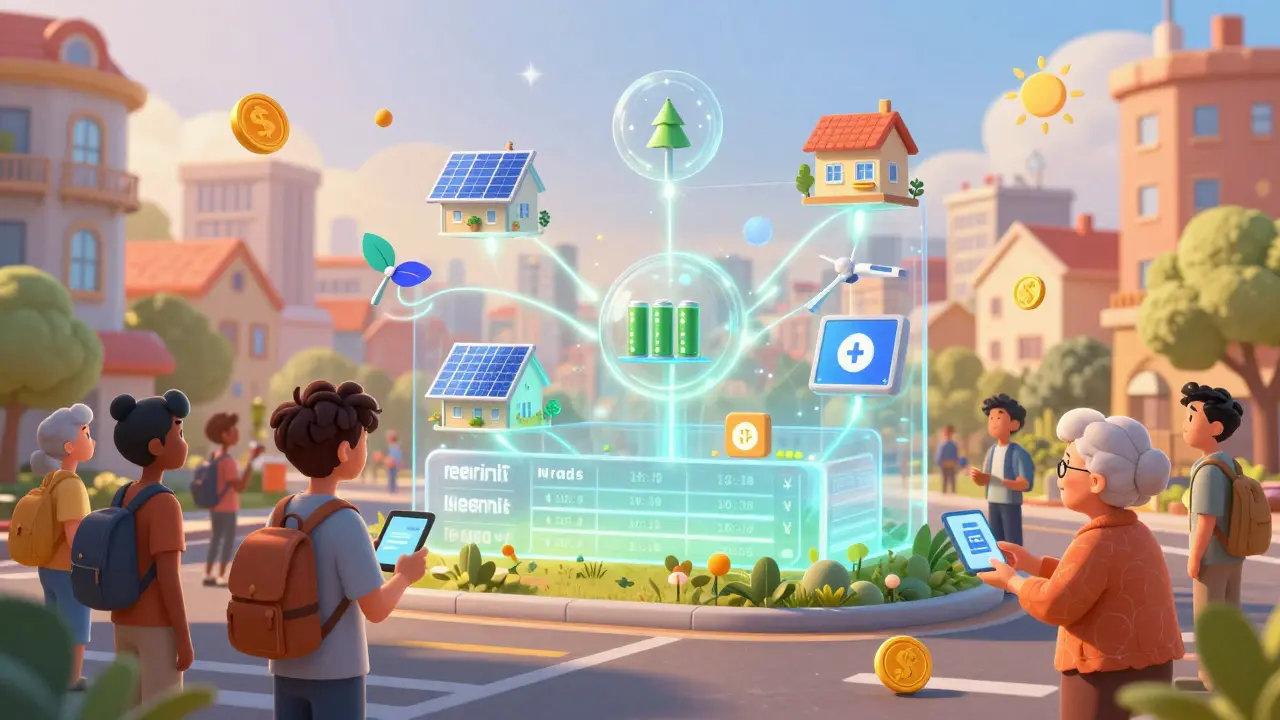
Tracking Renewable Energy with Certificates
Companies like Google and Microsoft promise to run on 100% renewable energy. But how do they prove it? Traditional Renewable Energy Certificates (RECs) are messy. They’re paper-based, easily duplicated, and often double-sold. Blockchain fixes that.
Every time a wind farm generates 1 MWh of electricity, a digital token is created on the blockchain and linked to that exact unit. That token can be sold separately from the physical electricity. When a company buys it, the token is retired-meaning it can’t be reused. This creates a clear, auditable trail from the turbine to the corporate balance sheet.
In 2025, the global REC market hit $28 billion, and blockchain-based systems are growing faster than traditional ones. Countries like Sweden and the Netherlands now require blockchain verification for public-sector renewable energy claims. It’s not just about greenwashing anymore-it’s about accountability.
Carbon Credits, Tokenized and Transparent
Carbon credits are another area where blockchain is making a difference. Farmers who plant trees, startups that capture CO2 from the air, or even communities that protect wetlands can now tokenize their carbon removal efforts. Each ton of CO2 captured becomes a digital asset that companies can buy to offset their emissions.
Before blockchain, carbon markets were plagued by fraud, inflated claims, and lack of verification. Now, sensors, satellite data, and AI inputs feed into smart contracts that validate each credit. A project in Kenya, for example, uses blockchain to track reforestation efforts and issue tokens to local communities who maintain the trees. Those tokens can be sold to international buyers, creating a direct financial incentive for conservation.
Annual growth in blockchain carbon credit systems is hitting 25-30%. That’s not just a trend-it’s a shift in how we value environmental action.
Smart Grids and Real-Time Stability
The power grid was built for one-way flow: big plants → cities. But now, energy flows in every direction. Solar panels on homes, EVs charging at night, batteries discharging during peak hours-all of this creates chaos for traditional grid operators.
Blockchain, combined with IoT sensors and AI, helps stabilize the grid in real time. When demand spikes in one neighborhood, the system automatically taps into nearby battery storage or redirects excess solar from another. These adjustments happen through automated smart contracts that respond to frequency, voltage, and load data-faster than any human operator could.
Utilities in the U.S. and U.K. are testing these systems now. In one pilot in Texas, blockchain helped reduce grid congestion by 22% by dynamically rerouting energy from surplus areas to deficit zones. That means fewer blackouts, lower costs, and better use of renewable resources.
Who’s Using This Right Now?
Adoption isn’t limited to tech startups. Major players are in:
- Residential users: 20% growth in 2025 as households trade solar power. In the U.K., over 150 community energy cooperatives now use blockchain platforms.
- Commercial buildings: Offices and malls with rooftop solar are selling excess power to tenants or nearby businesses, cutting energy bills by up to 30%.
- Industrial sites: Factories with on-site wind or solar use blockchain to track and verify their renewable usage for ESG reporting.
- Utilities: 35% of the blockchain energy market in 2025 was driven by utilities using blockchain to manage distributed energy resources like home batteries and EV chargers.
Europe leads with over 35% of global adoption, thanks to strong regulatory support and high solar penetration. North America follows, with the U.S. and Canada investing heavily in grid modernization projects that include blockchain.
Challenges and Risks
It’s not all smooth sailing. Blockchain energy systems still face hurdles:
- Security: Smart contracts can be hacked if poorly coded. There have been cases where vulnerabilities allowed attackers to drain energy tokens.
- Integration: Many utilities still run on 20-year-old software. Connecting legacy systems to blockchain isn’t easy.
- Regulation: Governments are still catching up. In some places, P2P energy trading is legally gray.
- Scalability: Public blockchains like Ethereum can get slow and expensive during high traffic. Private blockchains are faster but less transparent.
That’s why audits are critical. Every smart contract should be reviewed by independent experts before going live. And most successful projects start small-testing with a single apartment building or a village grid-before scaling up.
The Future: Blockchain as Infrastructure
The blockchain energy market was worth $4.4 billion in 2025. By 2035, it’s projected to hit $142.3 billion. That’s not hype-it’s math. The growth rate of 41.6% per year means this isn’t a niche experiment. It’s becoming the backbone of how energy systems operate.
Soon, you won’t think of blockchain as a “tech feature.” You’ll just think of it as how energy works. Your EV charges when your neighbor’s solar panels are producing. Your home battery sells power during a heatwave. Your company’s carbon footprint is verified in real time. All automated. All transparent. All secure.
And the best part? You don’t need to be a coder or a utility executive to benefit. All it takes is a smart meter, a solar panel, or even just a willingness to buy energy from your neighbor instead of a distant power plant.
Can I really sell my solar power to my neighbor using blockchain?
Yes. In places like Germany, Australia, and parts of the U.S. and U.K., community energy platforms let homeowners with solar panels sell excess power directly to neighbors. Smart contracts handle the pricing, payment, and recording automatically. You don’t need to sign paperwork or wait for a utility to process it. It’s like selling a digital item online-but it’s real energy.
Do I need special equipment to join a blockchain energy market?
You’ll need a smart meter that can communicate digitally and a way to connect to the blockchain platform-usually through a mobile app or web portal. If you have solar panels or a home battery, that’s ideal. But even if you don’t, you can still buy energy from others in the network. Some platforms let you join as a buyer only, with no installation required.
Is blockchain energy trading legal in the UK?
Yes, but it’s still emerging. The UK’s Ofgem regulator has approved pilot projects for peer-to-peer energy trading, and several local councils are supporting community blockchain energy schemes. There’s no law against it, but full national regulation is still being developed. Most current systems operate under regulatory sandboxes, meaning they’re monitored but allowed to test new models.
How is blockchain different from regular energy billing?
Traditional billing is centralized-you pay one company for all your energy, and they decide the price. Blockchain is decentralized: you can buy from anyone, prices change in real time based on supply, and every transaction is recorded permanently. There’s no monthly bill. Payments happen instantly. And you can see exactly where your energy came from-down to the specific solar panel or wind turbine.
What happens if the blockchain goes down?
Most blockchain energy systems use private or hybrid networks that are more stable than public ones like Bitcoin. They’re hosted across multiple servers, so if one goes offline, others keep running. Even if the digital system fails temporarily, the physical grid still works. You’ll still get electricity-just without the automated trading until the system comes back online. It’s designed as a backup layer, not a replacement for the grid.
Are there any cryptocurrencies tied to energy production?
Yes. SolarCoin (SLR) is a cryptocurrency awarded to solar energy producers-1 SLR for every MWh generated. Other tokens like Power Ledger’s POWR and WePower’s WPR are used within their platforms to facilitate trading and access services. These aren’t speculative coins like Bitcoin-they’re utility tokens built to support real energy transactions.


Don Grissett
so like... you're telling me my neighbor can just sell me solar power like it's a tiktok gift? no bills? no utility middlemen? i mean... i believe it but also i'm still waiting for my flying car. still, kinda cool.
Veronica Mead
While the technological architecture presented is undeniably sophisticated, one must not overlook the profound ethical implications of decentralizing energy distribution. The commodification of basic human necessity-electricity-risks exacerbating socioeconomic disparities under the guise of innovation.
Mollie Williams
It’s funny how we call it ‘blockchain energy’ like it’s a new thing, when really it’s just the old idea of community sharing-except now it’s encrypted and has a ledger. We’ve always traded surplus. Now we’re just giving it a fancy name and a digital signature. Makes me wonder: are we making energy more human… or just more transactional?
Surendra Chopde
Interesting concept. In India, we have solar microgrids in villages, but no blockchain yet. The real challenge isn’t tech-it’s access. Who pays for smart meters? Who trains elders to use apps? Tech is great, but it must serve people, not the other way around.
Tiffani Frey
Smart contracts are brilliant-but only if they’re audited. I’ve seen too many ‘decentralized’ systems fail because devs assumed the code was flawless. Always verify. Always test. Always assume someone’s trying to exploit it.
kris serafin
bro this is the future 😎 i just got solar panels last month and i’m already looking into powerledger. imagine waking up and your battery just sold 2kwh to the house next door while you slept. that’s magic.
Jordan Leon
Blockchain enables transparency. But transparency without equity is just surveillance with better UI. Who owns the data? Who controls the nodes? Who gets paid when the system scales? These aren’t technical questions-they’re political.
Rahul Sharma
Very good explanation. In India, we have many solar cooperatives. If blockchain can reduce fraud in REC trading, it will be very helpful. But internet access is still unreliable in rural areas. Technology must be simple and offline-capable to work.
Valencia Adell
Oh great. Another ‘blockchain fixes everything’ fantasy. Let me guess-next you’ll say NFTs will solve climate change? This is vaporware dressed up as progress. The grid doesn’t need crypto. It needs investment. And regulation. And engineers. Not a blockchain.
Sarbjit Nahl
Blockchain is just a glorified spreadsheet. The real innovation is smart meters. The rest is theater. You don’t need decentralization to trade energy. You need a better grid. And more nuclear.
Paul Johnson
so you mean i can sell my solar power to my neighbor without the utility stealing my profits?? i mean... i guess that sounds good but also i dont trust tech and also why would my neighbor pay me more than the utility pays??
Meenakshi Singh
Blockchain carbon credits? Lol. You think a sensor on a tree in Kenya proves it’s sequestering carbon? That’s greenwashing with blockchain glitter. The math doesn’t add up. And don’t get me started on the energy cost of mining crypto for this.
Kelley Ramsey
This is so exciting!! I’ve been dreaming of this since I installed my panels last year. Imagine neighbors helping each other during heatwaves-no more blackouts, just shared sunshine. We can do this!!
Krista Hoefle
Blockchain energy? Cute. Next you’ll say we’ll all drive teslas powered by unicorn tears. It’s not scalable. It’s not cheap. And honestly? I’d rather just pay my utility bill and not think about it.
Emily Hipps
Hey everyone-this isn’t just tech. It’s community. I joined a P2P group in Portland last year. My grandma’s house now buys power from the kid down the street who’s in college. They text each other ‘thanks for the juice!’ It’s beautiful. You don’t need to be a coder to be part of this.
Jessie X
It’s a start. I’m not sold on crypto but I like the idea of knowing where my power comes from. If it helps cut waste and gives people agency? I’m all for it. Let’s keep it simple though.
Kip Metcalf
my neighbor’s got solar and i’m jealous. why can’t i just buy some of his extra? this sounds like the answer. i’m in. sign me up.
Frank Heili
Real talk: the biggest barrier isn’t tech-it’s regulation. Utilities have lobbyists. Laws haven’t caught up. Until states legalize P2P trading without red tape, this stays niche. But the tech? It’s ready. The system just needs to catch up.
Natalie Kershaw
Y’all are underestimating the power of microgrids + blockchain. This isn’t just about energy-it’s about resilience. When storms hit, these systems keep lights on. When inflation hits, you’re not at the mercy of rate hikes. This is infrastructure for the 21st century. Let’s build it right.
Jacob Clark
Okay, but what if my neighbor is a jerk? What if he raises the price during a heatwave? What if he’s a crypto bro who only wants to flip tokens? This system rewards greed, not community. I’ve seen it happen. It’s not utopia-it’s capitalism with a blockchain filter.
Jon Martín
Imagine a world where your energy choices reflect your values. You buy from a wind farm owned by a local co-op. You help fund reforestation by buying carbon tokens. Your EV charges when the sun’s out. This isn’t just efficient-it’s meaningful. We’re not just using power. We’re shaping a better world. One transaction at a time.
Mujibur Rahman
Blockchains for energy trading are the future but only if integrated with legacy grid infrastructure. We need hybrid models-not full decentralization. Also, the energy cost of consensus mechanisms is still too high. Proof-of-stake is better but still needs optimization. We need engineers, not evangelists.
Don Grissett
wait so if i sell power to my neighbor and he doesn’t pay? does the blockchain just… freeze his fridge? 😂