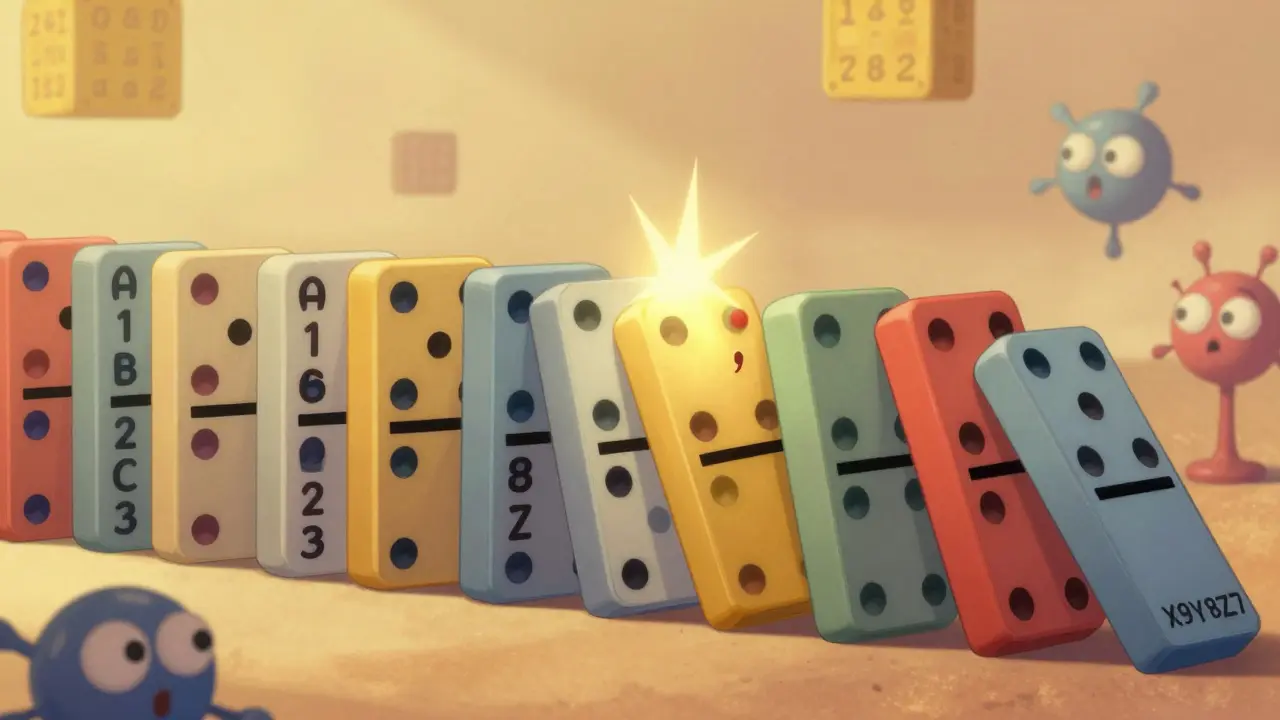
When you hear that blockchain is "immutable," what does that really mean? It doesn’t just mean "hard to change." It means impossible to change - not because someone locked it away, but because of how it’s built. Once a transaction is added to a blockchain, altering it would require rewriting history across thousands of computers at once. That’s not a feature you turn on with a switch. It’s the result of three tightly linked technical systems working together: cryptographic hashing, block chaining, and consensus protocols.
Cryptographic Hashing: The Digital Fingerprint
Every piece of data on a blockchain - whether it’s a Bitcoin transfer or a medical record - gets turned into a unique string of letters and numbers called a hash. This isn’t just a summary. It’s a fingerprint. Use the SHA-256 algorithm (used by Bitcoin), and even a tiny change - like swapping a comma for a period - creates a completely different hash. If you try to change a transaction from "Alice sent Bob $10" to "Alice sent Bob $100," the hash of that block changes. And since every block includes the hash of the one before it, that one change breaks the entire chain.Think of it like a row of dominoes, each painted with a unique color. If you repaint one domino, the color pattern that follows it no longer matches. The system knows something’s wrong because the sequence is broken. That’s what happens when someone tries to tamper with a block. The hash mismatch alerts every node on the network: "This block doesn’t belong here."
Block Chaining: The Chain That Can’t Be Broken
A blockchain isn’t just a list of transactions. It’s a chain. Each block contains:- The transactions it records
- A timestamp
- The hash of the previous block
That last part - the previous block’s hash - is the glue. It creates a direct, unbreakable link from one block to the next. If you change data in Block 5, its hash changes. That means Block 6’s reference to Block 5’s hash is now wrong. So you’d have to change Block 6’s hash too. But then Block 7’s reference to Block 6 is broken. And so on - all the way to the latest block. To successfully alter one transaction, you’d need to recalculate and replace every single block after it. And that’s not just hard. It’s computationally impossible on a live, growing network.
Plus, every block is timestamped. That means not only do you have to rewrite the data, you have to fake the timeline. The network doesn’t just check if the hashes match - it checks if the order makes sense. A block from 2024 can’t appear after one from 2026. Chronology is enforced by code, not by trust.
Consensus Mechanisms: The Network That Says "No"
Here’s the kicker: no single person controls the blockchain. Thousands of computers - called nodes - all hold copies of the entire ledger. When a new block is created, it doesn’t get added automatically. It has to be approved by the network. That’s where consensus mechanisms come in.Proof of Work (PoW), used by Bitcoin, makes nodes compete to solve a complex math puzzle. The first one to solve it gets to add the block. Others verify the solution. It takes massive computing power to solve the puzzle - and even more to redo it for every block after a change. The energy cost alone makes tampering uneconomical. A 2023 study by Cambridge University found that Bitcoin’s network uses more electricity than most countries - not because it’s wasteful, but because that’s the price of security.
Proof of Stake (PoS), used by Ethereum since 2022, works differently. Instead of solving puzzles, validators are chosen based on how much cryptocurrency they "stake" as collateral. If they try to cheat - say, approve a fake transaction - they lose their staked coins. The financial penalty is immediate and severe. The system doesn’t rely on brute force. It relies on self-interest. Why risk losing thousands of dollars to change one block? The math doesn’t add up.
Either way, the network doesn’t accept a change unless over 51% of nodes agree. That’s called the 51% rule. To alter history, you’d need to control more than half the network’s computing power (in PoW) or stake (in PoS). For Bitcoin, that would mean owning more than $100 billion worth of mining equipment. For Ethereum, it would mean locking up over $30 billion in ETH. That’s not a hack. That’s a national-level attack.

Why This Matters Beyond Cryptocurrency
Immutability isn’t just about money. It’s about trust without middlemen. Imagine a supply chain where every shipment - from coffee beans to vaccines - is recorded on a blockchain. If a package is delayed, you can trace exactly where it stopped. If someone tries to fake a delivery receipt, the hash mismatch shows up instantly. No more forged invoices. No more lost records. No more "I didn’t sign that."Hospitals use blockchain to store patient records. Once a diagnosis is added, it can’t be erased - even by accident. That protects both patients and providers. Land registries in Sweden and Georgia use blockchain to prevent fraudulent property transfers. In each case, immutability means the record is forever verifiable.
But here’s the trade-off: if you can’t change data, you can’t fix mistakes. What if you accidentally send ETH to the wrong wallet? Or a bug in a smart contract drains funds? The blockchain won’t undo it. That’s why many systems now use off-chain solutions - like legal arbitration or insurance - to handle errors. The ledger stays immutable. The resolution happens outside it.
What Happens When the Rules Change?
You might wonder: if blockchain is so unchangeable, how do upgrades happen? Ethereum didn’t just switch from PoW to PoS overnight. It required a coordinated hard fork - a deliberate split in the blockchain where everyone agreed to follow new rules. That’s not tampering. That’s evolution. But it’s rare. And it only works because the community agrees. No one can force a change. Not even the creators.That’s the beauty of it. Immutability doesn’t mean rigidity. It means authority is distributed. No CEO. No government. No central server. Just code, consensus, and cryptography. The system doesn’t trust people. It trusts math.

Real-World Limits
Immutability isn’t magic. It has limits. If a private key is stolen, the attacker can spend the coins - and that transaction will be permanent. If a smart contract has a flaw, the money is gone. Blockchain doesn’t prevent human error. It just records it forever.Also, not all blockchains are equally immutable. Private blockchains used by corporations often allow administrators to edit records. Those aren’t true blockchains. They’re just databases with a fancy name. True immutability only exists where no one has control - where trust is built into the structure, not granted by a person.
Final Thought: Why Immutability Endures
We don’t need blockchain because we’re bad at keeping records. We need it because we can’t trust the people who keep them. Banks get hacked. Governments alter archives. Corporations delete logs. Blockchain doesn’t promise perfection. It promises verification. If something happened, the record says so. And no one - not even the person who made it - can erase that.Can blockchain data ever be changed?
Technically, yes - but only if you control more than half the network’s power or stake, which is extremely expensive and unlikely. In practice, once data is confirmed across multiple blocks, changing it is computationally and economically impossible. That’s why blockchain is called immutable.
Does immutability mean blockchain can’t be updated?
No. Updates happen through consensus-driven upgrades called hard forks. These are planned changes where the entire network agrees to adopt new rules. It’s not editing old data - it’s creating a new version of the blockchain. The old chain still exists unchanged.
How does hashing prevent tampering?
Every block’s hash is generated from its content and the hash of the previous block. Change even one character in a transaction, and the entire block’s hash changes. That breaks the link to the next block. Since every node checks these links, any mismatch is instantly flagged as invalid.
Is Proof of Work the only way to achieve immutability?
No. Proof of Stake achieves immutability through economic incentives instead of computational power. Validators risk losing their staked coins if they act dishonestly. Ethereum switched to PoS in 2022 and still maintains full immutability - just with far less energy use.
Why can’t we just delete bad data from a blockchain?
Because deleting data breaks the chain. Each block depends on the one before it. If you remove a transaction, you’d need to recalculate every single hash after it - and get every node on the network to accept your version. Since no one controls the network, that’s impossible without overwhelming consensus - which defeats the purpose of decentralization.






Sahithi Reddy
Immutable doesn't mean unbreakable it means expensive to break
That's the whole point
Cost > reward
Simple as that
George Hutchings
I love how this breaks down the tech without jargon
Most people think blockchain = crypto
But this is about trust infrastructure
Like a digital notary that never sleeps
Henrique Lyma
Look I get the theory but let's be real
Everyone knows the 51% attack is theoretically possible
And if you're a nation state with unlimited resources
Why would you bother mining when you can just rewrite history
It's not a feature it's a gamble on economics
And let's not pretend PoS is somehow more secure
It's just a different flavor of centralization
Steph Andrews
I appreciate how you mentioned the tradeoff
Like yeah immutability is cool
But what if you send funds to the wrong address
Or a bug wipes out someone's life savings
There's no human layer to fix mistakes
That's scary when you think about it
Prakash Patel
Interesting take
But what about private blockchains
They're used everywhere in enterprise
And they can edit records
So is it really blockchain or just a buzzword salad
Elizabeth Kurtz
This is actually one of the clearest explanations I've seen
Hashing + chaining + consensus
Three pillars holding up the whole thing
And the part about timestamps enforcing chronology
That's genius
It's not just about data it's about time
john peter
The notion that math replaces trust is a delusion
Math is a tool
It does not possess morality
Or judgment
Or mercy
And when you place absolute faith in an algorithm
You create a new kind of tyranny
One that cannot be reasoned with
One that cannot be appealed
One that simply executes
And calls it justice
Marc Morgan
So let me get this straight
You're telling me the entire security model of Bitcoin boils down to 'it's too expensive to break'
Like a bank vault that's locked with a golden padlock
And the key costs a billion dollars
That's not security
That's a very expensive inconvenience
And I'm supposed to trust this because why
sai nikhil
I think the real power of blockchain isn't in the tech
It's in the cultural shift
It says: we don't need you to be trustworthy
We just need the system to be
That's revolutionary
Even if the tech is imperfect
Zachary N
I want to expand on the off-chain resolution point
Because this is where real-world systems are evolving
Smart contracts can't be undone
But insurance protocols can reimburse
Legal frameworks can recognize chain data as evidence
And arbitration services can adjudicate based on immutable records
The blockchain doesn't fix human error
It just gives you a perfect audit trail to fix it
That's the secret sauce
Not immutability alone
But immutability + external governance
That combo is what makes it usable in finance healthcare and supply chains
Anastasia Thyroff
I'm just sitting here
Thinking about how this whole thing
Is basically a digital version of a tattoo
Once you put it on
It's forever
Even if you regret it
Even if you were drunk
Even if the artist messed up
You're stuck with it
And somehow that's supposed to be a feature
Not a bug
Kira Dreamland
I love how this ties into real use cases
Like land registries in Georgia
Or vaccine supply chains
It's not about Bitcoin
It's about giving people who've been burned by corruption
A way to prove what happened
Without begging a bureaucrat
Or trusting a lawyer
Just let the chain speak
shreya gupta
You say blockchain is immutable
But what about the 2016 DAO hack
And the Ethereum hard fork that reversed it
That was a blockchain changing its own history
So is it immutable or just obedient to majority rule
Because that's not immutability
That's democracy with code
Derek Lynch
The fact that you even have to explain this
Is proof that people are still confused
And that's dangerous
Because if you think blockchain is magic
You'll trust it with your life savings
And when it fails
You'll blame the system
Not yourself
For not understanding that this is just math
And math doesn't care if you're poor
Or sick
Or lied to
It just does what it's told
So learn the code
Or get left behind