
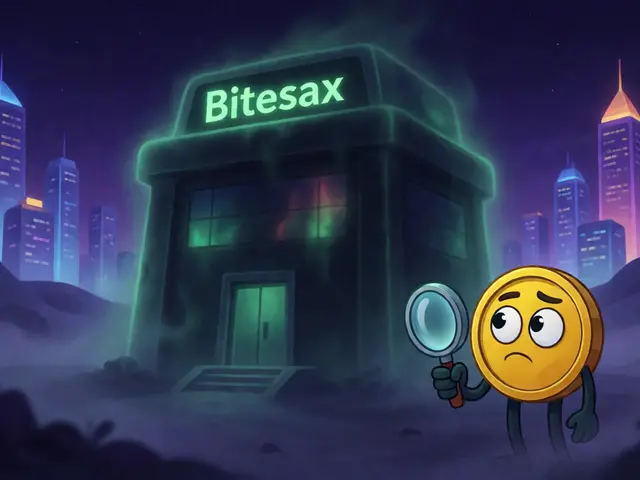
Imagine finding a shiny new tool that promises to make your trading faster and cheaper, but when you open the door, the room is completely empty. That is essentially the experience of using DoveSwap v3 is an automated liquidity protocol operating as a decentralized exchange (DEX) built on the Polygon zkEVM blockchain. Launched back in 2023, it tries to implement the high-efficiency models used by the giants of the industry, but it lacks the one thing every trader actually needs: people.
| Metric | Value / Status |
|---|---|
| Blockchain Network | Polygon zkEVM |
| Daily Trading Volume | Approx. $800 - $2,700 |
| Available Trading Pairs | 5 Pairs |
| Security Audits | None documented |
| Primary Asset Pair | USDC/WETH |
The Tech Under the Hood
To understand how DoveSwap v3 works, you have to look at its engine. It uses a Constant Product Formula is a mathematical algorithm (x * y = k) that ensures a trade can always be executed regardless of the size, though the price shifts as the pool reserves change. This is the standard for most automated market makers (AMMs). However, DoveSwap v3 attempts to level up by using Concentrated Liquidity is a mechanism that allows liquidity providers to allocate their capital to specific price ranges, increasing capital efficiency.
By focusing liquidity into narrow price bands, the platform theoretically reduces slippage and helps those providing the funds earn more in fees. But here is the catch: this only works if there are enough traders moving the price through those bands. On DoveSwap v3, the activity is so low that these advanced features are mostly theoretical. Most of the action happens in the USDC/WETH pair, which often accounts for over 66% of the entire platform's volume.
Trading Experience and Practicality
If you decide to try this out, you can't just log in with an email. You need a Web3 wallet like MetaMask is a widely used cryptocurrency wallet that allows users to interact with the Ethereum blockchain and other compatible networks. You'll also need to configure the Polygon zkEVM is a Layer 2 scaling solution that uses zero-knowledge proofs to provide Ethereum-compatible transactions with lower costs network and hold some MATIC tokens to pay for gas fees.
Once you're in, the interface feels familiar-very similar to the v3 versions of bigger exchanges. You can swap tokens or become a liquidity provider by depositing equal values of two ERC-20 tokens. But be careful. Because the liquidity is incredibly shallow, a trade of even $50 could cause a massive price swing. This is known as high slippage, and it can eat your profits before you've even made the trade.

The Red Flags: Security and Trust
In the world of DeFi, code is law. If the code has a hole, your money vanishes. The most alarming part of DoveSwap v3 is the total lack of security audits. Most reputable projects hire third-party firms to scan their smart contracts for vulnerabilities. DoveSwap v3 hasn't done this. When you combine unaudited code with a tiny user base, you're essentially gambling that the developers didn't make a critical mistake (or leave a "backdoor" for themselves).
While the platform promises censorship resistance and decentralization, those benefits don't mean much if the protocol itself is unstable. Industry analysts typically view any DEX with less than $10,000 in daily volume and no audits as a high-risk environment. It's a place for developers to experiment with new code, not for a regular person to store their life savings.
DoveSwap v3 vs. The Giants
To put the scale of DoveSwap v3 into perspective, let's look at the competition. While DoveSwap is struggling to hit $3,000 in daily volume, giants like Uniswap is the largest decentralized exchange by volume and total value locked, operating primarily on Ethereum and PancakeSwap is a leading DEX on the BNB Smart Chain known for high liquidity and a wide variety of tokens process billions of dollars every single day.
The only real "advantage" DoveSwap v3 has is its presence on Polygon zkEVM, which means transactions are faster and cheaper than on the Ethereum mainnet. However, there are other, more established platforms on the same network that offer better liquidity and proven security. DoveSwap v3 doesn't offer margin trading or any native token for fee discounts, leaving it with very few reasons for a user to choose it over a more stable alternative.

Who is this platform actually for?
Is DoveSwap v3 a total failure? Not necessarily, but it's not for everyone. If you are a blockchain developer who wants to see how concentrated liquidity behaves on a zk-rollup network with zero risk to your main portfolio, it's an interesting sandbox. You can play with the settings and see how the constant product formula reacts to small trades.
For anyone else-retail traders, long-term investors, or people looking for a safe place to swap a few hundred dollars-it's a hard pass. The risks far outweigh the rewards. Between the lack of audits, the ghost-town volume, and the high slippage, there is simply no logical reason to use this exchange when safer, deeper pools are available just a few clicks away.
Is DoveSwap v3 safe to use?
Generally, no. The platform has no documented security audits, which is a major red flag in DeFi. Combined with extremely low trading volume, the risk of bugs or liquidity issues is very high.
What blockchain does DoveSwap v3 run on?
It operates exclusively on the Polygon zkEVM network, which is a Layer 2 solution designed to make Ethereum transactions faster and cheaper.
How do I use DoveSwap v3?
You need a Web3 wallet like MetaMask configured for the Polygon zkEVM network and a small amount of MATIC for gas fees to connect to the interface and trade.
What is the best trading pair on the platform?
The USDC/WETH pair is the most active, usually representing the majority of the exchange's daily volume, though it still suffers from low liquidity.
Does DoveSwap v3 have its own token?
Based on current data, the platform does not implement a native token for fee discounts or governance, unlike many other popular DEXs.
Next Steps and Troubleshooting
If you've already put funds into DoveSwap v3 and are worried, your best bet is to withdraw your liquidity and swap your assets back to a more stable chain or a larger exchange immediately. Because the volume is so low, try doing this in small batches to avoid massive slippage that could cost you a percentage of your principal.
If you are experiencing transaction failures, check your MATIC balance first. Since this is on Polygon zkEVM, you cannot use ETH for gas. If the transaction is "stuck," it is likely due to the low activity and potential network congestion on the zkEVM side-wait a few minutes and try increasing your gas limit in MetaMask.





Keith Garcia
What a quaint little tragedy in the making 🙄 The audacity to launch a DEX without so much as a cursory audit is simply breathtaking in its incompetence. It's a veritable wasteland of liquidity where hope goes to die in a flurry of slippage and broken promises. One must truly admire the sheer, unadulterated gall required to invite users into such a financial abattoir. It's a masterclass in how to fail with absolute confidence 💅✨
Benjamin Forg
its all a setup man the zkEVM is just a layer to hide the money trails anyway they probably have the keys to the vault in some offshore server just waiting for the right moment to pull the plug on everyone
Doc Coyle
People need to stop looking for shortcuts. If there is no audit, there is no safety. It's that simple. Most of you just want a magic button to make money and ignore the basics of risk management.
Eric Raines
Actually, the real issue here isn't just the audit, it's that nobody understands how concentrated liquidity works on these smaller chains. I've seen this a million times where people think they'll make a killing on fees but they just get impermanent loss because the volume is non-existent. It's basically a ghost town pretending to be a city.
Alex Hunter
It's a tough lesson for some, but these gaps in security are where we learn the most. For anyone new to the space, always check for those third-party audits and liquidity depths before committing funds. It's better to miss a small opportunity than to lose your principal to a bug. Stay safe out there.
Paige Raulerson
Honestly, who even cares about the tech at this point. It's just another copy-paste project that failed because the devs were too lazy to actually market it. Typical.
Hannah Rubia
I would strongly advise all users to exercise extreme caution and prioritize the preservation of their capital by utilizing platforms with verified security credentials.
Tara Aman
Totally agree with the caution here but let's keep the energy positive for the devs who are actually trying to innovate even if they missed a few steps!
Kyle Bush
LMAO imagine using a DEX that isn't backed by US-based tech 🇺🇸 This is why you stick to the winners and not some random scrap of code 🤡💸
Candace Sherrard
There is something profoundly melancholic about these digital ghost towns, these architectural ruins of the blockchain era where the code continues to execute the laws of a dead economy while the creators have long since vanished into the void of the next hype cycle. We build these intricate systems of concentrated liquidity and mathematical certainty, yet we forget that the only true variable that matters is human trust, which is far more volatile than any token pair on a Layer 2 network. In the end, the silence of a DEX with no volume is a reflection of our own collective obsession with novelty over stability. We are merely wandering through a gallery of failed experiments, hoping to find a spark of something real amidst the noise of a thousand identical clones. It makes one wonder if the decentralization we crave is actually just a longing for a world where we don't have to trust anyone, yet we end up trusting the most anonymous entities of all. The tragedy isn't the loss of funds, but the loss of a vision that promised us freedom from the middleman only to replace him with a buggy smart contract. Perhaps the only real value here is the lesson in humility for those who thought they could beat the market with a few clicks of a mouse in a room that was always empty. It's a digital memento mori for the DeFi age.
Charlie Queen
Wow, some of the vibes in here are a bit harsh! 🌸 Let's just be glad we have the info now so we can make smart choices together 🌈✨
debashish sahu
The lack of audits is a serious concern for anyone considering this platform.
Ellie Drews
Just take a deep breath and move your funds if you're stressed, it's all manageable
Mike Word
It is interesting to see the transition to zkEVM for these smaller protocols even if the execution here was lacking
Matthew Morse
too much text for a project that basically doesnt exist lol
Sarah Ingrams
hope everyone gets their money out safely
Jennifer L
Oh my goodness I am just so worried for people who mighht have lost thier savings here!! This is truly devasating news for the community