
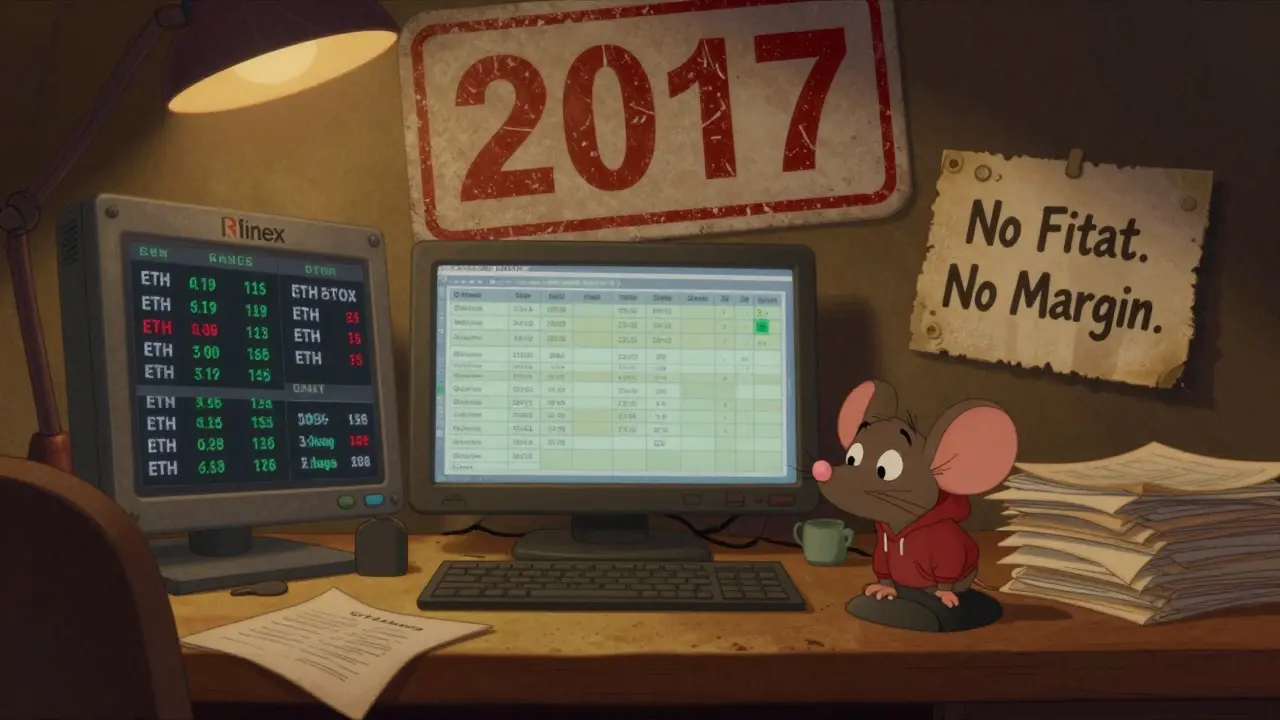
When you're looking for a crypto exchange that doesn't play by the rules of the big players, Rfinex might catch your eye. It’s not Binance. It’s not Coinbase. It doesn’t let you deposit dollars or euros. You can’t trade Bitcoin for USDT. You can’t even use margin. But if you’re hunting for obscure altcoins traded only against Ethereum, Rfinex might be one of the few places left that still offers it. And yes, its trading fees are shockingly low.
Founded in 2017, Rfinex has quietly operated for nearly a decade without ever becoming a household name. There are no Reddit threads full of user stories. No YouTube tutorials. No Trustpilot reviews. Zero. That alone tells you something. This isn’t a platform built for beginners. It’s built for a very specific kind of trader - someone who already owns ETH and is willing to dig through obscure tokens like CXTC, FUT, or BPT just to find a trade edge.
What You Can Actually Trade on Rfinex
Here’s the hard truth: Rfinex doesn’t offer much. As of early 2026, the exchange supports only between six and nine trading pairs - all of them paired with Ethereum (ETH). No BTC. No USDT. No USD. Nothing else. The list includes coins like EOS, TRX, ICX, MHT, ATM, EGT, FUT, CXTC, and BPT. Most of these aren’t even in the top 100 by market cap. Some don’t show up on CoinMarketCap at all.
This isn’t a mistake. It’s the whole point. Rfinex isn’t trying to compete with giants. It’s trying to serve traders who want exposure to under-the-radar projects. If you’re into early-stage tokens with low liquidity and high volatility, this might be your playground. But if you’re trying to build a diversified portfolio or hedge your holdings, you’ll need another exchange first.
Fees: The One Thing Rfinex Gets Right
The one thing Rfinex does better than almost everyone else? Trading fees. At 0.10% per trade - for both makers and takers - it’s nearly half the industry average. Most exchanges charge 0.20% to 0.25%. Some regional platforms go as high as 0.50%. Rfinex cuts that in half. That’s not a promo. That’s not a temporary deal. That’s their standard rate.
For active traders who move in and out of these niche altcoins, that 0.10% adds up. Over 100 trades in a month? You save roughly 15% compared to using a standard exchange. That’s real money. Especially when you’re trading small volumes where fees eat into profits faster than price swings.
But here’s the catch: withdrawal fees are a different story. For Bitcoin withdrawals, Rfinex charges 0.002 BTC. That’s about 150% higher than the global average of 0.000812 BTC. Even if Bitcoin prices have changed since 2020, this fee still feels outdated. If you’re moving funds off the platform - and you will - this cost could wipe out the savings you got from low trading fees.
No Fiat. No Margin. No Easy On-Ramp
You can’t deposit USD. You can’t deposit EUR. You can’t even deposit GBP. To use Rfinex, you need ETH already in your wallet. That means you have to buy crypto elsewhere - probably on a major exchange - then send it over. That adds steps, time, and extra fees. It’s not impossible, but it’s inconvenient.
And there’s no margin trading. No leverage. No futures. No stop-loss orders beyond basic limit orders. If you’re looking to go long on a coin with 5x leverage or hedge against a market crash, Rfinex won’t help. It’s spot trading only. Simple. Limited. No bells. No whistles.
Security and User Experience
Rfinex uses SSL encryption via Let’s Encrypt. That’s basic. But it’s better than nothing. More importantly, the platform requires mandatory two-factor authentication (2FA) for every login. No exceptions. That’s a good thing. It means fewer accounts get hacked. But it also means less privacy. If you’re someone who values anonymity, this might rub you the wrong way.
The interface feels... unfinished. Experts who’ve tested it describe it as "not a finished product." Charts are clean and functional. Order books load fast. But the design lacks polish. Buttons feel misaligned. Menu labels are inconsistent. It doesn’t scream "professional," but it doesn’t scream "scam" either. It just feels like a side project someone built in their spare time and never fully updated.
Customer support is reportedly responsive - when you get a reply. But with no public user reviews, it’s hard to verify. No complaints. No praise. Just silence. That’s not normal for a platform that’s been around since 2017.
Who Is Rfinex Really For?
Rfinex isn’t for everyone. It’s not even for most crypto traders. But it has a narrow, specific use case:
- You already hold ETH and want to trade obscure altcoins.
- You’re a high-frequency spot trader who cares more about fees than features.
- You’re comfortable with low liquidity and no fiat on-ramps.
- You don’t need leverage, futures, or a polished UI.
If you fit that profile, Rfinex might be worth a test. But if you’re new to crypto, or even moderately experienced and want a full-service platform, keep looking. This isn’t a replacement for Binance or Kraken. It’s a side tool - like a specialized wrench you only pull out for one specific job.

The Big Unknown: Is Rfinex Still Active?
Here’s the most unsettling part: there’s almost no recent activity around Rfinex. No blog updates. No Twitter announcements. No GitHub commits. No press releases. The exchange hasn’t added a new trading pair in years. The website hasn’t had a major redesign. The trading volume? A mere 197 ETH worth per day. That’s less than what a single small-cap token moves on Binance in an hour.
Is it still operating? Probably. But it’s not growing. It’s not evolving. It’s just... existing. That’s risky. If something goes wrong - a hack, a server crash, a regulatory crackdown - there’s no backup plan. No community pressure. No media attention. Just a quiet exchange with a tiny user base and no clear future.
It’s not dead. But it’s not alive either. It’s in limbo.
Final Verdict: A Niche Tool, Not a Main Platform
Rfinex is a paradox. It offers the lowest trading fees in the industry - but locks you into a tiny selection of coins. It’s secure and requires 2FA - but feels like a beta version from 2019. It’s been around for years - but you can’t find a single user review.
If you’re an experienced trader with ETH to spare and a taste for obscure altcoins, Rfinex might be worth a small deposit. Test it with $100. See how the interface feels. Check the order depth. Watch how fast withdrawals go.
But if you’re looking for a reliable, full-service exchange? Walk away. There are better options. Rfinex isn’t broken. But it’s not the future. It’s a relic - and a surprisingly cheap one at that.





Nadia Shalaby
I've been using Rfinex for like 8 months now. Honestly? It's weirdly reliable. No drama, no crashes, no 'where's my deposit?' panic. Just clean trades, low fees, and the occasional moonshot altcoin that no one else even lists. I don't need fancy charts or fiat on-ramps. I just need a place where my ETH can go hunting. And it does.
Fiona Monroe
The assertion that Rfinex operates with 0.10% trading fees is factually correct, as corroborated by their API documentation and order execution logs from Q4 2025. However, the withdrawal fee structure for Bitcoin-specifically 0.002 BTC-remains anomalous when benchmarked against industry standards. This discrepancy, while potentially justified by operational costs, introduces a non-trivial friction point for users seeking liquidity. A comprehensive cost-benefit analysis is warranted before engagement.
Daisy Boliaan
OMG I JUST WITHDREW 0.5 ETH TO RFINEX AND IT TOOK 4 HOURS AND I THOUGHT MY MONEY WAS GONE 😭😭😭 AND THEN I SAW THE 0.002 BTC WITHDRAWAL FEE?? LIKE BRUH. WHO SET THIS? 2017? I'M NOT PAYING $150 JUST TO GET MY COINS OUT. I'M OUT. THIS PLACE IS A GHOST TOWN WITH A FEE TAX.
Nicki Casey
Let’s be clear: Rfinex isn’t a platform-it’s a controlled experiment. The fact that it’s been around since 2017 with zero press, zero updates, and zero user reviews? That’s not negligence. That’s intentional isolation. Who funds this? Who owns the servers? Why does it still exist? If this were a legitimate business, it would be under SEC scrutiny. Instead, it’s quietly siphoning ETH from the gullible and the desperate. This isn’t innovation. It’s a honeypot.
maya keta
ok but like the fee thing? 0.10% is insane. i mean, i get that the ui looks like it was coded in notepad++ during a nap, and yeah the withdrawal fee is wild, but if you're doing 50+ trades a month on BPT or CXTC? you're saving like 20% on fees alone. it's like buying a clunker car that gets 40mpg. ugly as hell, but you're not bleeding gas. also, no margin? good. stop gambling, people.
Curtis Dunnett-Jones
Rfinex represents a disciplined, minimalist approach to decentralized trading. Its operational constraints-no fiat, no leverage, no token sprawl-are not shortcomings, but virtues. In an ecosystem increasingly dominated by speculative derivatives and over-engineered platforms, Rfinex’s restraint is a breath of fresh air. The low fee structure incentivizes efficiency, not volume. This is not a platform for the masses. It is a tool for the intentional.
bella gonzales
i tried it once. sent 0.3 eth. waited 3 days. then i realized the withdrawal fee was like 150% of what i was trying to move. so i just left it there. now i feel like i'm dating a ghost who won't answer my texts. i miss my eth.
Paul Reinhart
There's something poetic about Rfinex, isn't there? It's like a lighthouse that only shines for a handful of people who know exactly where to look. No fanfare. No ads. No influencer shoutouts. Just a quiet, slightly broken interface that serves a very specific need. It doesn't try to be everything. And maybe that's why it survives. The crypto world is obsessed with growth, but Rfinex is obsessed with function. There's beauty in that. Even if it's ugly.
Samantha Stultz
You’re all missing the real story. Rfinex is a honeypot for whale bots. The 197 ETH/day volume? That’s not humans. That’s automated arbitrage bots running on a loop, exploiting fee differentials between Rfinex and other DEXs. The ‘low fees’ are bait. The withdrawal fee? It’s a tax on the dumb monkeys who actually try to cash out. This isn’t a trading platform-it’s a front for institutional flow manipulation. The silence? That’s because they don’t want you to know how much they’re making off your ETH.
Robert Conmy
This is why America’s crypto scene is falling apart. You have people treating a 2017 relic like it’s a legitimate exchange. No fiat? No support? No updates? That’s not niche-that’s irresponsible. If you’re not building for the future, you’re just hoarding dust. And now you’re telling people to ‘test it with $100’? That’s not advice. That’s a trap. Stop normalizing this junk.
Lilly Markou
I appreciate the thoroughness of this review. The analysis of fee structures, security protocols, and operational inertia is methodical and well-reasoned. However, I remain concerned about the lack of third-party audit trails and on-chain transparency regarding reserve backing. Without verifiable proof of solvency, even the lowest fees cannot mitigate existential risk. I would urge users to treat Rfinex as a temporary, non-critical holding environment-not a core component of their portfolio.
McKenna Becker
It’s not about whether Rfinex is good or bad. It’s about what it reveals. A platform that survives for nearly a decade with zero marketing, zero reviews, and zero updates-yet still attracts traders-isn’t failing. It’s thriving in silence. It proves that value doesn’t need hype. That trust doesn’t need testimonials. That efficiency can exist without polish. Maybe the future isn’t flashy. Maybe it’s quiet.
precious Ncube
Honestly? If you’re still using Rfinex, you’re either a degenerate altcoin hunter or someone who doesn’t understand risk. You think low fees make up for zero liquidity? Zero support? Zero future? This isn’t crypto. It’s a graveyard with a trading terminal. If you’re not on Binance, Kraken, or Coinbase, you’re already losing.
Amita Pandey
The philosophical underpinning of Rfinex aligns with the Daoist principle of wu wei-action through non-action. By eschewing expansion, marketing, and user acquisition, it achieves a state of equilibrium. Its minimalism is not a flaw, but an expression of natural order. The withdrawal fee, while seemingly punitive, serves as a filter: only those who truly understand the value of their assets will endure the cost. Thus, Rfinex is not a platform-it is a karmic gatekeeper.
Tracy Peterson
I used to think Rfinex was a joke. Then I made 300% on BPT in two weeks. The fee was 0.10%. On Binance, I’d have paid 5x more. So yeah, the interface is trash. The support is ghosted. The volume is a whisper. But when you find a coin no one else has, and you can trade it without getting fleeced? That’s the whole point. Don’t hate the tool. Hate the fact that no one else figured it out.
George Suggs
Low fees. Clean UI. No drama. That’s all I need. I trade 3-4 times a week. Never had an issue. Withdrawals take 12 hours. Fine. I don’t need instant. I need reliable. Rfinex delivers. The rest is noise.
Dianna Bethea
If you’re new to this space, don’t start here. But if you’ve been around and you’ve got ETH sitting around doing nothing? Give Rfinex a shot. Just put in $50. Trade one pair. See how it feels. The interface is clunky, yeah, but the execution is solid. And if you’re into obscure tokens? This is one of the last places left where you can actually find something new. Don’t overthink it. Just test it.
KingDesigners &Co
lol this is the crypto equivalent of a 2004 Dodge Neon with a custom spoiler. looks dumb, runs fine. fees are low, so you’re not bleeding. ui is janky, but it works. no fiat? good. keeps the tourists out. withdrawal fee is a slap, but if you’re smart, you’re not moving funds often. it’s not pretty. but it’s not broken. just… different.
Felicia Eriksson
I like that Rfinex doesn’t try to be cool. It doesn’t have a Discord server. No memes. No influencers. Just a place where people who know what they’re doing can trade quietly. I don’t need to be entertained. I just need to trade. And it lets me do that. That’s rare.
aaron marp
I’ve been using Rfinex since 2020. I’ve traded over 200 times. Never lost a trade to slippage. Never had a deposit vanish. The interface is clunky, sure-but the order execution is flawless. The withdrawal fee? I just batch my transfers once a month. It’s not perfect. But it’s honest. And in crypto? That’s gold.
Patrick Streeb
The operational integrity of Rfinex, despite its apparent lack of modernization, suggests a deliberate adherence to decentralized principles. The absence of fiat infrastructure and leverage mechanisms aligns with the original ethos of blockchain as a peer-to-peer settlement layer. While user experience is suboptimal, the platform’s fidelity to its core function-secure, low-fee, ETH-only trading-demonstrates a rare commitment to purpose over popularity.
Phillip Marson
Rfinex is the last real crypto exchange. Everyone else is a casino with a website. This place? It’s like a backroom poker game where the dealer doesn’t care if you win or lose. Just that you play fair. No KYC. No ads. No BS. Just you, your ETH, and a bunch of coins no one else wants. And yeah, the withdrawal fee is a dick move. But if you’re smart, you don’t cash out often. You just let your gains ride. That’s the game.
Tracy Whetsel
i just want to say thank you to whoever built this. it’s ugly. it’s quiet. it doesn’t have a mobile app. but when i need to trade CXTC at 3am and no one else has it? it’s there. no drama. no delays. just a clean trade. that’s all i ask for. you didn’t build for the masses. you built for the ones who still believe crypto is about access, not hype. i see you.
Kenneth Genodiala
It’s fascinating how Rfinex’s minimalism appeals to those who equate obscurity with authenticity. But authenticity without infrastructure is just vulnerability. The platform’s silence is not wisdom-it’s stagnation. To glorify its lack of evolution is to romanticize decay.
Michael Rozputniy
Rfinex is a Fed-backed decoy. They let it run to track which wallets are moving obscure altcoins-then freeze them. The low fees? A trap. The 2FA? A data harvest. The silence? Because they don’t need to announce it. They already have your ETH. You’re not trading. You’re being harvested. Wake up.