
Fork Type Decision Tool
This tool helps you determine whether a blockchain change should be implemented as a hard fork or soft fork based on specific criteria from the article. Enter your scenario details and get a recommendation based on blockchain development best practices.
Describe Your Change
Soft Fork Recommendation
Based on your inputs, this change is best implemented as a soft fork.
Soft forks are preferred when:
- Old nodes still recognize new blocks as valid
- Changes are backward compatible with existing rules
- Minor improvements or security patches are needed
- Community consensus is strong but not absolute
Hard Fork Recommendation
Based on your inputs, this change requires a hard fork.
Hard forks are necessary when:
- Old nodes cannot recognize new blocks as valid
- Changes are incompatible with existing rules
- Major protocol changes are needed
- Community consensus is split or there's a need to reverse historical transactions
Recommendation:
This change should be implemented as a soft fork.
Why? Because soft forks maintain network unity, preserve backward compatibility, and avoid creating new coins. They're ideal for security patches, efficiency improvements, and minor feature additions that don't break existing functionality.
Recommendation:
This change requires a hard fork.
Why? Because hard forks are necessary for major protocol changes that break backward compatibility. They're used when fundamental changes to consensus rules are needed, when reversing hacks is required, or when the community is divided and cannot reach consensus on a soft fork approach.
When a cryptocurrency network needs to change how it works, it doesn’t just update like your phone app. It has to make a choice: hard fork or soft fork. These aren’t just technical terms-they’re decisions that split communities, create new coins, and sometimes wipe out millions in value overnight. Understanding the difference isn’t just for developers. If you hold Bitcoin, Ethereum, or any major crypto, you need to know what’s happening under the hood when a fork hits.
What Is a Soft Fork?
A soft fork is like tightening the rules without kicking anyone out of the party. Imagine a highway that used to allow cars with any tire width. Now, the rules say tires must be no wider than 8 inches. Cars with wider tires? They can still drive-just not as fast or as safely. The road still works for everyone, but only those who upgrade their tires get the full benefits. In blockchain terms, a soft fork introduces new rules that are stricter than the old ones. Older nodes (computers running the software) still recognize new blocks as valid, even if they don’t fully understand the new rules. That’s because the new rules are a subset of the old ones. Nothing that was allowed before becomes illegal. Only new, tighter restrictions are added. The most famous example is Bitcoin’s SegWit (Segregated Witness) upgrade in 2017. It fixed a problem called transaction malleability and made more transactions fit into each block-without increasing the block size. Miners signaled support by including a specific flag in their blocks. Once 95% agreed, the upgrade activated automatically. Nodes that didn’t upgrade kept working. No split happened. No new coin was born. Soft forks are preferred because they’re quiet, smooth, and keep the network united. They’re used for security patches, efficiency tweaks, and minor feature additions. About 80% of all blockchain upgrades are soft forks. They don’t scare exchanges. They don’t confuse users. They don’t cause price spikes from panic.What Is a Hard Fork?
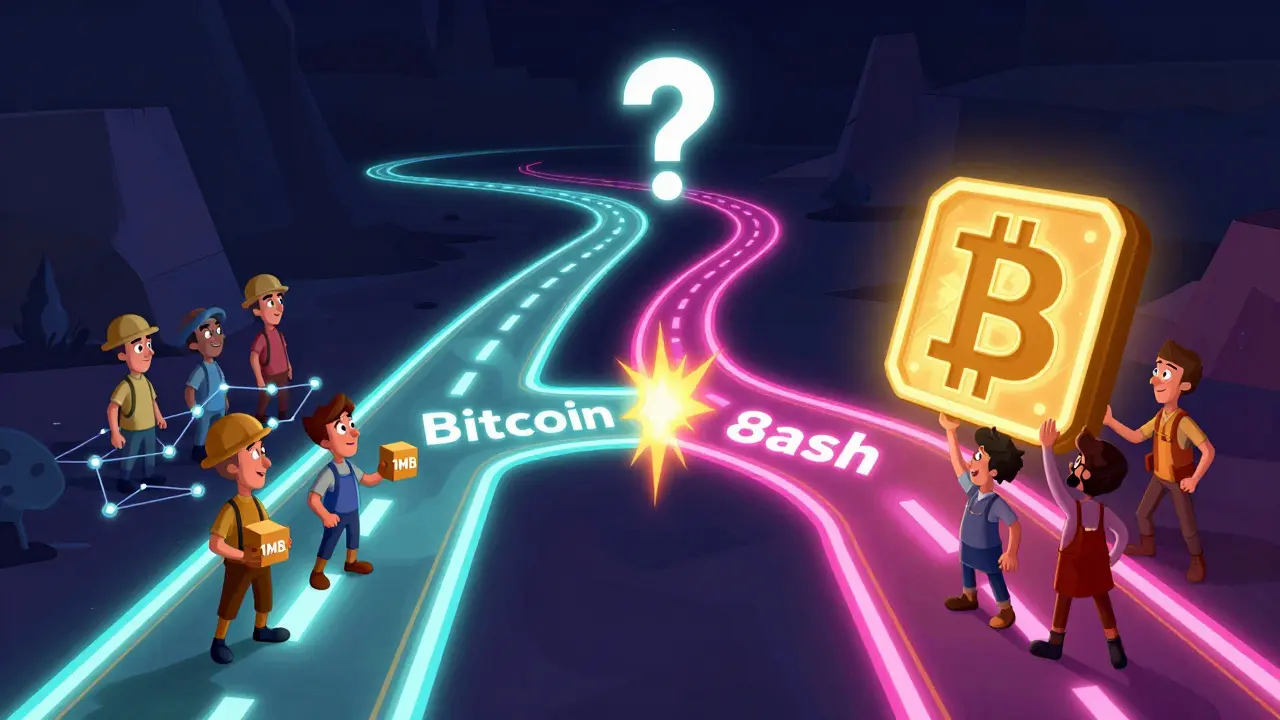
A hard fork is a divorce. It breaks the blockchain in two. One chain follows the old rules. The other follows new ones. Both exist forever. If you owned 10 Bitcoin before the fork, you now own 10 Bitcoin on the old chain and 10 Bitcoin on the new chain-assuming the new chain is recognized as legitimate. Hard forks happen when the changes are too big to fit inside the old rules. Maybe you want to double the block size. Maybe you want to change how mining rewards work. Maybe you’re trying to reverse a hack. None of that can be done with a soft fork. The old software would reject the new blocks as invalid. So everyone must upgrade-or get left behind. The most famous hard fork? Bitcoin Cash (a fork of Bitcoin created in 2017 to increase block size from 1MB to 8MB). A group of developers and miners believed Bitcoin should scale by making bigger blocks. Others disagreed, saying that would centralize power. The split happened. Bitcoin Cash was born. Its price jumped. Bitcoin’s price dropped. Traders scrambled. Exchanges had to decide which chain to support. Another major one: Ethereum Classic (the original Ethereum chain after the DAO hack was reversed via hard fork in 2016). The Ethereum team decided to roll back transactions to recover stolen funds. But a large part of the community believed “code is law.” They refused to change history. So they kept running the old chain. Ethereum Classic still exists today. Hard forks are messy. They cause confusion. They create new coins. They force exchanges to pause trading. They spark heated debates on Reddit and Twitter. But they’re the only way to make radical changes.Key Differences Between Hard and Soft Forks
| Feature | Soft Fork | Hard Fork |
|---|---|---|
| Backward Compatibility | Yes. Old nodes still accept new blocks. | No. Old nodes reject new blocks. |
| Network Split | Never. One chain only. | Yes. Two separate chains emerge. |
| New Crypto Created? | No. | Yes, if the new chain gains support. |
| Upgrade Requirement | Optional for nodes. Recommended for full benefits. | Required for all participants. |
| Typical Use Case | Security fixes, efficiency improvements, minor features. | Major changes: block size, consensus rules, reversing hacks. |
| Market Impact | Minimal. Usually stable prices. | High. Often causes volatility and new asset creation. |
| Community Consensus | Easier to achieve. Less conflict. | Harder. Often splits communities. |
Why Do Developers Choose One Over the Other?
It’s not about what’s easier-it’s about what’s possible. If you want to fix a bug in the signature verification system? Soft fork. If you want to switch from Proof of Work to Proof of Stake? Hard fork. Ethereum’s move to Ethereum 2.0 was a hard fork because it changed the entire consensus mechanism. No soft fork could do that. Developers prefer soft forks because they’re low-risk. No one gets left behind. No new coin confuses users. No exchange has to freeze withdrawals. But sometimes, you can’t avoid a hard fork. When the community is divided, and the code can’t evolve without breaking compatibility, you have no choice. Hard forks are also used as a political tool. If a group feels ignored by the core team, they can fork the chain and create their own version with different values. That’s how Bitcoin Cash, Bitcoin SV, and dozens of other altcoins were born.What Happens to Your Crypto During a Fork?
If you hold crypto in your own wallet-like a Ledger, Trezor, or MetaMask-you usually get the new coins automatically after a hard fork. Your private keys control both chains. You don’t need to do anything. But if you hold crypto on an exchange like Coinbase or Kraken, it’s different. Exchanges decide whether to support the new chain. Sometimes they do. Sometimes they don’t. Sometimes they wait weeks. Sometimes they say, “We don’t believe in this fork,” and you lose out on free coins. After the Bitcoin Cash fork in 2017, some users didn’t get BCH because their exchange didn’t support it. Others got it instantly. It was a lottery. Pro tip: If a hard fork is coming, move your coins to a wallet you control before the snapshot. That way, you’re guaranteed to get both versions.Security Risks and Replay Attacks
Hard forks create a dangerous side effect: replay attacks. After a hard fork, the same transaction can be broadcast on both chains. If you send 1 BTC on the new Bitcoin Cash chain, the same transaction might get replayed on the original Bitcoin chain-and you lose your BTC too. That’s why exchanges and wallets add replay protection. They modify the transaction format so it only works on one chain. Bitcoin Cash added a special flag. Ethereum Classic changed the chain ID. Without these protections, you could accidentally lose half your assets. Soft forks don’t have this problem. Only one chain exists. No replay risk.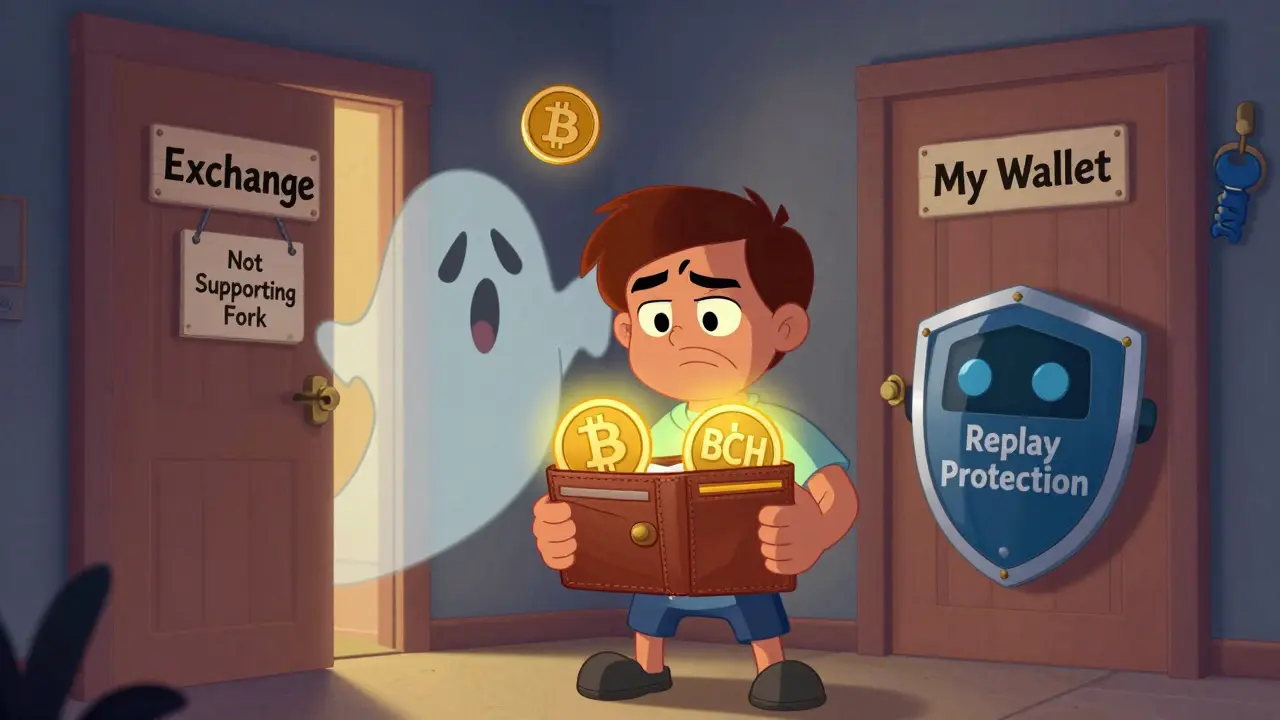
What’s the Future of Forks?
The trend is clear: soft forks are winning. Bitcoin has stuck to soft forks for years. Even big changes like Taproot (2021) were implemented as soft forks. Ethereum’s roadmap relies on soft forks for Layer 2 scaling and fee improvements. The goal is to avoid hard forks unless absolutely necessary. Why? Because fragmentation hurts adoption. If every upgrade splits the network, users get confused. Developers lose focus. Exchanges get overwhelmed. Regulators hate it. Hard forks still have their place. They’re the emergency brake. If a smart contract is hacked and $60 million is stolen, you might need to roll back time. If the network can’t scale and fees hit $100 per transaction, you might need to change the rules drastically. But those moments are rare. Most upgrades can-and should-be soft forks.How to Stay Informed
You don’t need to understand every line of code. But you should know when a fork is coming. - Follow official project blogs (Bitcoin.org, Ethereum.org) - Check major exchanges for announcements - Watch for “upgrade date” announcements on Reddit or Twitter - Never leave coins on exchanges right before a fork unless you’re sure they support it If you see a hard fork announced, ask: Why now? Who’s behind it? Is this a technical upgrade-or a power grab?Final Thoughts
Hard forks and soft forks aren’t just technical tools. They’re reflections of a community’s values. Soft forks say: “Let’s improve together.” Hard forks say: “We can’t agree, so we’ll go our separate ways.” The best blockchains know when to use each. Bitcoin stays stable with soft forks. Ethereum used a hard fork to survive the DAO hack. Both decisions made sense in context. If you’re holding crypto, your job isn’t to code the fork. It’s to understand what’s happening-and protect your assets when the network changes.Can a soft fork turn into a hard fork?
No. A soft fork is designed to be backward-compatible from the start. If a change breaks compatibility, it was never a soft fork-it was always meant to be a hard fork. You can’t convert one into the other. The distinction is built into the code design from day one.
Do I need to upgrade my wallet for a soft fork?
You don’t have to, but you should. Your wallet will still work, but you won’t benefit from the new features or security improvements. For example, if SegWit activates and you’re on an old wallet, you’ll pay higher fees than users who upgraded. Upgrading is free and takes minutes.
What happens if I don’t upgrade during a hard fork?
You’ll stay on the old chain. If the old chain loses support, it may become worthless. If it keeps running (like Ethereum Classic), you’ll still have coins-but they’ll be on a less-used, less-secure network. Most exchanges and services stop supporting the old chain within months.
Are hard forks illegal?
No. Forks are not illegal anywhere. But regulators treat the new coins as separate assets. If you receive new coins from a hard fork, you may owe taxes on them. The IRS, HMRC, and other agencies consider forked coins as income at their fair market value on the day you receive them.
Can a hard fork be undone?
No. Once a hard fork happens and blocks are mined on the new chain, the split is permanent. You can’t merge the chains back together. That’s why hard forks are so risky. There’s no undo button.




Ben VanDyk
So soft forks are just crypto band-aids? Feels like we're just delaying the inevitable.
michael cuevas
Hard forks are the only real way to fix shit. Soft forks are for people who don't want to pick sides.
Nina Meretoile
I love how soft forks let everyone stay at the table 🙌 even if they're still using flip phones. Progress shouldn't leave people behind.
Barb Pooley
Wait... so if a hard fork happens and I don't upgrade, I'm basically being erased from history? Sounds like a government surveillance tactic.
Shane Budge
Why do exchanges control fork support?
sonia sifflet
You think this is complex? In India we had 12 forks of Bitcoin in 2018 alone. People didn't even know what a wallet was. They just traded coins like lottery tickets.
rita linda
Soft forks are for weak minds who can't handle real change. America built the internet with hard forks. We don't cower behind backward compatibility.
Martin Hansen
If you're not upgrading your node for a soft fork, you're basically saying 'I don't care about security' and I'm not here for that kind of negligence.
Frank Cronin
Oh look, another post pretending hard forks are 'messy'. Nah. They're beautiful. Like a revolution with better UX.
Stanley Wong
I think the real question is not whether to fork but why we keep putting so much power in the hands of a few developers. Shouldn't the community vote on every change? Like a DAO or something? I mean... we say we're decentralized but then we let 12 people decide if we get SegWit or not. Feels off.
Nicole Parker
I just remember when Bitcoin Cash first dropped and my uncle called me crying because he lost his 'new Bitcoin'. He didn't even know he had two coins now. It broke my heart. We need better education. Not just tech talk.
jonathan dunlow
Let me tell you something real: soft forks are the silent heroes of crypto. They're the quiet guy who fixes the leaky roof while everyone else is throwing a party. No fanfare. No drama. Just safety. And yeah, you might pay a few cents more in fees, but you're not sleeping with one eye open wondering if your coins vanished because some miner decided to rebel. That peace of mind? Priceless.
Chris Mitchell
Forks reflect values. Soft forks = collaboration. Hard forks = conviction. Neither is wrong. Just different.
nicholas forbes
I'm not here to fight about forks. I just want my coins to be safe. Can we agree on that?
Regina Jestrow
I had a dream last night that Bitcoin split into 47 chains and I had to choose which one was 'real'. Woke up in a cold sweat. Someone please explain this to me again like I'm five?
Lore Vanvliet
You think hard forks are bad? Wait till you see what happens when a country bans crypto and then a fork happens. Now you've got a blockchain that's illegal in one country but still running in another. Welcome to the future, baby. 🤖💥
Scott Sơn
Hard forks are the punk rock of blockchain. Raw. Unapologetic. Chaotic. Soft forks? Corporate jazz. Smooth. Safe. Boring. I'll take the chaos any day.
Cristal Consulting
Just move your coins to a wallet before a fork. Seriously. It takes 5 minutes. Don't blame exchanges. You're the one holding the keys.
Tom Van bergen
Forks are just capitalism with code. If you don't like the new rules, start your own. That's freedom. Don't cry about it.
Sandra Lee Beagan
I'm from Canada and we don't do drama. Soft forks? Perfect. We keep the network running, everyone stays onboard, no one gets left out. Why make it harder than it needs to be? 🇨🇦❤️