
Smart contracts were supposed to be the future of trustless automation. No middlemen. No paperwork. Just code that executes exactly as written. But as billions in value moved onto blockchains, the cracks started showing. In 2025 alone, over $2.8 billion was stolen from smart contract exploits. That’s not a glitch. It’s a systemic problem-and the way we secure these contracts is changing faster than ever.
Why Old Security Methods Are Failing
A few years ago, the standard was simple: write the code, hire an auditor, run a few tests, and deploy. That’s how most early DeFi projects got started. But today, that approach is like locking your front door but leaving the back window wide open. Post-deployment audits catch only about 30% of critical flaws. By the time an auditor finds a bug, the contract is already live, and attackers are already testing exploits. In 2025, 64% of all DeFi hacks happened through bridges-protocols that connect different blockchains. These weren’t random errors. They were predictable failures caused by assumptions about how other chains behave. The old model relied on human auditors reviewing code after it was built. But humans miss things. Especially when contracts are complex, interconnected, and built across multiple chains. The new reality? Security has to be built in from day one, not patched on after launch.The Rise of Formal Verification
Formal verification is no longer a buzzword. It’s becoming mandatory. Think of it like math proof for code. Instead of just testing a contract with sample inputs, you use mathematical logic to prove that every possible path in the code behaves correctly. No surprises. No edge cases. Just certainty. Tools like VeraLang, ProverX, and Certora Prover are now used by 67% of major DeFi protocols, up from just 12% in 2023. According to ConsenSys Diligence’s 2025 study, projects using formal verification had 89% fewer critical vulnerabilities after deployment. And here’s the kicker: every single project that avoided a major exploit in 2025 had formal verification in place. The catch? It takes time. Developers report adding 3-4 weeks to their timeline to implement formal verification properly. But compared to losing millions in a hack? That’s a bargain. Ethereum Foundation’s Formal Verification Standard (FVS) 1.0, released in January 2026, is now the baseline for all new high-value contracts. If your contract handles over $100 million in value, you’re expected to use it-or risk being excluded from major exchanges and liquidity pools.Runtime Monitoring: The 24/7 Security Guard
Even the most perfectly verified contract can be attacked after deployment. That’s where runtime monitoring comes in. Tools like Forta Network now scan every transaction in real time, flagging suspicious behavior in under a second. How does it work? Imagine a security camera that doesn’t just record-it watches for patterns. If a contract suddenly starts sending funds to a known blacklisted address, or if a transaction triggers an unusual sequence of function calls, the system alerts the team instantly. In 2025, protocols using runtime monitoring blocked 83% of attempted exploits before they could succeed. These systems don’t replace audits. They complement them. Think of them as an always-on security team that never sleeps. And they’re getting smarter. AI-powered anomaly detection now identifies novel attack patterns that humans haven’t seen before. But don’t get fooled: AI still misses 31% of new threats, according to Cornell Tech’s 2026 study. Human expertise is still essential.Decentralized Key Management: No More Single Points of Failure
One of the most common mistakes in DeFi? Storing treasury funds in a simple multisig wallet controlled by a handful of developers. If one of them gets hacked-or gets a phishing email-your entire treasury is at risk. Enter Multi-Party Computation (MPC). This isn’t just another wallet. It’s a distributed key system where no single person holds the full key. Funds can only be moved when a threshold of participants (say, 5 out of 7) approve the transaction-but none of them ever see the full private key. Safeheron’s 2025 report showed MPC reduces single-point-of-failure risks by 92% compared to traditional multisig. And it’s not just for small teams. Major protocols like Aave and Uniswap now use MPC for their treasury management. The EU’s Blockchain Security Directive now requires MPC for all public-sector smart contracts handling over €1 million. It’s becoming the gold standard.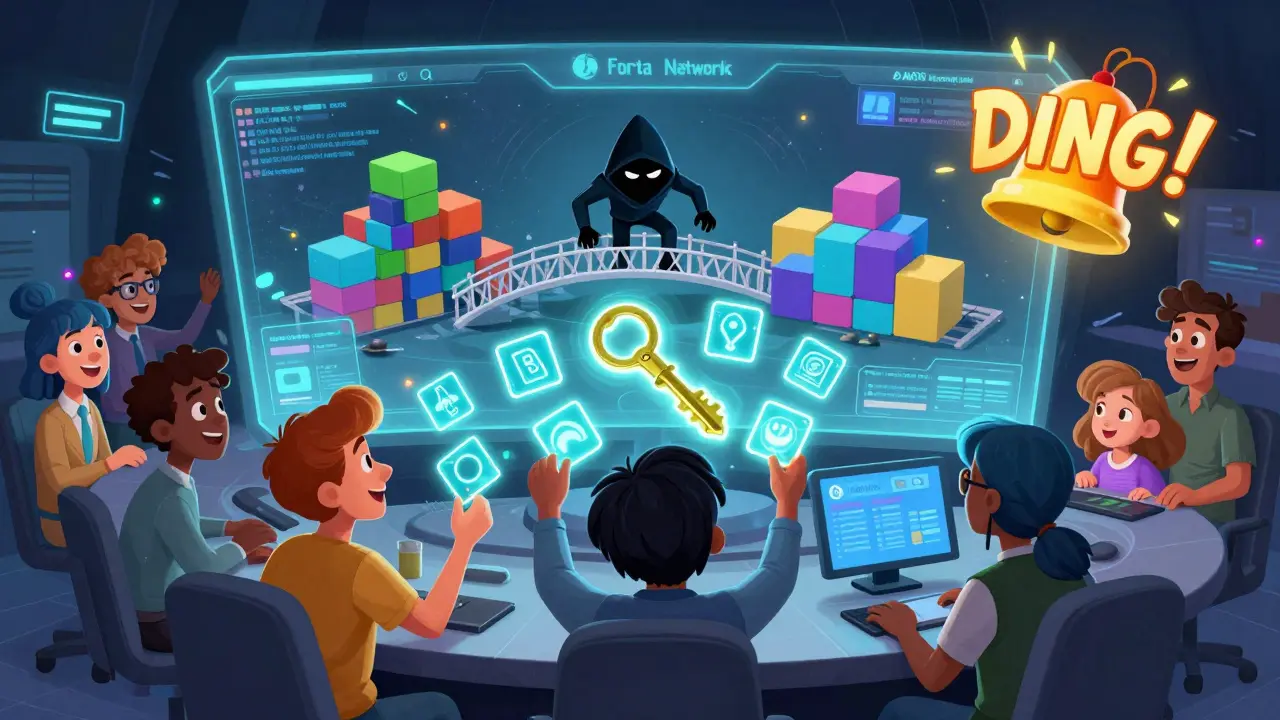
Cross-Chain Security: The New Frontier of Risk
The biggest threat today isn’t one blockchain. It’s the connections between them. Bridges-those gateways linking Ethereum, Solana, Polygon, and others-are the most hacked part of DeFi. In 2025, bridge exploits caused 64% of all losses. Why? Because each chain has its own rules. A contract that works perfectly on Ethereum might behave unpredictably when interacting with a Solana-based token. Attackers exploit these mismatches. Chainalysis found that 73% of bridge hacks came from unforeseen interactions between protocols. Solutions are emerging. Chainlink’s Cross-Chain Interoperability Protocol (CCIP) includes built-in security layers that validate message integrity across chains. Projects using CCIP saw a 54% drop in bridge-related vulnerabilities in tests. Meanwhile, the Blockchain Security Alliance launched the Cross-Chain Threat Intelligence Network (CTIN) in late 2025, connecting 37 major protocols to share real-time threat data. It’s like a global early-warning system for blockchain attacks.Regulation Is Here-And It’s Changing the Game
Governments aren’t waiting. The EU’s Blockchain Security Directive, effective since June 2025, requires formal verification for any public-sector smart contract handling over €1 million. The SEC’s December 2025 guidance made it clear: DeFi platforms operating in the U.S. must meet minimum security standards or face enforcement action. This isn’t about stifling innovation. It’s about protecting users. If you’re building a protocol that handles millions in user funds, you can’t just say, “We’re decentralized, so we don’t need rules.” The market now demands proof of security. Exchanges won’t list you. Investors won’t fund you. Liquidity providers won’t stake with you. The top five audit firms-OpenZeppelin, Trail of Bits, CertiK, Quantstamp, and BlockSec-now handle 58% of all major audits. That’s up from 39% in 2023. It’s not just about who you hire. It’s about proving you’ve hired the right ones.What Developers Need to Know Today
If you’re building a smart contract in 2026, here’s what you need to do:- Start with formal verification from day one-not as an afterthought.
- Integrate runtime monitoring tools like Forta Network into your deployment pipeline.
- Use MPC for all treasury and governance funds.
- Test cross-chain interactions with real bridge simulations before launch.
- Use Slither, Echidna, and Certora Prover as your core toolset.
- Document every security decision. Regulators and investors will ask for it.
The Dark Side: AI-Powered Attacks and False Confidence
Just as defenses improve, so do attacks. AI-generated exploits increased 300% in Q4 2025, according to Immunefi. These aren’t random scripts. They’re tailored, adaptive attacks that learn from past vulnerabilities and mimic human behavior to bypass detection. And here’s the dangerous part: many teams now believe AI tools can replace auditors. They’re wrong. Trail of Bits’ 2026 assessment found AI tools generate 12-15% false positives in complex DeFi protocols-enough to distract teams from real threats. Worse, they missed 31% of novel attack vectors that experienced human auditors caught. The lesson? AI is a tool, not a replacement. Use it to scan faster. But always pair it with expert review.What’s Next? The Next Five Years
By 2027, Gartner predicts 85% of new smart contracts will use AI-assisted security features. By 2028, quantum-resistant cryptography will become standard for contracts handling over $50 million. That means longer transaction times and higher gas fees-up to 22% more. But it’s necessary. Quantum computers are getting closer, and the window to upgrade is closing. The biggest shift? Security is no longer a cost center. It’s a competitive advantage. Protocols with strong security frameworks have 5.3x higher survival rates over five years, according to McKinsey. Investors know this. Users know this. The market rewards those who build safely.Final Thought
Smart contracts aren’t going away. But the era of “move fast and break things” is over. The future belongs to teams that treat security like a core feature-not a checkbox. Formal verification. Runtime monitoring. MPC. Cross-chain validation. These aren’t optional upgrades. They’re the new floor. If you’re building something today, don’t ask, “Can we afford to secure this?” Ask, “Can we afford not to?”What is the most important security practice for smart contracts in 2026?
The most critical practice is integrating formal verification from the earliest stage of development. Unlike traditional audits that happen after deployment, formal verification mathematically proves that a contract behaves correctly under all possible conditions. Projects using it have seen 89% fewer critical vulnerabilities, and by 2026, it’s required for any contract handling over $100 million in value. Skipping this step is no longer an option for serious projects.
Are smart contract audits still necessary if I use formal verification?
Yes. Formal verification checks logic, but audits check for implementation flaws, environmental risks, and human error. A contract might be logically sound but still have a misconfigured access control or a flawed upgrade mechanism. Auditors also spot issues that formal tools can’t detect-like social engineering risks or third-party dependency flaws. Think of formal verification as your foundation, and audits as the final inspection before launch.
How do I know if a DeFi protocol is secure enough to use?
Look for three things: 1) Public proof of formal verification (usually listed in their docs or GitHub), 2) Real-time monitoring tools like Forta Network integrated and active, and 3) Use of MPC for treasury management. Also check if they’ve been audited by one of the top five firms-OpenZeppelin, Trail of Bits, CertiK, Quantstamp, or BlockSec. If any of these are missing, assume the risk is high. Never rely on community hype alone.
Is quantum-resistant cryptography worth the extra cost right now?
For contracts handling under $10 million, probably not yet. But for anything above that-especially long-term staking or treasury contracts-yes. Quantum computers aren’t here yet, but the data to break current encryption is being harvested today. Ethereum Foundation and other major players are already testing post-quantum algorithms. If you’re building something meant to last five years, you need to plan for quantum resistance now. The gas cost increase (18-22%) is a small price to pay for future-proofing.
Can AI tools fully replace human auditors?
No. AI is excellent at scanning for known patterns and flagging anomalies, but it struggles with novel attack vectors. Cornell Tech’s 2026 study showed AI missed 31% of exploits that experienced human auditors caught. AI also generates false positives that waste developer time. The best approach is to use AI for initial scans and pair it with human review. Think of AI as your first line of defense-not your only one.






nalini jeyapalan
Formal verification is non-negotiable anymore. I’ve seen teams skip it to ship faster, then lose $20M in a weekend. The math doesn’t lie. If your contract can’t be proven correct under every edge case, it’s not secure-it’s a gambling chip. Stop treating security like a bonus feature. It’s the foundation. Period.
Christina Young
Formal verification is overhyped. 89% fewer vulnerabilities? That’s cherry-picked data. Most of those projects had 3 auditors and a team of 15 engineers. A solo dev with a $500 budget can’t afford VeraLang. This is elitism dressed as best practice.
Drago Fila
Hey, I get why some folks are skeptical, but hear me out-formal verification isn’t about being rich or fancy. It’s about not losing people’s life savings because you rushed. I helped a small DeFi team last year, they were on the fence, then they did it. Two months later, a hack targeted them but failed because the logic was bulletproof. That’s not luck. That’s discipline. You don’t need a big team. You just need to care enough to do it right.
Steven Lefebvre
I’m all for formal verification, but what about runtime monitoring? It’s the real-time safety net. I’ve seen contracts pass formal checks and still get hacked because of a misconfigured oracle. Forta caught a 0-day in under 40 seconds. That’s the kind of thing that saves millions. Don’t just do one-do both.
Ken Kemp
I agree with runtime monitoring but dont forget MPC. We switched from multisig to MPC last year and the difference is night and day. One dev got phished, tried to drain funds, but couldn’t because no single key existed. It’s scary how many still use 2-of-3 multisigs. That’s like locking your house with a key taped under the mat.
jonathan swift
This whole thing is a government/BigCrypto scam. 🤡 They want you to pay for ‘verification’ so they can backdoor your contracts. Quantum-resistant? More like quantum surveillance. They’re already harvesting your private keys. Wake up. The real security is not deploying anything at all. 💀
Datta Yadav
You all are missing the forest for the trees. Formal verification? Runtime monitoring? MPC? These are all Band-Aids on a corpse. The real issue is that smart contracts are built on a fundamentally flawed premise-trustless systems that require trust in developers, tooling, and infrastructure. You think a math proof changes the fact that a single dev can front-run his own contract? Or that Chainlink’s oracle can be bribed? This isn’t security-it’s theater. The entire ecosystem is a Ponzi scheme wrapped in Solidity. And you’re all dancing to the tune of the auditors.
Lydia Meier
The assertion that formal verification reduces critical vulnerabilities by 89% is statistically unsound. The sample size is not disclosed, and no peer-reviewed methodology is referenced. Furthermore, the ConsenSys study is a self-published whitepaper with no independent validation. Until these claims are subjected to rigorous academic scrutiny, they remain speculative marketing.
Josh Moorcroft-Jones
I’ve been doing this for 12 years, and I’ve seen every ‘revolution’ come and go. Formal verification? It’s just static analysis with more buzzwords. Runtime monitoring? That’s just Snort for blockchain. MPC? Multisig with extra steps. And don’t get me started on ‘cross-chain threat intelligence’-it’s a glorified Slack channel. The truth? The only thing that matters is code review. Human eyes. On every line. No tool replaces that. Everything else is noise.
Rachel Rowland
If you're building anything serious, you're already doing all this. The real question is why are we still talking about this like it's new? It's 2026. If you're not using formal verification + runtime monitoring + MPC, you're not a developer-you're a liability. Stop asking if it's worth it. Ask if you're willing to be the reason someone loses their life savings.
Bonnie Jenkins-Hodges
America built the internet. We don’t need EU regulations to tell us how to code. This is socialism for coders. Formal verification? That’s just government paperwork in a blockchain suit. We should be innovating, not obeying. If you want to be safe, don’t use DeFi. Go buy gold. 💪🇺🇸
Melissa Ritz
I read the whole thing. Interesting. But honestly? I’m just here because I’m bored. Also, I think ‘formal verification’ sounds like a PhD thesis nobody actually reads. I’ll stick with my trusty old audit reports. They’re easier to understand. And prettier. 🤷♀️
Jeffrey Dean
The irony is that we’ve created a system where the most secure contracts are also the most opaque. Formal verification requires deep mathematical literacy. Runtime monitoring requires institutional infrastructure. MPC demands coordination across multiple trusted parties. In trying to eliminate centralization, we’ve built a new hierarchy: the security elite. Who gets to decide what ‘correct’ behavior looks like? Who owns the proofs? The tools? The audit firms? The system isn’t trustless. It’s just more complicated. And that complexity is the new gatekeeper.
Brian T
I’m not saying any of this is wrong. But I keep wondering-what if we just stopped building smart contracts? What if the real innovation was not in making them more secure, but in realizing we don’t need them at all? Maybe the future isn’t about better code. Maybe it’s about not coding at all.
Shawn Warren
The most important security practice in 2026 is institutional accountability. Not tools. Not standards. Not audits. It’s the legal and financial responsibility of the team behind the contract. If a protocol loses funds due to negligence, the founders must be personally liable. That’s the only incentive strong enough to make teams prioritize security over speed. Everything else is decoration.