
Hotbit was once one of the biggest names in crypto trading, boasting over 2,800 coins and a sleek interface. But today, it doesn’t exist. Not as a working platform. Not as a service. Not even as a website you can log into. If you’re searching for Hotbit right now, you’re either looking for answers or trying to recover lost funds. Either way, here’s what really happened.
What Was Hotbit?
Hotbit launched in 2018 as a cryptocurrency exchange with no ties to banks or government oversight. It didn’t let you deposit dollars, euros, or pounds. You had to buy crypto elsewhere-like Binance or Coinbase-and transfer it over. That wasn’t unusual back then. But what made Hotbit stand out was how many coins it supported. While most exchanges offered 200 to 500 tokens, Hotbit listed over 2,800. That included obscure altcoins no one else touched. For traders chasing the next big pump, it was a playground.
Its interface was clean. Charts were fast. Trading fees were low-sometimes as low as 0.1%. And for a while, users loved it. The platform even had its own market-making engine to keep trading smooth. But none of that mattered when the foundation was cracked.
The Red Flags Nobody Wanted to See
Hotbit had no license. No regulation. No legal accountability. Not from the U.S., not from the EU, not from China, not from anywhere. That’s not a feature. It’s a warning sign. Every major exchange-Binance, Coinbase, Kraken-spends millions getting licensed. Hotbit skipped it. Why? Because regulation means transparency. And transparency means you can’t hide what’s going on behind the scenes.
Users started noticing strange things. Withdrawals took weeks. Some people waited 45 days just to get their USDT out. Meanwhile, Hotbit charged 30 USDT per withdrawal. That’s 10 to 30 times more than what other exchanges charged. For someone with 50 USDT in their account, that meant paying over half their balance just to move money. That’s not a fee. That’s a trap.
Customer support? Nearly non-existent. Emails went unanswered. Live chat bots gave the same scripted reply: “We’re processing your request.” One user on Sitejabber wrote: “I sent a message on March 5. It’s now April 12. Still no reply. My money is still stuck.”
The Collapse
On August 15, 2022, everything changed. Law enforcement froze Hotbit’s assets. The reason? A former executive was under criminal investigation for fraud. The exchange didn’t shut down immediately. It went dark for months. Users kept checking. Hoping. Waiting.
Then, on May 22, 2023, Hotbit made an official announcement: “We are permanently shutting down.” The reasons? “Deteriorating operating conditions, market instability, and a wave of fund outflows.” Translation: They ran out of money. And they didn’t have enough to pay everyone back.
Users were given until June 21, 2023, to withdraw what they could. But by then, the system was already broken. Many couldn’t log in. Others tried to withdraw and got errors. Some got their money back-luckily, early. Others didn’t.

Why Did It Fail When Others Survived?
Hotbit wasn’t the only unregulated exchange. But it was one of the largest. And it failed because it ignored the one rule that keeps crypto alive: trust.
Binance, even after its own legal troubles, kept working because it had real compliance teams, KYC processes, and global partnerships. Hotbit had none. It was built on hype, not structure.
When FTX collapsed in late 2022, the whole crypto world tightened up. Regulators cracked down. Exchanges with weak controls got squeezed. Hotbit didn’t have the resources to adapt. It had no legal team. No insurance. No backup plan. When users started pulling funds, there was nothing left to give.
By June 2023, Hotbit’s traffic dropped to zero. Its website went offline. Its social media vanished. The company never responded to inquiries. It simply disappeared.
Recovery Scams Are Everywhere Now
Here’s the dangerous part: people are still trying to get their money back. And scammers know it.
Today, you’ll find websites like hotbit.us.com or YouTube videos promising “Hotbit fund recovery services.” They’ll ask for a small upfront fee-usually in crypto-to “unlock” your account. Or they’ll claim to be former Hotbit employees who can “manually restore” your balance.
TradersUnion.com says 92% of these recovery services are scams. The Financial Crimes Enforcement Network (FinCEN) issued a public warning in July 2023: “Recovery scams targeting victims of exchange failures like Hotbit are rampant. Do not pay any fees to recover lost funds.”
If you lost money on Hotbit, you’re not alone. But paying someone to “help” you will only make it worse. There is no official recovery process. No government agency is stepping in. And no legitimate company is offering refunds.
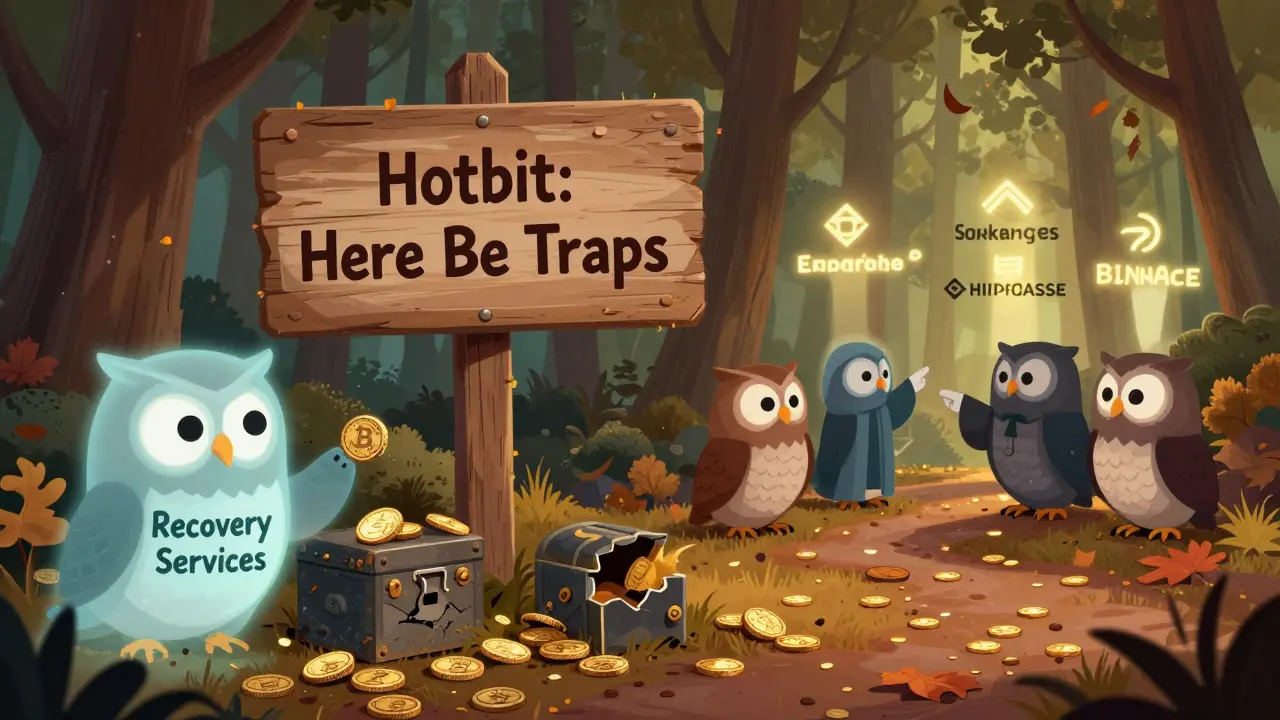
What You Can Learn From Hotbit
Hotbit’s story isn’t just about one failed exchange. It’s a lesson in how not to trade crypto.
- Never use an exchange without regulation. If they don’t say which country regulates them, walk away.
- Watch withdrawal fees. Anything over 5 USDT for crypto withdrawals is a red flag.
- Check reviews on independent sites. Sitejabber, Trustpilot, and Reddit are better than the exchange’s own “testimonials.”
- Don’t keep large amounts on any exchange. Use cold wallets for long-term storage.
- Assume any unregulated platform could vanish overnight. Hotbit didn’t collapse slowly. It vanished in a week.
The crypto market is full of opportunities. But it’s also full of traps. Hotbit looked like a goldmine. It turned out to be a hole with a sign that said, “Deposit here.”
What Happens to Your Money If an Exchange Dies?
If an exchange shuts down without regulation, your money is gone. There’s no FDIC. No insurance. No safety net. Unlike banks, crypto exchanges aren’t required to hold reserves or protect user funds. You’re essentially lending your coins to a company that doesn’t have to answer to anyone.
Even Binance, the biggest exchange in the world, has had users lose money during temporary outages. But Binance has lawyers, regulators, and a backup plan. Hotbit had none.
That’s why experts say: “If you can’t withdraw your funds in under 24 hours, you don’t own them.”
Is Hotbit still operating?
No. Hotbit permanently shut down on May 22, 2023. Its website is offline, its apps no longer work, and its servers have been decommissioned. Any site claiming to be Hotbit today is a scam or a copycat.
Can I get my money back from Hotbit?
The chances are extremely low. Hotbit had no insurance, no legal protection, and no assets left after its shutdown. Some users got their funds back before June 2023 by acting quickly. After that, the system was locked. Any service offering to recover your funds for a fee is a scam.
Why did Hotbit charge 30 USDT to withdraw?
It was a deliberate tactic to trap small balances. Most exchanges charge 1-3 USDT. Hotbit’s 30 USDT fee meant users with less than 50 USDT couldn’t realistically withdraw. This kept funds locked inside the platform longer, giving the company more time to use those coins-likely for other purposes.
Was Hotbit a scam?
It wasn’t labeled a scam before it shut down, but its practices matched classic scam patterns: no regulation, high withdrawal fees, poor support, and a sudden disappearance after a criminal investigation. The fact that law enforcement froze its assets confirms serious wrongdoing occurred.
What should I use instead of Hotbit?
Stick to regulated exchanges like Binance, Coinbase, Kraken, or KuCoin. These platforms are licensed in multiple countries, offer transparent fee structures, and have customer support that actually responds. Always check if they’re registered with authorities like the SEC, FCA, or CySEC before depositing money.
Final Thoughts
Hotbit didn’t fail because it was too ambitious. It failed because it was careless. It prioritized volume over safety, speed over security, and growth over responsibility. And in crypto, that’s a deadly mix.
If you’re trading crypto today, remember: the biggest risk isn’t the market. It’s the platform you choose. Hotbit is gone. Don’t let your next exchange meet the same fate.





Gene Inoue
This is why you never trust a platform that doesn't have a license. Hotbit was a walking scam with a clean UI. I told everyone I knew to stay away. And guess what? I was right. No one listens until they lose money. Classic.
Ricky Fairlamb
The 30 USDT withdrawal fee wasn't just greedy-it was predatory. It functioned as a liquidity trap designed to maximize exposure to market manipulation. Regulatory arbitrage is not a feature; it's a red flag written in neon. Anyone who traded on Hotbit was complicit in their own financial negligence.
Lauren J. Walter
So... they just vanished? Like a ghost in a blockchain? 😬 I guess that's what happens when you build a castle on sand and call it 'innovation'.
Carol Lueneburg
I'm so sorry for everyone who lost money 😔 This could've been avoided if people just prioritized safety over hype. Remember: if it feels too good to be true, it probably is. You're worth more than a pump-and-dump platform. 💛
Brenda White
hotbit was a mess fr fr. i had like 40 usdt in there and when i tried to withdraw it said 'processing' for 2 months. then poof. gone. no one replied. no one cared. i just gave up. dont be like me.
Tobias Wriedt
If you used Hotbit, you basically volunteered to be a pawn in a casino that didn't even have a license. No sympathy. You knew the risks. You chose to ignore them. That's on you.
Manali Sovani
The regulatory absence of Hotbit was not an oversight. It was a deliberate design choice to circumvent fiduciary obligations. Such entities operate under the premise of asymmetrical information, which is inherently unethical in financial markets.
Konakuze Christopher
They didn't collapse. They were exposed. And now the scammers are circling like vultures. Don't fall for recovery scams. They're just the second layer of the same pyramid.
S F
USA doesn't regulate crypto? Then why are we letting foreign trash like Hotbit target Americans? This is why we need a crypto crackdown. No more free passes.
Angelica Stovall
You think you're smart trading altcoins on some sketchy site? Nah. You're just the sucker who funded their yacht. And now you're crying about it. Wake up.
Sahithi Reddy
Learn from this. Always use cold wallets. Always check reviews. Always assume the worst. Crypto is wild but you can survive it if you stay sharp
George Hutchings
Man. I remember when Hotbit was the go-to for obscure tokens. Looked slick. Felt legit. Turns out, it was just a really good-looking trap. Lesson: never trust the interface. Always check the bones.
Henrique Lyma
The fundamental flaw in Hotbit's model was its assumption that volume could substitute for trust. In financial ecosystems, liquidity without accountability is not innovation-it's a time bomb with a user interface. The fact that it lasted as long as it did speaks less to its competence and more to the collective blindness of retail traders who equated speed with safety
Steph Andrews
I know people lost money and that sucks but honestly if you didn't check if an exchange was regulated you kinda asked for it. I'm not mad just disappointed. Maybe next time read the fine print
Prakash Patel
Actually, Hotbit wasn't the worst. I've seen way sketchier. At least they had 2800 coins. That's dedication. The real issue is people expecting government to babysit their investments. Grow up.
Robert Kunze
i lost like 800 usdt on hotbit and its still killing me. i wish i listened to the people who said dont use it. i thought i was being smart by going for the high volume. turns out i was just dumb. dont be like me
Ann Liu
Withdrawal fees of 30 USDT on a stablecoin? That's not a fee-it's a tax on desperation. This was a deliberate strategy to lock users in. Any legitimate exchange would have been fined for this. Hotbit operated in a legal gray zone because they never intended to be legitimate.
Dionne van Diepenbeek
I had a friend who lost everything on Hotbit. He kept saying 'I'll get it back' for months. Then he started DMing people on Twitter offering to 'help recover funds' for 5% fee. He's now the scammer. The cycle never ends
Ross McLeod
The tragedy isn't that Hotbit failed. The tragedy is that so many people still don't get it. Regulation isn't bureaucracy-it's the firewall between your life savings and a bunch of guys in a basement with a fake whitepaper. You think you're trading crypto. You're actually gambling on whether someone will get caught before they vanish.
rajan gupta
Hotbit was never about trading. It was about the illusion of trading. The real product was hope. And hope? That's the most expensive asset of all. 💔
Cheri Farnsworth
It is imperative that individuals recognize the necessity of regulatory oversight in financial platforms. The absence of such frameworks constitutes a material risk to economic stability. Hotbit exemplifies the consequences of institutional negligence.
Arlene Miles
I know some of you are still mad. I get it. But let’s turn this pain into power. Share this post. Warn your friends. Start a subreddit. If we stop being quiet, maybe the next Hotbit won’t even get off the ground. You’re not alone. We got you.
Tony Weaver
The 30 USDT fee wasn’t a mistake. It was a feature. They wanted you to stay. They wanted your small balances locked in so they could rehypothecate them into DeFi pools or pump-and-dump schemes. This wasn’t incompetence. It was calculus. And you were the variable.
Lucy de Gruchy
I’m British. We don’t even have a proper crypto regulatory framework here. And yet, we have FCA warnings. Hotbit had zero. That’s not a loophole. That’s a crime waiting to happen. And it did.
Taylor Holloman.
I used to love Hotbit. The charts were buttery smooth. The altcoin selection? Insane. I thought I was ahead of the curve. Turns out I was just on the edge of a cliff. I still have nightmares about that 'processing' screen. Don't let your crypto dreams turn into a ghost story.