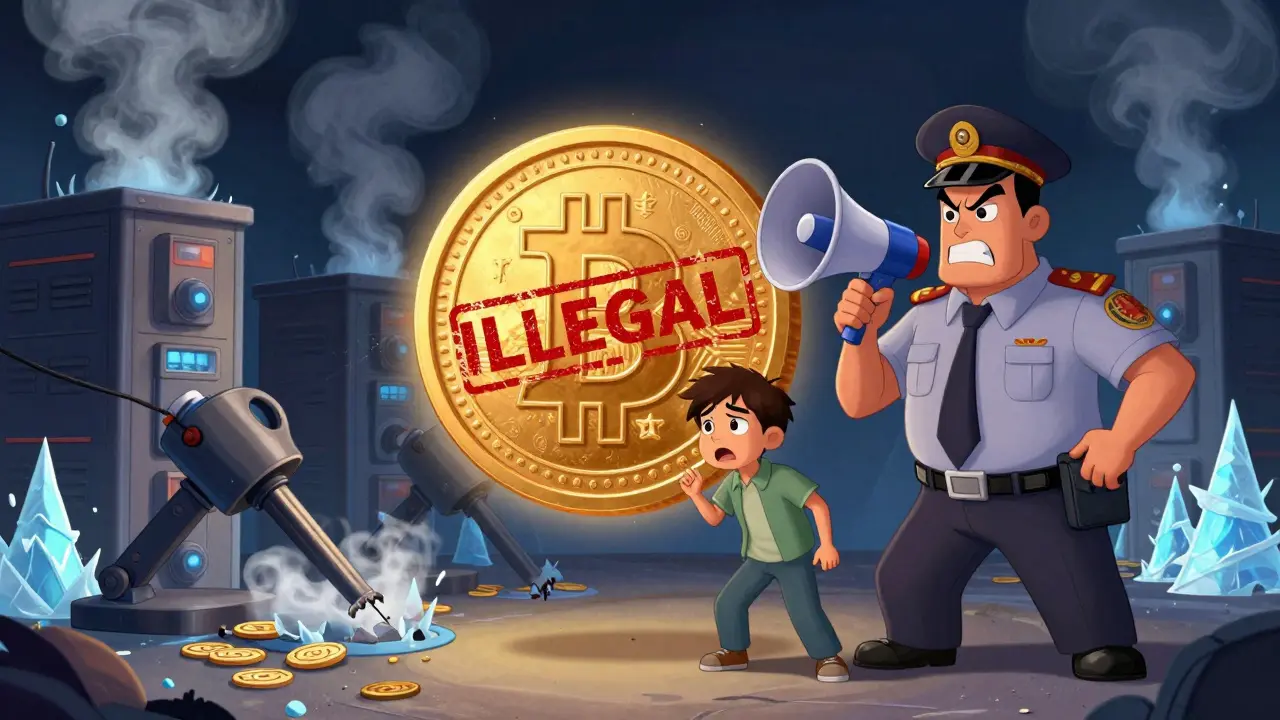
If you hold cryptocurrency, you might think your digital assets are safe as long as you don’t break the law. But in some countries, simply owning or trading crypto can land you in legal trouble-even if you didn’t launder money, didn’t run a scam, and didn’t touch darknet markets. The truth is, your risk isn’t about what you did with crypto. It’s about where you did it.
China: The Harsh Reality of a Complete Ban
China doesn’t just regulate crypto. It erases it. Since 2017, the government has banned all cryptocurrency exchanges, ICOs, and mining operations. By 2021, even peer-to-peer trading was targeted. Authorities don’t just shut down platforms-they go after individuals. Chinese citizens caught trading crypto on decentralized apps or using foreign exchanges face fines, asset seizures, and in some cases, criminal charges under financial crime statutes. Mining rigs are confiscated. Bank accounts linked to crypto activity are frozen. The state doesn’t just discourage crypto-it treats it as a threat to financial sovereignty. If you’re in China and you hold Bitcoin, you’re already on the wrong side of the law, no matter how small your balance.Algeria and Bolivia: Zero Tolerance, Zero Gray Areas
Algeria and Bolivia are two of the most extreme cases globally. In Algeria, the central bank declared all cryptocurrency transactions illegal in 2018. Holding, trading, or even promoting crypto can lead to prosecution under anti-fraud and money laundering laws. Penalties include prison time and heavy fines. The government doesn’t just block access-it actively investigates users. Bolivia followed suit in 2014, with its central bank stating that cryptocurrencies have no legal status and are not recognized as payment. Any use of crypto is considered a violation of financial regulations. Unlike China, where enforcement is heavy but sometimes inconsistent, Algeria and Bolivia have made it clear: no exceptions. If you’re caught with crypto in either country, you’re not getting a warning-you’re getting a legal case.Bangladesh: Crypto as a Criminal Act
Bangladesh doesn’t just tax crypto-it criminalizes it. The central bank banned cryptocurrency in 2017, classifying it as illegal under the country’s Money Laundering Prevention Act. In 2023, authorities arrested multiple individuals for using Binance and other foreign exchanges. One case involved a student who bought $500 worth of Bitcoin and was charged with violating foreign exchange rules. Fines can reach tens of thousands of dollars, and jail time is possible. Banks are required to report any suspicious transactions linked to crypto. Even receiving crypto as a gift can trigger an investigation. There’s no tax system to legalize it, no regulatory sandbox-just outright prohibition and active prosecution.India: Taxation as Enforcement
India doesn’t ban crypto. It taxes it into submission. Since 2022, the government has imposed a 30% flat tax on all crypto gains-no deductions, no offsets, no exemptions. On top of that, every single transaction triggers a 1% tax deducted at source (TDS). That means if you buy $1,000 worth of Ethereum, $10 is automatically withheld by the exchange and sent to the government. If you sell it later for $1,500, you owe 30% on the $500 profit-$150-plus another $15 in TDS on the sale. The system is designed to make crypto trading unprofitable for most people. While owning crypto isn’t illegal, the tax burden is so high that many users are forced to hide their activity. The government has launched audits targeting high-volume traders, and unreported gains can lead to penalties up to 200% of the tax owed. It’s not jail-but it’s financial pressure with teeth.
United States: Targeting Criminals, Not Users
The U.S. doesn’t prosecute average crypto users. It goes after the big fish. In September 2024, the Treasury’s OFAC sanctioned Russia-based exchange Cryptex and its operator Sergey Sergeevich Ivanov for laundering over $5.88 billion in funds tied to ransomware and darknet markets. The State Department offered a $10 million reward for his capture. That’s the kind of enforcement the U.S. prioritizes: major criminal networks, not people buying Bitcoin on Coinbase. The Trump administration’s crypto-friendly policies have reduced regulatory pressure on exchanges and individual traders. While the SEC still sues token issuers, and IRS audits high-income traders, the average person holding crypto in a U.S. wallet faces almost no risk of prosecution. The real danger? Getting caught using crypto to move money for fraud, scams, or illegal goods.Europe: New Rules, New Oversight
Europe is shifting from fragmented rules to centralized control. In July 2025, the Anti-Money Laundering Authority (AMLA) launched with 30 staff-planning to grow to over 400 by 2028. All EU-based crypto exchanges must now report suspicious activity, verify identities, and freeze funds tied to sanctioned entities. The EU’s AMLD5 directive already required this, but AMLA gives enforcement teeth. Dutch authorities, working with Chainalysis and Tether, seized €7 million in crypto linked to a payment processor that funneled $97 million to Cryptex in 2024. This isn’t about prosecuting users-it’s about cutting off criminal pipelines. If you’re a regular European crypto holder, you’re not at risk. But if your wallet interacts with a blacklisted address, your funds could be frozen. Compliance is now mandatory-and monitored at a scale never seen before.Singapore and South Korea: Regulation Over Prosecution
Singapore and South Korea show how enforcement can work without fear. Singapore’s Monetary Authority (MAS) doesn’t ban crypto-it regulates it. Since 2020, exchanges must be licensed. Stablecoin issuers must back every token with real reserves held in regulated banks. No one gets prosecuted for holding Bitcoin. But if you run an unlicensed exchange? You’re done. South Korea’s 2024 Act on Protection of Virtual Asset Users (VAUPA) forces exchanges to keep client funds separate, carry insurance, and report suspicious activity. The goal? Protect users, not punish them. In both countries, you can trade freely. The government doesn’t want you to stop using crypto-it wants you to use it safely. Prosecution? Only for fraudsters and hackers.
Portugal: The Crypto Haven
Portugal remains one of the few places in Europe where crypto is practically tax-free. Capital gains from personal crypto trading are not taxed. No TDS. No reporting requirements. No penalties for holding. The government doesn’t encourage it-but it doesn’t interfere. In 2025, Portugal still has minimal enforcement risk for individual users. While lawmakers are discussing potential changes, no bill has been introduced to criminalize or tax crypto holdings. If you’re looking for a country where you can hold crypto without fear of legal action, Portugal is still one of the safest.What About the Rest?
Brazil passed a crypto law in 2023 but is still drafting implementation rules. Ecuador discourages crypto but doesn’t ban it. Nigeria has cracked down on exchanges but rarely prosecutes individuals. Most countries fall into one of three buckets: ban and prosecute (China, Algeria), tax and monitor (India, U.S.), or regulate and protect (Singapore, Portugal). The trend is clear: authoritarian states use crypto bans as control tools. Democratic states focus on preventing crime, not punishing ordinary people.Where Are You at Risk?
If you live in China, Algeria, Bolivia, or Bangladesh, your crypto activity is illegal-and enforcement is real. In India, your wallet is under tax scrutiny. In the U.S. and Europe, you’re safe unless you’re linked to criminal activity. In Singapore, South Korea, and Portugal, you can trade without fear. Your risk isn’t about how much crypto you own. It’s about where you live.Can I go to jail for owning Bitcoin?
Yes-if you’re in a country that bans cryptocurrency outright. China, Algeria, Bolivia, and Bangladesh have prosecuted individuals for holding or trading crypto. In most other countries, owning Bitcoin is legal. Prosecution only happens if you use it for illegal purposes like money laundering or fraud.
Is crypto taxed everywhere?
No. Portugal doesn’t tax personal crypto gains. Singapore doesn’t tax individuals who hold crypto as assets. But India taxes gains at 30% and applies a 1% TDS on every trade. The U.S. taxes capital gains, but only if you sell and profit. Tax rules vary widely-what’s legal in one country can be expensive in another.
What happens if I send crypto to someone in China?
You’re not at risk-but the person receiving it might be. China actively investigates incoming crypto transactions. Even if you’re overseas, sending crypto to someone in China could trigger an audit or investigation into their accounts. The Chinese government tracks blockchain activity and can freeze wallets linked to foreign transfers.
Are crypto exchanges safe in Europe?
More than ever. Since July 2025, all EU exchanges must be licensed under AMLA oversight. They must verify users, monitor transactions, and freeze funds tied to sanctions. If an exchange is hacked or involved in fraud, users have a better chance of recovering funds. But this also means your activity is tracked. Privacy is reduced-but security is higher.
Can the U.S. government seize my crypto?
Only if you’re suspected of a crime. The U.S. has seized billions in crypto from criminals, darknet markets, and sanctioned entities. But if you’re a regular user with no ties to fraud, your wallet is safe. The government doesn’t go after people just because they own crypto. They go after those using it to hide illegal money.
Which country is safest for crypto users in 2025?
Portugal remains the safest for individual users-no taxes, no reporting, no prosecution risk. Singapore and South Korea are next, with strong legal protections and clear rules. The U.S. and EU are safe if you avoid criminal activity. Avoid China, Algeria, Bolivia, and Bangladesh if you want to hold crypto without fear.





Vijay n
India taxes crypto at 30% and adds 1% TDS on every trade thats not enforcement thats financial terrorism
Vyas Koduvayur
Let me break this down for you because clearly nobody else understands how the state uses taxation as a weapon of control
The 30% tax on crypto gains in India isn't about revenue its about psychological domination
By forcing every single transaction to trigger a 1% TDS the government is creating a digital breadcrumb trail that turns every trader into a suspect
This isn't fiscal policy its behavioral engineering
They don't want you to stop trading they want you to feel guilty for trading
The IRS in the US audits high income traders but at least they don't tax your buy orders
In India your wallet is monitored like a prisoner's phone calls
The state doesn't care if you're profitable or not it only cares that you're visible
And visibility equals vulnerability
They're not taxing crypto they're punishing digital autonomy
Compare that to Portugal where you can hold Bitcoin without filing a single form
The difference isn't policy its philosophy
One nation sees you as a taxpayer the other sees you as a free person
And the fact that so many Indians defend this system shows how deeply the fear of noncompliance has been drilled into us
Its not about money its about control
Sheila Ayu
Wait, so if I send crypto to my cousin in China, she gets investigated but I'm fine? That's like giving someone a poisoned gift and saying 'I didn't do anything wrong'... I mean, come on.
Janet Combs
Portugal sounds like a dream. No taxes, no reports, just chill. I wish I could move there just to hold my BTC without looking over my shoulder.
Tristan Bertles
Great breakdown. I especially liked how you contrasted the authoritarian crackdowns with the regulatory approaches in Singapore and South Korea. It shows that you don't have to choose between freedom and safety - you can have both with the right rules.
Sophia Wade
The true measure of a society's liberty lies not in its laws, but in its willingness to leave its citizens alone. China bans crypto because it fears decentralized sovereignty. India taxes it into submission because it fears individual economic agency. Portugal ignores it because it trusts its people to make their own choices. This is not a financial narrative - it is a political one. The blockchain does not change morality. It only reveals it.
Rebecca F
Everyone's acting like the US is safe but good luck explaining to the IRS why you bought 0.03 BTC in 2021 and sold it for $1200 in 2024 without getting flagged for 'structuring'
vaibhav pushilkar
India's 30% tax is a trap. You can't even offset losses. It's a tax on hope.
SHEFFIN ANTONY
Portugal is a joke. No taxes? That’s because they’re too lazy to enforce anything. Real economies tax everything. If you’re not paying, you’re cheating the system.
Helen Pieracacos
So the US is 'safe' unless you're a criminal... but what if you're just bad at math and accidentally send crypto to the wrong address? Do they still come for you? Just asking.
Dustin Bright
imagine being in algeria and someone sends you 0.001 btc as a birthday gift and then you get raided 😭
Melissa Black
The regulatory frameworks in Singapore and South Korea represent a paradigm shift: compliance as empowerment. By mandating segregation of client assets and insurance coverage, they transform crypto from a speculative gamble into a fiduciary instrument. This is not overreach - it is institutional maturation. The state becomes the guardian of trust, not the enforcer of prohibition.
Tyler Porter
Honestly? If you're in India, just use P2P. The tax is insane, but people still do it. Just don't tell the bank you're trading.