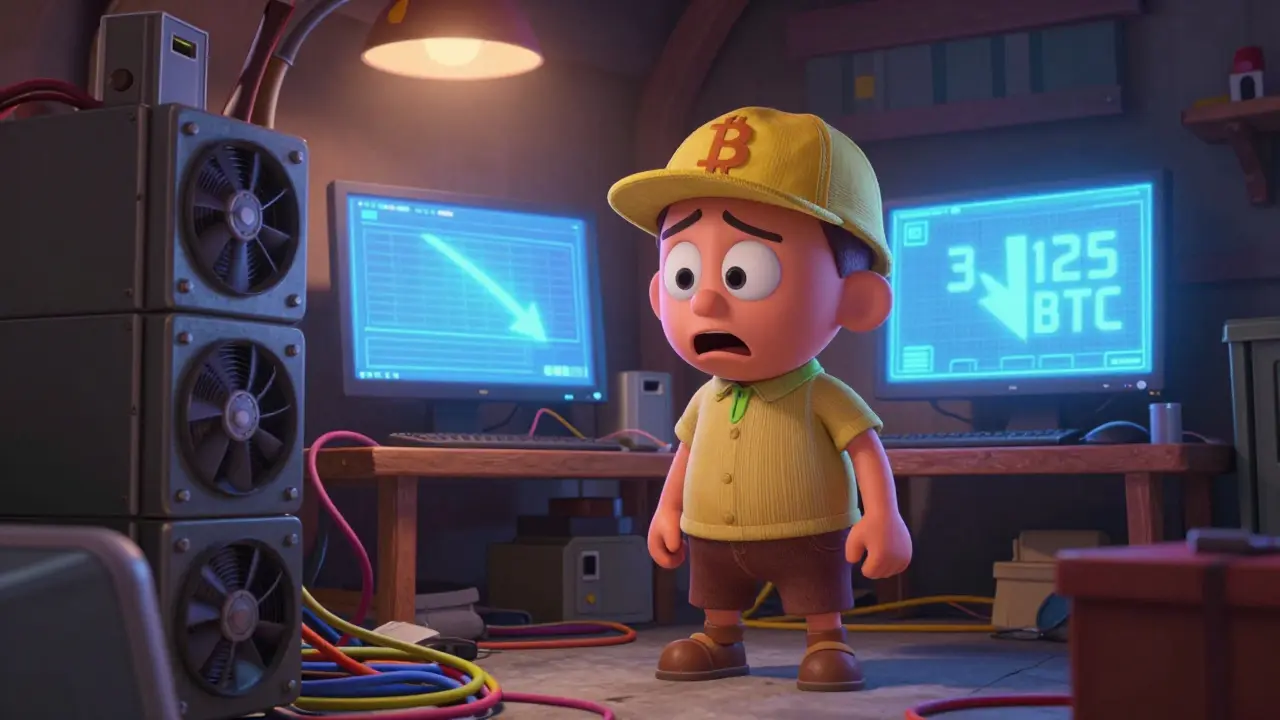
Imagine waking up to find your primary source of income has been cut in half overnight, but your rent, electricity, and equipment costs haven't budged an inch. For thousands of Bitcoin miners, this isn't a nightmare-it's a scheduled event called the halving. When the block reward drops, the industry enters a period of miner capitulation, a brutal process where the inefficient are purged from the network to make room for the lean and the powerful.
| Feature | Pre-Halving | Post-Halving |
|---|---|---|
| Block Reward | 6.25 BTC | 3.125 BTC (since April 2024) |
| Revenue Stream | High reward + fees | Low reward + higher reliance on fees |
| Miner Survival | Broad participation | Only high-efficiency operations |
The Mechanics of the Great Purge
To understand why miners quit, we first need to look at the central entity of this process: Bitcoin Halving is a programmed reduction of the mining reward that occurs every 210,000 blocks, roughly every four years. By cutting the new supply of coins in half, it ensures that the maximum supply never exceeds 21 million BTC.
When this happens, the math becomes unforgiving. If a miner was barely breaking even before the halving, they suddenly find themselves paying more for electricity than they earn in Bitcoin. This creates an immediate profitability crisis. This isn't just about "bad luck"; it's an economic filter. Only those who can lower their costs or increase their efficiency survive. This lead to capitulation-the moment a miner realizes the math no longer works and pulls the plug on their rigs.
Who Actually Survives the Cut?
Not all miners are created equal. The gap between a hobbyist in a garage and an industrial farm in Texas is massive. Survival usually comes down to three things: hardware, power, and cash.
First, consider the hardware. ASIC (Application-Specific Integrated Circuit) miners are the specialized machines used to secure the network. Old models, like those from several generations ago, consume way too much power for the amount of hash rate they produce. New-gen machines, hitting performance ratios over 30 TH/s per 3000W, are the only ones that stay in the green when rewards drop.
Second is the cost of electricity. If you're paying retail rates-say $0.08 per kWh-you're likely doomed. The winners are operations that secure long-term contracts below $0.05 per kWh or those using "stranded energy," such as excess power from hydroelectric dams or wind turbines that would otherwise go to waste.
Finally, there's the "war chest." Big players like Marathon Digital or Riot Platforms often have the capital to operate at a loss for a few months, betting that the price of Bitcoin will rise enough to make their operations profitable again.
The Ripple Effect on Network Hash Rate
When a huge chunk of miners shut down, it doesn't just affect their bank accounts; it affects the entire network. The Hash Rate is the total computational power being used to mine and process transactions on the Bitcoin blockchain. When inefficient miners capitulate, the total hash rate drops. In the months following the April 2024 event, some estimates showed a 10-20% disappearance of global hash rate.
However, Bitcoin has a built-in safety valve called the Mining Difficulty adjustment. Every 2,016 blocks (about two weeks), the network looks at how fast blocks are being found. If too many miners quit and blocks are found slower, the difficulty drops. This makes it slightly easier for the remaining miners to find blocks, effectively redistributing the rewards among the survivors.
| Metric | Danger Zone | Survival Zone |
|---|---|---|
| Electricity Cost | Above $0.06 / kWh | Below $0.04 / kWh |
| Hardware Age | 2+ Generations Old | Current Gen ASIC |
| Cash Reserves | Less than 3 months OpEx | 6-12 months OpEx |
Consolidation: The Rise of the Mining Giants
One of the most cynical parts of miner capitulation is the resulting consolidation. When a small or mid-sized firm goes bankrupt, they don't just vanish. They leave behind valuable assets: energy contracts, data center space, and hardware. Large, publicly traded companies often swoop in to buy these distressed assets for pennies on the dollar.
This trend creates an oligopolistic landscape. We are seeing a shift where mining is no longer a decentralized hobby but an industrial-scale game of efficiency. Companies like Bitdeer and Cleanspark use their scale to negotiate better power deals, which in turn makes them even more efficient, further squeezing out the little guys.
Diversifying the Revenue Stream
Since the block reward is no longer the guaranteed goldmine it once was, miners are getting creative. They can't just rely on the 3.125 BTC per block. Many are now focusing on transaction fee optimization. When the network is congested, transaction fees spike, and these fees are added to the block reward. For a miner with a low electricity cost, these fees can be the difference between a loss and a profit.
We're also seeing a push toward Layer-2 protocols and other ways to monetize the infrastructure. Some mining farms are even pivoting to provide high-performance computing (HPC) or AI hosting services using their existing power infrastructure, essentially turning their "mining" centers into general-purpose data centers to hedge against the volatility of Bitcoin's price.
How to Survive Future Halvings
If you're running an operation, you can't treat the halving as a surprise. It's a known date on the calendar. To avoid capitulation, you need a three-pronged strategy:
- Aggressive Hardware Upgrades: Don't hold onto old gear out of sentiment. If your efficiency isn't improving by 15-25% every cycle, you're essentially mining with a shovel in the age of excavators.
- Energy Arbitrage: Look for power purchase agreements (PPAs) or move to regions with subsidized industrial power. If you can't get your power below $0.04 per kWh, your margins will be razor-thin.
- Liquidity Management: Keep enough cash or liquid BTC to cover at least six months of operational expenses. The period immediately after a halving is often the most volatile; you need to be able to outlast the difficulty adjustment.
Does miner capitulation make Bitcoin less secure?
Actually, it often makes the network healthier in the long run. While a drop in hash rate seems scary, it removes the least efficient players. The remaining miners are more stable, better capitalized, and more committed to the network's long-term viability, which prevents the network from being bogged down by fragile operations.
Why does Bitcoin price usually go up after a halving if miners are suffering?
This is the great paradox of the halving. While miners face a revenue crisis, the market sees a supply shock. With fewer new coins entering the market, scarcity increases. If demand stays the same or grows (thanks to things like Spot ETFs), the price typically rises, which eventually saves the miners who didn't capitulate.
Can a regular person still mine Bitcoin after capitulation events?
For the average person using home electricity, mining is largely no longer profitable. This is why many have switched to "cloud mining" or simply buying and holding the asset. Unless you have access to nearly free electricity, the industrial-scale ASIC farms have effectively priced out the home miner.
What happens to the machines when miners capitulate?
Hardware is usually sold off at a steep discount on the secondary market. Large firms buy these up to expand their footprint cheaply, or the machines are scrapped for their raw materials. In some cases, older gear is repurposed for mining other, less intensive cryptocurrencies, though this is becoming rarer as Bitcoin's dominance grows.
When is the next halving expected?
Based on the 210,000 block cycle, the next halving is anticipated in 2028. By then, the reward will drop again, likely to 1.5625 BTC, making energy efficiency and hardware performance even more critical than they are today.





Michael Harms
Honestly, it's pretty cool to see how the network just heals itself over time. For anyone just starting out, don't let the big industrial farms scare you off from learning about the tech!
Sean Mitchell
The sheer tragedy of the hobbyist miner is truly Shakespearean in its cruelty. To imagine a man pouring his soul into a garage rig only to be dismantled by a pre-programmed mathematical inevitability is nothing short of a cinematic catastrophe.
Luke George
Funny how they call it a "safety valve" but the real winners are just the massive corporations buying up the scrap. It's all a game to centralize the hash rate under a few US-based entities while they pretend it's still decentralized. Just follow the money and you'll see who's actually pulling the strings behind these "difficulty adjustments." Probably just another layer of the system to keep the little guy from ever actually winning.
Joshua Salwen
OH MY GOD, people actually believe the "difficulty adjustment" is just some natural process??!! Its a TOTAL SHAM designed to liquidate the weak hands!! I saw this coming miles away and nobody listened to me!! The whole thing is just a giant wealth transfer to the elites who have the newest ASICs while the rest of us are left with expensive space heaters in our basements!! Absolute madness!!
Shantal Sanjur
Right? Like, imagine actually thinking that
Shantal Sanjur
Right? Like, imagine actually thinking that
Shantal Sanjur
Right? Like, imagine actually thinking that the"safety valve" is for our benefit. It's honestly hilarious that people still fall for the basic mechanics of the system without realizing the industrial complexes are just eating the competition for breakfast. I've seen this movie before and the ending is always the same: total corporate capture of the network. But hey, keep believing in the decentralization fairy tale while the big firms buy your gear for pennies.
Thomas Jewett
It is a disgrace that we allow foreign entities to even compete for this resource when the US should be leadng the way in every single aspect of the digital economy!! If you can't afford the power bills then you dont deserve to secure the network and you should just get out of the way for real americans who know how to run a business without cryin about it!! This is exactly why we need to prioritize our own industrial power grids and stop worrying about some "global" hash rate when the only thing that matters is American dominance!!
John and Lauren Busch
Just vibing with the crash.
Tracy Sperandio
Let's get fired up about this transition! It's a total metamorphosis of the ecosystem. We are moving from a chaotic wild west to a polished, high-efficiency powerhouse. The energy of this shift is electric, literally! We need to embrace the pivot to AI hosting and HPC because that's where the real magic happens. Let's stop mourning the garage miners and start celebrating the birth of the ultra-efficient data era!
Robert Preston
For those wondering about the hardware, you really need to look at the J/TH (Joules per Terahash) ratio. If you're running anything above 30 J/TH in the current climate, you're essentially donating your electricity to the network. It's a tough pill to swallow, but the math doesn't lie. I'd suggest looking into liquid cooling if you're trying to squeeze more life out of older units, though the ROI is often questionable now.
Michelle Stanish
Mining is just a waste of power.
Kaitlyn Wu
It's important to remember that while the transition is harsh, it's a feature, not a bug. We should support those trying to pivot their operations toward sustainable energy. If we can guide the industry toward using that "stranded energy" mentioned, it actually turns a negative into a positive for the environment.
nikki krinkin
I've been following the hash rate drops and it's actually kind of peaceful to see the noise die down. It feels like the network is just breathing, exhaling the inefficient parts to make room for something more stable.
Shannon Kelly Smith
Keep pushing forward everyone! 🚀 The pivot to AI hosting is such a smart move for those with the infrastructure. It's all about adapting and evolving! 💎🙌 Let's get those efficiency gains up! ⚡️
Anna Grealis
probs just a way for the govt to track who has the most power... its all connected. those "energy contracts" are just tethers lol.
Kevin Lư
I mean, who actually cares about the hobbyists? They were just playing around with toys anyway. Let the big boys handle it, it's way more efficient and honestly, way more fun to watch the big numbers move on a corporate balance sheet than some guy in a shed.
Ankit Sindhu
It is very helpful to see the survival metrics laid out like this. For those of you in regions where power is expensive, perhaps consider joining a mining pool or exploring the Layer-2 options mentioned. There is always a way to participate if you are willing to learn and adapt your strategy.
Chintu Parikh
I believe this consolidation is a necessary step toward institutional maturity. While the loss of small-scale mining is regrettable, the increase in professional management will likely lead to a more stable network overall. I am quite optimistic that the synergy between Bitcoin infrastructure and AI will create unprecedented value for all stakeholders involved!
Jeff Barlett
Everyone is acting like the "industrial scale" is a bad thing. I actually think it's hilarious that people are mourning the loss of "decentralized" mining when it was just three guys in a basement in Ohio. Give me the big corporate wars any day, at least there's some actual drama in the boardroom!
Kim Smith
It makes me think about how we view "value" in the first la place... like we spend all this energy just to prove we have the energy to spend it lol. Its kind of a circular philosophy if you think about it long enough. The way these miners just vanish into the ether of the market is almost poetick in a weird way, like digital ghosts left behind by a machine that doesnt care about human effort, only about the hash rate and the math of the universe... just wild how we've built this whole city on a foundation of electricity and code.
Adedamola Oyebo
Hardware resale is key!! Look for the S19s!!
Karen Mogollon Gutierrez
The audacity of the industry to suggest that a mere "adjustment" compensates for the utter devastation of the independent operator is truly appalling. I find the cold, calculating nature of the halving to be an affront to the very spirit of innovation that birthed this technology. It is a tragedy of the highest order that we have traded our autonomy for the sterile efficiency of a corporate data center!
Gillian Kent
i think its ok that some people quit. it just means more room for others who realy want it and have the tools. we all just gotta find our own way to make it work in the long run.
Mike Kempenich
The market always finds a way. Sure, the capitulation hurts now, but the resulting supply shock is what actually fuels the growth. I'm betting on the survivors to lead us into the next bull run with way more efficiency than before.