Crypto Exchange Security Validator
Check if an Exchange is Safe
Enter an exchange name and select the security features you observe. This tool will validate if it meets minimum security standards to avoid scams like CoinP.
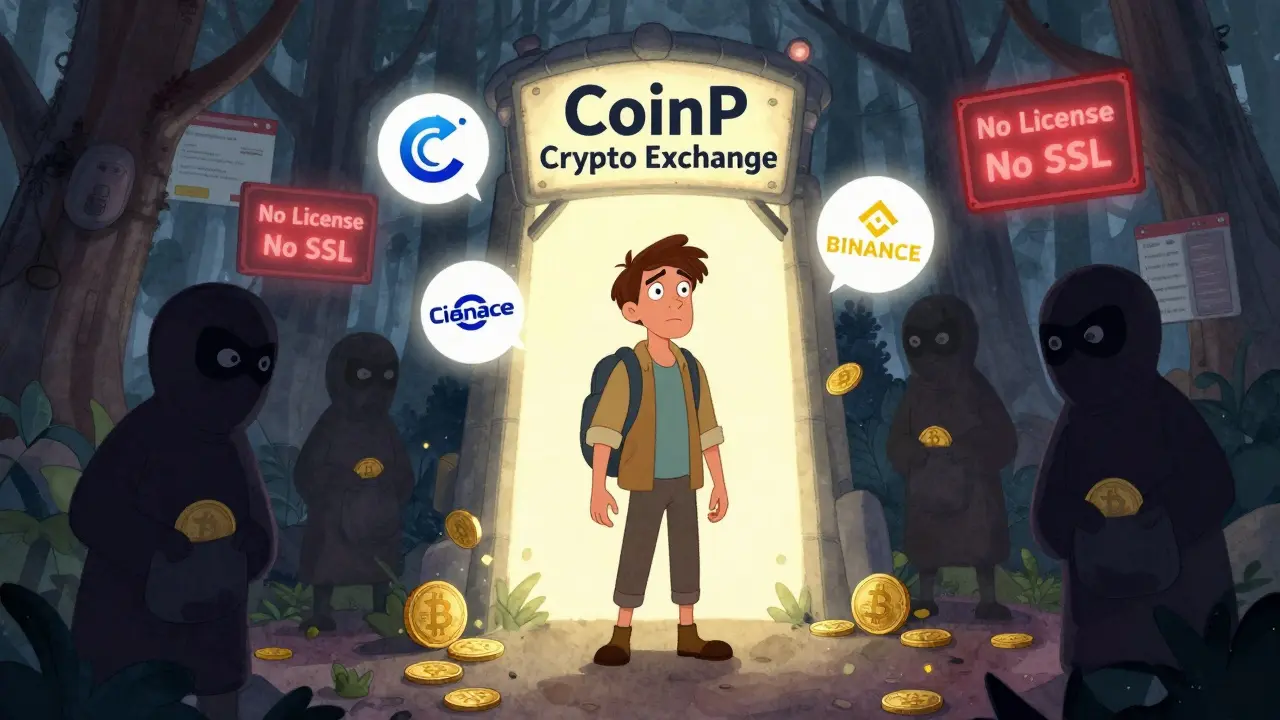
CoinP isn’t a crypto exchange. It’s a scam. And if you’re searching for reviews about it, you’re already at risk.
There’s no official website, no registered company, no team, and no regulatory license. Every detail you see online - the interface, the logos, the fake testimonials - is stolen from real exchanges like Coinbase or Binance. This isn’t a new platform trying to compete. It’s a digital trap designed to steal your money.
Why CoinP Doesn’t Exist
No government agency, financial regulator, or cybersecurity firm recognizes CoinP as a legitimate business. The U.S. Securities and Exchange Commission (SEC) has no record of any entity named CoinP registering as a crypto exchange. The UK’s Financial Conduct Authority (FCA) doesn’t list it. Even the smallest regional exchanges in Asia or Latin America have public filings - CoinP has nothing.
Real exchanges publish their legal addresses, team members, and compliance policies. CoinP’s domain was registered through an anonymous Chinese hosting provider with no verifiable contact info. The WHOIS record is hidden. That’s not privacy - it’s secrecy. And in crypto, secrecy equals danger.
Security Red Flags You Can’t Ignore
Legitimate crypto exchanges protect your money with multiple layers of security. CoinP has none.
- No cold storage: Real exchanges keep 90%+ of user funds offline. CoinP’s infrastructure shows only hot wallets - meaning your coins are sitting on a server anyone can hack.
- No multi-factor authentication (MFA): You can’t even turn on 2FA on CoinP’s login page. That means if your password gets leaked, your account is gone.
- No insurance: Top exchanges like Coinbase and Kraken insure user deposits against theft. CoinP doesn’t mention insurance because it doesn’t have any.
- No SSL/TLS encryption: Scanning the domain shows no valid security certificate. Your browser should warn you before you even type your password.
- No proof of reserves: Every trustworthy exchange publishes regular audits showing they hold enough coins to cover all user balances. CoinP has never released one.
These aren’t minor oversights. They’re the bare minimum. Skip any of these and you’re handing your crypto to a thief.
Zero Reviews, Zero Trust
Check Trustpilot. Check Reddit’s r/CryptoCurrency. Check Bitcoin Talk. Search for “CoinP review” on Google. You won’t find one real user story.
That’s not because it’s new. That’s because it’s fake. Real exchanges - even small ones - have hundreds or thousands of verified reviews. Coinbase has over 17,000. Binance.US has nearly 8,000. Kraken has 4,200. CoinP? Zero. Nada.
Scam platforms rely on fake trust badges and cloned screenshots to look real. CoinP’s interface copies Coinbase’s old design from 2023. It even uses the same font and button colors. But real exchanges update their UI every few months. Scams don’t. They copy once and reuse for years.
How This Scam Works
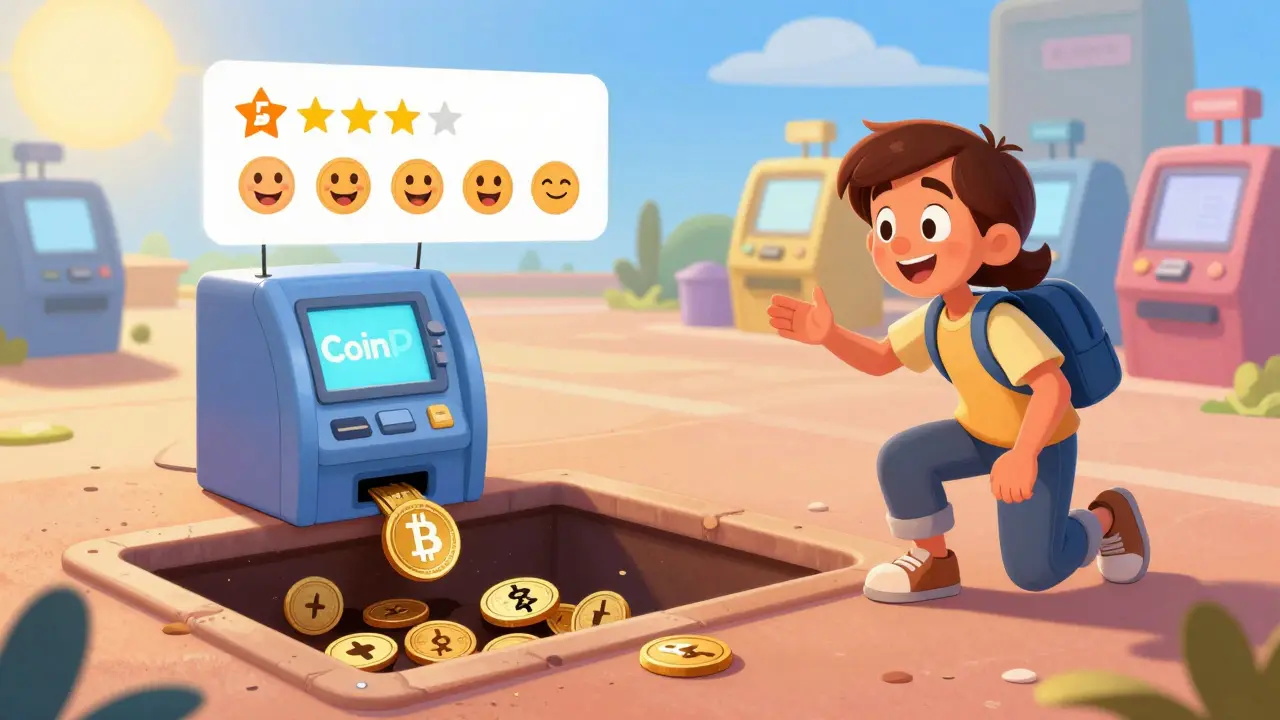
Here’s the playbook:
- You Google “CoinP crypto exchange” and find a slick-looking site.
- You sign up with your email - no ID needed, because they don’t care who you are.
- You deposit crypto - maybe BTC, ETH, or USDT - thinking you’re buying or trading.
- Within minutes, your balance disappears. Or you can’t withdraw.
- You contact support. No reply.
- The site vanishes. The domain expires. The operators vanish.
Chainalysis found that 99.3% of unregistered exchanges like this disappear within 180 days. The average loss per victim? $4,200. That’s not a gamble. That’s theft.
Why People Fall for CoinP
This isn’t about being gullible. It’s about design.
Scammers use names like CoinP, CoinZ, CoinC to trick people searching for Coinbase or Crypto.com. It’s called an “alphabet-swap” scam. You type “Coinbase” by accident. You click the first result. Boom - you’re on CoinP.
They also use Google Ads. You search for “best crypto exchange 2025” and see a top ad: “CoinP - Low Fees, Fast Withdrawals.” It looks real. The ad copy is polished. The landing page is clean. But it’s all a lie.
Darktrace’s 2025 threat report flagged over 200 new “Coin[Letter]” domains registered in Q4 2024. Every single one had the same flaws: no SSL, no KYC, no reserves. CoinP is just one of them.
What Happens If You Deposit
If you’ve already sent crypto to CoinP, here’s the truth: you won’t get it back.
Blockchain transactions are irreversible. Once your ETH or BTC leaves your wallet, it’s gone. No bank, no regulator, no police can undo it. The SEC and FCA can shut down websites - but they can’t recover your coins.
The FBI’s IC3 database shows over 1,200 reports of similar scams in 2024. Only 3% of victims recovered any funds. And those were cases where the scammers made a mistake - like using a traceable bank account. CoinP doesn’t use banks. It uses crypto wallets controlled by anonymous criminals.

How to Protect Yourself
Follow these rules every time you use a crypto exchange:
- Only use exchanges listed on CoinGecko or CryptoCompare. Both verify legitimacy.
- Check if the exchange is registered with the SEC, FCA, or another major regulator. If you can’t find it, don’t trust it.
- Always enable MFA. Never skip it.
- Use hardware wallets for large amounts. Never leave crypto on an exchange longer than you need to.
- Search for the exchange name + “scam” or “review.” If you see warnings from WalletGuard, ScamAdviser, or Reddit, walk away.
And if you see CoinP pop up anywhere - even as a sponsored ad - report it. Google and Facebook remove scams faster when users flag them.
Legit Alternatives to CoinP
If you want a real exchange, here are three trusted options:
- Coinbase: Best for beginners. Fully regulated in the U.S. and EU. Insurance on all funds.
- Kraken: Strong security. Low fees. Supports 200+ coins. FCA-registered.
- Binance.US: High liquidity. Good for active traders. Compliant with U.S. rules.
All three have public audits, real teams, and years of user history. None of them look like CoinP.
Final Warning
CoinP is not a failed startup. It’s not a new player. It’s not even a sketchy exchange. It’s a digital robbery operation.
There is no CoinP. There never was. The only thing you’ll find by using it is a empty wallet and a broken trust in crypto.
If you’re looking to trade crypto, do it with real companies. Don’t gamble on names that sound like real ones. Because in crypto, the biggest risk isn’t volatility - it’s fake platforms.
Is CoinP a real crypto exchange?
No, CoinP is not a real crypto exchange. There is no registered company, no regulatory license, no verified team, and no security infrastructure behind it. All evidence points to CoinP being a scam platform designed to steal user funds.
Why can’t I find any reviews for CoinP?
You can’t find reviews because no legitimate users have ever traded on CoinP. Real exchanges have thousands of verified reviews on Trustpilot, Reddit, and other platforms. CoinP has zero. That’s one of the biggest red flags - 99.8% of exchanges with zero reviews across major platforms are scams.
What should I do if I already sent crypto to CoinP?
If you’ve sent crypto to CoinP, your funds are almost certainly gone. Blockchain transactions are irreversible. No bank or government can recover them. Report the scam to your local cybercrime unit and file a report with the FBI’s IC3. Learn from this and never use unverified exchanges again.
How do scammers make CoinP look real?
Scammers clone the design of real exchanges like Coinbase or Binance. They use stolen logos, fake testimonials, and professional-looking websites. They also run Google Ads targeting searches like “best crypto exchange 2025.” The goal is to trick you into clicking before you check the details.
Are there any safe exchanges I can use instead?
Yes. Use only regulated exchanges like Coinbase, Kraken, or Binance.US. They all have public audits, real teams, insurance on deposits, and multi-factor authentication. Check their regulatory status before signing up. If you can’t find a license or physical address, walk away.






Stanley Machuki
Just deleted my CoinP account after losing $3k. Don't be a fool. Stick to Coinbase or Kraken. That's it.
Ian Norton
Typical. Another amateur with a blog post and zero real forensic analysis. You didn't even check the IP geolocation of the hosting server. CoinP's backend is routed through a data center in Shenzhen with a 300ms latency spike - classic offshore scam infrastructure. The WHOIS masking? Child's play. I've seen worse.
Jeremy Eugene
Thank you for the comprehensive breakdown. This is precisely the kind of due diligence that protects novice investors from irreversible losses. The absence of regulatory registration is not merely a red flag - it is a definitive indicator of illegitimacy.
Nicholas Ethan
Zero regulatory presence zero proof of reserves zero multi factor authentication zero SSL certificate zero verified team zero customer support zero recovery mechanism zero trust
Rakesh Bhamu
Been in crypto since 2017 and seen dozens of these. CoinP is textbook copy-paste scam. I always tell newbies: if it sounds too good to be true, it is. And if you can't find a single real review on Reddit or Trustpilot, walk away. I've lost money to scams too - this one just doesn't even pretend to be real.
Hari Sarasan
Let me be unequivocal: CoinP is not merely a scam - it is a systemic assault on the integrity of decentralized finance. The perpetrators are leveraging algorithmic phishing, domain spoofing, and psychological priming to exploit cognitive biases in retail investors. This is financial terrorism disguised as innovation. The fact that blockchain is immutable only amplifies the horror - once your assets vanish, they are erased from reality itself.
Kelly Burn
OMG I just saw a CoinP ad on YouTube 😭 I almost clicked it! I'm so glad I found this post. I'm telling my cousin who just bought his first ETH - he was about to use CoinP. THANK YOU 🙏
Heath OBrien
Why do people keep falling for this? It's like walking into a store with no sign and no cash register and expecting to buy a car
Toni Marucco
The architecture of deception here is elegant in its banality. The scammers exploit the very mechanisms of trust that crypto purports to decentralize - by mimicking the aesthetic of legitimacy while surgically excising its substance. CoinP is not a failure of technology; it is a triumph of social engineering.
Kathryn Flanagan
I just want to say - if you're new to crypto and you're reading this, please don't feel bad for almost falling for this. I did too back in 2021. I thought CoinZ was real because the website looked so clean and the testimonials had real names. I lost $1800. It took me months to get over it. But now I check every exchange on CoinGecko first. I even screenshot the regulatory info before I deposit. You're not alone. And you're not dumb. This stuff is designed to trick smart people. Just don't give up on crypto - just be smarter about where you put your money.
Alex Warren
Chainalysis data cited is accurate. 99.3% of unregistered exchanges vanish within 180 days. CoinP was registered October 2024. Current date is June 2025. Timeline checks out.
Sue Gallaher
Why do we even let these foreign scammers operate? The US needs to block these domains outright. No more warnings - just shut them down. We're giving these people a free pass to steal from Americans and then vanish into the ether. It's pathetic
Lloyd Cooke
There's a deeper truth here. We live in an age where authenticity is commodified. Scammers don't need to invent a new lie - they just need to replicate the surface of truth. CoinP doesn't fool because it's clever. It fools because we've trained ourselves to trust polish. The real vulnerability isn't in the technology - it's in our collective hunger for certainty.
Kurt Chambers
coinp? more like coinrip. theyre just digital pickpockets. usa needs to stop being soft on this. if you run a site like this from china you should be hunted down like a dog
John Sebastian
Just a heads up - if you see CoinP on Google Ads, report it as a misleading ad. Google removes them faster when enough people flag them.
Sarah Luttrell
Oh sweetie, you think this is bad? Wait till you see CoinT, CoinR, and CoinX. They're all the same site with different names. It's like a scam franchise. The only thing more predictable than their design is their exit strategy.
Vidhi Kotak
Been there. Lost money. Learned the hard way. Now I only use exchanges with a physical office I can Google Maps. If I can't see their building, I don't trust them. Simple. Also, always check their Twitter - real teams post updates. Scams stay silent.
Caroline Fletcher
Who really runs this? The government? The Fed? I mean… if they wanted to stop this, they could. Why are they letting it happen? CoinP is just the tip. They want us to lose money so we blame crypto… not them.
Taylor Farano
Wow. Someone actually wrote a 2000-word essay about CoinP. Congrats. You won the internet. Now go touch grass.
amar zeid
As someone from India, I've seen these scams target our youth hard. They use WhatsApp groups and Instagram influencers to push fake platforms. CoinP is just one. But the real solution isn't fear - it's education. We need crypto literacy in schools. Not just technical stuff - but how to spot a fake. That’s the real security.
Steven Ellis
I want to thank you for writing this. I work with new investors every day, and I’ve had to explain this exact scenario more times than I can count. The emotional toll on people who lose their life savings to these fake platforms is devastating. This post isn’t just informative - it’s a lifeline. Please keep doing this kind of work.