
By 2025, China’s Digital Yuan - officially called e-CNY - isn’t just a pilot project anymore. It’s the most advanced, largest, and most real-world-tested central bank digital currency on the planet. While other countries are still debating whether to launch one, China has already moved billions of dollars through its system. Over 7 trillion e-CNY ($986 billion) has been transacted across 17 cities. That’s more than every other CBDC in the world combined. And it’s not theoretical. People are using it every day - to pay for groceries, ride the subway, get government benefits, and even buy New Year red envelopes.
What Exactly Is the Digital Yuan?
The Digital Yuan isn’t Bitcoin. It’s not a decentralized cryptocurrency. It’s not even a blockchain-based system like some assume. It’s the digital version of the Chinese yuan, issued directly by the People’s Bank of China (PBC). Think of it like cash, but in your phone. You hold it, spend it, and save it - but the central bank knows every transaction. That’s the trade-off: convenience and control. It’s called the Digital Currency Electronic Payment (DCEP) system. The PBC created it in 2014, making China the first major economy to seriously build a sovereign digital currency. By 2020, pilots started in cities like Shenzhen and Suzhou. Now, it’s in 21 cities, with over 260 million users. That’s more than the entire population of Germany.How Does It Actually Work?
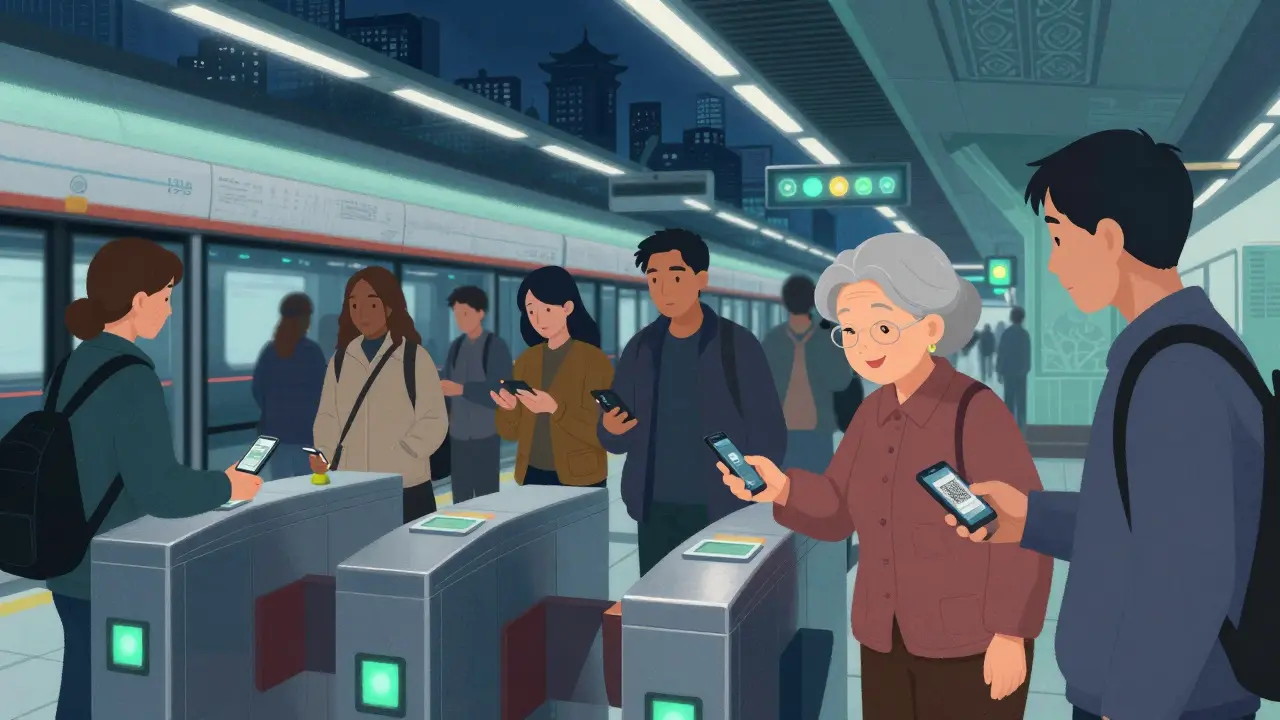
The system uses a two-tier model. The PBC prints the digital yuan and gives it to the four big state-owned banks - ICBC, CCB, ABC, and BOC. Those banks then give it to you through apps. You don’t need a bank account to use it. Just a Chinese ID and a smartphone. You download an e-CNY wallet from one of those banks, or you can add it directly into Alipay or WeChat Pay. Once you do, you can send money to anyone else with the app. Payments happen in under 1.2 seconds - faster than traditional mobile payments. And here’s the kicker: you can send money even when your phone has no internet. It uses NFC or QR codes that work offline. That’s why it’s been a lifesaver during subway outages in Beijing. Unlike Bitcoin or Ethereum, the e-CNY doesn’t run on blockchain. It uses a hybrid architecture designed for speed, scalability, and central control. The PBC can track every transaction. That’s not a bug - it’s a feature. The government wants to see where money flows, especially to stop corruption, tax evasion, and illegal activity.Why Is China Doing This?
There are three big reasons:- Modernize payments: China already has the world’s biggest mobile payment market - over 900 million users. The e-CNY makes that system more efficient, cheaper, and less dependent on private companies like Alibaba and Tencent.
- Reach the unbanked: Even in a digital superpower, some rural elderly people don’t have bank accounts. The e-CNY wallet works with basic phones and doesn’t require credit checks. It’s giving them access to the financial system for the first time.
- Control the future of money: If the dollar loses its global dominance, China wants the yuan to be the next standard. The e-CNY is the first step. By letting foreign tourists and businesses use it in pilot zones, China is testing international adoption. Projects like mBridge with Hong Kong, Thailand, and the UAE are already testing cross-border payments.
What Makes It Different From Other CBDCs?
Only four countries have fully launched retail CBDCs: the Bahamas (Sand Dollar), Jamaica (JAM-DEX), Nigeria (e-Naira), and Zimbabwe (ZiG). But none come close to China’s scale. The Bahamas’ Sand Dollar serves 400,000 people. China’s pilot reaches 260 million. The U.S. is still stuck in debate. Congress has passed laws like the Anti-CBDC Act that block the Federal Reserve from issuing a digital dollar. Meanwhile, the European Central Bank is still in the research phase. China isn’t just ahead - it’s decades ahead in execution. Another key difference: programmable money. In Shenzhen and Suzhou, the government has tested e-CNY with built-in rules. For example, a subsidy for small businesses might only be usable for rent or utilities. A school meal allowance can’t be spent on cigarettes. This level of control is impossible with cash or even traditional bank transfers.What Are the Downsides?
It’s not perfect. The biggest criticism is privacy. With cash, you can buy something anonymously. With e-CNY, the central bank sees exactly what you bought, when, and from whom. Critics say this creates a surveillance state. The PBC says data is protected and only accessed under legal authority - but there’s no independent oversight. Merchant adoption is still spotty. Only 42% of small businesses in pilot cities accept e-CNY. Many don’t have the right POS terminals. And for foreign visitors, it’s a hassle. You need a Chinese ID to open a wallet. Tourists can’t easily use it, even though the government is trying to expand access. Technical glitches happen too. About 7% of users report wallet sync issues. Some apps freeze or lose balance. And while the interface is simple for Chinese users, English documentation is almost nonexistent. That’s a barrier for global adoption.
How Are People Using It?
Real users give us the clearest picture. In Shenzhen, 87% of pilot participants said the app was easy to use. People love the offline feature. One user in Beijing told Caixin Global: “I paid for my dumplings during a subway blackout. My phone didn’t have data, but the QR code still worked.” The government has also used e-CNY to distribute welfare. By mid-2025, 89% of Chinese local governments used it to pay out pensions, unemployment aid, or housing subsidies. That’s more transparent and faster than handing out cash or checks. During the 2024 Lunar New Year, the government gave out 150 million e-CNY in digital red envelopes. People rushed to claim them. It became a viral trend - not because it was new, but because it was fun and useful.What’s Next for the Digital Yuan?
The PBC announced in July 2025 that a “Phase 3” nationwide rollout could begin in Q4 2025. That means every citizen in China could eventually have access. The goal is for e-CNY to make up 15-20% of all retail payments by 2027. Cross-border use is expanding. Hong Kong’s Faster Payment System now connects with e-CNY. That means tourists from Hong Kong can pay in mainland China without exchanging currency. Similar links are being tested with Thailand and the UAE. Internationally, the e-CNY is seen as a geopolitical tool. The Atlantic Council warns it could help China bypass Western financial sanctions. The Cato Institute fears it could erode financial privacy globally. The Regulatory Review says the U.S. is “ceding ground” in the race to define the future of money.Should You Care?
If you’re outside China, you might think this doesn’t matter. But it does. The e-CNY isn’t just about Chinese citizens. It’s about what the next global financial system looks like. If more countries follow China’s model - centralized, programmable, state-controlled - the dollar’s dominance could fade. Trade deals could be settled in yuan instead of dollars. Sanctions might become easier to circumvent. China didn’t just build a better payment app. It built a new kind of monetary system. One that prioritizes control over decentralization, efficiency over anonymity, and state power over private innovation. The world is watching. And whether you like it or not, the Digital Yuan is already shaping the future of money.Is the Digital Yuan the same as WeChat Pay or Alipay?
No. WeChat Pay and Alipay are private payment platforms owned by Tencent and Alibaba. They move money from your bank account or credit card. The Digital Yuan (e-CNY) is actual digital cash issued by China’s central bank. You can link e-CNY to WeChat Pay or Alipay, but the money itself comes from the PBOC, not your bank. It’s like having physical cash in your phone - not a digital card.
Can foreigners use the Digital Yuan?
Limitedly. Foreign tourists can use e-CNY in pilot zones like Beijing, Shanghai, and Shenzhen, but only if they have a Chinese bank account or ID. Some pilot programs allow temporary wallets for visitors, but they’re restricted in amount and duration. Full access requires real-name verification under China’s strict identity system. There’s no easy way for a U.S. or European tourist to just download the app and start using it.
Does the Digital Yuan use blockchain?
No. Despite early speculation, the People’s Bank of China confirmed in 2021 that e-CNY does not rely on blockchain technology. Instead, it uses a centralized ledger system designed for speed and scalability. This allows the central bank to process millions of transactions per second - something blockchain networks like Bitcoin or Ethereum can’t handle. The trade-off is less decentralization, but far greater efficiency.
Is the Digital Yuan a threat to the U.S. dollar?
Potentially, yes - but not immediately. The dollar still dominates global trade, reserves, and finance. But if the e-CNY becomes widely adopted in Asia, Africa, and Latin America for cross-border payments, countries may start settling trade in yuan instead of dollars. That could slowly reduce demand for the dollar. The U.S. isn’t building its own CBDC, while China is already testing international use. That’s a strategic gap.
Can the government track every e-CNY transaction?
Yes. That’s by design. The People’s Bank of China can see who sent money, who received it, when, and for what purpose - especially if programmable features are active. While the PBC says data is protected and only accessed under legal authority, there’s no independent audit system. This level of visibility is far greater than with cash or even credit cards. Privacy advocates see this as a major risk to personal freedom.
Is the Digital Yuan legal tender in China?
Yes. Since 2022, the PBOC has declared e-CNY legal tender, meaning businesses must accept it if offered as payment - just like physical cash. Refusing e-CNY in a pilot zone can be considered a violation of payment regulations. This is different from other digital payment apps, which remain optional.






Alison Hall
This is wild. I never realized how far ahead China is. Offline payments? Programmable money? That’s next-level stuff. I’m not saying I like it, but you can’t ignore the engineering.
Amy Garrett
e-cny? more like e-spy. they know what u bought for lunch. 😳
Haritha Kusal
so cool how theyre helping the elderly and rural folks get access to money! its not just tech for techs sake. its actual change 💛
Mike Reynolds
The offline feature is genius. I’ve been stuck in subway tunnels with no signal and just wanted to buy a snack. This solves that. Honestly, I’m impressed.
Brooklyn Servin
Let’s be real - this isn’t just a currency. It’s a behavioral control system wrapped in a shiny app. Programmable money? You mean the government can decide you can’t spend your subsidy on beer? 🤯 That’s not innovation. That’s authoritarianism with a UX upgrade. And don’t even get me started on the surveillance. This isn’t the future of money - it’s the future of obedience.
Phil McGinnis
The United States is losing the monetary cold war. While we debate privacy, China is building the monetary infrastructure of the 21st century. This is not a technological leap - it is a strategic victory. The dollar is not sacred. It is a relic.
Ian Koerich Maciel
Hmm. The architecture is fascinating - centralized ledger, no blockchain, ultra-low latency... but the trade-offs... the absolute lack of anonymity... it gives me pause. One must ask: is convenience worth the erosion of financial privacy? The answer may vary by culture, but the question remains universal.
Andy Reynolds
I think people are missing the forest for the trees. This isn’t just about payments - it’s about financial inclusion. In rural India or Nigeria, people still use cash because banks are miles away. China’s doing something radical: making digital money accessible without a bank account. That’s huge. We should be studying this, not panicking.
Rick Hengehold
They’re not just tracking transactions - they’re controlling behavior. That’s not finance. That’s social engineering. And it’s working.
Brandon Woodard
Ah yes. The ‘Digital Yuan.’ How progressive. How innovative. How… totalitarian. The PBOC doesn’t issue currency - it issues compliance. Bravo, China. You’ve turned money into a loyalty card.
Antonio Snoddy
You know what this really is? A mirror. We think we’re free because we use credit cards and Venmo, but we’re just trading one form of surveillance for another. Amazon knows what you bought. Google knows what you searched. Facebook knows your feelings. Now China knows what you spent your subsidy on. The difference? At least in China, you know who’s watching. Here? We’re just numb. We don’t even ask anymore. We just tap our phones. The Digital Yuan doesn’t create surveillance - it just makes it visible. And that’s terrifying.
Ryan Husain
The global financial system is at a fork. One path leads to decentralized, open, permissionless money. The other leads to state-controlled, programmable, traceable currency. China chose the latter. The West is still arguing about whether to build a bike lane. We’re not just behind - we’re not even on the same road.
Rajappa Manohar
e-cny is good for poor people. no need for bank. simple.
Daniel Verreault
The programmable money aspect is the real game-changer. Imagine stimulus checks that expire in 30 days unless used on groceries - that’s macroeconomic policy on steroids. We’re not just digitizing money - we’re algorithmizing social policy. The implications for fiscal targeting are massive. We’re talking about dynamic, behavior-influencing monetary policy. This isn’t CBDC 1.0 - it’s CBDC 2.0 with AI integration baked in.
Jacky Baltes
There’s a philosophical question here: Is money a tool of the state, or a right of the individual? The Digital Yuan answers that decisively. It’s not a currency - it’s a covenant between citizen and sovereign. And like all covenants, it comes with obligations. We in the West have spent decades pretending money is neutral. China reminds us: it’s never been.
prashant choudhari
China leads because it acts. Others talk. This is real progress.
Willis Shane
The central bank's control over transactional data constitutes a fundamental shift in monetary sovereignty. The implications for economic policy, fiscal transparency, and illicit financial flows are profound and warrant immediate academic and legislative attention.
Jake West
So China built a better PayPal. Big whoop. Meanwhile, we’re still stuck with banks that charge $35 for a bounced check. This isn’t revolutionary - it’s just another app with a government stamp.
Shawn Roberts
This is the future 😎 offline payments? yes please. no more ‘no signal’ at the dumpling shop. China’s not just ahead - they’re playing 4D chess while we’re still learning checkers
dina amanda
This is how they track everything. Next they’ll control your thoughts. Mark my words - this is step one. The deep state is coming for your wallet. Then your voice. Then your mind. Don’t let them normalize this.