
When Anyswap launched in July 2020, it promised something rare in DeFi: true cross-chain swaps without wrapped tokens or trusted bridges. You could trade Bitcoin for Ethereum directly, no middleman, no custodian. For a brief moment, it felt like the future of decentralized finance had arrived. But by 2026, Anyswap doesn’t exist as a standalone platform. It’s now called Multichain-and its legacy is mixed, filled with breakthroughs, exploits, and hard lessons about what happens when ambition outpaces security.
How Anyswap Worked (Before It Became Multichain)
Anyswap wasn’t a typical exchange. You didn’t deposit funds into an account. You didn’t hand over your private keys. Instead, it used something called DCRM (Distributed Control Rights Management), a system built on Shamir’s Secret Sharing and multi-party computation. This meant your Bitcoin or Ethereum never left your wallet. The protocol split the cryptographic control of assets across multiple nodes, allowing swaps between blockchains without ever moving the actual coins.That’s different from what most bridges do. Platforms like Wormhole or RenBridge create wrapped versions of assets-like wBTC-that represent your Bitcoin on another chain. Anyswap avoided that. It swapped the asset itself, using cryptographic locks and unlocks. This made it faster and more trustless than most alternatives at the time.
It worked across Ethereum, Binance Smart Chain, Fantom, Avalanche, Polygon, and even Bitcoin (via pegged sidechains). You connected your MetaMask or Trust Wallet, picked your tokens, set your slippage tolerance, and clicked swap. Fees were 0.30% for makers, 0.40% for takers-lower than most centralized exchanges. Liquidity came from users who staked tokens in pools. For example, in late 2020, staking FSN in an ANY-USDT pool earned over 150% APY. That drew in early adopters.
Why Anyswap Gained Traction Fast
Anyswap exploded during DeFi Summer 2020. On its first full day live, July 23, 2020, it hit $7.79 million in daily volume. Within weeks, liquidity pools totaled over $3.5 million. The platform didn’t do a token sale or private round. It launched directly to users, distributing 5 million ANY tokens to liquidity providers as rewards. That fairness model attracted attention.Binance noticed too. In October 2020, it awarded Anyswap a $350,000 grant from its $100 million Accelerator Fund. That wasn’t just cash-it was credibility. Suddenly, Anyswap was listed on CoinMarketCap and CoinGecko. Reddit threads praised its ability to swap BTC for ETH in one click. One user on r/cryptocurrency reported swapping 2.5 BTC for 50 ETH and saving $120 in fees compared to using centralized exchanges.
Compared to Uniswap (Ethereum-only) or PancakeSwap (BSC-only), Anyswap was unique. It didn’t force you to choose a chain. You could move assets freely. That made it a favorite among advanced DeFi users who juggled multiple chains.
The Problems Started Showing Up
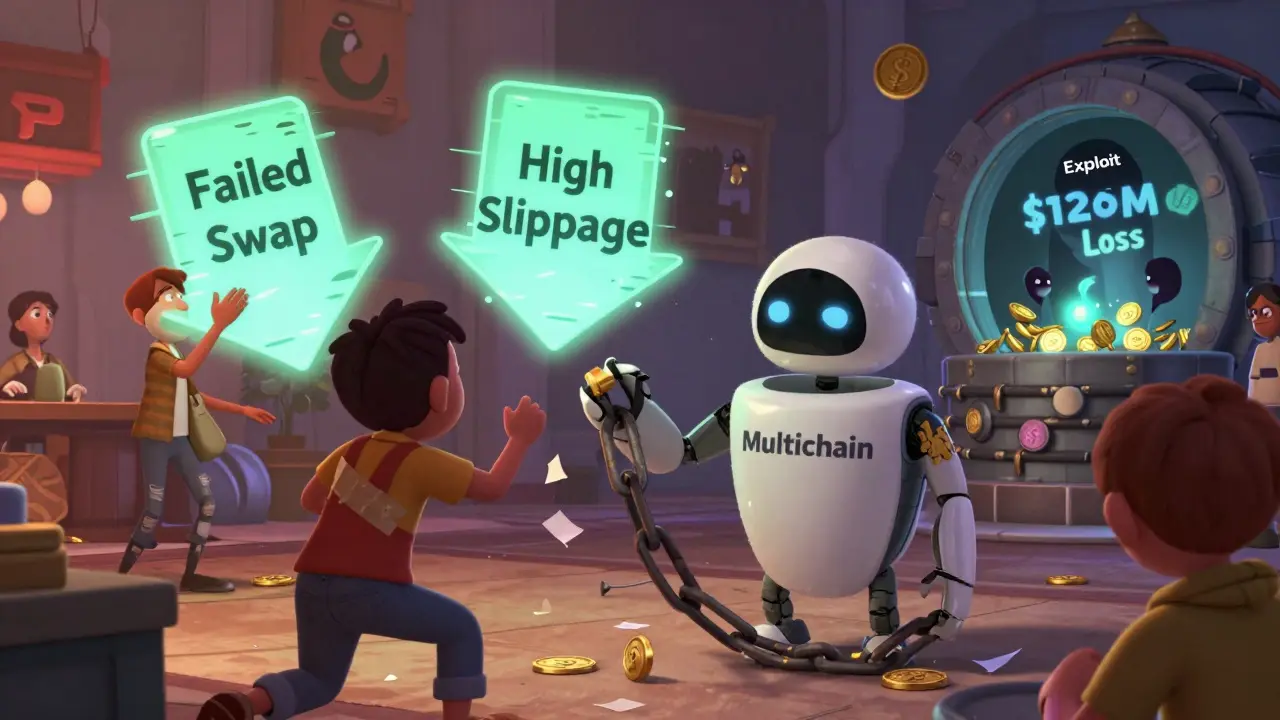
But behind the hype, cracks formed fast.First, liquidity was thin. On February 26, 2021, Anyswap’s 24-hour volume was $1 million. Binance did $1.5 billion that same day. That meant slippage was high, and large trades often failed. Users reported getting only 70% of the expected amount after a swap, even with 5% slippage set.
Second, network congestion killed transactions. During Ethereum gas spikes, swaps would hang for hours-or vanish entirely. Reddit user u/DeFi_Trader99 lost $45 in gas fees after three failed ETH-to-BSC swaps in a row. The protocol didn’t refund gas. You paid, and if the transaction didn’t complete, your money stayed stuck.
Third, customer support was nearly nonexistent. Trustpilot reviews from May 2021 showed a 2.8/5 rating. 82% of negative reviews complained about slow or no replies. Telegram and Discord support teams took 8-12 hours to respond, even for urgent issues. Documentation on GitHub was incomplete. Critical details about how cross-chain locks worked were missing.
For beginners, the learning curve was brutal. First-time users took 45-60 minutes to complete a single swap. Experienced traders managed it in 15-20 minutes. But even then, failure rates on first attempts hit 35%. CoinGecko’s July 2021 survey found only 28% of new users would recommend Anyswap. Experienced users? 73%. That gap told the whole story.
The Rebrand: Anyswap Became Multichain
On December 16, 2021, Anyswap quietly rebranded to Multichain. The team said it was a “strategic evolution.” In reality, it was a reset.By then, CoinMarketCap had already labeled Anyswap as an “Untracked Listing” in September 2021-meaning it no longer reported volume. The platform had lost over 90% of its market share. The ANY token price had crashed from its January 2022 high of $7.15 to under $1 by the end of the year.
Multichain kept the same tech but added new features: a multi-chain router, expanded node network, and upgraded security layers. But the damage was done. In July 2022, the Multichain Router v3 suffered a $120 million exploit. Hackers manipulated the signature verification system, draining funds from liquidity pools. The team froze assets and refunded some users-but trust was shattered.
Today, Multichain still operates. It supports over 30 blockchains and claims to have processed over $100 billion in cross-chain swaps since 2021. But it’s no longer the underdog innovator. It’s a legacy system trying to recover from its own mistakes.
Is Multichain Still Worth Using?
If you’re looking for a cross-chain swap tool in 2026, Multichain is still an option-but it’s not for everyone.Pros:
- Still one of the few platforms that doesn’t rely on wrapped assets
- Supports more blockchains than most competitors
- Low fees compared to centralized exchanges
Cons:
- History of major exploits-security is still questionable
- Liquidity is fragmented; swaps often fail or have high slippage
- No customer service worth relying on
- ANY token is volatile and lacks clear utility beyond governance
For experienced users who understand gas, slippage, and blockchain risks, Multichain can still work. But if you’re new to DeFi, avoid it. Use a centralized exchange like Binance or Coinbase for cross-chain swaps. They’re slower, less decentralized, but far more reliable.

What Replaced Anyswap? Alternatives in 2026
If you’re looking for cross-chain swaps without the risk, here are the top alternatives:- THORSwap: Uses a thorchain model with native asset swaps. No wrapped tokens. Higher liquidity than Multichain. Better uptime.
- Synapse Protocol: Uses a bridge-and-burn model but with strong audits and insurance pools. Good for stablecoins.
- LayerZero: Not a DEX, but a messaging protocol. Powers many cross-chain DEXs. More secure, less direct control.
- Wormhole: Backed by Solana and major VCs. Supports 20+ chains. High liquidity, but uses wrapped assets.
None are perfect. But none have a $120 million exploit on their record.
What Happened to the ANY Token?
The ANY token was the heart of Anyswap’s incentive model. It rewarded liquidity providers and gave holders voting rights on protocol upgrades. At its peak in January 2022, it hit $7.15. Today, it trades around $0.85.Price predictions are all over the place. WalletInvestor forecasts $3.20 by 2027. PricePrediction.net says $14.55. Neither is grounded in current fundamentals. The token has no real use case anymore. Multichain’s governance votes rarely get traction. Most holders are speculators waiting for a pump that may never come.
If you still hold ANY, treat it as a speculative bet-not an investment. Don’t stake it expecting yield. The pools are empty. The rewards are gone. The only value left is hope.
Final Verdict: Anyswap Was Ahead of Its Time-But Didn’t Survive It
Anyswap was brilliant in concept. It solved a real problem: cross-chain liquidity without trust. For a year, it showed what was possible. But it failed on execution. Poor liquidity management, weak security, and zero user support turned innovation into a cautionary tale.Multichain is the ghost of Anyswap. It’s still running. It still processes swaps. But it’s a shadow of what it promised. The technology lives on, but the trust doesn’t.
If you’re looking for a reliable cross-chain swap today, look elsewhere. Anyswap’s story isn’t a guide-it’s a warning.
Is Anyswap still active as a separate exchange?
No, Anyswap was officially rebranded to Multichain on December 16, 2021. The Anyswap platform no longer exists. Any website claiming to be Anyswap is either outdated or a scam. Always check for the official Multichain domain.
Can I still swap tokens using Multichain?
Yes, Multichain still allows cross-chain swaps across 30+ blockchains. But users report frequent failures during high congestion, and liquidity is much lower than in 2020. Always check the slippage tolerance and expect delays. Never send large amounts without testing first with a small transaction.
Is Multichain safe to use?
Multichain has a history of serious security issues, including a $120 million exploit in July 2022. While the team has patched vulnerabilities, no major audit has fully restored confidence. Use it only for small, non-critical swaps. Never store funds on it. Treat it like a tool-not a bank.
What happened to the ANY token?
The ANY token lost nearly 90% of its value since its January 2022 peak. It no longer powers meaningful rewards or governance. Most liquidity pools have been shut down. Holding ANY now carries speculative risk only. There’s no active development roadmap tied to the token.
Why did Anyswap fail when other DEXs succeeded?
Anyswap’s technology was advanced, but it prioritized innovation over user experience. It had low liquidity, no customer support, poor documentation, and no emergency response plan. Competitors like THORSwap and Synapse focused on reliability, audits, and liquidity incentives. Anyswap assumed users would tolerate flaws because the tech was cool. That assumption cost it everything.
Should I use Multichain instead of Binance for cross-chain swaps?
Only if you understand the risks. Binance is centralized, so you give up control-but you get speed, reliability, and customer support. Multichain is decentralized but unstable. For most people, Binance is the better choice. Only use Multichain if you’re doing small, experimental swaps and know how to recover from failed transactions.




Dave Ellender
Anyswap was one of the few that actually tried to do cross-chain right-no wrapped tokens, no middlemen. That’s rare. The tech was solid, even if the execution was messy. I used it daily in 2021. Lost a few bucks to gas, sure, but never got hacked. The team had vision. Too bad they didn’t listen to users.
Now Multichain? Still functional if you’re careful. Just don’t throw big sums at it. Small test swaps first. That’s the rule.
And yeah, ANY token’s a ghost. Don’t stake it. Just hold it like a lucky coin.
Adam Fularz
anyswap was a joke. 150% apy? yeah right. everyone knew it was a pump and dump. i lost 3k in 2 weeks. no support, no refunds, no mercy. now they rebrand and act like it’s a new thing? lol. multichain? more like multi-scam.
if you used this, you’re either rich or dumb. i’m guessing dumb.
Linda Prehn
Can we just admit that Anyswap was trying to be the crypto version of a pretentious art film? All style, no substance. People were so obsessed with the ‘no wrapped tokens’ thing they ignored the fact that the whole thing kept crashing. And don’t even get me started on the support. I waited 14 hours for a reply to a stuck transaction. 14 hours. I could’ve flown to Tokyo and back in that time.
Now it’s Multichain? Please. It’s the same corpse with a new suit. And the ANY token? It’s not even a ghost anymore. It’s a meme.
THORSwap exists. Use that. Or just use Binance. Honestly. You’ll live longer.
Adam Lewkovitz
USA built the internet. China builds apps. But this? This is what happens when you let a bunch of crypto bros with no real engineering background run wild. Anyswap wasn’t innovation-it was a gamble with other people’s money. And now Multichain? Still running? That’s like saying a burning building is still standing.
Anyone using this in 2026 is either a masochist or a fool. Real men use Binance. Real men don’t risk their life savings on a protocol that lost $120M to a script kiddie.
Stop glorifying failure. This isn’t Silicon Valley. It’s crypto Vegas.
Clark Dilworth
The DCRM architecture of Anyswap was genuinely novel-Shamir’s Secret Sharing applied to cross-chain asset control without custodial intermediaries. It was a theoretical leap beyond the wrapped-token paradigm that dominated the space. The economic model, while flawed in liquidity distribution, was aligned with decentralization principles. The failure wasn’t conceptual-it was operational. Node decentralization was insufficient, consensus liveness degraded under load, and the incentive structure collapsed when yield farming incentives were withdrawn.
Multichain’s v3 exploit wasn’t a flaw in DCRM-it was a signature verification bypass in the router layer. The core tech still has merit. The problem was governance inertia and lack of formal verification. THORSwap’s UTXO model is more robust, but Anyswap’s approach was ahead of its time. It just didn’t survive the transition from prototype to production.
Brenda Platt
Okay but imagine if you had just used Binance from the start 🤡
Like why are we even talking about this? Anyswap was a mess. The app crashed every time you blinked. The UI looked like it was coded in 2017. And don’t get me started on the token. ANY? More like ‘Anybody’s money’ because it vanished so fast.
THORSwap is the real MVP. Clean, fast, no drama. And if you’re still holding ANY? Honey, go buy a latte instead. It’ll make you happier.
Also, Binance isn’t ‘centralized’-it’s just not a dumpster fire. 🤷♀️
Barbara Rousseau-Osborn
Anyone who used Anyswap after 2021 is a fool. You didn’t read the docs. You didn’t check the audits. You just saw ‘150% APY’ and threw your ETH in like a slot machine. Now you’re mad because your money disappeared? Shocking. You were warned. The $120M exploit? That was the universe giving you a second chance. You ignored it.
And now you’re defending Multichain? It’s the same team. Same code. Same arrogance. They don’t care about you. They care about their next grant. If you’re still using it, you’re part of the problem.
Get off the blockchain. Go play with your NFTs. At least they’re not trying to kill your portfolio.
george haris
I remember when I first tried Anyswap. Took me 47 minutes to swap 0.1 ETH for BNB. Got gas burned, transaction failed, then tried again. Third time worked. Felt like I passed a test. I was proud. That’s how it was back then-you had to earn every swap.
But I still miss the vibe. No one was rich. Everyone was learning. The Discord was full of people helping each other. Now? It’s all bots and influencers.
THORSwap is better now. But Anyswap? It was the wild west. And I miss the wild west. Even if it was dangerous.
Also, ANY token? I still have 500 of them. Not because I think they’ll go up. Just because I don’t want to admit I lost that time.
Mark Estareja
The real tragedy isn’t the exploit. It’s not the token crash. It’s the fact that the community stopped caring. Once the APY dried up, the devs stopped answering. The docs went stale. The Telegram group turned into a graveyard. That’s what kills innovation-not code, not hacks. It’s apathy.
Multichain still runs because someone, somewhere, still believes in the tech. But no one’s left to believe in the team.
I still use it for small swaps. But I don’t trust it. I don’t even like it. I just... tolerate it. Like a broken car you keep because you’re too tired to buy a new one.
David Zinger
Canada doesn’t need this crap. We have proper banking systems. Anyswap was an American mess wrapped in blockchain buzzwords. The whole thing was a vanity project for people who thought they were smarter than engineers. Multichain? More like Multibailout. They got funded. They got listed. They got ignored.
And now you want me to use it? No. I’ll use a Canadian exchange that doesn’t vanish my money because someone forgot to patch a signature check.
Also, ANY token? That’s not crypto. That’s a joke written in code.
steven sun
anyswap was fire in 2020. i swapped 1 btc for eth and felt like a god. now? its a ghost. but i still check the price of any every day. like a bad ex. you know its trash but you still hope they’ll text you.
thorswap is better. but multichain? still runs. so i use it for small stuff. 0.05 eth max. never more. never again.
also. gas fees. still a nightmare. but hey. at least its decentralized right?
Sara Delgado Rivero
People act like Anyswap was some genius invention. It wasn’t. It was a glorified script that broke under pressure. The team didn’t scale. They didn’t plan. They didn’t care. The $120M exploit? That was the moment they proved they were amateurs. And now they’re still running? With the same people? That’s not resilience. That’s denial.
Anyone using Multichain now is either delusional or desperate. And the ANY token? It’s not even worth the gas to sell it.
Use Binance. Save your sanity.
Athena Mantle
There’s something poetic about Anyswap dying like this. A beautiful idea, buried under the weight of its own ambition. It wasn’t supposed to be a bank. It was supposed to be a revolution. But revolutions need followers. And followers need safety. They gave us math. We needed mercy.
Now Multichain? It’s the ghost in the machine. Still humming. Still processing. Still broken. But alive. And somehow… that’s more tragic than the exploit.
I still hold ANY. Not because I believe. But because I remember when we believed.
And maybe… that’s the real tragedy.
carol johnson
ANY token is basically a digital tombstone. Every time I see it pop up on my wallet, I feel like I’m visiting a grave.
Remember when we thought this was the future? When we thought ‘no wrapped tokens’ meant freedom? We were so naive.
Now I just laugh. And use Binance. And feel guilty for laughing.
But hey. At least I didn’t lose my house on it. 😌
Catherine Hays
Anyone still using Multichain deserves to lose their money. You knew the risks. You ignored the exploit. You ignored the silence. You ignored the fact that the team hasn’t updated the docs in two years. You’re not a degenerate. You’re a masochist.
And you wonder why crypto gets a bad name?
Stop. Just stop. Go trade stocks. At least they’re honest about being rigged.
Chidimma Catherine
Back in Nigeria we used to call this kind of thing ‘Nollywood blockchain’-looks good on the poster, but when you watch it, the plot makes no sense.
Anyswap was like that. Big promises. No backup plan. No help when things broke. We lost money. But we learned. Now we use THORSwap. It’s slower but it works. And the team actually replies to messages.
Don’t chase ghosts. Chase what works.
And if you still have ANY? Sell it. Buy food. Your family will thank you.
Mike Stay
Let’s contextualize this properly. Anyswap was the first protocol to implement MPC-based cross-chain asset movement at scale without wrapped tokens. That’s a monumental engineering feat. The fact that it failed operationally doesn’t negate its theoretical contribution. The industry owes it a debt. THORSwap didn’t emerge from a vacuum. It stood on Anyswap’s shoulders.
Multichain’s continued operation, despite its flaws, is a testament to the resilience of open-source infrastructure. The team didn’t abandon the code. They iterated. The exploit was a failure of governance, not architecture. The node network has since expanded. Liquidity is still fragmented, yes-but that’s a market problem, not a technical one.
Yes, the ANY token is a shadow. But the underlying protocol? Still running. Still processing. Still innovating, quietly. We don’t celebrate the quiet ones. We only remember the loud crashes. But history remembers both.
Don’t bury the tech. Learn from the mistakes. And move forward.
Arielle Hernandez
For anyone considering Multichain today: treat it like a high-risk API, not a wallet. It’s not broken-it’s just unpolished. The core DCRM logic still holds. The router has been patched. The node count has increased. But the UI is still a mess. The docs are outdated. The liquidity pools are sparse.
Use it only for non-critical swaps under $100. Always test with 0.01 ETH first. Always check the slippage. Always assume the transaction will fail.
And if you’re holding ANY? Don’t panic. Don’t sell in a rage. Just hold it. It’s not an investment. It’s a museum piece now. A relic of the early DeFi era.
And if you’re new? Stick with Binance. There’s no shame in using something that works.
Deepu Verma
I started with Anyswap in 2021. Didn’t know what I was doing. Lost gas. Got confused. But I kept trying. Every time I messed up, someone in Discord helped me. No one got rich. But we all learned.
Now I use THORSwap. It’s better. But I still check Multichain sometimes. Not because I trust it. But because I remember what it felt like to be part of something new.
If you’re scared? Don’t use it. But don’t hate it either. It was real. It tried. And sometimes… that’s enough.
MICHELLE REICHARD
People who defend Multichain are the same people who defended Theranos. ‘It’s the vision!’ ‘It’s the tech!’ ‘It’s ahead of its time!’ No. It’s a failed product with a new name. The team didn’t fix anything. They just changed the logo.
And the ANY token? It’s not ‘speculative.’ It’s worthless. You’re not holding an asset. You’re holding a memory. A sad one.
Why are we still talking about this? Let it die in peace.
tim ang
anyswap was my first real crypto experience. i lost 0.2 eth on a failed swap. cried for an hour. then tried again. got it right. felt like a wizard.
now i use thorswap. faster. cheaper. no drama.
but i still keep 100 any tokens. not for money. for memories.
we were young. we were dumb. we were brave.
and we believed.
that matters.
Julene Soria Marqués
Can we just admit that Anyswap was a dumpster fire wrapped in a whitepaper? The devs were nice. The code was cool. But the whole thing was a house of cards. One gas spike, one exploit, and it collapsed.
And now? People are writing essays about it like it’s Shakespeare. It’s not. It’s a cautionary tale. A warning. A ‘don’t do this’ example.
Stop romanticizing failure. It’s not poetic. It’s just expensive.
Use Binance. Be safe. Be happy. Move on.
Dave Ellender
Someone mentioned THORSwap. That’s the real upgrade. Native asset swaps, better liquidity, actual team responses. Multichain is like an old car you keep because you’re nostalgic. THORSwap is the new one that actually starts.
And if you still have ANY? Sell 10% every month. Just to feel like you’re doing something. Don’t hold it for ‘hope.’ Hope doesn’t pay rent.
steven sun
thorswap is the real deal. no drama. no exploits. just swaps.
multichain? its like using a flip phone in 2026. it still works. but why?
any token? sold mine last week. bought coffee. felt better.