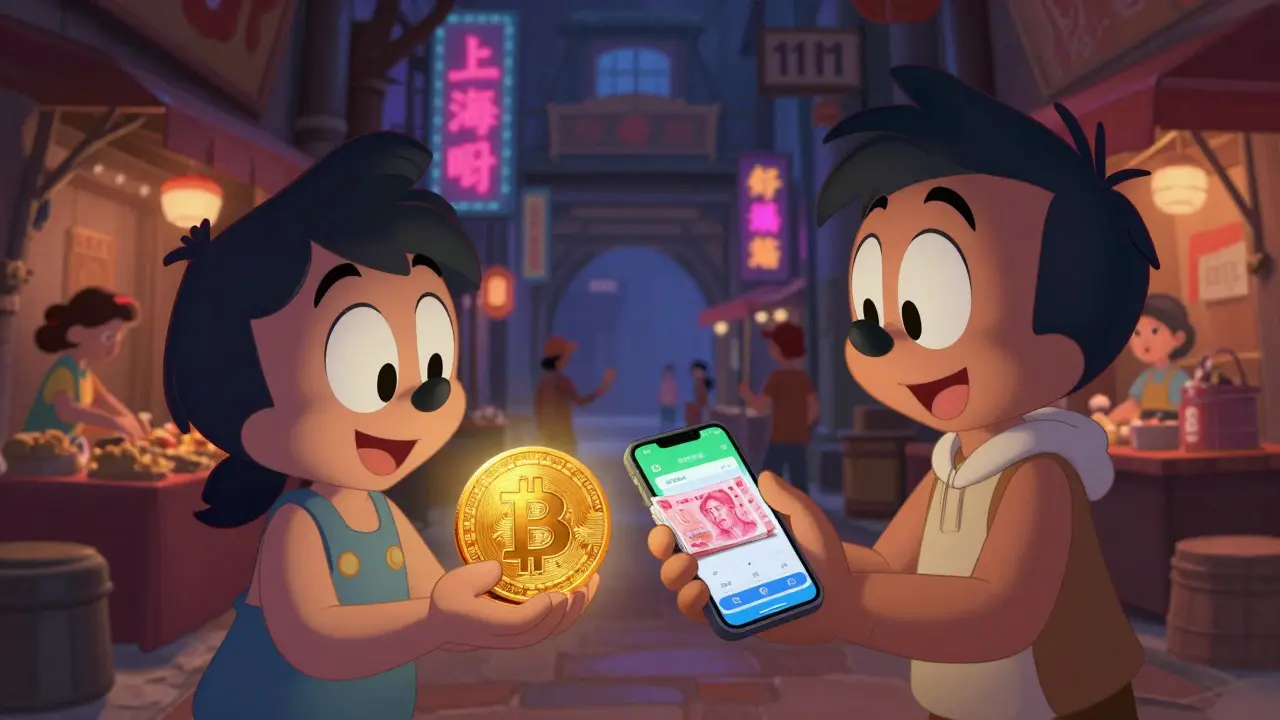
Imagine trying to buy a coffee with Bitcoin in Shanghai. You can’t just pull out your phone and scan a QR code at the local café. In fact, you’d be breaking the law if you tried to use it for payment. Yet, between July 2022 and June 2023, Chinese traders moved an estimated $86.4 billion in cryptocurrency transactions despite comprehensive government bans. That’s more than Hong Kong’s legal market volume of $64 billion during the same period. How does a market worth nearly 3% of China’s GDP survive under a strict prohibition? It goes underground.
If you’re looking at the Chinese crypto scene from the outside, it looks like a graveyard. Exchanges are gone, miners have fled, and banks refuse to touch digital assets. But look closer, and you’ll see a bustling, hidden economy. This isn’t just about stubborn enthusiasts; it’s driven by real economic pressure. With China’s stock market delivering some of the world’s worst performances recently-think the blue-chip CSI Index dropping significantly over three years-investors are desperate for alternatives. They aren’t just gambling; they’re hedging against a stagnant domestic financial system. But playing this game comes with serious risks that don’t exist in regulated markets like the US or Europe.
The Legal Gray Zone: What You Can and Cannot Do
The rules here are nuanced, which is exactly what makes them dangerous. In 2021, the People’s Bank of China (PBOC) issued a sweeping ban on all cryptocurrency trading and mining. This wasn’t a suggestion; it was a mandate. Major exchanges like Binance and Coinbase were forced to shut down operations within mainland China. Banks are explicitly prohibited from facilitating any crypto-related business activities. If you try to open a bank account linked directly to a crypto exchange, expect rejection.
However, there’s a twist. While commercial trading and mining are illegal, personal ownership of digital assets like Bitcoin and Ethereum technically remains legal. Chinese courts have even referred to cryptocurrencies as 'legal property' in recent rulings, giving individual holders a degree of legitimacy. But don’t let that lull you into a false sense of security. The moment you start buying, selling, or exchanging these assets commercially, you step back into the red zone. Enforcement can be unpredictable. One day you’re fine; the next, your bank account might be frozen because a transaction looked suspicious to their algorithms.
| Activity | Official Status | Real-World Practice |
|---|---|---|
| Personal Ownership | Legal (as property) | Common; held in private wallets |
| Exchange Trading | Banned | Done via VPNs and offshore platforms |
| Mining | Banned | Largely relocated to Kazakhstan/US |
| P2P Payments | Gray Area | Widespread via WeChat/Alipay transfers |
| Bank Services | Prohibited | Banks freeze accounts linked to crypto |
How the Underground Market Actually Works
So, how do people trade without exchanges? They rely on Peer-to-Peer (P2P) networks and Over-the-Counter (OTC) brokers. Think of it like buying gold bars from a guy in an alley, but digital. Traders use Virtual Private Networks (VPNs) to access international exchanges like OKX or Bybit, which still serve Chinese users despite the ban. They deposit fiat currency into a bank account, then transfer it to another user’s account via Alipay or WeChat Pay, while the seller releases the crypto from escrow.
For larger sums, usually ranging from $10,000 to $1 million, traders turn to OTC desks. These are often based in Hong Kong or Singapore but cater to mainland clients. The proportion of large retail transactions in China is nearly twice the global average, suggesting that sophisticated investors dominate this space. They aren’t day-trading meme coins; they’re moving significant capital. Many high-net-worth individuals set up corporate entities in Hong Kong to legally hold assets, using those structures to interact with global markets while keeping their main residence in mainland China.
Stablecoins play a crucial role here too. Because converting Bitcoin directly to Yuan is tricky and risky, many traders move funds into Tether (USDT) first. It acts as a buffer, allowing them to park value in a dollar-pegged asset before deciding whether to exit to fiat or stay in crypto. This strategy reduces exposure to Bitcoin’s volatility while navigating the regulatory maze.

The Real Risks: Beyond Just "Illegal"
When we talk about risk in China’s underground crypto market, we’re not just talking about price crashes. We’re talking about existential threats to your capital. First, there’s the legal risk. While owning Bitcoin isn’t a crime, participating in commercial trading is. If authorities decide to crack down hard, your assets could be seized, and you could face fines or even criminal prosecution for engaging in unauthorized financial activities. There is no consumer protection agency to call if your OTC broker disappears with your money.
Then there’s the operational risk. Counterparty default is huge. In a P2P trade, you’re trusting a stranger to send you the crypto after you’ve sent the cash. Scams are rampant. Fake buyers will claim they’ve paid, show you a screenshot, and wait for you to release the coins. If you’re not careful, you lose both. Furthermore, technical vulnerabilities abound. Using a free, slow VPN to access a major exchange can lead to timeouts during critical market movements. Your order doesn’t fill, and you miss the entry point.
Financially, the lack of liquidity channels is a killer. Getting your profits back into clean Yuan is difficult. Banks monitor transactions closely. A sudden large deposit from an unknown source can trigger a freeze. You might have to spend weeks proving the source of funds, dealing with bureaucratic hurdles that don’t exist in regulated jurisdictions. Some traders resort to using family members’ accounts or splitting deposits across multiple cards, adding layers of complexity and stress.
Why Investors Still Bother: The Economic Driver
You might wonder why anyone would endure this hassle. The answer lies in the alternative. Traditional investment avenues in China have struggled. The real estate sector, once the go-to store of wealth, has faced a prolonged crisis. Stock market performance has been dismal, with analysts noting that earnings at listed companies consistently miss forecasts. When your local options yield low returns or carry high systemic risk, Bitcoin starts looking attractive again.
It’s also about diversification. The Chinese Yuan is subject to capital controls, meaning you can’t easily move money out of the country. Crypto offers a workaround. For wealthy families, holding a portion of their wealth in decentralized assets provides a hedge against policy shifts. Even though the Digital Yuan (e-CNY) is being rolled out aggressively to maintain state control, it lacks the anonymity and borderless nature of Bitcoin. For those who distrust centralized systems, the underground crypto market remains a vital escape valve.

Survival Strategies for the Modern Trader
If you’re operating in this environment, adaptability is key. Successful traders don’t rely on one method. They use a mix of tools. Most maintain active accounts on international exchanges accessed via reliable, paid VPN services. They avoid using their primary bank accounts for direct crypto interactions, opting instead for secondary accounts or trusted intermediaries.
- Use Reputable OTC Desks: Avoid random Telegram contacts. Stick to established firms with physical offices in Hong Kong or Singapore that offer KYC verification.
- Leverage Stablecoins: Keep most of your portfolio in USDT or USDC to minimize conversion friction when exiting positions.
- Diversify Banking Relationships: Don’t put all your eggs in one bank basket. Spread transactions across different institutions to reduce the chance of a total freeze.
- Stay Updated on Policy: Regulations change fast. Follow official announcements from the PBOC and local regulators in Shanghai, where discussions on stablecoin regulations have hinted at potential future openings.
Community feedback suggests that psychological resilience is just as important as financial savvy. The constant fear of enforcement actions creates stress. Traders report spending hours verifying counterparties and double-checking transaction details. It’s not passive investing; it’s active management in a hostile environment.
The Future: Crackdown or Controlled Entry?
Will China ever fully embrace crypto? Probably not in the way the West does. The government’s priority is maintaining monetary sovereignty through the e-CNY. However, the sheer scale of the underground market suggests that outright suppression has limits. Recent talks in Shanghai about regulating stablecoins indicate a possible shift toward controlled integration. Perhaps we’ll see a sandbox model where specific digital assets are allowed under strict supervision.
Until then, the paradox continues. The ban exists, but so does the market. For now, underground trading remains a high-stakes game of cat and mouse, driven by smart money seeking refuge from traditional finance’s shortcomings. If you’re considering entering this arena, understand that you’re not just trading assets; you’re navigating a complex web of legal, operational, and reputational risks. The rewards can be significant, but the path is anything but smooth.
Is it illegal to own Bitcoin in China?
No, personal ownership of Bitcoin is technically legal and recognized as 'legal property' by Chinese courts. However, using it for payments or engaging in commercial trading activities is strictly prohibited.
Can I use Binance in China?
Binance officially withdrew from mainland China in 2021. However, many Chinese users still access it via VPNs. Transactions are handled through P2P methods since direct bank integrations are blocked.
What are the biggest risks of underground crypto trading?
The main risks include bank account freezes due to suspicious transactions, counterparty scams in P2P trades, lack of legal recourse in disputes, and potential asset seizure if authorities deem activities commercial rather than personal.
How do Chinese traders buy crypto without exchanges?
They primarily use Peer-to-Peer (P2P) platforms and Over-the-Counter (OTC) brokers. Funds are transferred via WeChat Pay or Alipay to counterparties, who then release cryptocurrency from escrow wallets.
Does the Digital Yuan replace Bitcoin in China?
Not entirely. The e-CNY is a centralized digital currency controlled by the state. Bitcoin remains popular among underground traders for its decentralization and ability to bypass capital controls, serving a different purpose than the e-CNY.