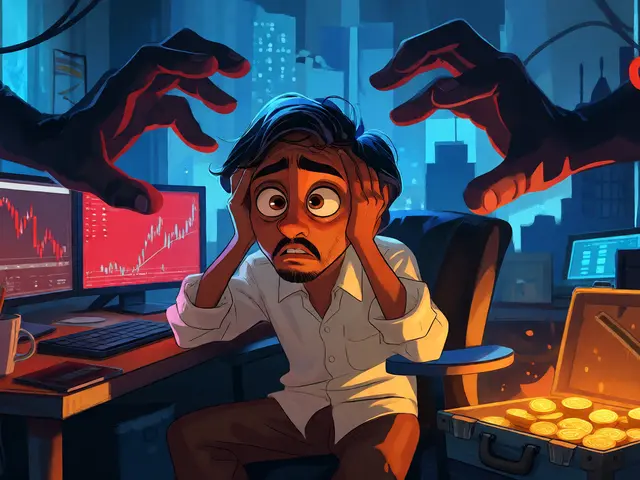
Imagine checking your portfolio and seeing a token you bought last week skyrocket by 300% overnight. You feel like a genius. Then, the next morning, it crashes 80%. Where did all that value go? It didn't evaporate; it was likely siphoned off by someone who knew the game before you did. This is the dark underbelly of market cap manipulation in cryptocurrency markets.
Unlike traditional stock exchanges where regulators watch every tick and trade, the crypto world operates with far less oversight. This freedom attracts honest builders, but it also invites sharks. These manipulators don't just move prices; they rewrite the reality of what an asset is worth, often leaving retail investors holding the bag. Understanding how these schemes work isn't just about protecting your money-it's about understanding the true nature of the market you are participating in.
The Anatomy of a Pump and Dump Scheme
The most common tactic in the crypto playbook is the pump and dump scheme. It sounds simple, but its execution is deceptive. A group of traders or influencers identifies a low-liquidity token-often one with few buyers and sellers. They quietly accumulate a large position without moving the price significantly. Once they have enough chips on the table, they start the "pump."
This phase involves coordinated buying and heavy social media hype. Influencers post glowing tweets, private Telegram groups buzz with excitement, and volume spikes appear on charts. Retail investors see the momentum and fear missing out (FOMO), rushing to buy. As the price inflates, the manipulators execute the "dump," selling their entire position into the new wave of buyers. The result? The price collapses, and latecomers are left with assets that may never recover their inflated value.
This isn't just theory. In 2023 alone, over 90,000 tokens were flagged for involvement in such schemes, generating an estimated $241.6 million in profits for the manipulators. The severity of this issue caught the attention of law enforcement. In October 2024, the FBI launched "Operation Token Mirrors," creating a fake cryptocurrency called NexFundAI to catch fraudsters red-handed. The sting operation revealed a $25 million scheme and led to charges against 18 individuals for market manipulation and conspiracy. If federal agents need to create fake coins to catch them, you can imagine how hard it is to spot these schemes in real-time.
Wash Trading: Creating Ghost Volume
If pump and dumps rely on hype, wash trading relies on illusion. This practice involves traders conducting trades amongst themselves to feed misleading volume signals. By using ghost accounts or unregulated exchanges, manipulators make it look like there is massive demand for a coin when, in reality, no new money is entering the system.
Why does this matter? High volume suggests liquidity and interest. When an exchange shows billions in daily trading volume, it attracts new investors and coin listings. Research suggests that wash trading can represent over 70% of volume on some unregulated crypto exchanges. For small-cap altcoins traded on smaller platforms, this distortion is even more severe. A token might appear to be trending because of organic interest, but blockchain analysis often reveals circular movements of funds between linked addresses, proving the activity was artificial.

Spoofing and Sell Walls: Controlling the Price Range
Spoofing is a subtler form of manipulation that doesn't always involve buying or selling immediately. Instead, manipulators place large buy or sell orders with no intention of executing them. These orders sit on the order book, creating false impressions of supply or demand.
A specific variation known as "sell wall manipulation" is particularly effective. Here, a whale places a massive sell order at a specific price level, creating artificial resistance. This prevents the price from rising while the whale accumulates tokens at lower prices below the wall. Once they have acquired enough inventory cheaply, they remove the wall. With the artificial ceiling gone, the price often spikes, allowing them to sell their accumulated holdings at a profit. This tactic exploits the fragmented nature of crypto markets, where different exchanges have different order books, making it difficult for surveillance teams to track the full picture across multiple platforms.
Oracle Manipulation: Breaking the DeFi Backbone
Decentralized Finance (DeFi) introduced a new layer of complexity: oracles. Oracles are smart contracts that bring external data, like token prices, onto the blockchain. Since DeFi protocols rely on these prices for lending, borrowing, and swapping, manipulating the oracle itself becomes a high-stakes game.
The most notorious example occurred in October 2022 with Mango Markets on Solana. Crypto trader Avraham Eisenberg and associates manipulated the price oracle by making leveraged purchases of Mango tokens, which shot up in value and were used as collateral for loans. They extracted $115 million in profit through this strategy. Although Eisenberg defended his actions as a "highly profitable trading strategy" rather than a hack, the SEC eventually arrested him and charged him with violating anti-fraud and market manipulation provisions. Mango Markets sued to recover the remaining $47 million plus interest. This case highlighted that even in decentralized systems, centralized points of failure exist, and those who understand the code can exploit them.

How to Spot the Red Flags
Detecting manipulation requires looking beyond the price chart. While it's impossible to predict the exact timing of a scheme, several warning signs can help you identify potential traps:
- Sudden Volume Spikes Without News: If a low-profile token sees a 500% increase in volume with no corresponding fundamental development or announcement, be skeptical.
- Coordinated Social Media Campaigns: Look for identical hashtags or messages appearing across different influencer accounts within a short timeframe.
- Low Liquidity Ratios: Tokens with very low liquidity relative to their market cap are easier to manipulate. A small amount of capital can move the price significantly.
- Unusual Order Book Patterns: Large, static orders that disappear when the price approaches them are classic signs of spoofing.
Blockchain analysis tools can also help by tracking wallet movements. If you see funds moving in circles between a few addresses, it’s a strong indicator of wash trading. However, this requires specialized knowledge and access to on-chain data, so most retail investors should rely on heuristics and due diligence.
| Tactic | Mechanism | Primary Target | Detection Difficulty |
|---|---|---|---|
| Pump and Dump | Coordinated buying + Hype, then selling | Low-liquidity tokens, new ICOs | Medium (requires social listening) |
| Wash Trading | Self-trading to inflate volume | Unregulated exchanges, small caps | High (requires on-chain analysis) |
| Spoofing/Sell Walls | Fake large orders to suppress/boost price | Liquid pairs on major exchanges | Medium (visible in order books) |
| Oracle Manipulation | Tampering with price feeds in DeFi | DeFi protocols with weak oracle design | Very High (requires technical audit) |
The Regulatory Landscape and Future Outlook
For years, crypto operated in a regulatory gray zone. That is changing. Traditional securities laws are increasingly being applied to digital assets, as seen in the SEC's pursuit of Avraham Eisenberg. However, the global and decentralized nature of crypto presents unique challenges. A manipulator in one country can easily operate on an exchange in another, making jurisdictional enforcement complex.
As markets mature and institutional participation grows, manipulation may become more sophisticated but potentially less prevalent in mainstream assets. Institutions require transparency and clean data, which naturally filters out many obvious scams. However, the long tail of thousands of new tokens and emerging DeFi protocols will continue to provide opportunities for manipulators to exploit less experienced investors. The key takeaway is that vigilance is not optional; it is a requirement for survival in this market.
What is the difference between market cap and fully diluted valuation?
Market cap is calculated by multiplying the current price by the circulating supply of tokens. Fully Diluted Valuation (FDV) multiplies the current price by the total supply, including tokens that are locked or not yet released. Manipulators often target tokens with a large gap between these two figures, as future unlocks can cause significant price pressure.
Can whale wallets be tracked to prevent manipulation?
Yes, blockchain analytics firms use clustering algorithms to link multiple wallets to a single entity. By monitoring these "whale" clusters, investors can see if a large holder is moving funds to an exchange (a sign of potential selling) or accumulating in cold storage. Tools like Glassnode and Whale Alert provide public data on these movements.
Is wash trading illegal in all jurisdictions?
In regulated markets like the US and EU, wash trading is generally considered market manipulation and is illegal. However, in offshore jurisdictions with lax regulations, it remains widespread. Enforcement depends on whether the exchange or trader falls under the jurisdiction of a regulator willing to pursue the case.
How do I protect myself from pump and dump schemes?
Avoid FOMO-driven buying, especially in low-liquidity tokens. Check the distribution of holders-if a few wallets hold a massive percentage of the supply, risk is high. Use limit orders instead of market orders to avoid slippage, and always have an exit strategy defined before you enter a trade.
Do central banks monitor crypto market manipulation?
Currently, central banks focus more on monetary policy and financial stability rather than individual market manipulation cases. That role typically falls to securities regulators like the SEC in the US or the FCA in the UK. However, as crypto integrates into the broader financial system, central bank oversight may expand to include market integrity concerns.