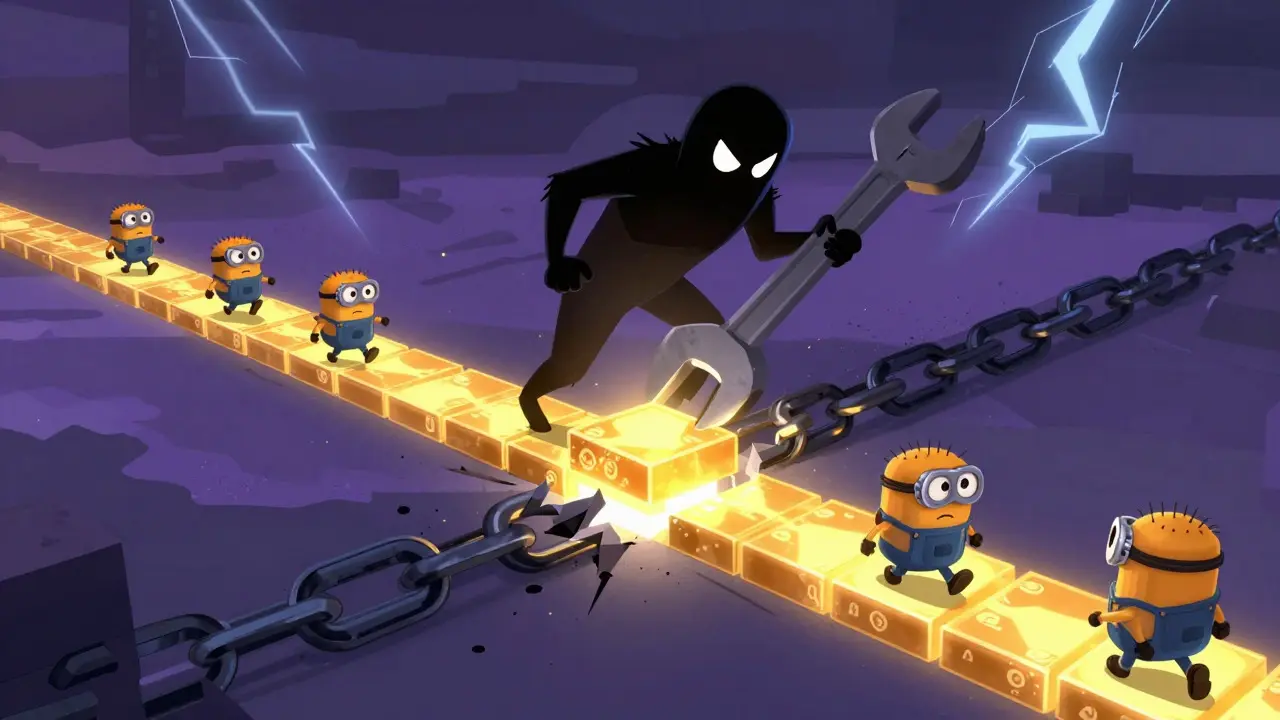
Imagine waking up to find that your confirmed Bitcoin transaction has vanished. The coins are back in your wallet, and you can spend them again. This is the nightmare scenario of a 51% attack, where an entity controls more than half of a network's computing power to rewrite history. While often portrayed as a permanent catastrophe, these attacks are rarely the end of the road. In fact, most successful recoveries rely on a simple mathematical truth: if honest nodes regain control, the attacker’s chain becomes mathematically obsolete.
The core problem isn't just about losing money; it's about breaking the consensus mechanism. When an attacker dominates the hashrate, they can prevent new transactions from being recorded, reverse existing ones, or double-spend coins. However, the recovery process is not a single event but a gradual restoration of trust. It involves both the automatic self-healing properties of Proof of Work protocols and deliberate actions by developers and exchanges. Understanding how this healing happens is crucial for anyone holding assets on smaller or newer chains.
How the Network Self-Heals
The beauty of Bitcoin and similar Proof of Work blockchains lies in their resilience. Once the majority of hashing power returns to honest miners, the network doesn't need a manual reset. It simply continues to build blocks on the longest valid chain. The probability that an attacker’s fork will ever overtake the honest chain drops exponentially with every new honest block added. Think of it like a race: if the honest runners are faster (have more computing power) and keep running, the attacker falls behind so quickly that catching up becomes statistically impossible.
This self-correction relies on the "longest chain rule." Nodes always accept the chain with the most cumulative work. If an attacker tries to push a shorter, fraudulent chain, honest nodes will ignore it once the honest chain grows longer. The delay in recovery depends on how much power the honest side regains. If they immediately hold 60% of the total hashrate, recovery is fast. If they only have 51%, it takes longer, but the math still works in their favor. This is why Bitcoin's high market cap and massive hashrate make it nearly immune to such attacks-the cost to take it down is prohibitive, and the cost to recover is just time.
Real-World Case Studies: Ethereum Classic and Bitcoin Gold
History provides clear examples of how this plays out. In January 2019, Ethereum Classic suffered a 51% attack. An attacker mined a parallel chain and reversed transactions worth approximately $1.3 million. The recovery was swift because the community acted fast. Exchanges froze deposits and withdrawals, preventing further double-spending while honest miners continued to build the main chain. Within days, the honest chain was significantly longer, making the attacker's fork irrelevant. The network didn't change its code; it just waited for the honest majority to outpace the bad actor.
A similar incident occurred with Bitcoin Gold in 2018. Here, the attack was more complex, involving multiple waves of reorganizations. Recovery required a combination of user vigilance and protocol adjustments. Some users lost funds because they moved coins too early, before the chain had sufficiently stabilized. These cases highlight a critical lesson: recovery isn't instantaneous. Users must wait for the chain to confirm beyond a certain depth before considering transactions final. For smaller networks, this waiting period can be weeks, whereas for Bitcoin, six confirmations are usually sufficient due to the sheer scale of its security.

Strategic Mitigation and Protocol Changes
While self-healing is powerful, it assumes the attacker eventually runs out of money or motivation. What if they don't? In extreme cases, protocol developers might intervene. One option is implementing checkpoints. These are specific blocks that all nodes agree to treat as immutable. By locking in recent history, checkpoints prevent attackers from rewriting old transactions, limiting the damage to only very recent activity. However, checkpoints introduce centralization risks, as they require trusted parties to agree on which blocks to lock.
In more drastic scenarios, a hard fork might be used. This could involve changing the mining algorithm entirely. If the network switches from SHA-256 to a different algorithm, the specialized ASIC miners the attacker purchased become useless overnight. This neutralizes the threat instantly but comes at a cost: it forces all users to update their software and may temporarily reduce network security during the transition. Another long-term solution is migrating to Proof of Stake. Unlike Proof of Work, where you rent computing power, Proof of Stake requires you to own the currency itself. Attacking a Proof of Stake network means buying up to 51% of the supply, which is often economically irrational because the act of attacking devalues the asset you're trying to steal.
Detection and Monitoring Systems
You can't recover from what you don't see. That's why monitoring is the first line of defense. The MIT Digital Currency Initiative built a system specifically to track 51% attacks across various cryptocurrencies. This tool monitors for chain reorganizations (reorgs), analyzes the affected blocks, and estimates the cost of the attack based on real-time hashrate rental prices. By tracking reorg rates, the industry can identify vulnerable chains before they get hit. For example, if a coin with a low hashrate starts experiencing frequent deep reorgs, it's a red flag that someone is testing the waters or actively attacking.
Exchanges also play a vital role in detection. They monitor for unusual patterns, such as large amounts of coins moving from cold storage to hot wallets without corresponding sales. When suspicious activity is detected, they can freeze accounts temporarily. This buys time for the network to stabilize. It’s a defensive measure, not a fix, but it prevents the bleeding. For individual users, keeping an eye on the mempool and block explorers helps. If you see a sudden drop in the number of confirming blocks or a spike in orphaned blocks, something is wrong. Acting early-by withholding further transactions-can save you from being caught in the middle of a reorg.

Risk Factors: Why Smaller Chains Are Vulnerable
Not all blockchains are created equal when it comes to attack risk. The vulnerability correlates directly with total network hashrate. A coin with a $10 billion market cap like Bitcoin has a hashrate so high that renting enough power to attack it would cost billions and likely crash the price before you even started. But a coin with a $50 million market cap? The barrier to entry is tiny. An attacker might only need to rent a few thousand GPUs for a few weeks. This is why Proof of Space chains like Chia face a slightly different dynamic. They require controlling 43% of the storage capacity rather than 50% of the compute power, which changes the economics of the attack but not the fundamental recovery mechanics.
The key takeaway is that decentralization matters. If a small group of mining pools controls most of the hashrate, the network is fragile. Even if no single pool holds 51%, a coalition of two or three pools could easily reach the threshold. This is why many experts advocate for higher difficulty adjustments and broader distribution of mining hardware. The more decentralized the network, the harder it is to coordinate an attack, and the faster the recovery when one does happen. For investors, this means doing your homework. Don't just look at the technology; look at the miner distribution and the total hashrate. A technically superior coin with a centralized mining base is far riskier than a simpler coin with a highly distributed network.
| Strategy | How It Works | Pros | Cons |
|---|---|---|---|
| Self-Healing (Honest Majority) | Honest miners outpace attacker, making fork obsolete. | No code changes needed; preserves decentralization. | Takes time; requires sustained honest power advantage. |
| Checkpoints | Locks in recent blocks to prevent rewriting. | Limits damage to recent transactions. | Introduces centralization; requires trusted validators. |
| Hard Fork (Algorithm Change) | Changes mining algorithm to invalidate attacker hardware. | Instantly neutralizes specific attack vectors. | Requires user updates; temporary security dip. |
| Migration to Proof of Stake | Shifts security model from compute to capital ownership. | Higher economic barrier to attack; energy efficient. | Major protocol change; potential for new vulnerabilities. |
What Should You Do During an Attack?
If you hold assets on a network under attack, panic is your enemy. First, check the official network channels. Are developers acknowledging the issue? Is there a recommended action plan? Often, the best advice is "wait." Moving your coins during a reorg storm can lead to them landing on the wrong chain or being double-spent. Wait until the chain has been stable for a significant number of blocks. For Bitcoin, that's around 6 confirmations. For smaller chains, it might be 100 or more.
Second, communicate with exchanges. If you're planning to sell, ask if they are freezing deposits. If they are, you might want to wait until they unfreeze to avoid complications. Third, diversify. If you hold a lot of value in a single, smaller-cap coin, consider spreading your risk. A 51% attack is rare for Bitcoin, but common for mid-tier altcoins. Your portfolio should reflect the security profile of each asset you hold. Finally, stay informed. Follow blockchain news aggregators and developer forums. Early warning signs, like unusual hashrate spikes or deep reorgs, give you time to prepare. Recovery is a process, not a switch you flip. Patience and awareness are your best tools.
Does a 51% attack destroy the blockchain forever?
No. As long as honest miners regain control of the majority of the hashrate, the network will self-correct. The attacker's chain will eventually become shorter than the honest chain, rendering it invalid. The blockchain continues to exist, though some transactions may have been reversed during the attack window.
How long does recovery take?
It depends on the difference in power between honest and malicious miners. If honest miners have a strong advantage (e.g., 70% vs 30%), recovery can take hours or days. If the advantage is slim (51% vs 49%), it can take weeks. The key factor is the accumulation of honest blocks.
Can I lose my coins permanently in a 51% attack?
Yes, if you double-spend or move coins during the active attack phase. If you send coins to an exchange that gets reorganized, those coins might revert to your wallet. If you then spend them again, you create a conflict. To minimize risk, wait for the chain to stabilize before moving assets.
Is Bitcoin safe from 51% attacks?
It is highly improbable. The cost to acquire 51% of Bitcoin's hashrate is enormous, and the economic incentive to attack is low compared to the potential loss. While not theoretically impossible, the practical barriers make it one of the safest major cryptocurrencies against this type of threat.
What is the difference between a 51% attack and a hard fork?
A 51% attack is an external threat where an adversary manipulates the consensus. A hard fork is a planned or emergency change to the protocol rules. Sometimes a hard fork is used to *recover* from an attack by changing the rules to exclude the attacker's blocks, but they are fundamentally different concepts: one is a breach, the other is a governance action.