
You bought the rig. You plugged it in. The fans are spinning, and your electricity bill is already ticking up. But before you see a single satoshi hit your wallet, you have to make one critical choice that will dictate your profitability for months or even years: which mining pool do you join?
Solo mining Bitcoin today is like trying to win the lottery by buying one ticket every day. It’s statistically nearly impossible. That’s why miners band together in pools, combining their computing power to solve blocks more consistently. But not all pools are created equal. Some promise steady income; others offer high-risk, high-reward volatility. Some charge hidden fees that eat your profits alive, while others provide transparent dashboards that let you track every share.
Picking the wrong pool can cost you money through downtime, poor payout structures, or excessive fees. This guide cuts through the noise. We’ll look at how payouts work, what the big players are doing in 2026, and exactly what metrics matter when you’re trying to maximize your return on investment.
How Mining Pools Actually Work
At its core, a mining pool is a cooperative group of miners who combine their hash rate (computational power) to find blocks faster than they could individually. When the pool finds a block, the reward-plus any transaction fees included in that block-is distributed among participants based on how much work they contributed.
This system smooths out the variance of solo mining. Instead of waiting weeks or months for a single block reward, pool members receive smaller, more frequent payments. Think of it like a salary versus a commission. Solo mining is pure commission-you only get paid if you close the deal yourself. Pool mining gives you a regular paycheck proportional to your effort.
The pool operator runs servers that coordinate this effort. They distribute 'shares'-smaller, easier puzzles-to your hardware. When your miner solves a share, it proves you’re working. The pool tracks these shares to calculate your percentage of the total work done during the time a block was found.
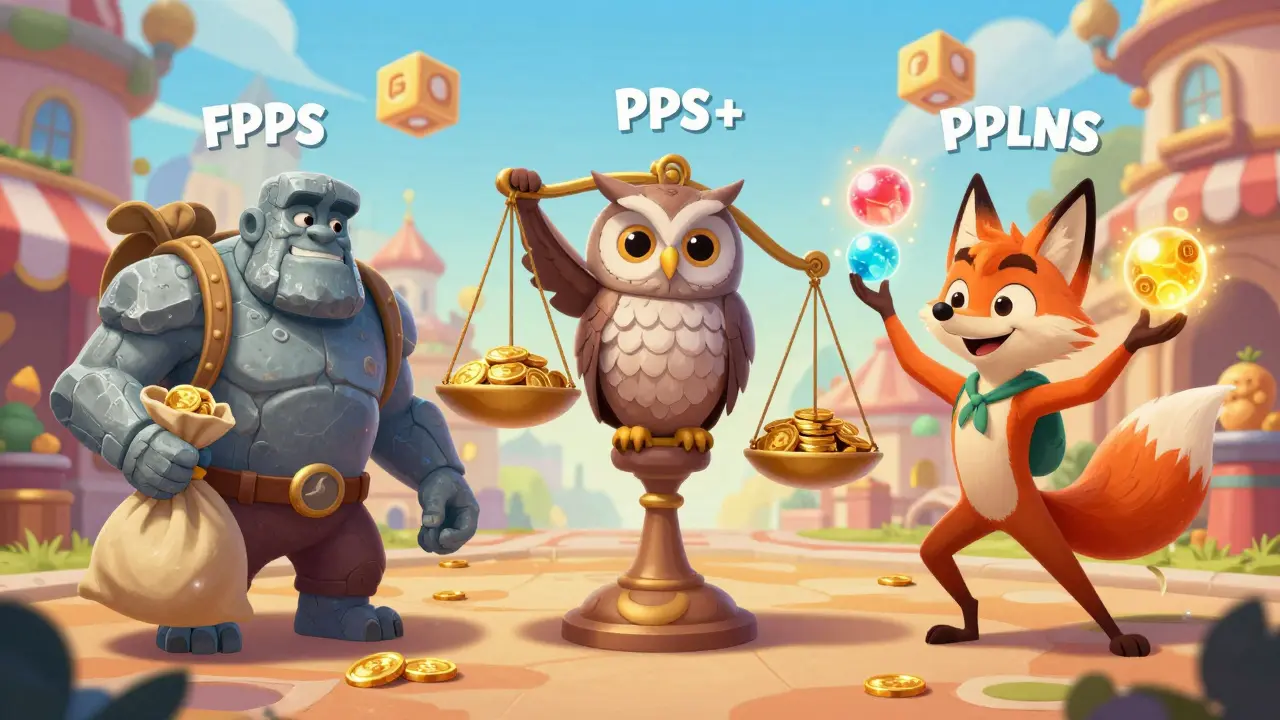
Decoding Payout Schemes: FPPS, PPS+, and PPLNS
If you don’t understand the payout scheme, you don’t know what you’re earning. There are three main models you’ll encounter, and each has distinct pros and cons depending on your risk tolerance and cash flow needs.
- FPPS (Full Pay Per Share) is a method that guarantees a fixed payment per share submitted, regardless of whether the pool finds a block. This includes the block subsidy and transaction fees in the calculation. It offers the most predictable income but usually comes with higher fees (often around 1-2%). It’s ideal for miners who want stability and hate surprises.
- PPS+ (Pay Per Share Plus) is a hybrid model where miners are paid for shares plus a portion of the transaction fees. It balances stability with potential upside from fee spikes. If transaction fees on the network are high, you earn more. If they’re low, your base share payment keeps you safe.
- PPLNS (Pay Per Last N Shares) is a variable payout system that rewards miners based on the number of shares submitted within a specific window before a block is found. If the pool gets lucky and finds blocks frequently, you earn significantly more. If the pool goes dry, you might earn less than your expected average. This model often has lower fees because the pool takes on less risk, but your income fluctuates wildly.
For most hobbyists and small-scale operations, FPPS or PPS+ provides peace of mind. If you’re running a large farm and can absorb variance, PPLNS might squeeze out slightly higher long-term yields, but only if the pool performs well.
The Hidden Cost of Pool Fees
Pool fees are the price you pay for coordination. Most reputable pools charge between 1% and 4% of your earnings. While 1% sounds negligible, on a large scale, it adds up. However, beware of 'zero-fee' pools. Often, these older, peer-to-peer networks lack the infrastructure of modern farms, meaning they may have lower overall hash rates, leading to fewer blocks found and potentially inconsistent payouts.
Look beyond the headline fee. Check for:
- Withdrawal Fees: Does the pool charge a flat fee or a percentage when you move funds to your personal wallet?
- Transaction Fee Deductions: Some pools deduct network transaction fees from your payout, especially during congestion periods.
- Stale Share Penalties: If your connection lags and your share arrives late, does the pool penalize you? A good pool discards stale shares without punishing your account balance unfairly.
In 2026, transparency is non-negotiable. A pool should clearly display its fee structure on its homepage. If you have to dig through terms of service to find it, consider that a red flag.
Market Leaders and Hash Rate Dominance in 2026
Size matters in mining pools. Larger pools find blocks more frequently, which means more consistent payouts for everyone involved. However, there’s a trade-off: as pools grow, the individual share of the reward shrinks. Smaller pools offer larger chunks of the pie, but you wait longer for the pie to be baked.
As of mid-2026, the Bitcoin mining landscape remains concentrated. According to recent data analysis, Foundry USA leads the market with approximately 256.3 EH/s hash rate, controlling about 26.6% of the network. This level of dominance raises decentralization concerns, but from a purely practical standpoint, it offers immense stability for miners.
Other major players include:
| Pool Name | Est. Hash Rate (EH/s) | Market Share | Avg. Fee Structure |
|---|---|---|---|
| Foundry USA | 256.3 | 26.6% | Competitive FPPS/PPS+ |
| AntPool | 178.4 | 17.96% | ~1.5% |
| ViaBTC | 113.7 | 13.69% | ~1.5% |
| F2Pool | 102.9 | 10.68% | ~1% |
| SpiderPool | 87.9 | 9.13% | ~1.35% |
Note that Binance Pool operates with lower fees (~0.99%), making it attractive for cost-conscious miners, though its hash rate is lower than the top tier. Meanwhile, specialized pools like Luxor cater to independent miners seeking better control over block templates and transaction inclusion policies.
Server Stability and Latency: The Silent Profit Killers
You can have the best ASIC miner in the world, but if your pool’s server is down or located halfway across the globe, you’re losing money. Every second your miner isn’t submitting valid shares is wasted energy.
Uptime is critical. Industry standards expect pools to maintain 99%+ uptime. Look for pools that publish real-time status pages. If a pool goes down for hours during a difficulty adjustment period, your effective hash rate drops, and so do your earnings.
Latency is equally important. The closer the pool’s server is to your physical location, the faster your shares reach the pool. High latency increases the chance of 'stale shares'-shares that arrived too late to count toward the current block. For example, if you’re in Bristol, UK, connecting to a pool with servers in Europe (like ViaBTC or F2Pool’s European nodes) will likely yield better results than connecting to a US-based pool, despite the latter having higher total hash rate.
Transparency and Reputation Checks
Never trust a pool blindly. In the crypto space, reputation is everything. Before committing significant hash rate, perform due diligence:
- Check Community Feedback: Visit Reddit, Bitcointalk, or Discord channels. Are users complaining about delayed payouts? Are there reports of phantom fees?
- Verify Payout History: Reputable pools allow you to view past block finds and payout distributions. If the data looks manipulated or missing, walk away.
- Assess Dashboard Clarity: A good dashboard shows real-time hash rate, accepted/rejected shares, and estimated earnings. If the interface is confusing or outdated, the underlying technology might be too.
- Look for Open Source Code: Some pools release their software code for public audit. This is a strong signal of integrity.
Scams exist. Some fake pools mimic legitimate ones with similar names. Always double-check the URL and server addresses provided in your mining software configuration.

User Experience and Setup Simplicity
Mining shouldn’t require a PhD in computer science. Modern pools prioritize user experience, offering mobile apps, simple registration processes, and intuitive dashboards. ViaBTC is known for requiring only an email address to start mining, lowering the barrier to entry for beginners.
Consider whether you need advanced features like worker management, API access for automation, or integration with third-party monitoring tools. If you’re running a single Antminer S21, simplicity wins. If you’re managing a fleet of 100 machines, you’ll need robust APIs and detailed reporting.
Risk Factors: Concentration and Decentralization
While large pools offer stability, their dominance poses a risk to the Bitcoin network. With Foundry USA and AntPool controlling over 44% of the hash rate combined, concerns about centralization persist. A 51% attack becomes theoretically easier if a few entities collude.
As a miner, you can contribute to decentralization by choosing smaller, reputable pools. Yes, your payouts might be less frequent, but you’re supporting a healthier network. Additionally, diversify your risk. Don’t put all your hash rate into one pool. Splitting your operation across two different pools can mitigate the impact of a single pool’s outage or policy change.
Future Trends: What’s Next for Mining Pools?
The mining pool landscape is evolving. We’re seeing increased consolidation among major players, but also growth in niche pools focusing on specific cryptocurrencies or eco-friendly mining practices. Regulatory pressures are also shaping the industry, with some regions imposing stricter compliance requirements on pool operators.
Expect improvements in reward distribution mechanisms, such as more sophisticated PPLNS variants that reduce variance without sacrificing fairness. Security protocols will also tighten, with multi-signature wallets and enhanced encryption becoming standard for payout storage.
Ultimately, the best mining pool for you depends on your goals. Do you want steady income? Choose FPPS with a large, stable pool. Do you want maximum potential returns and can handle volatility? Try PPLNS with a mid-sized pool. Always monitor your performance, stay informed about network changes, and don’t hesitate to switch pools if conditions change.
What is the best mining pool for beginners in 2026?
For beginners, pools with simple interfaces, low minimum payout thresholds, and FPPS payout schemes are ideal. ViaBTC and F2Pool are often recommended due to their user-friendly dashboards, global server presence, and reliable customer support. They offer straightforward setup guides and clear fee structures, reducing the learning curve for new miners.
Do mining pools charge hidden fees?
Reputable pools disclose all fees upfront. However, watch out for withdrawal fees, transaction fee deductions during network congestion, and penalties for stale shares. Always read the fine print regarding payout thresholds and minimum amounts. Avoid pools that obscure their fee structure in complex terms of service agreements.
Is it better to mine in a large pool or a small pool?
Large pools offer more consistent, frequent payouts due to higher block-finding rates, making them suitable for those needing steady income. Small pools offer larger individual rewards when a block is found but with greater variance and longer wait times. Choose based on your risk tolerance and cash flow needs.
How does latency affect my mining earnings?
High latency increases the likelihood of stale shares, which are rejected by the pool and result in lost earnings. Miners should choose pools with servers geographically close to their location to minimize ping times. Even a few milliseconds difference can impact efficiency, especially with high-hash-rate ASICs.
Can I switch mining pools easily?
Yes, switching pools is generally easy. You simply update the stratum server address and port in your mining software configuration. There are no financial penalties for leaving a pool, though you may lose unwithdrawn earnings if you haven’t met the minimum payout threshold. Plan your switch to avoid interrupting active mining sessions unnecessarily.