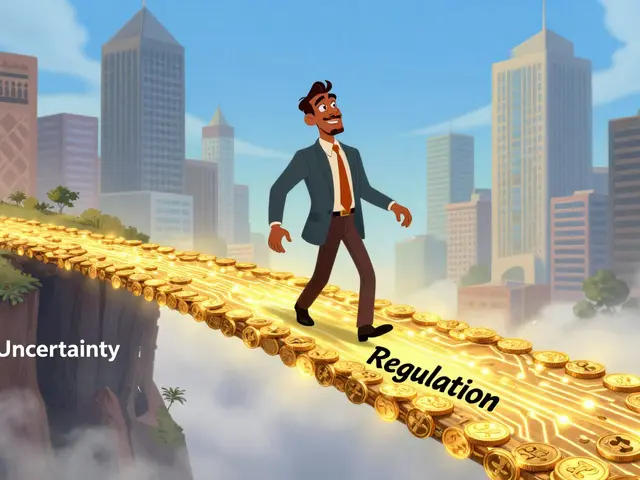
Gone are the days when you could hide your crypto gains behind a private wallet address. As we move through 2026, the landscape of automated crypto tax reporting is a system where blockchain data is automatically shared between exchanges, tax authorities, and users to ensure compliance without manual calculation has shifted from a theoretical threat to a daily reality. If you are still manually tracking transactions in a spreadsheet, you are likely already behind. The global infrastructure for tracking digital assets is now live, connecting billions of dollars in value directly to government servers.
This isn't just about stricter rules; it's about technology that makes evasion nearly impossible. With frameworks like the OECD's CARF and the EU's DAC8 fully operational, your transaction history is no longer yours alone. It belongs to the tax authorities as well. Understanding how this works, what tools you need, and where the loopholes still exist is critical for anyone holding digital assets today.
The Global Shift: From Self-Reporting to Automatic Exchange
For years, crypto taxation relied on self-declaration. You reported what you wanted, and if you didn't report it, you hoped no one noticed. That era ended with the implementation of the Crypto-Asset Reporting Framework (CARF) is an international standard developed by the OECD for the automatic exchange of information on crypto-assets between tax administrations. Originally proposed in 2022, CARF became fully operational in 2025, linking 112 tax administrations worldwide.
How does this affect you? If you use an exchange in one country but live in another, your data is automatically shared. The International Compliance Assurance Programme (ICAP) processes over 1.2 million crypto asset reports monthly. This means the IRS in the United States can see transactions you made on an exchange in Japan or Singapore, provided those jurisdictions are part of the network. The IMF identified a $10 billion annual tax gap in crypto, and this automated infrastructure is designed specifically to close it.
In Europe, the DAC8 directive is an EU regulation requiring crypto-asset service providers to report customer transaction data to national tax authorities took effect on January 1, 2025. Unlike previous rules that only applied to platforms within the EU, DAC8 requires any platform serving EU citizens to submit data, regardless of where the company is headquartered. This extraterritorial reach ensures that offshore exchanges cannot be used to bypass European tax laws.
In the United States, the IRS Form 1099-DA is a new tax form introduced by the IRS to report digital asset transactions to taxpayers and the government is now mandatory for 2025 transactions. Announced in IRS Notice 2024-39, this form captures detailed information about sales, exchanges, and staking rewards. The IRS's new Digital Asset Transaction System (DATS) handles 1.8 billion crypto transactions daily, using AI to flag discrepancies between what you report and what the exchanges send them.
How the Technology Works Under the Hood
You might wonder how governments track decentralized finance (DeFi) transactions where there is no central intermediary. The answer lies in advanced blockchain analytics. The technical architecture behind automated reporting relies on three main components: blockchain analytics engines, standardized XML data exchange protocols, and AI-powered reconciliation systems.
The OECD's CARF XML Schema 2.1 defines 37 mandatory data fields. These include wallet addresses, transaction timestamps accurate to the millisecond, and precise cost basis calculations. Leading forensic providers like Chainalysis Reactor is a blockchain investigation platform that helps identify and analyze cryptocurrency transactions and Elliptic Horizon achieve 98.7% transaction attribution accuracy. They process millions of transactions per second across dozens of blockchain networks.
But it's not perfect. There are significant limitations, especially in DeFi. Only 63% of Uniswap v3 transactions are properly attributed according to recent analysis. Cross-chain transactions remain a challenge, with nearly 19% of bridge transactions between Ethereum and Solana remaining untraceable. This creates a gray area where some activity slips through the net, though regulators are closing these gaps rapidly.
| Framework | Region | Coverage Scope | Data Capture Rate | Key Feature |
|---|---|---|---|---|
| CARF (OECD) | Global (112 Jurisdictions) | Multilateral Exchange | 92% | Standardized XML Data Sharing |
| DAC8 | European Union | EU Citizens Worldwide | 84% | Extraterritorial Enforcement |
| Form 1099-DA | United States | US-Based Exchanges/Taxpayers | 76% | Real-Time Blockchain Monitoring |

The Role of AI and Real-Time Monitoring
Artificial intelligence is the engine driving this new compliance regime. The IRS established a Real-Time Blockchain Monitoring Unit in February 2025. This unit uses AI pattern recognition to identify wallet-to-wallet transfers with 89.3% accuracy. It doesn't just look at exchanges; it looks at the blockchain itself.
If you send Bitcoin from your personal wallet to another personal wallet, the system flags it. It analyzes patterns to determine if the transaction is likely taxable. While this sounds invasive, it is highly effective at catching large-scale evasion. However, it also creates false positives. Retail investors often find their legitimate trades flagged for review because the AI cannot always distinguish between a long-term investment hold and a short-term trade based solely on transaction timing.
The market for crypto tax software is specialized applications that integrate with exchanges and wallets to calculate tax liabilities automatically has grown to $5.04 billion in 2025. Tools like CoinTracker and TokenTax are no longer optional luxuries; they are essential utilities. CoinTracker leads traditional exchange reporting with a 38% market share, while specialized solutions dominate the DeFi segment. These tools connect via API to your exchanges, pulling data directly into a format that matches the IRS or HMRC requirements.
Pain Points: Where Automation Fails
Despite the sophistication of these systems, users are frustrated. A survey of Reddit communities revealed that while 68% of users appreciate the reduction in manual work, 74% express serious concern about privacy. The feeling of being watched is palpable. One user noted that while Form 1099-DA saved them time, having Coinbase report wallet-to-wallet transfers felt like overreach.
Technical errors are common. Cost basis miscalculations affect 31% of users with multi-chain activity. This happens when a token moves from Ethereum to Arbitrum via a bridge. The tax software may see two separate events instead of one transfer, triggering a phantom capital gain. NFT taxation is even worse, with 47% of royalty payments remaining unreported due to complex smart contract structures that current software struggles to parse.
DeFi staking rewards present another major hurdle. Only 31% of platforms correctly calculate taxable events for staking. When you stake ETH on Lido or provide liquidity on Curve, the tax treatment varies wildly depending on jurisdiction. In the US, receiving staking rewards is ordinary income at fair market value. In other countries, it might be treated as capital gains. Automated systems often default to one method, leaving users liable for corrections later.

What You Need to Do Now
If you are active in crypto, you need to adapt your workflow immediately. The learning curve for tax professionals has dropped significantly, but for individual investors, the complexity remains high. Here is how to get compliant:
- Consolidate Your Wallets: The average user maintains 3.7 distinct wallets. This fragmentation makes tracking difficult. Try to consolidate non-active wallets to reduce noise in your data.
- Integrate APIs Early: Connect your major exchanges to a reputable tax software provider. This should take less than 48 hours. Ensure the software supports the specific chains you use.
- Verify Blockchain Addresses: Manually check that all your wallet addresses are linked to your tax profile. If you use hardware wallets like Ledger or Trezor, export your transaction histories regularly.
- Hire a Specialist: General CPAs are often unequipped for DeFi and NFT taxes. Look for firms hiring dedicated blockchain tax specialists. Their average salary is $142,500, reflecting the niche expertise required.
Documentation quality varies. The IRS guidelines score low in user comprehension tests, while the EU's DAC8 handbook is more accessible. Don't rely on guesswork. Use the official handbooks and cross-reference with your software's support documentation.
Looking Ahead: 2027 and Beyond
The trajectory points toward complete integration. Deloitte predicts that by 2027, crypto tax reporting will be embedded within standard financial statements. There will be no separate "crypto tax" workflow; it will be part of your overall financial reporting.
We are also seeing the emergence of AI-powered tax optimization engines. These won't just report taxes; they will suggest strategies to minimize liability legally, such as harvesting losses before year-end or structuring DeFi positions to defer taxes. Privacy-preserving compliance is also under testing by the OECD, using decentralized identity solutions to verify transactions without exposing full wallet histories.
Quantum-resistant encryption is another mandate coming under the EU Cyber Resilience Act 2025. As quantum computing advances, protecting tax data becomes a national security issue. Expect your tax software to require updates to handle these new encryption standards.
The convergence of AI analytics, standardized reporting, and global cooperation suggests that automated crypto tax reporting will become as fundamental as SWIFT payments by 2030. It is no longer a question of if you will be tracked, but how accurately you can manage your own data before the system does it for you.
Will I receive a 1099-DA for every crypto transaction?
Not necessarily for every single micro-transaction, but yes for most taxable events on US-based exchanges. The IRS Form 1099-DA covers sales, exchanges, and staking rewards. Small transactions below certain thresholds might be aggregated, but the goal is comprehensive reporting. Non-US residents using US exchanges will also receive this form, which must be reported to their home country via CARF.
Can the government see my private wallet transactions?
Indirectly, yes. While they cannot read your private keys, blockchain analytics firms like Chainalysis can cluster addresses and link them to known identities (like exchanges). If you ever deposit or withdraw funds from a centralized exchange, your entire wallet history associated with that address can potentially be traced back to you. Pure peer-to-peer transactions remain harder to track but are not invisible.
How do I handle DeFi taxes if no 1099 is issued?
You are responsible for self-reporting DeFi activities. Use specialized tax software that integrates with blockchains (Ethereum, Solana, etc.) via RPC nodes. These tools import your wallet addresses and categorize interactions (swaps, liquidity provision, staking) as taxable events. You must maintain records of these transactions yourself, as exchanges do not report them.
Is my data safe with automated tax reporting systems?
Security is a major concern. While tax authorities use encrypted channels, third-party tax software companies have been targets for hackers. Choose providers with strong security certifications (SOC 2, ISO 27001). Additionally, be aware that sharing your wallet data with multiple services increases your attack surface. Regularly audit who has access to your private keys or seed phrases-never share these.
What happens if my tax software calculates the wrong amount?
Software errors are common, especially with cross-chain bridges and NFTs. Always review the generated reports before filing. If you file incorrectly due to software error, you may face penalties unless you can demonstrate reasonable cause. Keep raw transaction logs and screenshots of your portfolio at the time of each transaction to dispute any assessments from tax authorities.