Multi-Layer VPN Detection Simulator
Test Your VPN Usage
See how your current VPN setup would be detected by major crypto exchanges based on the multi-layer security systems described in the article.
If you’ve ever tried using a VPN to access a crypto exchange like Binance or Coinbase from a restricted country, you’ve probably run into a wall. Even if your VPN worked fine for streaming or browsing, the exchange suddenly blocked you-sometimes within minutes. This isn’t random. Crypto exchanges now use multi-layered VPN detection to catch users trying to bypass regional bans. And it’s getting harder to beat.
Why Crypto Exchanges Block VPNs
Crypto exchanges don’t block VPNs because they dislike privacy tools. They do it because they have to. Governments in countries like China, Russia, Turkey, and Iran have made it illegal for local residents to trade cryptocurrencies on foreign platforms. If an exchange lets users from these regions sign up using a VPN, it risks heavy fines, legal action, or being shut down entirely. To stay legal and keep operating, exchanges must prove they’re not serving users in banned regions. That’s where VPN detection comes in. It’s not about stopping privacy-it’s about compliance. But the side effect? Legitimate users in restrictive countries lose access, even if they’re just trying to protect their funds or avoid surveillance.How Multi-Layered Detection Works
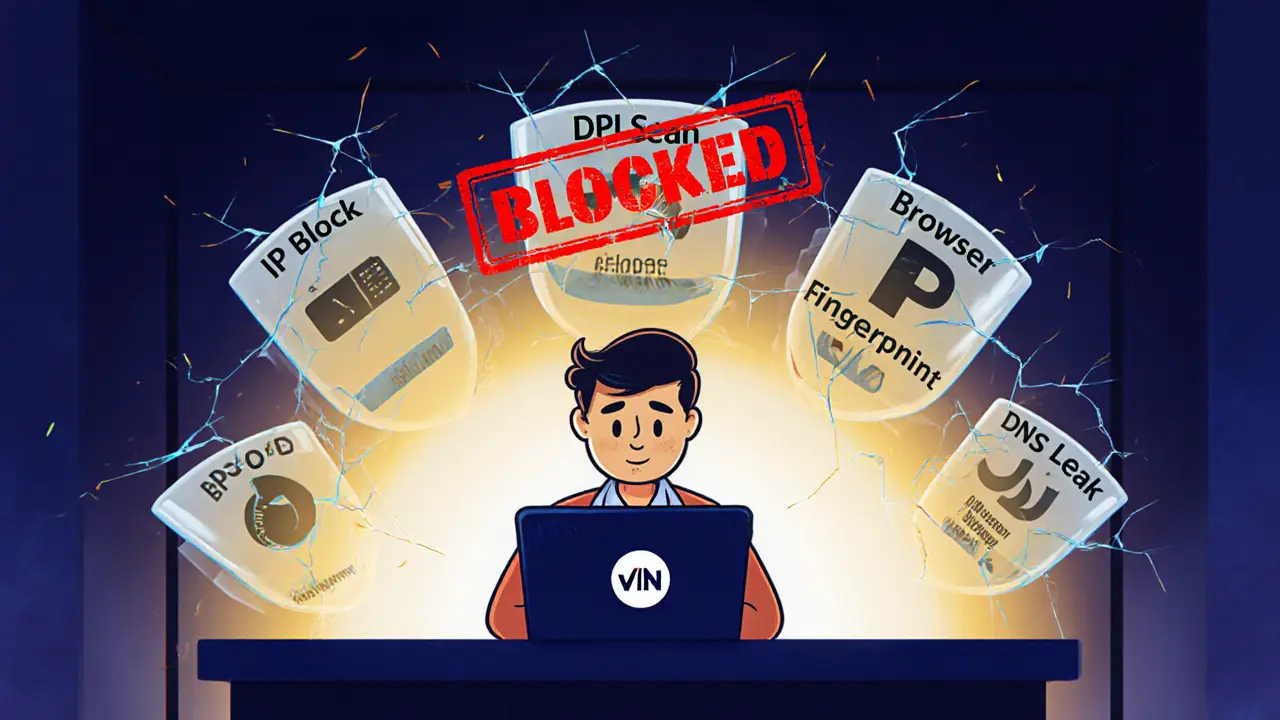
Modern crypto exchanges don’t rely on one trick. They stack detection methods like layers in an onion. If one layer fails, another catches you.- IP Address Blacklisting: Every major VPN provider-NordVPN, ExpressVPN, Surfshark-has known server IPs. Exchanges maintain huge, constantly updated lists of these IPs. If your connection comes from one, you’re flagged immediately.
- Deep Packet Inspection (DPI): Even if you’re using a less common or obfuscated VPN, DPI looks at how your traffic behaves. VPN traffic has telltale patterns: consistent packet sizes, timing delays, encrypted headers. Machine learning models now spot these patterns with 90%+ accuracy.
- DNS Leak Detection: Your device might say you’re in Germany, but if your DNS resolver is in the U.S., that’s a red flag. Exchanges check if your DNS matches your claimed location. A mismatch? Account review triggered.
- Time Zone and Behavior Analysis: If you log in at 3 a.m. local time but your trading history shows activity during U.S. market hours, the system notices. It also watches how fast you type, where you click, and how often you deposit or withdraw. These behavioral cues help identify bots or proxy users.
- Browser Fingerprinting: Your browser leaks info-screen size, fonts, plugins, GPU model. If your fingerprint doesn’t match your claimed location (e.g., you say you’re in Brazil but your system language is Japanese and your font list is full of Windows-only fonts), you’re suspicious.
- Split Tunneling Detection: Some users try to route only their crypto app through the VPN while keeping other traffic direct. Exchanges now monitor for this inconsistency. If your IP changes mid-session or your device connects to both local and VPN networks simultaneously, you’re caught.
Which Exchanges Are the Strictest?
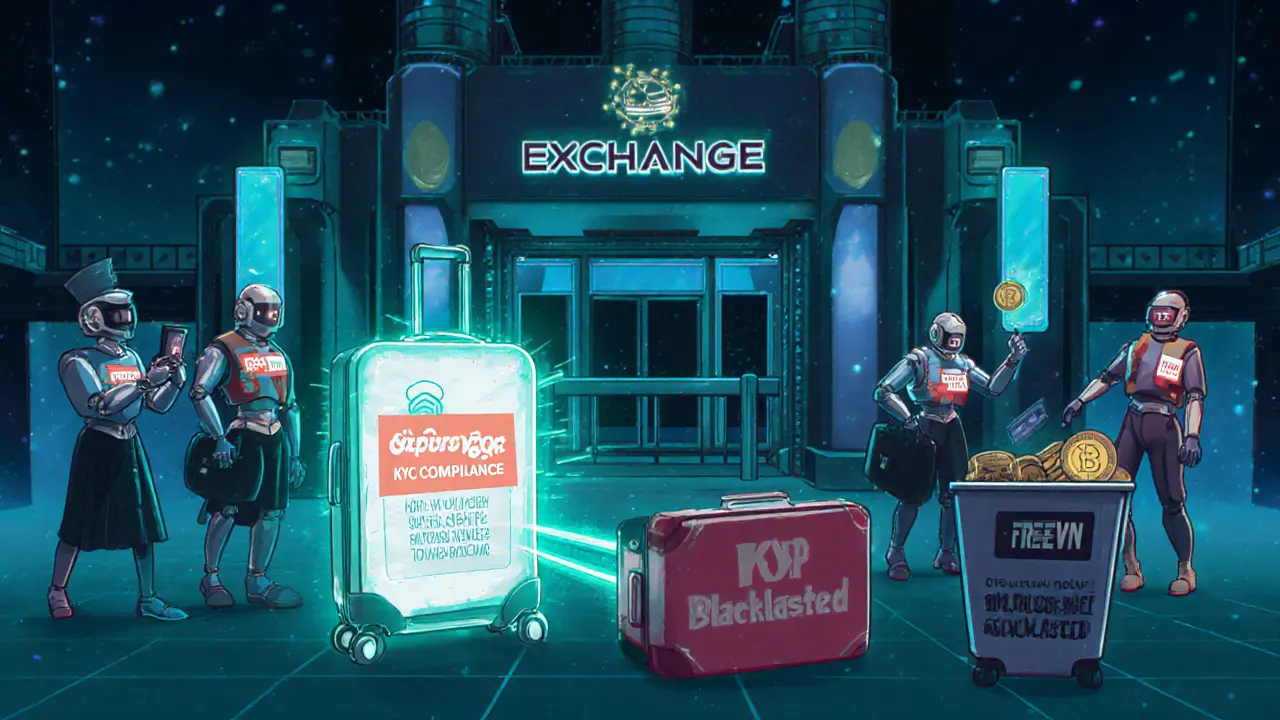
Not all exchanges are equal. Big players have the resources to build advanced detection systems. Smaller ones? They often just block known IP ranges and call it a day.- Binance: Uses all layers-IP, DPI, behavioral, fingerprinting, and even mobile device location checks. Reports from users show bans within 2-5 minutes of connecting via common VPNs.
- Coinbase: Heavy on KYC integration. If your ID says you’re in the U.S., but your login IP is in Russia-even with a clean VPN-you’ll get a verification request or account freeze.
- Kraken: Similar to Coinbase. Strong DNS and time zone checks. Known to flag users who switch servers frequently or use free VPNs.
- Smaller Exchanges: Many only use IP blacklisting. Some can be bypassed with lesser-known or private VPNs, but they’re riskier and less reliable.
What VPNs Still Work (Sometimes)
Free VPNs? Forget it. They’re on every blacklist. Even many premium ones fail.- NordVPN: Has over 7,000 servers and accepts crypto payments. But its IP ranges are well-known. Users report success only with specific servers labeled "Obfuscated" or "Stealth"-and even then, success lasts days, not weeks.
- ExpressVPN: Strong encryption and good reputation, but its IP pool is heavily monitored. Some users report 3-7 days of access before being flagged.
- ProtonVPN: Less popular with crypto users, so fewer IPs are flagged. Still, DPI and fingerprinting can catch it.
- Decentralized Options (NymVPN): This one’s different. Instead of centralized servers, Nym routes traffic through hundreds of anonymous nodes using a Noise mixnet. There’s no single IP to block. No logs. No patterns. This is the only type of VPN that’s currently hard for exchanges to detect. But it’s slow, experimental, and not user-friendly for trading.
The Arms Race Is Escalating
It’s not just about blocking IPs anymore. Exchanges are now tying VPN detection to blockchain analytics. If your wallet has ever been linked to a banned region-even years ago-your new account might get flagged, even if you’re on a clean connection. Some platforms now require mobile number verification and cross-check your phone’s GPS location with your login IP. If your phone says you’re in London but your laptop’s IP says you’re in Singapore, you’re done. Machine learning models are being trained on millions of user sessions to spot anomalies. Typing speed. Mouse movements. Time between trades. Even how long you spend reading the terms of service before signing up. All of it adds up. Meanwhile, VPN providers are fighting back. Some now offer "crypto mode" servers optimized to mimic regular traffic. Others use dynamic IP rotation or run servers inside cloud platforms like AWS or Google Cloud to blend in. But exchanges are catching on. The cycle continues.What Happens When You Get Caught?
Getting flagged doesn’t always mean an instant ban. More often, you’ll get:- A message asking you to verify your identity again
- Temporary withdrawal limits
- Required video KYC with live facial recognition
- Account suspension until you prove you’re not using a VPN

Will Decentralized Exchanges (DEXs) Solve This?
The only real long-term solution? DEXs like Uniswap, PancakeSwap, or dYdX. These platforms don’t require sign-ups. No KYC. No login. No IP tracking. You connect your wallet and trade. But here’s the catch: regulators are catching up. The EU’s MiCA law and other global frameworks are starting to target wallet providers and DeFi aggregators. Soon, DEXs might be forced to integrate on-chain surveillance tools that flag wallets tied to banned regions. Right now, DEXs are the last free zone. But that won’t last forever.What Can You Do?
If you’re in a restricted country and need access:- Use a reputable, crypto-friendly VPN with obfuscation (NordVPN’s Stealth servers, ExpressVPN’s Lightway protocol)
- Never use free VPNs-they’re worse than useless
- Don’t switch servers constantly-consistency helps avoid behavioral flags
- Use a dedicated device or browser profile for trading-don’t mix it with your daily browsing
- Consider DEXs if you’re comfortable with self-custody and higher gas fees
- Understand the risk: your funds could be frozen with no recourse
The Bigger Picture
This isn’t just about crypto. It’s about control. Governments want to know who’s trading, how much, and where. Exchanges are the gatekeepers. And they’re building walls that get higher every year. The tools to bypass them exist-but they’re becoming riskier, slower, and more complex. What was once a simple workaround is now a technical gamble with your money on the line. The future? More AI. More biometrics. More integration with global financial systems. And fewer places to hide.Can crypto exchanges detect if I’m using a VPN even if it’s a premium one?
Yes. Premium VPNs like NordVPN and ExpressVPN are heavily monitored. Exchanges use IP blacklists, traffic pattern analysis, and browser fingerprinting to catch them-even if the connection looks secure. Success depends on server choice and how often you switch, but detection often happens within minutes to hours.
Why does my account get flagged even when I’m not using a VPN?
Your account might have been flagged in the past for VPN use, or your IP address could have been previously used by someone else who was using a VPN. Exchanges keep records and may trigger verification even if you’re now on a clean connection. Behavioral patterns like trading at odd hours or mismatched device info can also trigger flags.
Are free VPNs more likely to be blocked than paid ones?
Extremely. Free VPNs use shared IPs, often abused by thousands of users, and are on every exchange’s blacklist. They also leak data, have weak encryption, and lack obfuscation features. Almost all free services are blocked instantly on major exchanges.
Can I use a VPN with a decentralized exchange (DEX)?
Technically yes-DEXs like Uniswap don’t track your IP or require login. But if your wallet has a history tied to a banned region, some DeFi analytics tools may flag your activity. Using a VPN on a DEX adds no real benefit and can slow down transactions.
Is there a VPN that crypto exchanges can’t detect?
Currently, NymVPN is the only one with a realistic chance. It uses a decentralized mixnet that scrambles traffic through hundreds of community-run nodes, making it nearly impossible to trace back to a single server. But it’s slow, complex, and not designed for fast trading. For now, it’s the only option that truly resists detection.
What happens if I’m banned for using a VPN?
You’ll typically get a warning, withdrawal limits, or a request for extra verification. If you don’t comply-or if the exchange suspects you’re still using a VPN-your account may be frozen permanently. Funds are usually not lost, but you may never get them back without proving your location, which is often impossible.
Do exchanges track my location through my phone?
Yes, if you’ve linked your mobile number or use their app. Many exchanges now require two-factor authentication via SMS or authenticator apps tied to your phone’s GPS. If your phone says you’re in Mexico but your laptop logs in from Germany, the system will flag the inconsistency.
Can I avoid detection by using a residential proxy instead of a VPN?
Residential proxies are harder to detect than standard VPNs because they use real home IP addresses. But exchanges are starting to block known proxy networks, especially those used by crypto traders. They also check for patterns like multiple accounts from the same proxy. It’s not foolproof and can be expensive.






Lawal Ayomide
This is why I use DEXs now. No KYC, no tracking, no drama. Just my wallet and the blockchain.
Rod Filoteo
lol they’re all just scared of decentralized money. the gov wants to know every dime you spend, and crypto says ‘fuck you’ to that. they’re not blocking VPNs-they’re blocking freedom.
and yeah, NymVPN? that’s the only one that doesn’t suck. everyone else is just a glorified proxy with a fancy logo.
they’ll ban you for breathing wrong next.
samuel goodge
What’s fascinating here is the convergence of surveillance capitalism and regulatory overreach. Exchanges aren’t acting out of malice-they’re caught between sovereign mandates and user autonomy.
But the real tragedy is that the tools designed for privacy-VPNs, encryption, obfuscation-are being weaponized against the very people who need them most.
This isn’t about compliance; it’s about control. And the creep is systemic.
Every fingerprint, every DNS leak, every keystroke delay-these aren’t security measures. They’re behavioral profiling engines.
We’re building a financial panopticon, and we’re calling it ‘safety’.
Meanwhile, the people in Nigeria, Iran, Turkey-they’re not criminals. They’re just trying to preserve their wealth from inflation, corruption, or capital controls.
And now they’re being treated like threats.
It’s dystopian. And it’s happening in real time.
Decentralized exchanges are the last refuge. But even they won’t survive MiCA or similar laws for long.
What happens when your wallet’s on-chain history is scanned for ‘suspicious’ patterns? When your transaction history becomes a criminal record?
We’re not just losing access to exchanges. We’re losing financial sovereignty.
And nobody’s talking about it.
Ivanna Faith
Anyone else notice how everyone’s suddenly ‘pro-privacy’ but still uses Coinbase? lol
you want freedom but you want your crypto in a bank that asks for your birth certificate??
the cognitive dissonance is real
Joe B.
Okay but let’s be real-NordVPN’s Stealth mode? That’s just marketing fluff. I used it for 3 days on Binance and got flagged because my browser had 14 fonts installed and my screen resolution was 1920x1080… which, shocker, is the most common setup on Earth.
They’re not detecting VPNs anymore-they’re detecting HUMANS.
My mouse movements? Too slow. My typing cadence? Too consistent. My account creation time? Too close to U.S. market open.
They’ve turned crypto into a psychological surveillance test.
And the worst part? The more you try to hide, the more you stand out.
I’ve given up. I use a DEX now. Slow? Yes. Annoying gas fees? Absolutely.
But at least I don’t feel like I’m being interrogated every time I trade 0.001 ETH.
Also-why does everyone think ExpressVPN is magic? Their IPs are in every exchange’s database since 2021. I’ve seen screenshots of their IP ranges being flagged with timestamps.
Stop drinking the VPN Kool-Aid.
Use Nym. Or go full self-hosted Tor. Or accept that you’re not supposed to be here.
Vidyut Arcot
Hey, if you're in a country with restrictions, don't give up. DEXs are your friend. Yeah, gas fees hurt, but your funds stay safe.
And if you're new, start small. Learn the interface. Use MetaMask with a clean browser profile.
You got this. The system's rigged, but you're still in control of your keys.
One trade at a time.
Bhoomika Agarwal
India banned crypto and now we’re all using VPNs like it’s a national sport 😂
But guess what? Binance still blocks us in 2 minutes. Meanwhile, my cousin in Dubai just bought 5 BTC with his credit card. Double standards much?
Why do we get treated like criminals just because we live in a country with a bad economy?
It’s not about compliance-it’s about classism.
Ann Ellsworth
The real issue isn’t the VPN detection-it’s the normalization of behavioral biometrics in financial infrastructure.
Typing cadence? Mouse trajectories? Timezone mismatches? These are not security features-they’re dystopian identity verification protocols.
We’re moving toward a world where your financial access is determined by algorithmic profiling of your digital fingerprint.
And the worst part? It’s all framed as ‘user protection’.
When did ‘know your customer’ become ‘know your soul’?
And why are we okay with this?
Christy Whitaker
Ugh I tried using a VPN on Kraken and got locked out for 3 weeks. They made me send a selfie holding my utility bill. Like… I’m not even in the country anymore. How is that fair?
And now I can’t even access my funds. They just sit there. Frozen. Forever.
I’m so done with this system.
alex bolduin
Just use a DEX and stop stressing. The whole point of crypto is to be outside the system, right?
Why are we still trying to play by their rules?
They want you to use their app with their KYC and their VPN blocks?
Then don’t. Use Uniswap. Use a wallet. Move your coins. Done.
It’s not hard. Just different.
Mark Stoehr
lol they block you for using a VPN but let you use a proxy from a data center in the same country
what a joke
also i used a free vpn once and it stole my wallet
so yeah dont use free ones
Jay Weldy
It’s wild how we’re all trying to outsmart a system designed to control us.
But maybe the real win isn’t bypassing the blocks-it’s building alternatives.
DEXs. Self-custody. Decentralized identity.
Let them chase IPs. We’ll build networks they can’t touch.
It’s not about beating them. It’s about leaving them behind.
Steve Savage
Been using Nym for a month now. It’s slow as molasses, but I’ve never been flagged.
Trade 10 minutes, wait 20 minutes for a swap to confirm… but my funds are safe.
Worth it.
Also-why does everyone still think ExpressVPN is the gold standard? Their servers are on every blacklist since 2020.
It’s like using a locked door with a sign that says ‘BROKEN’.
Katherine Alva
Honestly, I feel bad for people in countries like Nigeria or Iran.
They’re not trying to cheat the system-they’re trying to survive it.
When your currency is collapsing, crypto isn’t a hobby. It’s survival.
And now we’re building walls around the only lifeline they have?
That’s not compliance. That’s cruelty.
And the worst part? The people who built these detection tools probably don’t even realize who they’re hurting.
Nancy Sunshine
It is imperative to note that the deployment of multi-layered detection mechanisms by centralized crypto exchanges constitutes a significant escalation in the corporatization of financial sovereignty.
Through the aggregation of behavioral biometrics, DNS telemetry, and device fingerprinting, these entities are constructing a panopticonic infrastructure under the guise of regulatory compliance.
Such practices are antithetical to the foundational ethos of decentralization and undermine the very principles of financial autonomy upon which blockchain technology was predicated.
It is therefore not merely a technical challenge but a philosophical imperative to transition toward permissionless, non-custodial alternatives.
Decentralized exchanges represent the only viable path forward toward the preservation of individual financial liberty in the digital age.
Akash Kumar Yadav
USA and EU block VPNs? What a joke. India has 1.4 billion people and we still trade crypto like nothing. You think they care about your IP?
They don’t. They just want your money.
And you’re all crying because your NordVPN got blocked?
Grow up.
Use a DEX. Use a proxy. Use a friend’s Wi-Fi. Stop whining.
We’re not in the West. We don’t get luxury.
Just trade.
Nora Colombie
Why do people still use VPNs? It’s 2025. Everyone knows they’re useless.
Use a residential proxy. Or better yet-buy a SIM card in another country and tether.
Or just stop pretending you’re not breaking the law.
Exchanges aren’t the enemy. You are.
You want freedom? Then don’t use a service that requires you to log in.
Use a wallet. Trade on DEX. Done.
Stop being lazy.
Nelia Mcquiston
It’s sad how the same people who scream ‘decentralization’ still cling to centralized exchanges like Coinbase.
You can’t have it both ways.
If you want freedom, you have to give up convenience.
And if you’re okay with KYC and VPN blocks, then you’re not a crypto believer-you’re just a trader with a wallet.
There’s nothing wrong with that.
But don’t pretend you’re fighting the system when you’re still wearing their uniform.
Alan Brandon Rivera León
As someone who grew up in a country where the government controls everything-banks, phones, even internet access-I know what it’s like to need crypto.
It’s not about bypassing rules.
It’s about survival.
My dad lost his savings to inflation. My sister couldn’t send money abroad without paying 30% in fees.
Crypto gave us back our dignity.
So when I see people complaining about VPN blocks… I just feel sad.
You think this is hard?
Try living in a country where you can’t even open a bank account without a government ID.
At least here, you can still use a DEX.
That’s a miracle.
Melinda Kiss
I’ve been using NymVPN for 6 months now. It’s slow, yes. But I’ve never been flagged.
And honestly? I don’t mind the wait.
It reminds me why I’m doing this.
Not for profit.
For freedom.
Every 10-minute trade feels like a quiet act of rebellion.
And that’s worth it.