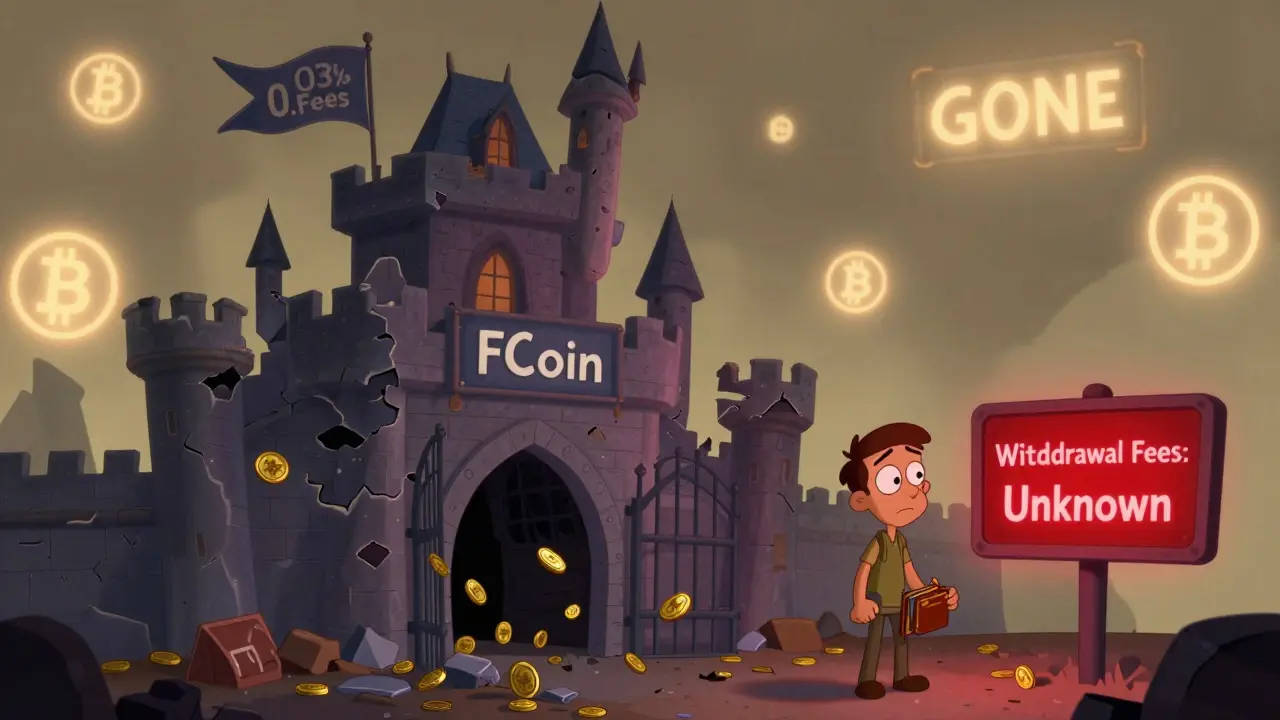
FCoin once claimed to be the cheapest crypto exchange on the market. Its trading fees? A staggering 0.03% for takers and 0.029% for makers. That’s lower than almost every major exchange at the time. But here’s the truth: low fees don’t matter if you can’t trust the platform. And FCoin? It didn’t just fail - it vanished without warning.
What FCoin Actually Offered
FCoin wasn’t a place to buy Bitcoin with your bank card. It didn’t accept USD, EUR, or any fiat currency. You had to already own crypto - like Bitcoin or Ethereum - to even get started. That meant if you were new to crypto, FCoin was useless. You couldn’t sign up, deposit money, and start trading. You had to first go to Coinbase, Kraken, or Crypto.com, buy your coins, then move them over. That’s not a feature - it’s a barrier.Its only real selling point was price. For active traders moving large volumes, those fees looked great. But here’s the catch: FCoin never clearly stated its withdrawal fees. No official page. No FAQ. No transparency. If you wanted to pull your coins out, you had no idea how much it would cost. That’s a red flag bigger than any fee discount.
The User Experience Was a Disaster
According to Cryptogeek, FCoin had a 1 out of 5 rating - based on just one review. One. That’s not a coincidence. It’s a signal. When an exchange has almost no users left to rate it, and the few who did gave it the lowest score possible, something went very wrong. Compare that to Kraken, which has a 4.8 rating from hundreds of users, or Crypto.com, consistently ranked as the best overall exchange in 2025. FCoin didn’t just lose - it collapsed.People didn’t leave because fees were too high. They left because they couldn’t get their money out. They left because customer support was nonexistent. They left because the platform felt like a black box - you deposit, you trade, but you never know what’s happening behind the scenes.
Why FCoin Couldn’t Survive
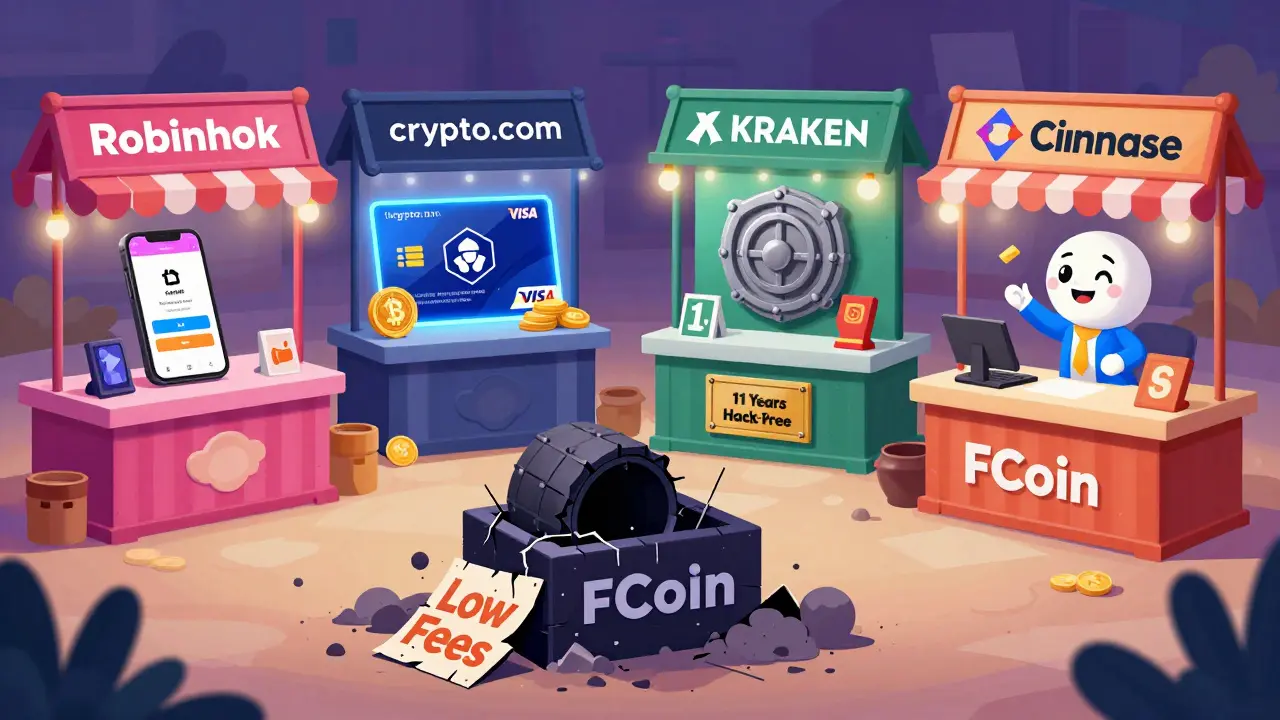
The crypto exchange market didn’t stay stuck in 2019. By 2025, users didn’t just want cheap trades. They wanted security, compliance, and reliability.- Security: Kraken went 11 years without a single hack. Coinbase insures cash deposits up to $250,000 with FDIC coverage. FCoin? Zero public security record.
- Regulation: Exchanges like Gemini and Binance US are licensed in multiple U.S. states. FCoin? No regulatory footprint anywhere.
- Support: Leading exchanges offer 24/7 live chat, email, and phone support. FCoin? No verified contact channels.
- Transparency: Every major exchange publishes its fee schedule, withdrawal limits, and audit reports. FCoin didn’t.
Low fees are nice. But if your money disappears because the exchange shuts down or freezes withdrawals, you don’t care how cheap trading was. You care that you lost everything.

What Replaced FCoin in 2026
Today, the best crypto exchanges don’t compete on price alone. They compete on trust.- Robinhood: Offers commission-free crypto trading with a clean, mobile-first interface. No hidden fees. Easy fiat deposits.
- Crypto.com: Finder’s top pick for 2025. Low fees, strong security, rewards program, and Visa card integration.
- Kraken: Proven security, deep liquidity, and regulatory compliance. Trusted by institutional investors.
- Coinbase: Best for beginners. Simple UI, insured cash balances, and educational resources.
These platforms all have something FCoin never did: a track record. You can check their security audits. You can read their terms. You can call them if something goes wrong.
What You Should Do Instead
If you’re looking for low fees today, don’t chase ghosts. FCoin is gone. Its website is offline. Its social media is silent. Its users have moved on.Here’s what to do:
- Start with an exchange that accepts fiat: Coinbase, Kraken, or Crypto.com.
- Use their low-fee tiers - many offer 0.1% or less for high-volume traders.
- Enable two-factor authentication and store large holdings in a hardware wallet.
- Never move funds to an exchange that doesn’t publish its withdrawal fees.
FCoin’s story isn’t a lesson in fee competition. It’s a warning: in crypto, trust beats price every time. And if you can’t trust a platform, no discount is worth the risk.






Howard Headlee
Low fees don't mean shit if the platform vanishes overnight. I lost six months of trading gains on FCoin. Zero warning. Zero support. Just gone. Never again.
Chelsea Boonstra
I'm not surprised. FCoin was always a front for something sketchy. No audits, no transparency, no compliance. If you're trading on a platform that doesn't publish its withdrawal fees, you're not a trader-you're a gambler.
Anthony Marshall
This is why we need regulation. Not to stifle innovation-to stop scammers from walking away with people's life savings. FCoin didn't fail. It was exposed.
Lindsay Girvan
Trust > fees. Always.
Tina Keller
I remember when FCoin was the talk of the Telegram groups. Everyone was like, 'Finally, a real disruptor!' Then the withdrawals stopped. Then the site went dark. Then the devs disappeared. It wasn't a failure-it was a heist with a UI.
PIYUSH KOTANGALE
LMAO 🤣 I tried to withdraw 0.5 ETH from FCoin. Took 3 weeks. Then I got a message: 'Your account is under review.' Never heard back. Now I use Crypto.com. Life is easier.
Anshita Koul
You know, the real tragedy isn't that FCoin collapsed-it's that people still chase 'low-fee' platforms without asking: 'Who's behind this?' The market rewards speed, not safety. And that's why we keep repeating the same mistakes.
Julie Tomek
I've been in crypto since 2017, and I've seen dozens of exchanges rise and fall. But FCoin was uniquely dangerous-not because it was unregulated, but because it pretended to be transparent. It had a sleek interface, a clean dashboard, and a promise of 'revolutionary' fees. But behind it? Nothing. No whitepaper, no team, no legal entity. It was a ghost story dressed as a trading platform. And the worst part? People still reference it like it was a pioneer. It wasn't. It was a trap. If you're new to crypto, don't look for the cheapest fee. Look for the longest track record. Look for the ones who've survived bear markets, regulatory crackdowns, and hacking attempts. Look for the ones who publish their audits, their compliance licenses, their contact info. Those are the platforms worth your capital. Not the ones with 0.029% fees that vanish when you need them most.
Tom Jewell
It's funny how people romanticize FCoin. Like its failure was a tragedy of capitalism. Nah. It was a tragedy of hubris. You don't build trust by lowering fees. You build it by showing up, by being accountable, by answering when someone asks, 'Where's my money?' FCoin never showed up. And now? It's a footnote. A cautionary tale.
vishnu mr
i used fcoin for like 2 weeks and then my eth just dissapeard lol. no one replied to my ticket. now i use kraken and its like night and day. also fcoin had this weird thing where they'd 'rebalance' your portfolio. no one knew what that meant. i lost 15% in a day. dumbest thing ever.
Brandon Kaufman
I just want to say thank you for writing this. I was considering trying FCoin because of the fees. I'm glad I didn't. This saved me from a nightmare. I appreciate the clarity.
Grace van Gent-Korver
I'm from the Philippines. We had a lot of people here who put their savings into FCoin. Some lost everything. No one helped. No one cared. It's not just about crypto. It's about people. Real people. And they got burned.
Allison Davis
The comparison to Kraken and Coinbase is spot on. I moved from FCoin to Kraken after my withdrawal got stuck for 17 days. Kraken responded within 4 hours. They gave me a tracking number for my transaction. I cried. It was the first time I felt like a customer, not a lab rat.
Adam Ashworth
I used to think FCoin was cool. Then I realized they were paying traders in FT tokens, which were only worth something if you kept trading on their platform. It was a pyramid. The fees were low because they were using your deposits to fund their own operations. They weren't a exchange. They were a Ponzi with a website.
ann neumann
They didn't just vanish. They were shut down by the Chinese government. I know because I work in compliance. FCoin was a front for money laundering. The 'low fees' were a lure. The real business was moving dirty crypto. The platform was never meant to last. It was a vessel. And now? All the users are left with nothing. No one's coming to help them. That's the real horror story.
Zephora Zonum
If you think Robinhood or Coinbase are trustworthy you're delusional. They're just regulated scams with better PR. The real winners are the decentralized exchanges. You don't need a middleman. You don't need a CEO. You just need your keys. FCoin was bad. But so are all centralized exchanges. They're all just waiting for you to trust them so they can take it.