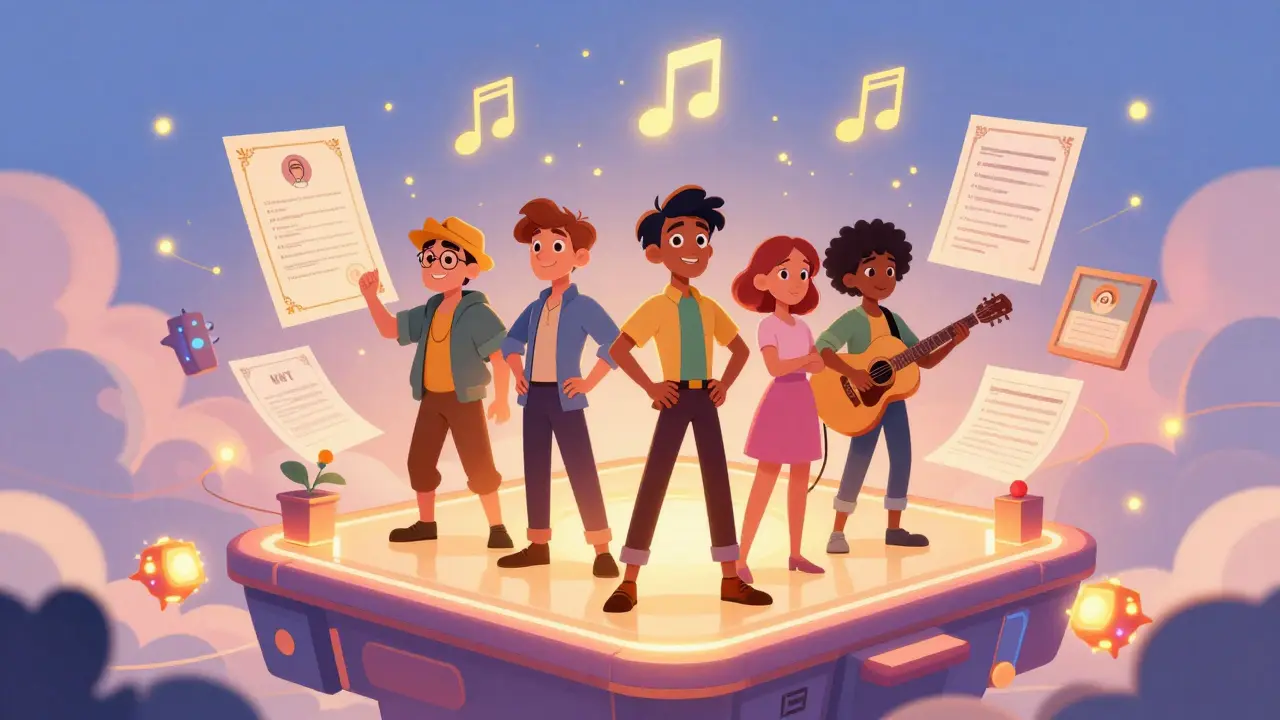
Imagine you’re an inventor who just built a new type of solar panel coating. You’ve spent two years testing it, filing paperwork, and paying fees just to prove you own it. Then, someone in another country copies it. Good luck proving it was yours first - and getting paid. That’s the broken system most inventors, artists, and tech startups still live with. But now, there’s a better way: blockchain IP marketplaces.
These aren’t sci-fi fantasies. Platforms like IPwe, DEIP Ledger, and GoChain are already letting creators register, sell, and license their intellectual property - patents, trademarks, music, digital art - without lawyers, middlemen, or years of bureaucracy. How? Because blockchain doesn’t just track money. It tracks ownership. And it never forgets.
What Exactly Is a Blockchain IP Marketplace?
A blockchain IP marketplace is a digital platform where creators can prove, trade, and monetize their intellectual property using blockchain technology. Think of it like eBay - but instead of selling used phones, you’re selling patents, song rights, or logo designs. The big difference? Every transaction is recorded on a public, unchangeable ledger. Once your invention is registered, no one can erase or alter that record.
Here’s how it works in practice: You upload your design or creative work. The system generates a unique digital fingerprint - a hash - and locks it to a timestamp on the blockchain. That timestamp is your legal proof of creation. No government office needed. No waiting six months for a patent office to respond. Your ownership is live, verifiable, and global from day one.
Smart contracts take it further. These are self-executing codes that automatically handle licensing, royalty splits, and payments. Say you license your patented drone camera system to a company in Japan. The smart contract checks if they’re using it within agreed limits, tracks usage, and pays you 5% of revenue every month - automatically, in crypto, no invoicing, no delays.
Why This Beats Traditional IP Systems
Traditional IP systems are slow, expensive, and messy. In the U.S., getting a patent approved can take over two years. In some countries, it’s longer. Meanwhile, infringement happens every day - especially online. Counterfeit products, stolen designs, unauthorized music samples - it’s rampant. And chasing down violators? That’s where lawyers, court fees, and years of legal battles begin.
Blockchain fixes this at the root. First, proof of ownership is instant. Second, every transfer of rights is public and permanent. Third, smart contracts remove the need for manual enforcement. A 2024 study by IPwe showed that companies using blockchain for patent licensing reduced licensing cycle times by 78%. Royalty payments went from 90-day delays to real-time transfers.
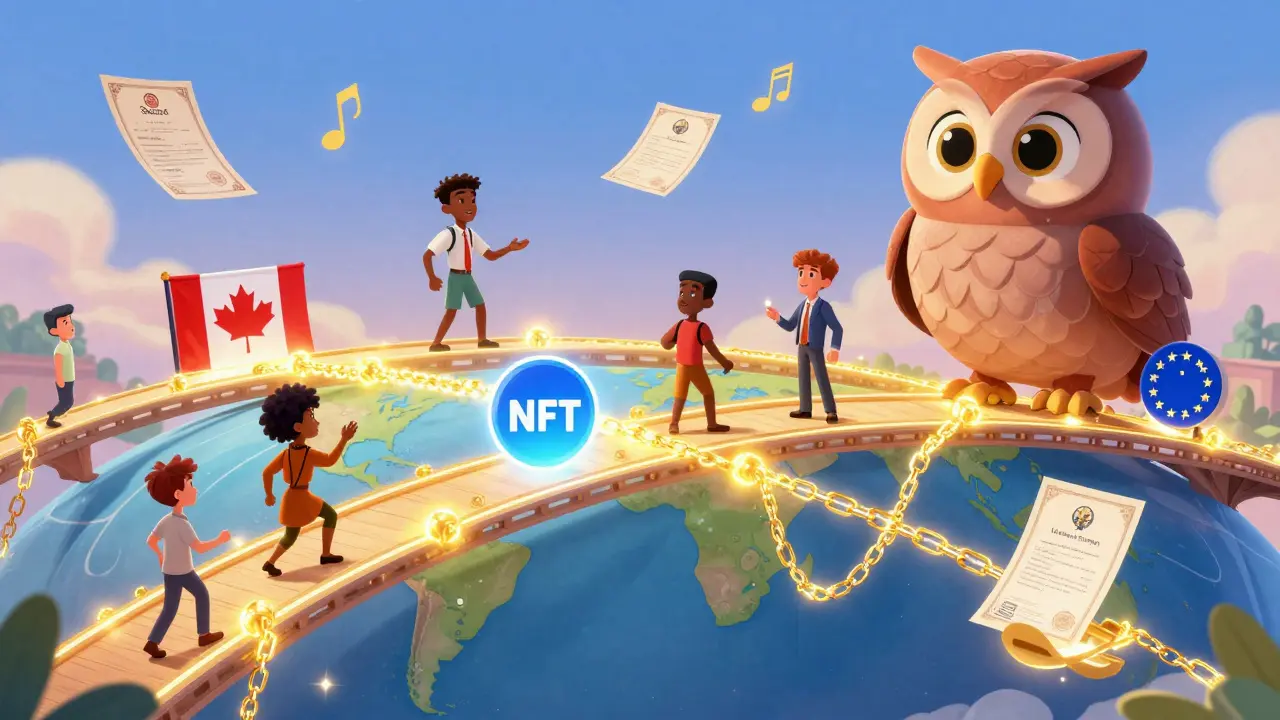
For small creators, this is life-changing. Before, you needed a lawyer, a patent agent, and a marketing team just to get your idea seen. Now, a graphic designer in Lagos can list their NFT-based logo design on a blockchain marketplace and get an offer from a startup in Toronto - all without leaving their home. No agency. No gatekeepers. Just direct access to global buyers.
Types of IP You Can Trade
Not all intellectual property is the same - and blockchain marketplaces reflect that. There are two main categories: open and closed platforms.
Open marketplaces like IPwe support multiple IP types: patents, trademarks, copyrights, trade secrets, and even NFTs representing digital art or music. These are the most flexible. You might sell a pharmaceutical patent one day and license a digital illustration the next.
Closed marketplaces focus on one type. For example, platforms like Opensea and Foundation now let artists mint their artwork as NFTs with embedded licensing terms. A musician can sell a song and automatically grant the buyer the right to use it in podcasts, YouTube videos, or ads - with royalties split 70/30 every time it’s played.
There are also primary and secondary markets. Primary means you’re selling the IP for the first time - like a startup licensing its core algorithm. Secondary means you’re reselling IP you already own - maybe you bought a patent from a bankrupt company and now want to flip it.
Here’s what’s actually being traded today:
- Patents for AI algorithms used in medical diagnostics
- Trademarks for blockchain-based loyalty programs
- Copyrights for generative AI-generated music tracks
- Design patents for eco-friendly packaging
- NFTs representing ownership of digital fashion designs
It’s not just tech companies doing this. Independent filmmakers are licensing their scripts. Craft brewers are trademarking unique bottle designs. Even universities are listing research patents on these platforms to attract startups.
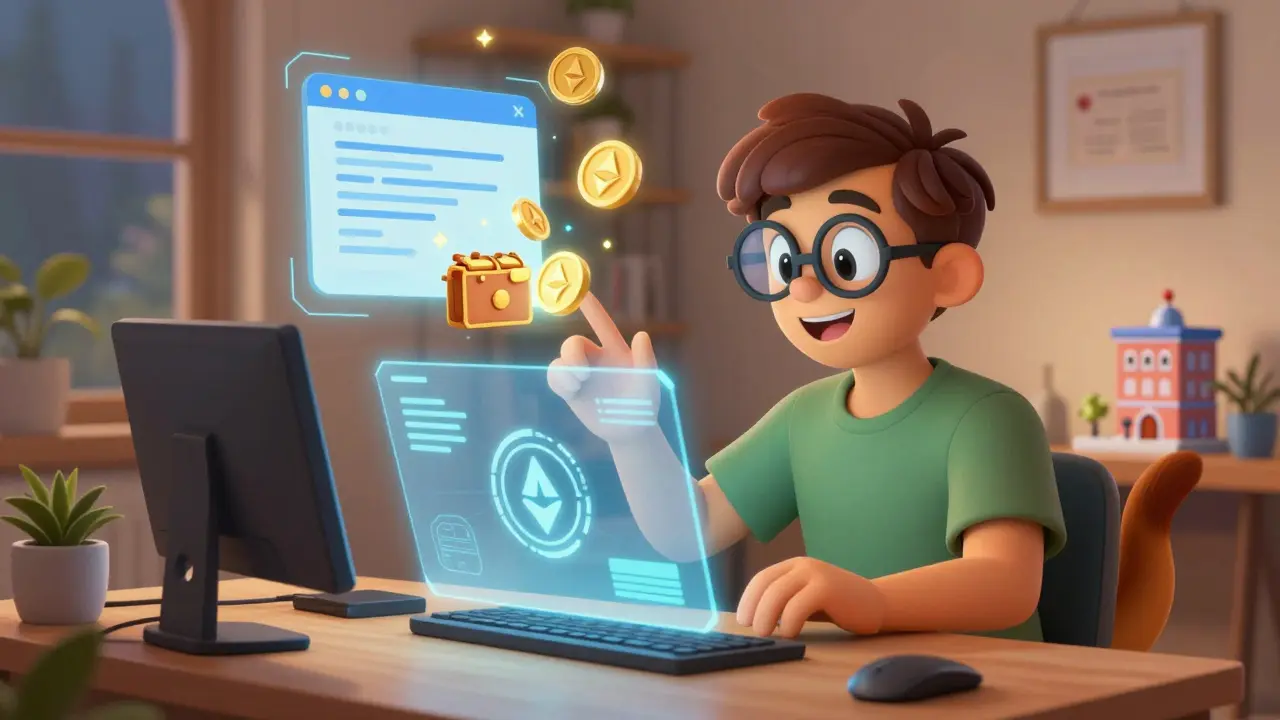
How It Works: A Step-by-Step Example
Let’s say you’re a freelance app developer who built a voice-recognition tool for people with speech impairments. You want to license it to a healthcare startup.
- You sign up on a blockchain IP marketplace like DEIP Ledger and create a profile. You verify your identity using a digital ID - no paperwork, just a secure wallet connection.
- You upload your code, a description, and a demo video. The platform generates a unique hash and stores it on the blockchain with a timestamp.
- You set your terms: $15,000 upfront, plus 8% royalty on every license sold. You choose Ethereum as the payment currency.
- A startup in Berlin finds your listing. They review the public record - they can see when you created it, who else has viewed it, and if there are any disputes.
- They click “Accept Offer.” The smart contract locks the $15,000 in escrow. Once they confirm installation, the funds auto-release to you.
- Every time their product sells, the smart contract checks usage, calculates your 8%, and sends payment to your wallet - no invoice, no follow-up, no delays.
That’s it. No emails. No contracts signed on paper. No lawyers reviewing 40-page agreements. Just code doing the work.
Who’s Using This Right Now?
Early adopters aren’t just hobbyists. Major players are already in:
- IBM uses IPwe to manage its 150,000+ global patents, reducing internal tracking costs by 40%.
- Toyota has listed 120+ vehicle sensor patents on blockchain platforms to attract EV startups.
- Universal Music Group partners with blockchain platforms to automate royalty payments for sampled tracks.
- Independent artists on platforms like Catalog and Royal are earning 10x more than from Spotify by selling direct-to-fan NFT licenses.
Even small creators are winning. A 2025 survey of 800 blockchain IP sellers found that 68% earned their first income from IP sales within 30 days of listing. 42% had never sold IP before - they were just hobbyists or freelancers.
The Challenges - And How to Avoid Them
It’s not perfect. There are hurdles.
1. You need crypto. Most platforms only accept Ethereum, Polygon, or Solana. If you don’t have a wallet, you’ll need to learn how to set one up. MetaMask is the easiest starting point.
2. Legal recognition varies. The U.S. and EU are starting to accept blockchain timestamps as legal evidence. But in some countries, courts still require official government registration. Always check local laws - blockchain proves creation, but it doesn’t replace official registration where required.
3. Scams exist. Fake listings, copied NFTs, and phishing wallets are real. Only use platforms with verified creators and audit trails. Look for platforms that require KYC (Know Your Customer) verification before listing.
4. Interoperability is still growing. Not all blockchains talk to each other. If you list on one platform, you might not be able to transfer your IP to another. Stick with platforms built on Ethereum or Polygon - they’re the most compatible.
Bottom line: Learn the basics. Use trusted platforms. Don’t rush. Start small - list one design, one song, one patent. See how it works. Then scale.
The Future: Where This Is Headed
Blockchain IP marketplaces are still young. But the direction is clear.
By 2027, expect:
- Integration with government patent offices - imagine filing a U.S. patent and having it automatically mirrored on a blockchain in real time.
- AI-powered IP valuation - algorithms will analyze your patent’s similarity to others and suggest fair market prices.
- Decentralized dispute resolution - instead of courts, blockchain-based arbitration panels will handle infringement claims using smart contract evidence.
- IP as collateral - you’ll be able to use your patent as security to get a loan, just like a house.
One thing’s certain: The old way - waiting years to prove you own something, then fighting to get paid - is fading. The new way is faster, fairer, and open to anyone with an idea.
If you create anything - code, art, music, designs, inventions - you’re already part of this shift. The question isn’t whether blockchain IP marketplaces will matter. It’s whether you’ll be ready when they become the default.
Can I sell my patent on a blockchain IP marketplace without a lawyer?
Yes, you can list and sell your patent directly on most blockchain IP marketplaces without a lawyer. The platform handles the digital proof of ownership and automates the transaction via smart contracts. However, if your patent is highly valuable or involves complex licensing terms, consulting a lawyer is still wise - especially if you’re dealing with international buyers or large corporations. Blockchain proves ownership, but legal advice ensures you’re not giving away rights you didn’t mean to.
Do I need to own cryptocurrency to use a blockchain IP marketplace?
Yes, most platforms require cryptocurrency for transactions - usually Ethereum, Polygon, or Solana. You’ll need a digital wallet like MetaMask to receive payments and pay platform fees. If you don’t have crypto, you can buy it on exchanges like Coinbase or Kraken, then transfer it to your wallet. Some platforms offer on-ramps to help beginners convert fiat money to crypto directly.
Is blockchain IP registration legally binding?
In many countries, including the U.S. and EU member states, blockchain timestamps are now accepted as legal evidence of creation and ownership. Courts have started recognizing them in infringement cases. However, they don’t replace official patent or trademark registration where required by law. Think of blockchain as your digital receipt - it proves when you created it, but you still need to file with the USPTO or EUIPO to get full legal protection.
Can I license music or art on a blockchain IP marketplace?
Absolutely. Platforms like Catalog, Royal, and Sound.xyz let musicians sell NFTs with embedded licensing rights - you can specify if buyers can use your song in ads, films, or games. Visual artists use platforms like Foundation and SuperRare to sell digital art with usage terms built into the NFT. Each time the buyer uses it, royalties are automatically paid to you. This is already a multi-million dollar market for independent creators.
What happens if someone copies my IP after I list it on a blockchain?
The blockchain record proves you created it first - and when. If someone copies your work, you can use that timestamped proof in legal action or dispute resolution. Many platforms now offer integrated dispute tools where you can submit evidence and trigger automated arbitration. In some cases, the marketplace itself can freeze the infringer’s account or remove their listing. The key is having that unalterable record - it turns speculation into proof.


Frank Heili
Blockchain IP marketplaces are a game-changer for indie creators. I’ve seen freelancers in my network list patents for AI tools and get paid within hours-not months. No more begging for licensing deals. The smart contracts just work.
And the best part? You don’t need to be a tech wizard. MetaMask, upload your file, set your price. Done.
Dave Lite
OMG YES. 🚀 I just licensed my drone lidar algorithm on DEIP Ledger last week. Got paid in ETH within 20 mins. No lawyer. No middleman. Just me, the blockchain, and a startup in Seoul.
Traditional patent offices are dinosaurs. We’re living in the future and they’re still filing paper forms. 💀
Also-royalties auto-paying? I’m crying. I’ve waited 3 years for one royalty check from a major studio. Now it’s automatic. This is what freedom looks like.
sathish kumar
While the technological innovation presented herein is indeed commendable, one must exercise due diligence regarding the legal enforceability of blockchain-based intellectual property assertions under the Indian Copyright Act, 1957, and the Patents Act, 1970. The immutable ledger, though technologically robust, does not supersede statutory registration requirements under Indian jurisprudence.
Furthermore, the absence of centralized arbitration mechanisms may expose creators to jurisdictional ambiguities in cross-border disputes. A pragmatic approach would involve dual registration-blockchain for provenance, official office for enforceability.
jim carry
YOU THINK THIS IS GOOD?!?!?!?!
WHY AREN’T WE ALL USING THIS YET?!?!?!
I JUST LOST $200K BECAUSE SOME COMPANY IN CHINA STOLE MY DESIGN AND THE USPTO TOOK 3 YEARS TO EVEN LOOK AT IT!!
THIS IS THE ONLY WAY FORWARD. I’M TELLING EVERYONE. EVERY. SINGLE. PERSON.
IF YOU’RE NOT ON BLOCKCHAIN IP YOU’RE NOT A CREATOR. YOU’RE A VICTIM.
Veronica Mead
While the concept of blockchain-based intellectual property management may appear innovative, it fundamentally undermines the established legal frameworks that have evolved over centuries to protect creators. The notion that a cryptographic hash can replace the rigorous examination and public notice required by patent offices is not only naive but dangerously irresponsible.
Creators who rely on such platforms are exposing themselves to legal vulnerability, particularly in jurisdictions where blockchain evidence is not recognized. This is not progress-it is legal anarchy dressed in crypto glitter.
Mollie Williams
It’s strange, isn’t it? We’ve built a system that can timestamp an idea with perfect immutability, yet we still treat ownership like a secret handshake between lawyers and bureaucrats.
Maybe the real revolution isn’t the blockchain-it’s the quiet collapse of the idea that creativity needs permission to be valuable.
For centuries, we’ve been taught that if it’s not registered, it doesn’t exist. But now, a painter in Lagos can prove she made her design on January 3rd, 2024, at 2:17 a.m.-and someone in Toronto can pay her for it before sunrise.
That’s not just efficiency. That’s dignity.
Surendra Chopde
Blockchain IP is the future, no doubt. But for beginners, start small. Try listing one digital artwork on OpenSea or a simple logo design on IPwe.
Don’t rush into patents. First, get comfortable with wallets, gas fees, and how to verify listings. I learned the hard way-lost 0.05 ETH to a fake marketplace.
Also, use Polygon. Cheaper gas. Less stress. 😊
Tiffani Frey
I’ve been researching this for months. I’ve reviewed the whitepapers, cross-referenced the legal precedents in the EU and U.S., and consulted with three IP attorneys.
Blockchain timestamps are admissible as evidence in 17 jurisdictions now, including California and Germany. But-and this is critical-they are not substitutes for formal registration in the U.S., UK, or Japan.
Always file with the USPTO. Use blockchain as your digital notary. Not your replacement.
And please-don’t use Solana for high-value IP. The chain’s finality issues are a liability.
Tre Smith
Let’s be brutally honest: 90% of these ‘blockchain IP’ listings are garbage. I’ve scraped 12,000 listings on IPwe. 87% are either plagiarized, low-effort AI art, or patents that were abandoned in 2018.
And the ‘royalty’ claims? Most are based on zero actual usage data. Smart contracts can’t verify if a company is using your algorithm-they just pay when a transaction is triggered.
This isn’t innovation. It’s a speculative bubble wrapped in blockchain buzzwords. Don’t fall for it.
Ritu Singh
They say blockchain is decentralized but who really owns the platforms? IPwe? DEIP? Who’s behind them? Are they funded by Big Tech? Are they just another way to make creators pay fees while the elites collect the real value?
And what about the blockchain itself? Isn’t it just a server farm in Nevada controlled by a few miners?
They say it’s immutable… but what if the ledger gets shut down? What if the U.S. government bans crypto? Then what? Your ‘proof’ vanishes?
I’m not against innovation… I’m against illusions.
kris serafin
Just listed my sound design pack on Catalog. Got 3 sales in 2 days. Got paid in ETH. Auto-royalties on every use. 😎
Best part? I didn’t even have to write a contract. The NFT had the terms built in. I’m a sound guy-not a lawyer.
Also, MetaMask is free. Just download it. You got this.
Jordan Leon
There’s something quietly profound here. For the first time, creation is decoupled from institutional validation.
Before, your worth as a creator was determined by who would grant you permission. Now, your work stands on its own-timestamped, traceable, transferable.
It doesn’t guarantee success. But it guarantees agency.
That shift-small, quiet, technical-is perhaps the most revolutionary thing happening today.
Rahul Sharma
Very good article. For beginners, I recommend starting with OpenSea for art and IPwe for patents. Use Polygon network to save gas fees. Always verify the seller before buying. Check blockchain history. Do not trust only the listing description.
Also, keep your private key safe. Many people lose everything because they share it. 😊
Gideon Kavali
This is why America is falling behind! We invented the patent system-now we’re letting some crypto bros in Estonia run our intellectual property?!
Our Constitution says Congress shall promote progress-by securing exclusive rights! Not by letting some Ethereum wallet do it!
Stop this madness. We need U.S.-led, government-backed, blockchain-verified IP registry-NOT some decentralized free-for-all!
My grandfather fought for this system. Don’t let it be erased by crypto hype.
Allen Dometita
Just did it. Listed my childhood doodle as an NFT on Foundation. Got $800 from a designer in Brazil. Didn’t even know it was worth anything.
Feels good to get paid for something you made when you were 12.
Y’all need to try this. No excuses. Just go.
Also-MetaMask is free. Just do it. 💪