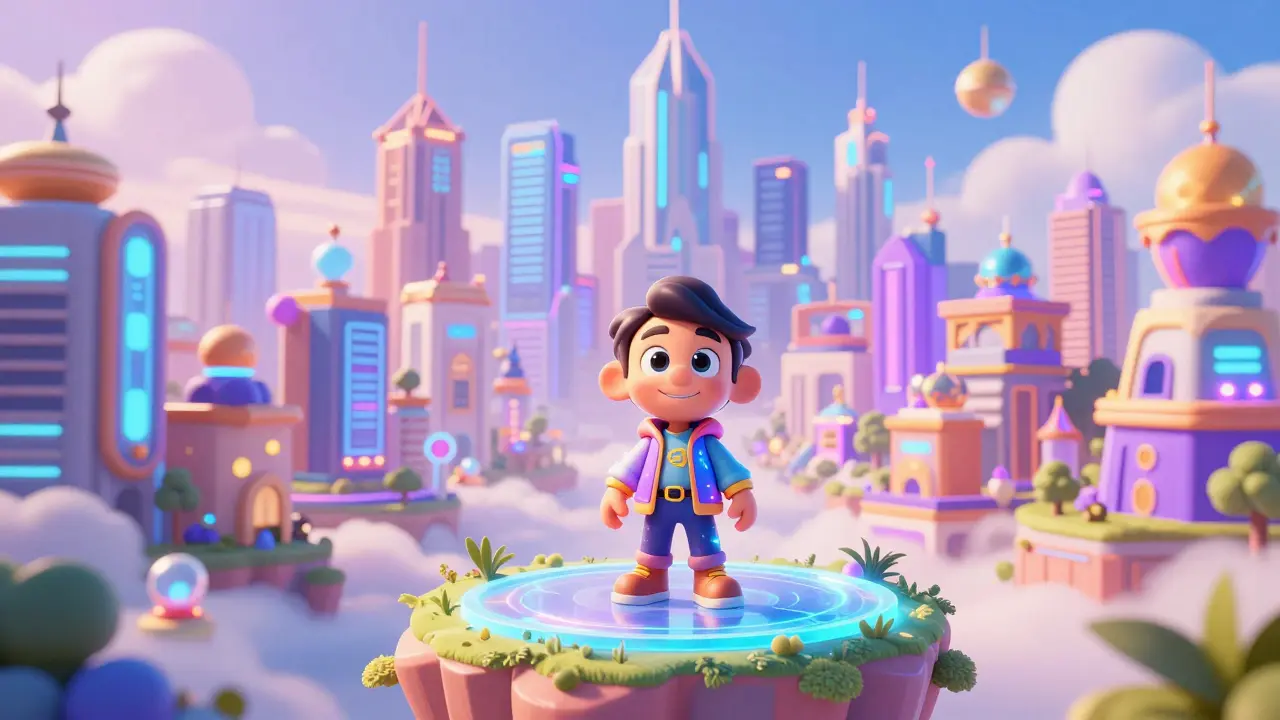
Imagine walking into a digital city where you don't just rent a profile, but you actually own the land beneath your feet and the clothes on your avatar. For years, we've had virtual worlds, but they were always owned by a single corporation that could delete your assets with one click. blockchain metaverse platforms change that by shifting power from a central server to a decentralized ledger, making digital ownership real and permanent.
| Platform | Primary Blockchain | Core Focus | Key Asset | Access Method |
|---|---|---|---|---|
| Decentraland | Ethereum | Social & Governance | LAND NFTs | Browser-native |
| The Sandbox | Ethereum / Polygon | Gaming & Branded IP | LAND / VOXELS | App Download |
| Spatial | Multi-chain | Professional & Art | Virtual Spaces | Browser/VR |
True Digital Ownership and the Role of NFTs
The magic happens when you combine virtual reality with Non-Fungible Tokens is a unique digital identifier that proves ownership of a specific asset on a blockchain. Commonly known as NFTs, these tokens ensure that if you buy a piece of virtual real estate, it belongs to your wallet, not the platform's database.
In a traditional game, if the company shuts down, your items vanish. In a blockchain metaverse, your assets exist on the chain. This has created a massive secondary market for virtual real estate. For instance, prime locations in digital hubs can command thousands of dollars because they offer higher visibility for brands and creators. You can lease your land to a company for a virtual pop-up shop or sell it for a profit as the platform grows.
Decentraland: The Social Pioneer
Decentraland is a decentralized 3D virtual world built on the Ethereum blockchain where users control the environment and economy. It's one of the most accessible platforms because it's browser-native, meaning you don't need to download heavy software to start exploring.
The platform runs on MANA is the native cryptocurrency used for transactions and governance within the Decentraland ecosystem. If you hold MANA or LAND NFTs, you aren't just a user; you're a stakeholder. This is managed through a DAO is a Decentralized Autonomous Organization that allows token holders to vote on policies and development updates. Want to change the zoning laws of the virtual city? You can propose a vote and let the community decide.
The Sandbox: Gaming and Creative Toolkits
While Decentraland focuses on social spaces, The Sandbox is a voxel-based metaverse platform focused on user-generated content and gaming experiences. It feels more like a game, utilizing a "voxel" aesthetic (think digital LEGOs).
What makes it stand out is the toolkit. They provide VoxEdit for creating 3D objects and a Game Maker that lets people build complex interactive experiences without needing to write a single line of code. This approach has attracted massive brands and entertainment companies who want to build branded "experiences" rather than just static galleries. If you're a creator, this is where you can actually monetize your skills by designing assets for others.
The Engine Under the Hood: Choosing the Right Blockchain
Not all blockchains are created equal, and the choice of infrastructure changes the user experience entirely. Most pioneers started with Ethereum is the primary smart contract platform that powers most early decentralized applications. However, Ethereum is known for high gas fees. During peak times, a simple transaction to move an NFT could cost $15 or more, which is a huge barrier for a casual user.
To fix this, many platforms use Polygon is a Layer 2 scaling solution that allows for faster and cheaper transactions while remaining compatible with Ethereum. By moving transactions to a side-chain, users get the security of Ethereum but with fees that cost pennies.
On the other side, we have Solana is a high-performance blockchain capable of processing over 50,000 transactions per second. Its speed is incredible for real-time interactions. The 2025 Alpenglow upgrade significantly boosted its stability, making it a strong contender for high-volume trading and gaming. The trade-off? It's generally less decentralized than Ethereum, which is a risk some users aren't willing to take.
Interoperability: Breaking the Walls
The current problem with most metaverses is that they are "walled gardens." Your avatar in The Sandbox can't just walk into Decentraland. This is where Polkadot is a multichain protocol that connects different specialized blockchains through a relay chain. By using parachains like Moonbeam, developers are working toward a future where assets can flow between worlds.
Imagine buying a digital sword in one world and wearing it as a trophy in a virtual corporate meeting in another. This interoperability is the "holy grail" of the metaverse. Without it, we just have several different games; with it, we have a connected digital universe.
Making Money in the Virtual World
Monetization in these platforms isn't just about flipping NFTs. We're seeing a shift toward real services. Some users act as "virtual architects," designing layouts for corporate land parcels. Others run virtual events-like fashion shows or art galleries-charging admission in crypto.
We're also seeing the integration of DeFi (Decentralized Finance). Some platforms now allow users to borrow against their virtual land as collateral to get liquid crypto. This turns digital real estate into a productive financial asset, similar to how physical real estate works in the real world.
Do I need a VR headset to use these platforms?
No, you don't. While VR enhances the experience, most blockchain metaverses like Decentraland are browser-based and work on a standard laptop or desktop. Some, like The Sandbox, require a software download but still work with a keyboard and mouse.
Is virtual land a safe investment?
Like any crypto-asset, virtual land is highly volatile. Its value depends on the platform's popularity, the location's demand, and the overall health of the blockchain it's built on. Never invest more than you can afford to lose.
What is the difference between a regular game and a blockchain metaverse?
The main difference is ownership. In a regular game, the developer owns all the items. In a blockchain metaverse, the items are NFTs held in your own wallet, meaning you can sell them on external marketplaces without the developer's permission.
What are gas fees?
Gas fees are the payments made to network validators to process a transaction on the blockchain. On Ethereum, these can be expensive, but on Layer 2s like Polygon or high-speed chains like Solana, they are usually very low.
How do DAOs work in the metaverse?
A DAO (Decentralized Autonomous Organization) lets users vote on how the platform is run. If you hold the platform's native token, you get voting power. This means the community, not a CEO, decides on things like feature updates or tax rates on land sales.
Next Steps for New Explorers
If you're just starting, don't jump straight into buying expensive land. Start by setting up a secure crypto wallet (like MetaMask or Phantom) and exploring the free areas of these worlds. Try creating a simple asset in VoxEdit or attending a community event in Decentraland to see if the vibe fits your interests. Once you understand how the economy works, you can look into smaller, more affordable assets or contribute to the community through a DAO.

Iestyn Lloyd
The mention of Polygon is quite relevant here. For those just starting, using a Layer 2 solution really removes the friction that plagued early Ethereum adopters, making the onboarding process far more seamless for the average user.
Noel Mandotah
Oh sure, because buying a JPEG of a digital plot of land is totally the peak of human evolution. Groundbreaking stuff!
Janis Naglis
This is such a vibe!!! The synergy between DeFi liquidity pools and virtual real estate is honestly a game-changer for the whole ecosystem!!! Just imagine the scalability of these tokenized assets!!! So exciting!!!
Michael Repak
I totally agree with the approach of starting small!!! Exploring the free areas first is the best way to get a feel for the community!!! Really great advice!!!
Sri Astuti
It is actually laughable that anyone considers this 'ownership' when you are still dependent on the underlying protocol stability, and frankly, the UI of Decentraland is an absolute disaster that looks like it was coded in 2005 by someone who had never seen a modern browser before, which makes the whole 'future of 2026' claim feel like a complete joke 🙄.
Livvy Cooper
It's all just a scam to make people spend money on things that aren't even real. Why would I want a digital house when I can't even touch it?
Ryan Nakielny
Right, because we definitely need more ways to spend money on digital air. Truly revolutionary.
Elle Kharitou
I find it so fascinating how we are redefining the very concept of 'space' and 'belonging' in a digital realm that transcends physical borders 🌍. It feels like we are witnessing the birth of a new global consciousness where our creative spirits can finally roam free without the limitations of gravity or geography, allowing us to build sanctuaries of art and peace for everyone to enjoy 🕊️✨.
April D Thompson
The idea of interoperability is literally the only thing that matters here. If I can't carry my identity across worlds, I'm just a prisoner in a slightly different flavored cage! We need a total liberation of digital assets if we're actually going to call this a 'universe' and not just a collection of corporate theme parks!
Wayne Gillis
Who wants to trade NFTs? 🚀 I've got some wild assets in The Sandbox you guys need to see! Check your DMs! 💎🙌
Kara Spadone
Most people are just chasing the hype without understanding the spiritual void they are trying to fill with pixels 🙄. You cannot buy enlightenment in a voxel world :)
edie rosa
The environmental impact of these blockchains is a moral failure that this post completely ignores. We are literally burning the actual planet to build a fake one where rich people can flex digital shoes. It's disgusting and the lack of ethics in the 'metaverse' push is a testament to the greed of the current tech era.
AP Fisher
So I just need a wallet to try this? That sounds a bit easier than I thought.