Imagine sending money to a friend across the world without paying a single penny in fees. It sounds like a dream, but for many users of specific cryptocurrencies, it is reality. While Bitcoin and Ethereum often charge high fees during busy times, other networks have built architectures that make transactions completely free or nearly so. This shift challenges the traditional idea that miners must be paid to secure a network.
If you are tired of watching your transfer value shrink due to gas fees or network congestion, understanding these zero-fee models can change how you use digital assets. These systems aren't just theoretical; they are live, active, and being used for everything from micro-payments to Internet of Things (IoT) device communications. Let's look at how they work, which ones are truly free, and what trade-offs you need to accept.
The Problem with Traditional Blockchain Fees
To understand why zero-fee options matter, we first need to look at why fees exist in the first place. In traditional blockchains like Bitcoin, fees serve two main purposes: they prioritize transactions when the network is crowded, and they pay miners who secure the network through Proof-of-Work. When demand spikes, users bid up these fees to get their transactions processed faster. This creates a frustrating experience for everyday users who just want to send $10 without losing $5 to fees.
Ethereum faces similar issues, though its fee structure is tied to computational complexity rather than just block space. Smart contracts require processing power, and users pay for that execution. While Layer 2 solutions have helped reduce costs, the base layer still incurs significant expenses during peak usage. This is where alternative architectures step in, offering different ways to validate transactions without relying on user-paid incentives.
Nano: The Pioneer of True Zero Fees
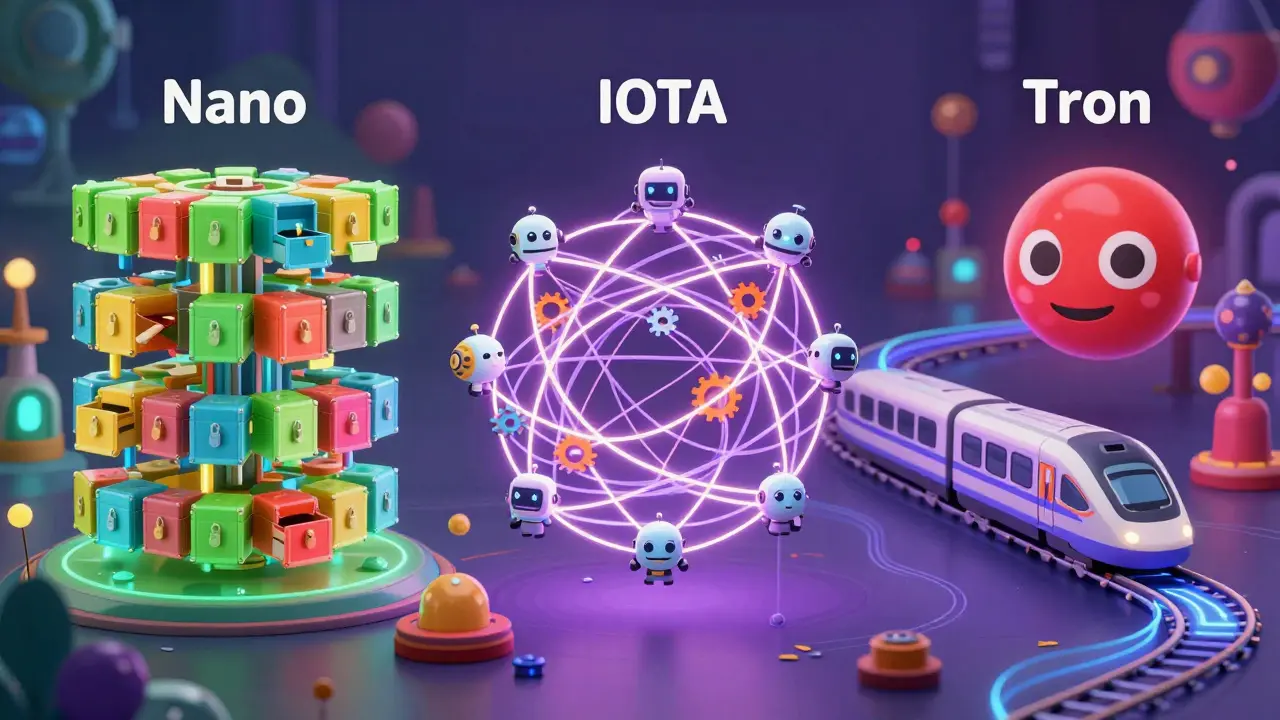
When people talk about zero-fee cryptocurrency, Nano is usually the first name mentioned. Launched in 2017 (originally as RaiBlocks), Nano was designed from the ground up to eliminate transaction costs entirely. Unlike Bitcoin’s single chain where everyone competes for space, Nano uses a unique architecture called a block-lattice. This means every account has its own blockchain. If you send money to someone, you sign a transaction on your chain, and they sign a receiving transaction on theirs. There is no central ledger to congest, so there is no need for fees to prioritize your payment.
| Cryptocurrency | Architecture Type | Consensus Mechanism | Fee Structure | Best Use Case |
|---|---|---|---|---|
| Nano | Block-Lattice (DAG) | Open Representative Voting (ORV) | $0.00 (Truly Free) | Micropayments, Remittances |
| IOTA | Tangle (DAG) | User Validation (Proof-of-Work) | $0.00 (User Validates) | IoT, Machine-to-Machine |
| Tron | Blockchain (DPoS) | Delegated Proof-of-Stake | Near-Zero (<$0.01) | Gaming, DeFi, Media |
| Stellar | Blockchain (SCP) | Stellar Consensus Protocol | Ultra-Low (0.00001 XLM) | Cross-Border Payments |
Nano’s consensus mechanism, Open Representative Voting (ORV), relies on nodes selected by the community to vote on transaction validity. These representatives are not paid in fees; instead, they run nodes for altruistic reasons or to support the network’s growth. Because there is no mining reward, the network doesn’t need to burn energy solving complex puzzles. The result? Transactions settle in under a second, cost nothing, and scale infinitely because each account processes its own history independently.
IOTA: Validating Without Paying
IOTA takes a different approach to eliminating fees. Instead of a blockchain, IOTA uses a Directed Acyclic Graph (DAG) known as the Tangle. In this system, there are no blocks and no miners. To issue a transaction, a user must first validate two previous transactions on the network. This process requires a small amount of Proof-of-Work, which acts as a spam prevention measure rather than a financial incentive. Essentially, every user becomes a mini-validator.
This model makes IOTA particularly powerful for the Internet of Things (IoT). Imagine millions of smart devices communicating and exchanging tiny amounts of data or value. Charging even a cent per transaction would break the economics of such a system. With IOTA, a coffee machine could pay a sensor for temperature data instantly and for free. However, this comes with a trade-off: the user’s device must perform the validation work. For lightweight IoT devices, this might be challenging, but for smartphones and computers, it is negligible.
Tron and Stellar: Near-Zero Fee Alternatives
Not all low-fee cryptocurrencies are technically "zero," but some are close enough that the difference is irrelevant for most users. Tron operates on a Delegated Proof-of-Stake (DPoS) model. In DPoS, token holders vote for a limited number of validators (Super Representatives) who produce blocks. Since these validators are rewarded through staking rewards and potentially inflationary issuance rather than direct transaction fees, the cost to transact is incredibly low. Often, transferring TRX tokens costs less than a fraction of a cent, and many transfers within the ecosystem are effectively free if you hold sufficient bandwidth resources.
Stellar is another strong contender, especially for cross-border payments. It uses the Stellar Consensus Protocol (SCP), which allows nodes to reach agreement without requiring massive computational power. The base fee on Stellar is fixed at 0.00001 XLM per transaction. Given that XLM trades at a low price, this translates to roughly $0.000004 per transaction. While not technically zero, it is so low that it rounds down to nothing for practical purposes. This makes Stellar ideal for banks and payment processors looking to move funds internationally without the friction of traditional correspondent banking fees.
How Do These Networks Stay Secure?
A common question arises: if users don’t pay fees, who pays for security? In Bitcoin, fees and block rewards incentivize miners to secure the network. In zero-fee models, the economic incentives are structured differently.
- Altruism and Reputation: In Nano, node operators often run their infrastructure out of belief in the technology or to gain reputation within the community. Some may receive donations, but there is no mandatory fee revenue stream.
- Self-Validation: In IOTA, security is distributed among users. By requiring users to validate transactions, the network avoids reliance on a separate miner class. The cost of attacking the network is high because an attacker would need to control a significant portion of the validation power.
- Staking Rewards: In Tron and other DPoS chains, validators are compensated through new token issuance (inflation) and staking rewards. The network’s value proposition attracts stakeholders who lock up tokens to earn yields, indirectly funding network security.
While these models work, critics argue that they may be less decentralized than Bitcoin. Without financial incentives, fewer people may run nodes, leading to centralization among large players or enthusiasts. However, proponents counter that the current state of Bitcoin mining is also highly centralized among large industrial farms, so the comparison is nuanced.

Practical Challenges and Adoption Barriers
Despite the technical advantages, zero-fee cryptocurrencies face real-world hurdles. The biggest issue is adoption. Merchants and exchanges prefer established cryptocurrencies like Bitcoin and Ethereum because of their liquidity and brand recognition. Finding a store that accepts Nano or IOTA is difficult compared to finding one that accepts Visa or even Bitcoin.
Liquidity is another concern. While you can easily swap USDT for BTC on any exchange, swapping for NANO or IOTA might require using specialized platforms or decentralized exchanges with lower depth. This can lead to slippage when buying or selling larger amounts. Additionally, wallet support varies. Not all hardware wallets support every zero-fee coin, meaning users need to do extra research to ensure their funds are stored securely.
Regulatory uncertainty also plays a role. As governments tighten rules around cryptocurrency, niche coins with smaller communities may struggle to comply with KYC/AML requirements on major exchanges. This could limit accessibility in certain jurisdictions.
Which Zero-Fee Crypto Is Right for You?
Your choice depends on your specific needs. If you want to send small amounts of money to friends or family abroad without worrying about fees, Nano is likely your best bet. Its simplicity and true zero-cost structure make it perfect for personal remittances. If you are a developer building IoT applications or machine-to-machine communication systems, IOTA offers the necessary infrastructure for feeless micro-transactions between devices.
For those involved in DeFi, gaming, or media platforms, Tron provides a robust ecosystem with near-zero fees and high throughput. If you are a business looking to streamline cross-border payments, Stellar offers regulatory compliance and ultra-low costs that integrate well with traditional financial systems. Each option has its strengths, and understanding these distinctions helps you choose the right tool for the job.
Is Nano really completely free to use?
Yes, Nano transactions are truly free. There are no fees attached to sending or receiving XRB (Nano's ticker). The network does not charge users because it relies on a block-lattice architecture where each account maintains its own blockchain, eliminating the need for miners who require payment.
Why don't more merchants accept zero-fee cryptocurrencies?
Adoption is slow primarily due to liquidity and familiarity. Most merchants already accept credit cards or established cryptos like Bitcoin. Switching to a new currency involves integration costs and consumer education. Additionally, smaller markets mean less price stability and fewer trading pairs, which can deter businesses.
Are zero-fee cryptocurrencies safe?
They are generally safe, but their security models differ from Bitcoin. Nano and IOTA rely on different consensus mechanisms that have been tested but lack the decades-long battle-testing of Proof-of-Work. Users should always use reputable wallets and verify addresses carefully, as transactions on these networks are often irreversible and instant.
What is the difference between IOTA and Nano?
Both are feeless, but their architectures differ. Nano uses a block-lattice where each account has its own chain, optimized for peer-to-peer payments. IOTA uses a Tangle (DAG) where users validate previous transactions, making it better suited for IoT and machine-to-machine data exchange. Nano is simpler for humans; IOTA is designed for machines.
Can I mine Nano or IOTA?
No, you cannot mine Nano or IOTA in the traditional sense. Both networks pre-mined their total supply. Nano distributes funds through donations and exchanges, while IOTA requires users to perform Proof-of-Work for validation, but this does not yield new tokens. You acquire them by purchasing on exchanges or earning through services.