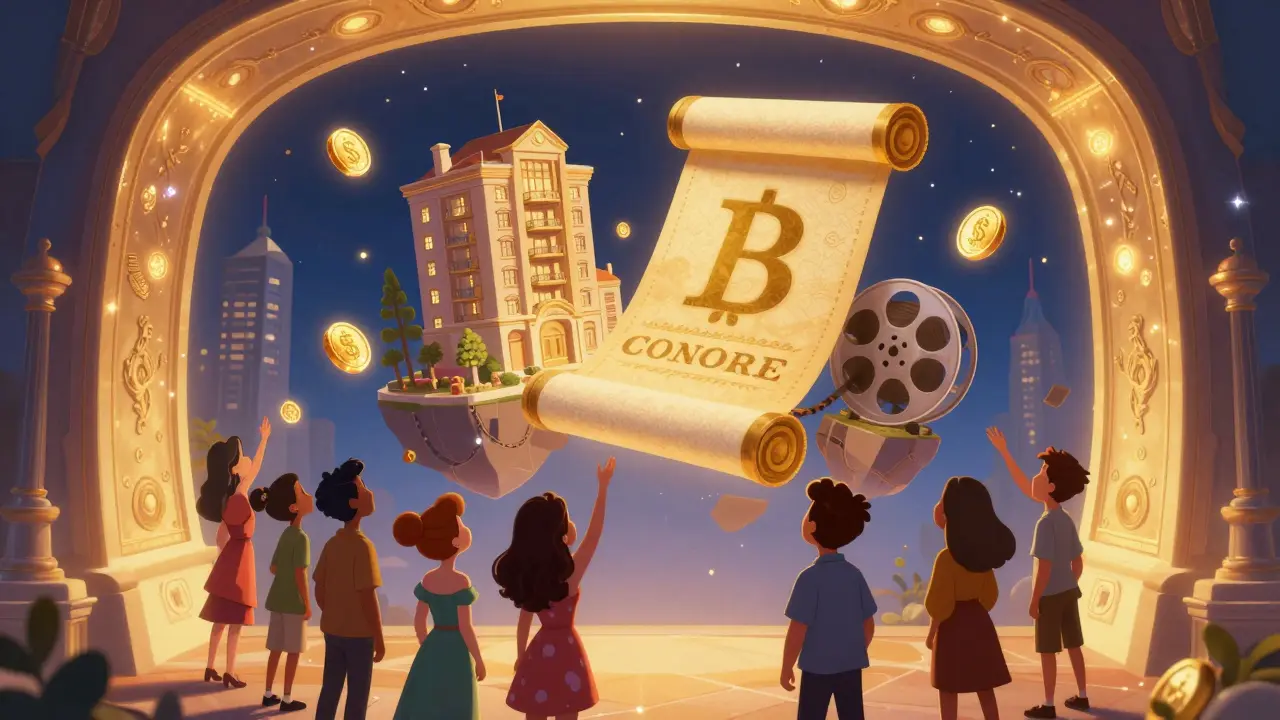
Imagine being able to own a piece of a luxury apartment building, a high-yield corporate bond, or a slice of a hit movie's royalties without needing a million dollars in your bank account. That is the core promise of RECON is a Real World Asset (RWA) and intangible asset investment platform built on the Solana blockchain. It aims to break down the walls that keep retail investors away from institutional-grade investments, turning massive, illiquid assets into digital tokens that anyone can trade.
How RECON Changes the Investment Game
For decades, the best investment opportunities-like commercial real estate or private equity-were reserved for "accredited investors" (basically, the very wealthy). RECON tries to fix this by using tokenization. This process takes a physical or intangible asset and represents it as a digital token on a blockchain. Because these tokens can be split into tiny fractions, you can invest small amounts into assets that were previously impossible to access.
The platform doesn't just stick to buildings. It targets three main pillars: real estate, bonds, and entertainment. This diversification is a smart move; if the property market dips, the entertainment or bond sectors might still be performing. By moving these assets onto a blockchain, RECON removes the need for mountains of paperwork and middle-men who take huge cuts of the profit.
The Power of the Solana Network
RECON doesn't just float in space; it lives on Solana, which is a high-performance blockchain known for its incredibly fast transaction speeds and minimal costs. Why does this matter for an investment platform? If you're trading fractions of a bond or a piece of art, you don't want to pay $20 in gas fees for a $10 investment. Solana's architecture allows RECON to process thousands of transactions per second, making the user experience feel more like a modern banking app and less like a clunky legacy system.
Using Smart Contracts on Solana, RECON can automate the distribution of dividends or rental income. Instead of waiting for a quarterly check in the mail, the smart contract can automatically send a portion of the asset's earnings directly to the token holders' wallets in real-time.
Token Economics and Market Reality
When looking at the RECON token, it's important to understand the numbers. The project has a maximum supply of 100 billion tokens. However, if you check different price trackers, you'll notice something strange: the prices are all over the place. Some sites show it at $0.017, while others report it as low as $0.000270.
Why is there such a gap? This is a classic sign of a micro-cap project with limited liquidity. When a coin is only traded on a few smaller exchanges, a single large buy or sell order can swing the price wildly. It also means that data aggregators aren't always synced up. For a regular person, this means high volatility. You could see a 40% drop or an 8% jump in a single day, which is a rollercoaster ride even by crypto standards.
| Attribute | Value |
|---|---|
| Blockchain | Solana |
| Max Supply | 100 Billion RECON |
| Primary Use Case | RWA Tokenization |
| Price Range (est.) | $0.00027 - $0.017 |
| Available Pairs | RECON/USDT |
The Risks: What You Need to Watch Out For
Investing in early-stage RWA projects isn't without danger. First, there is the liquidity issue. With a 24-hour trading volume often fluctuating between $11,000 and $84,000, it might be difficult to sell a large amount of RECON without crashing the price. Second, there are no derivative tools. You won't find perpetual contracts or ETFs for RECON, meaning you can't easily hedge your bet or "short" the coin if you think it's going down.
There is also the regulatory hurdle. Tokenizing real estate is one thing; making it legal in every country is another. RECON has to navigate a maze of international laws to ensure that a token actually represents a legal claim to a physical asset. Without transparent audits and clear legal documentation, the "ownership" of these assets remains a point of skepticism for many experienced investors.
Comparing RECON to the Broader RWA Sector
RECON is part of a larger trend. Big players like BlackRock are already experimenting with tokenized funds, proving that the industry is moving in this direction. While RECON is currently a micro-cap project, its focus on entertainment and bonds gives it a slightly different niche than platforms that only do gold or real estate.
The success of RECON depends on three things: creating a steady flow of high-quality assets, building a community that trusts the platform, and maintaining a stable price through better exchange listings. Right now, it's a high-risk, high-reward play for those who believe in the future of the Solana ecosystem and the democratization of finance.
Is RECON a safe investment?
Like most micro-cap cryptocurrencies, RECON is considered high-risk. It experiences extreme price volatility and has limited liquidity, meaning it can be hard to buy or sell large amounts without affecting the price. You should only invest money you are willing to lose.
Which blockchain does RECON use?
RECON is built exclusively on the Solana blockchain, utilizing its high speed and low transaction costs to enable efficient asset trading.
What exactly are "Real World Assets" (RWA) in crypto?
RWA refers to the process of bringing tangible assets-like real estate, gold, or bonds-onto the blockchain. By tokenizing these assets, they can be traded in smaller fractions, making them more accessible to the general public.
Where can I buy RECON tokens?
RECON is available on select exchanges, such as Biconomy, primarily through the RECON/USDT trading pair.
Why is the price of RECON different on different websites?
This happens because RECON is traded on a small number of exchanges with low volume. Different data aggregators may pull data from different sources, and the lack of a massive, unified market leads to price discrepancies.
Next Steps for Potential Users
If you're thinking about getting into RECON, don't just rely on a price chart. Start by visiting their official channels on X (@reconrwa) and Telegram. Look for their whitepaper to see exactly how they handle the legal side of asset ownership. If you're a conservative investor, you might want to wait until they are listed on more reputable, high-volume exchanges. If you're a risk-taker, start with a small amount and monitor how the token interacts with the broader Solana RWA trend.

Samson Selleck
The systemic opacity regarding the liquidity depth of this micro-cap asset is frankly alarming. One cannot simply ignore the slippage implications when the order book is this thin, as the arbitrage opportunities are practically nonexistent due to the fragmented nature of the current exchange listings. It is a textbook case of market inefficiency where the nominal price is a mere phantom, devoid of any actual fundamental support or institutional validation. Any investor lacking a sophisticated understanding of asymptotic pricing models is essentially gambling on a coin toss. The delta between the reported values across aggregators isn't just a "gap" but a symptom of a dysfunctional market structure. We are seeing a complete lack of market-making maturity here. The volatility is not a feature, it is a failure of the project to secure a primary liquidity provider. Without a robust treasury management strategy, the token's utility is purely speculative. It's practically a lottery ticket wrapped in a blockchain facade. The socio-economic aspiration of democratizing finance is a noble sentiment, but the execution here lacks the necessary rigorous financial engineering to be viable. One must wonder if the developers even understand the Basel III implications for RWA tokenization. It's laughable to suggest this is an "investment" in the traditional sense. This is purely an exercise in high-beta volatility. I find the optimism surrounding such low-liquidity assets to be intellectually bankrupt.
Tracie and Matthew Hartley
rwa is just a fancy word for the same old scams but on solana lol
Artavius Edmond
I think the idea of splitting up luxury real estate is actually pretty cool and could help a lot of people get into the market
Akshay Gorad
I appreciate the breakdown of the risks involved, especially the regulatory hurdles mentioned. It is important to maintain a realistic perspective on these projects.
Alan Seiden
Absolute rubbish. This is just another way to fleece retail investors while the developers laugh all the way to the bank. Only a fool would touch a coin with such pathetic volume. Typical garbage crypto nonsense!
Amanda Faust
solana is the only choice for this since eth gas would kill any small investment
aletheia wittman
omggg the price is like a rollercoster i cant even deal with this volatility right now!!! 😭
Jason Davis
Just a heads up for everyone, make sure you double check the smart contract adress before swapping since there are often fakes of these RWA tokens out there. Be careful with your seed phrases too!
Jessie Tayaban
Oh my god i am SO excited about the entertainment part!! Imagine owning a piece of a movie!! I cant believe this is realy happening in our lifetime!!
EDOZIEM MICHAEL
wealth is just a shadow of what we truly value in life anyway
Tyler Webb
It's definitely a bit scary for beginners, but the concept is promising :)
Omotola Balogun
Actually the tokenomics of 100 billion supply are quite standard for micro-caps, though the lack of an automated market maker on major dexes is a clear oversight in their launch strategy.
Adam Auksel
Great to see more people exploring the Solana ecosystem! 🚀 Just remember to do your own research!
Chidinma Sandra okafor
Sure, because we trust random tokens more than our own national banks. What a joke.
Heather Warren
I think the diversification into bonds and entertainment is a really smart way to stabilize the portfolio over time.
william manes
Total scam! 🤡 Stay away!
Kieran Smith
I wonder if they'll ever list on a bigger exchange maybe then the price gaps will go away
jennelle williams
everyone should just be careful
Prasanna Shembekar
this is just too much stress for me honestly
Rob Mitchell
Solana's speed is definitely the key here.
Artavius Edmond
Glad to see we're on the same page about the potential!