You’ve probably seen the endless parade of animal-themed cryptocurrencies. Dogs, cats, frogs-they’re everywhere. But have you heard about Bear Coin on Avax? It’s a small-cap meme token riding the wave of the Avalanche ecosystem, and it has a backstory that’s equal parts cute and chaotic. If you are wondering what this coin actually does, why it exists, or if it’s worth your time, you are in the right place. Let’s cut through the noise and look at the hard facts.
Bear Coin on Avax, trading under the ticker **BEAR**, is not a high-tech DeFi protocol or a governance token for a major platform. It is, quite simply, a meme coin. Its entire identity is built around being named after Bear, the pet dog of one of Avalanche’s co-founders. The project positions itself as a community-driven asset meant to promote the Avalanche network in a playful way. There is no complex whitepaper, no revolutionary technology, and no grand roadmap. Just a token, a story, and a community hoping for price action.
The Origin Story: Why a Dog?
In the world of crypto, narratives drive value more often than utility. For BEAR, the narrative is personal. The token takes its name from the actual dog owned by an Avalanche co-founder. This connection gives it a sense of authenticity within the Avalanche community-it’s not just another random animal token slapped onto a blockchain; it has a direct link to the founding family of the network.
CoinMarketCap and CoinGecko both highlight this origin, describing BEAR as a "unique and charming" token dedicated to promoting Avalanche and its protocols. However, don’t expect to find a formal team page with LinkedIn profiles or a detailed technical documentation folder. The creators remain largely anonymous or low-profile, which is standard for meme coins but raises eyebrows for anyone looking for institutional-grade transparency. The lack of a public whitepaper or open-source code repository suggests this is purely a social experiment rather than a software product.
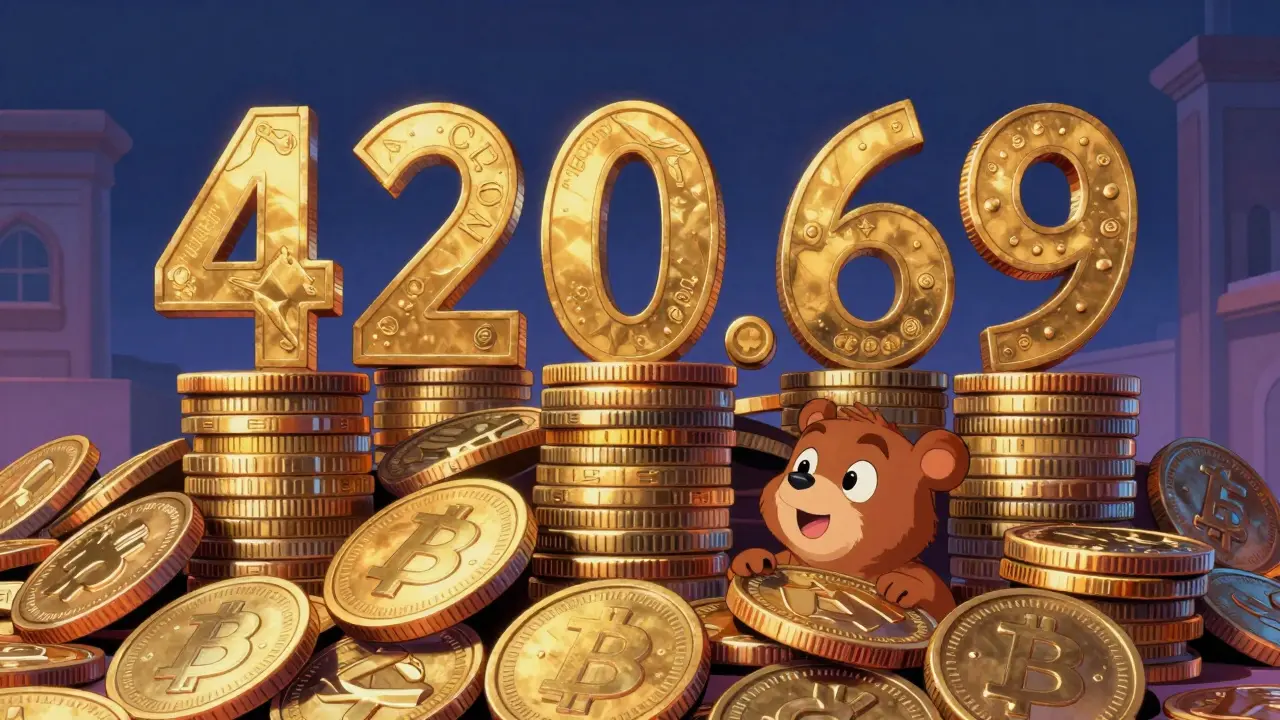
Tokenomics: The 420.69 Billion Supply
If you want to understand the financial structure of BEAR, you need to look at its supply numbers. They are specific, stylized, and very much in line with internet culture.
| Metric | Value |
|---|---|
| Total Supply | 420.69 Billion BEAR |
| Maximum Supply | 420.69 Billion BEAR |
| Circulating Supply | 420.69 Billion BEAR (Self-reported) |
| Blockchain | Avalanche (C-Chain) |
The number 420.69 is a deliberate nod to meme culture. It signals that the project doesn’t take itself too seriously. More importantly, the fact that the total, maximum, and circulating supplies are identical means there are no hidden tokens waiting to be unlocked by founders or investors. In theory, this prevents future inflationary dumps. In practice, it means the current holders control the entire float, making the price highly sensitive to any large sell-off.
There is no information available regarding initial distribution, liquidity pool allocations, or vesting schedules. This opacity is a red flag for risk-averse investors. You are buying into a fixed-supply asset where you have no idea who holds the largest chunks of the pie.
Price Reality: Is Anyone Trading This?
Let’s talk about the money. Or rather, the lack of it. When you check the price of BEAR across different aggregators, you get a confusing picture that highlights a critical issue: illiquidity.
Some platforms like Crypto.com might show a tiny price, such as $0.0000000755, while others like CoinMarketCap may display $0.00 because they cannot calculate a reliable market price due to zero volume. CoinGecko has shown minute volumes, sometimes less than $10 in a single day. To put that in perspective, major Avalanche tokens handle millions of dollars in daily trades. BEAR handles pennies.
This extreme thinness in liquidity means two things:
- High Slippage: If you try to buy even a modest amount of BEAR, your transaction could drastically move the price up, meaning you pay much more per token than the listed price.
- Selling Difficulty: If you decide to exit, there might not be enough buyers on the other side. You could be stuck holding tokens with no easy way to convert them back to AVAX or USD without crashing the price further.
The trading activity is sporadic. On days when nothing happens, the price chart looks flat. On days when a whale moves some tokens, the percentage change can swing wildly-up 6% or down 20%-based on trades totaling just a few dollars. This is not investing; this is gambling on volatility in a nearly empty room.
How to Buy BEAR on Avalanche
You won’t find BEAR on major centralized exchanges like Binance Spot, Coinbase, or Kraken. As stated clearly by Binance’s help pages, BEAR is not listed on their primary exchange. To get your hands on these tokens, you have to go decentralized.
Here is the practical path most users take:
- Get a Web3 Wallet: You need a wallet that supports the Avalanche network. MetaMask, Trust Wallet, or the Binance Web3 Wallet are common choices.
- Buy AVAX: Purchase Avalanche (AVAX) on a centralized exchange and transfer it to your Web3 wallet address on the Avalanche C-Chain.
- Connect to a DEX: Navigate to a decentralized exchange on Avalanche. CoinGecko identifies "LFJ" as a venue where BEAR/WAVAX pairs have been traded, though other popular Avalanche DEXs like Trader Joe or Pangolin might also list it if liquidity is added there.
- Swap for BEAR: Connect your wallet, select AVAX as the input, and paste the BEAR contract address as the output. Be prepared to set high slippage tolerance (often 5-10% or more) because of the low liquidity.
Warning: Always verify the contract address. Scammers often create fake tokens with similar names. Since there is no official website or verified social media presence prominently linked in major data aggregators, finding the correct contract address requires cross-referencing multiple sources like CoinGecko or DexScreener.

Risks and What’s Missing
We need to be honest about the risks here. BEAR lacks almost every safety net that serious crypto projects provide.
First, there are no code audits. No reputable security firm has reviewed the smart contract. This leaves open the possibility of hidden vulnerabilities or malicious functions, although the simplicity of meme contracts often reduces this risk compared to complex DeFi apps. Still, it’s an unverified environment.
Second, there is no utility. BEAR doesn’t offer staking rewards, governance rights, or fee discounts. Its only "use case" is speculation and community signaling. If the hype dies, the token has no fundamental reason to retain value.
Third, the community sentiment is hard to gauge. Unlike larger meme coins with massive Twitter followings and active Discord servers, BEAR’s social footprint is minimal. There are no aggregated user reviews, no prominent influencers shilling it, and no visible grassroots movement. It exists in the shadows of the Avalanche ecosystem.
Conclusion: Who Is This For?
Bear Coin on Avax is a niche curiosity. It appeals to die-hard Avalanche fans who want to support the ecosystem in a fun, low-stakes way, or to degenerate traders looking for micro-cap gems with high upside potential. It is absolutely not for conservative investors or those seeking stable returns.
If you decide to play, treat it like entertainment money. Only spend what you are willing to lose entirely. The liquidity is so thin that getting in might be easier than getting out. Keep an eye on the volume-if it stays near zero, the token is effectively dead weight in your portfolio.
Is Bear Coin on Avax a scam?
There is no definitive proof that BEAR is a scam, as it is listed on major trackers like CoinGecko and CoinMarketCap. However, it lacks transparency, audits, and a known team, which are common characteristics of risky or potentially fraudulent projects. The extreme illiquidity makes it dangerous regardless of intent.
Where can I buy BEAR tokens?
You cannot buy BEAR on centralized exchanges like Binance Spot or Coinbase. You must use a decentralized exchange (DEX) on the Avalanche network, such as LFJ or potentially Trader Joe, by swapping AVAX for BEAR using a Web3 wallet.
What is the total supply of BEAR?
The total, maximum, and circulating supply of BEAR is 420.69 billion tokens. This fixed supply indicates no future inflation, but all tokens are already in circulation.
Does BEAR have any utility or staking?
No. BEAR is a pure meme coin with no stated utility, staking mechanisms, or governance features. Its value is derived solely from community interest and speculative trading.
Why is the price of BEAR showing as $0 on some sites?
Due to extremely low trading volume, many aggregators cannot calculate a reliable market price. When there are no recent trades or insufficient liquidity data, platforms like CoinMarketCap may display $0.00 to reflect the lack of actionable pricing information.