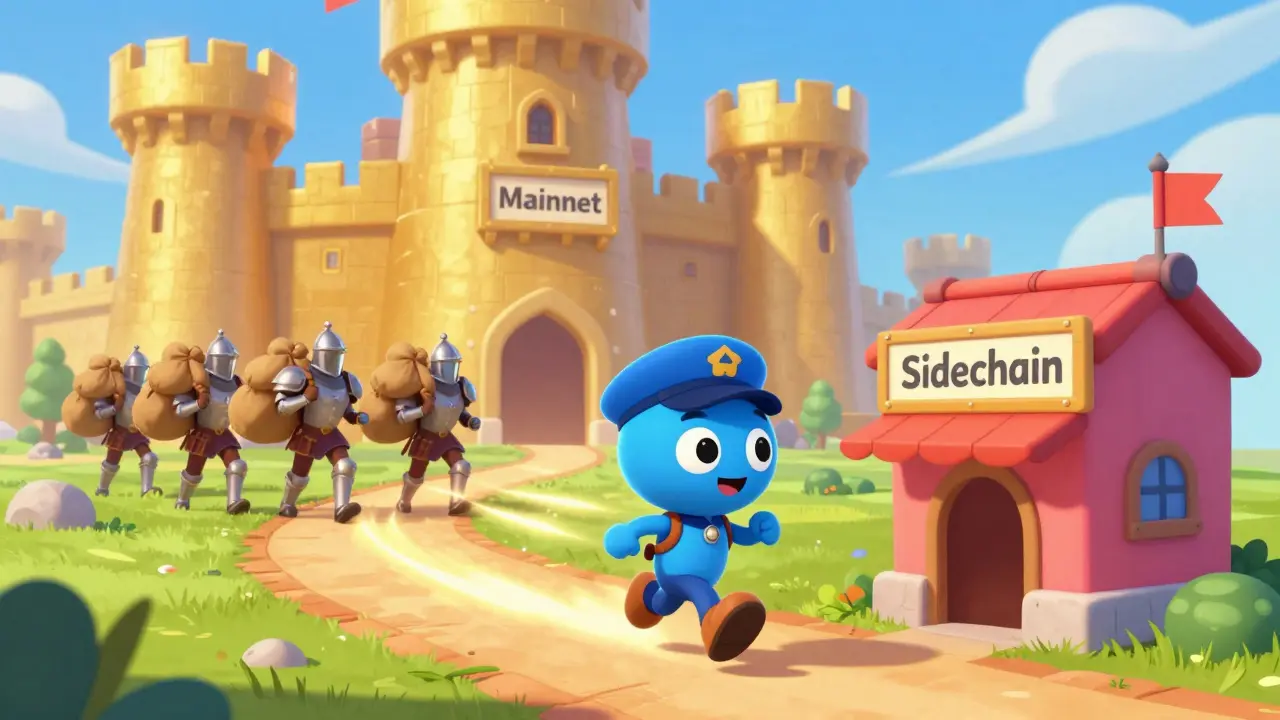
Imagine trying to send a package through the world’s most secure postal service. It’s incredibly safe, but it’s also slow and expensive because every single letter is checked by thousands of people. Now imagine there’s a local courier service that connects directly to that main post office. You can ship your package quickly and cheaply locally, and when you’re ready, you can move it back to the main system securely. That is exactly what sidechains are in the world of cryptocurrency.
If you have ever struggled with high gas fees on Ethereum or waited hours for a Bitcoin transaction to confirm, you have felt the pain of network congestion. Sidechains offer a solution. They are separate blockchain networks that connect to a parent blockchain (the mainnet) via a mechanism called a two-way peg. This allows assets to move back and forth freely, giving you the security of the main chain with the speed and flexibility of a specialized network.
How Sidechains Actually Work: The Two-Way Peg
To understand sidechains, you need to understand how they talk to the main blockchain. They don’t just share data; they share value. This happens through a process known as a two-way peg. Think of this like an escrow service between two banks.
Here is the step-by-step flow of moving Bitcoin from the main network to a sidechain:
- Locking the Assets: You send your Bitcoin to a specific address on the main Bitcoin network. This address acts like a lockbox. Your coins aren’t gone; they are just frozen and unspendable.
- Verification: The sidechain network monitors the main Bitcoin blockchain. Once it sees your transaction confirmed and locked, it triggers a release on its own side.
- Minting Equivalent Tokens: The sidechain creates an equivalent amount of tokens (let’s call them “Side-BTC”) and sends them to your wallet on the sidechain. These tokens represent your original Bitcoin.
- Using the Sidechain: You can now use these Side-BTCs for fast, cheap transactions within the sidechain ecosystem.
- Burning and Unlocking: When you want your real Bitcoin back, you send the Side-BTCs to a special “burn address” on the sidechain. This destroys the sidechain tokens. The system then unlocks your original Bitcoin on the mainnet and releases it to your wallet.
This mechanism ensures that no new Bitcoin is created out of thin air. For every token on the sidechain, there is a real Bitcoin sitting in a lockbox on the mainnet. This preserves the scarcity and value of the original asset while allowing it to be used elsewhere.
Why Do We Need Sidechains?
You might wonder why we can’t just upgrade the main blockchain to be faster. The answer lies in the trade-offs of blockchain design. Mainnets like Bitcoin prioritize security and decentralization above all else. Changing their rules (a hard fork) is risky and controversial. If a bug is introduced into the main code, billions of dollars could be at risk.
Sidebar chains solve three major problems:
- Scalability: Main blockchains have limited throughput. Bitcoin handles about 7 transactions per second. Sidechains can handle hundreds or even thousands, reducing fees to fractions of a cent.
- Experimentation: Developers want to test new features like complex smart contracts or privacy protocols. Testing these on the mainnet is too dangerous. Sidechains provide a sandbox where innovation can happen without threatening the core network.
- Interoperability: Different blockchains often speak different languages. Sidechains act as bridges, allowing assets and data to move between disparate networks more smoothly.
As noted by technical experts at Ledger Academy, sidechains maintain sovereignty through independent consensus mechanisms. This means if a sidechain gets hacked, the mainnet remains secure. The loss is contained to the sidechain’s assets, not the entire Bitcoin network.

Real-World Examples of Sidechains
Theory is great, but let’s look at how this works in practice. There are several prominent sidechains already in operation, each serving a different purpose.
| Sidechain Name | Primary Purpose | Key Feature | Consensus Mechanism |
|---|---|---|---|
| Liquid Network | Faster settlements for exchanges | Confidential Transactions (privacy) | Federated Byzantine Agreement |
| Rootstock (RSK) | Smart Contracts on Bitcoin | Ethereum-compatible virtual machine (EVM) | Proof of Work (merged mining) |
| Stacks (STX) | Decentralized Apps (dApps) | Clarity Smart Contract Language | Proof of Transfer (PoX) |
Liquid Network, launched by Blockstream, is primarily used by financial institutions and exchanges. It allows them to settle trades instantly and privately, which is crucial for high-volume trading. Because it uses a federated model (a group of trusted operators), it is faster than the main Bitcoin chain but less decentralized.
Rootstock (RSK) takes a different approach. It brings smart contract functionality to Bitcoin. Before RSK, Bitcoin was mostly used for simple payments. RSK allows developers to build decentralized applications (dApps) using Solidity, the same language used on Ethereum. This expands Bitcoin’s utility beyond just being digital gold.
Sidebar Chains vs. Layer 2 Solutions
A common point of confusion is the difference between sidechains and Layer 2 solutions like the Lightning Network. While both aim to scale blockchains, they work differently.
Layer 2 solutions sit *on top* of the main blockchain. They rely entirely on the main chain for security. If the main chain goes down, the Layer 2 stops working. The Lightning Network, for example, processes payments off-chain and only settles the final result on the main Bitcoin blockchain. It is lightweight and highly dependent on the parent chain.
Sidebar chains, on the other hand, are independent blockchains. They have their own nodes, miners, and consensus rules. They connect to the main chain via the two-way peg, but they do not rely on the main chain for their day-to-day operations. This independence gives them more flexibility but also introduces a different security model. You are trusting the sidechain’s own security measures, not just Bitcoin’s.
Think of it this way: A Layer 2 solution is like a side room in a house. It’s part of the house, uses the same electricity, and relies on the main structure. A sidechain is like a guest house next door. It has its own utilities and locks, but there’s a bridge connecting it to the main house.

Risks and Security Considerations
No technology is perfect, and sidechains come with their own set of risks. Understanding these is crucial before you move significant assets onto one.
Centralization Risks: Many sidechains, especially those focused on speed like Liquid, use a federated model. This means a small group of entities controls the peg. If these operators collude or are compromised, users could lose funds. This is a trade-off for speed and efficiency. Rootstock mitigates this by using merged mining with Bitcoin, inheriting some of Bitcoin’s security, but it is still distinct from the mainnet.
Smart Contract Vulnerabilities: If a sidechain supports smart contracts (like RSK or Stacks), bugs in the code can lead to hacks. Since the sidechain is a separate entity, a hack here does not affect Bitcoin directly, but users’ bridged assets are at risk. Always audit the projects you interact with.
Bridge Attacks: The two-way peg is the weakest link. Historically, many cross-chain bridges have been targeted by hackers. While sidechain pegs are generally more robust than arbitrary bridges, they are not immune. Users should monitor the security audits and reputation of the sidechain’s peg operators.
The Future of Sidebar Chains
As blockchain adoption grows, the demand for scalability will only increase. Sidechains are likely to play a central role in the future of crypto infrastructure. We are seeing a trend toward greater interoperability, where sidechains can communicate not just with their parent chain, but with each other. Projects like Polkadot and Cosmos are exploring similar concepts, creating ecosystems of interconnected parachains.
For developers, sidechains offer a playground for innovation. They can experiment with new consensus algorithms, privacy features, and governance models without the political and technical hurdles of upgrading a major mainnet. For users, this means lower fees, faster transactions, and access to a wider variety of applications.
However, the industry is also moving toward standardized communication protocols. In the future, you may not even notice you are using a sidechain. Wallets and exchanges will handle the bridging automatically, presenting a seamless user experience. The underlying complexity will remain, but the friction for the average user will disappear.
Are sidechains safer than the main blockchain?
Generally, no. The main blockchain (like Bitcoin) is secured by the largest amount of computational power and decentralization. Sidechains have their own security models, which are often less decentralized. For example, some sidechains rely on a federation of validators rather than thousands of independent miners. While this makes them faster, it introduces a higher risk of central points of failure. However, a compromise on a sidechain does not compromise the main blockchain.
Can I lose my money if a sidechain fails?
Yes, it is possible. If the two-way peg is hacked or the sidechain’s consensus mechanism fails, you could lose the assets locked on that sidechain. This is why it is important to use reputable sidechains with strong security audits and transparent governance. Never leave large amounts of long-term savings on a sidechain if you do not fully trust its security infrastructure.
What is the difference between a sidechain and a fork?
A fork creates a completely new, independent blockchain that splits from the original history (e.g., Bitcoin Cash). Once forked, there is usually no easy way to move assets back and forth. A sidechain, however, is designed to stay connected to the main blockchain via a two-way peg, allowing for continuous asset transfer. Sidechains complement the main chain; forks replace or diverge from it.
Do I need a special wallet to use sidechains?
It depends on the sidechain. Some wallets support multiple chains natively, such as Electrum plugins for Liquid or Rootstock. Others may require you to use a dedicated wallet provided by the sidechain project. Always check the official documentation of the sidechain you wish to use to ensure your wallet supports the specific address format and token standards.
How long does it take to move assets between a mainchain and a sidechain?
The time varies significantly based on the security requirements of the peg. Moving Bitcoin to a sidechain might take anywhere from 10 minutes to several hours. This delay is necessary to ensure that the transaction on the main blockchain is irreversible and secure before releasing the equivalent tokens on the sidechain. Faster transfers usually imply lower security guarantees.