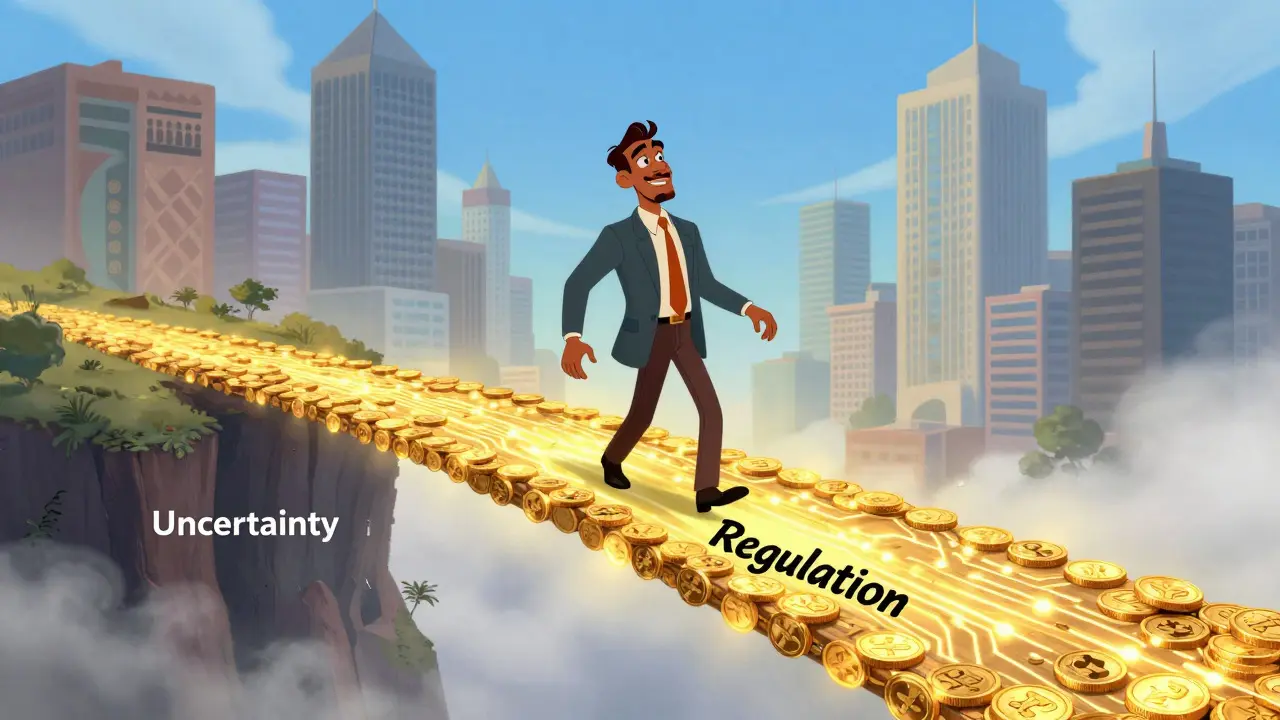
For years, sending money via Bitcoin or USDT in Nigeria felt like walking a tightrope. You knew your friends were doing it, you saw the ads, but one wrong move with your bank account could mean a frozen balance. That era of uncertainty ended in 2025. If you are wondering whether you can legally pay for goods, send remittances, or trade digital assets today, the short answer is yes-but with strict conditions.
The regulatory landscape flipped dramatically with the signing of the Investments and Securities Act (ISA) 2025, which officially recognized cryptocurrencies as securities under Nigerian law. This means crypto is no longer illegal, nor is it legal tender like the Naira. It sits in a regulated middle ground where licensed platforms operate freely, while unregistered ones face heavy fines or shutdowns. Understanding this new framework is critical for anyone holding or transacting in digital assets in Nigeria as we move through 2026.
The Shift from Ban to Regulation: What Changed in 2025?
To understand where we stand today, you have to look at how far things have come. Between 2021 and early 2023, the Central Bank of Nigeria (CBN) issued circulars effectively banning banks from servicing crypto exchanges. This didn't stop people from using crypto; it just pushed everything underground into peer-to-peer (P2P) markets. Nigeria remained a global leader in P2P volume, but users had no recourse if a counterparty scammed them.
The turning point arrived in March 2025 when President Bola Ahmed Tinubu signed the ISA 2025 into law. This legislation was a game-changer because it moved digital assets out of the "gray area" and placed them under the supervision of the Securities and Exchange Commission (SEC). Suddenly, crypto wasn't just a speculative tech toy; it was a financial instrument subject to federal oversight. This shift allowed legitimate businesses to operate openly without fearing arbitrary bank closures, provided they followed the rules.
Who Regulates Crypto in Nigeria Now?
You might think one agency handles everything, but the current system involves a multi-agency approach designed to cover different risks. Knowing who does what helps you understand why certain rules exist.
- Securities and Exchange Commission (SEC): They are the primary regulator for digital assets. Under the ISA 2025, the SEC issues licenses to Virtual Asset Service Providers (VASPs), such as exchanges and payment processors. If a platform isn't on the SEC's registered list, it’s operating illegally.
- Central Bank of Nigeria (CBN): The CBN controls monetary policy and banking. In December 2023, they reversed their ban and issued VASP Guidelines that allow banks to open accounts for SEC-licensed crypto firms. This connection between traditional banking and crypto is vital for seamless payments.
- Nigerian Financial Intelligence Unit (NFIU): This body focuses on anti-money laundering (AML) and counter-terrorism financing (CFT). They ensure that crypto transactions aren't used to fund illicit activities, requiring platforms to perform strict Know Your Customer (KYC) checks.
- Economic and Financial Crimes Commission (EFCC): While not a direct regulator of crypto operations, the EFCC works with the SEC to prosecute fraud, Ponzi schemes, and cybercrimes within the sector.
This collaboration creates a safety net. For example, if you use a licensed exchange, your identity is verified by the NFIU standards, your funds are held by a company audited by the SEC, and your bank transfer is processed by a CBN-approved institution. It’s much safer than the wild west of early P2P trading.
Licensing Requirements for Payment Providers
If you are a business looking to accept crypto payments or build an exchange in Nigeria, the bar is high. The ISA 2025 introduced stringent compliance standards to weed out scams. All Virtual Asset Service Providers must register with the SEC and adhere to the Digital Assets Rules.
The licensing process has been thorough, sometimes leading to delays as regulators vet applicants carefully. Early approvals went to established local players like Quidax and Busha in 2024. These companies now serve as models for compliance. However, non-compliance carries a steep price. Fines start at ₦10 million ($6,693) for the first month of operating without a license, plus ₦1 million ($669) for every subsequent month. The SEC also has the power to revoke licenses, effectively killing a non-compliant business overnight.
It’s worth noting that the scope of regulation includes investment-focused NFTs and online forex trading platforms linked to crypto. Artistic NFTs, however, remain largely outside the SEC’s direct scrutiny, distinguishing between financial speculation and creative expression.
| Agency | Primary Role | Key Authority |
|---|---|---|
| SEC | Regulate digital assets as securities | Issue/revoke VASP licenses |
| CBN | Monetary policy & banking oversight | Approve bank-crypto relationships |
| NFIU | Anti-money laundering (AML) | Enforce KYC/transaction monitoring |
| EFCC | Criminal investigation | Prosecute fraud & Ponzi schemes |

Taxing Crypto: The New Rules for 2026
Perhaps the most immediate change for users in 2026 is taxation. Starting January 1, 2026, the Nigerian Tax Administration Act (NTAA) 2025 came into effect. Before this, many Nigerians operated under the assumption that crypto gains were tax-free simply because the government couldn't track them easily. Those days are over.
Under the NTAA 2025, crypto assets are treated as property. Holding Bitcoin doesn't trigger a tax bill. You only pay when you realize a gain-meaning when you sell, trade, or exchange it for profit. Here is how the rates break down:
- Individuals: Profits from crypto transactions are subject to personal income tax on a sliding scale, capped at 25%. This aligns with standard capital gains treatments for other investments.
- Corporations: Companies earning between ₦25 million and ₦100 million annually pay a 20% corporate income tax on crypto profits. Larger firms earning over ₦100 million pay 30%.
- Value Added Tax (VAT): All companies subject to corporate tax must charge 7.5% VAT on the transaction fees they collect from users. So, if an exchange charges a 1% fee, you’ll see that 1% plus the applicable VAT.
Industry experts describe this regime as progressive compared to global standards. It provides clarity rather than punitive surprises. However, it does mean you need to keep records of your trades. The "set and forget" mentality of early crypto adoption is no longer financially viable for serious investors.
Practical Implications for Users and Businesses
So, what does this mean for your daily life? If you are a regular user, you should stick to licensed platforms. Using Quidax, Busha, or other SEC-registered entities ensures that your fiat-to-crypto conversions go through compliant banking channels. This reduces the risk of your bank account being flagged for suspicious activity.
For businesses accepting crypto payments, the path is clearer but requires diligence. You can integrate payment gateways that are themselves licensed or partnered with licensed VASPs. This allows you to receive stablecoins like USDT or USDC and settle in Naira without navigating complex foreign exchange restrictions manually. The key is ensuring your payment processor holds valid SEC registration.
International platforms face a tougher choice. Many global exchanges may choose not to pursue Nigerian licensing due to the cost and complexity. This could limit options for users seeking access to niche tokens or advanced trading features found only on foreign apps. Users relying solely on international platforms may find their bank links severed if those platforms don't comply with local VASP guidelines.
Risks and Pitfalls to Avoid
Even with regulation, risks remain. The SEC explicitly prohibits Ponzi schemes and has enhanced tools to combat fraud, including accessing telecom records. If you encounter a platform promising guaranteed high returns with zero risk, it is likely a scam targeting the confusion around new regulations.
Another pitfall is assuming all crypto is equal. The ISA 2025 regulates digital assets as securities, but this doesn't guarantee price stability. Volatility remains a core feature of crypto markets. Furthermore, while the CBN allows banks to service licensed firms, individual bank policies can still vary. Always confirm with your specific bank branch that they support transactions to your chosen exchange.
Finally, don't ignore the tax implications. Failing to declare crypto gains can lead to audits under the new NTAA framework. With the NFIU monitoring large transactions, anonymity is largely a myth in the regulated space. Keep clear records of your buy and sell prices to calculate your taxable gains accurately.
Future Outlook: Cautious Optimism
The trajectory for crypto in Nigeria is positive. The establishment of the ISA 2025 provides a foundation for sustainable growth, attracting institutional interest that was previously hesitant. The tax revenue generated from the 2026 regime may further reduce any political incentive to restrict crypto, creating a virtuous cycle of acceptance and innovation.
However, implementation will be tested. As regulators gain experience throughout 2026, expect more detailed guidelines on specific issues like cross-border payments and decentralized finance (DeFi) protocols. For now, the message is clear: crypto payments are allowed, regulated, and here to stay-if you play by the rules.
Is cryptocurrency legal tender in Nigeria?
No, cryptocurrency is not legal tender in Nigeria. The Nigerian Naira remains the only official currency for government payments and debts. However, crypto is legally recognized as a security and asset class under the Investments and Securities Act (ISA) 2025, allowing it to be traded and used for private contracts between consenting parties.
Which crypto exchanges are licensed in Nigeria?
As of 2026, several platforms have obtained or are in the final stages of obtaining licenses from the Securities and Exchange Commission (SEC). Notable examples include Quidax and Busha. Always verify the current status of an exchange on the official SEC website before depositing funds, as the list of approved Virtual Asset Service Providers (VASPs) is updated regularly.
Do I need to pay tax on my crypto profits in Nigeria?
Yes. Under the Nigerian Tax Administration Act (NTAA) 2025, effective January 1, 2026, individuals must pay personal income tax on realized crypto gains, capped at 25%. Corporations pay 20% or 30% depending on their annual revenue. Holding crypto does not incur tax; only selling or exchanging it for a profit triggers liability.
Can Nigerian banks freeze my crypto account?
Banks can no longer arbitrarily ban crypto transactions if you are using SEC-licensed platforms. Since December 2023, the Central Bank of Nigeria (CBN) has permitted banks to offer services to licensed crypto businesses. However, if you transact with unlicensed or suspicious entities, your account may still be flagged for anti-money laundering (AML) reviews.
What happens if I use an unlicensed crypto exchange?
Using an unlicensed exchange poses significant risks. The exchange itself faces fines starting at ₦10 million per month and potential license revocation. For users, there is no regulatory protection if the platform fails or engages in fraud. Additionally, banks may block transactions linked to unverified entities, disrupting your ability to move funds.