
OKX Swap Fee Calculator
Fee Comparison Calculator
Compare trading fees for perpetual swaps on OKX versus Binance and Bybit
Why OKX Is the Go-To Exchange for Perpetual Swap Traders
If you're trading crypto derivatives, especially perpetual swaps, you’ve probably heard of OKX. It’s not the biggest exchange by total volume, but when it comes to perpetual swaps, it’s second to none. With $20.7 billion in 24-hour futures trading volume as of December 2024, OKX holds a solid #2 spot behind Binance - and for many active traders, that’s more than enough. What sets OKX apart isn’t just its size. It’s how deep the liquidity is, how low the fees are, and how efficiently it lets you use your capital across spot, margin, and derivatives.
Unmatched Liquidity in Perpetual Swaps
Perpetual swaps are the backbone of crypto trading right now. They let you go long or short without an expiry date, making them perfect for day traders and swing traders alike. OKX’s BTC-USDT perpetual contract has an average order book depth of 1,850 BTC within 0.5% of the mid-price. That’s way above Binance’s 1,200 BTC and Bybit’s 1,100 BTC. What does that mean for you? Smaller slippage. Even during high volatility, like the March 2024 crash, OKX maintained sub-50ms execution times when competitors were lagging at 200-300ms. One trader on Reddit, CryptoTrader88, executed 127 profitable BTC swaps during the October 2024 spike with an average slippage of just 0.03%.
Fees That Beat the Competition
OKX’s fee structure is simple and aggressive: 0.02% for makers, 0.05% for takers on perpetual swaps. That’s lower than Binance’s 0.06% taker fee and Bybit’s 0.07%. For someone making 50+ trades a month, that difference adds up fast. A $10,000 trade every day saves you $30 a month just on fees compared to Binance. And it’s not just about the numbers - OKX also has lower average funding rates. BTC perpetuals on OKX charge 0.0045% every 8 hours, while Bybit charges 0.0051%. Over time, that 12% gap can mean extra profits or smaller losses on long-term positions.
Unified Margin: Trade More With Less Capital
One of OKX’s most powerful features is its unified margin system. Unlike other exchanges that lock your capital into separate accounts for spot, margin, and derivatives, OKX lets you use your entire balance across all three. That means if you’re holding BTC in spot and want to open a 50x leveraged ETH swap position, you don’t need to transfer funds. Your spot balance acts as collateral automatically. This cuts capital requirements by 30-40% compared to isolated margin models. For professional traders, this isn’t a nice-to-have - it’s a necessity. It’s why 68% of advanced traders (50+ trades/month) in Coin Bureau’s survey ranked OKX as their top platform for swaps.
Web3 Wallet and DeFi Integration
OKX isn’t just a centralized exchange. It’s also a Web3 gateway. The built-in OKX Wallet supports 130+ blockchains and connects directly to 200+ decentralized exchanges through its X Routing algorithm. This reduces slippage by 0.87% on average compared to using a single DEX. You can swap tokens, stake stablecoins for up to 14.5% APY, and even interact with DeFi protocols without leaving the platform. That’s something Binance and Bybit don’t offer. If you’re into yield farming or using DeFi apps, OKX gives you a seamless bridge between centralized and decentralized finance.
Security: Cold Storage, Reserves, and Proof of Reserves
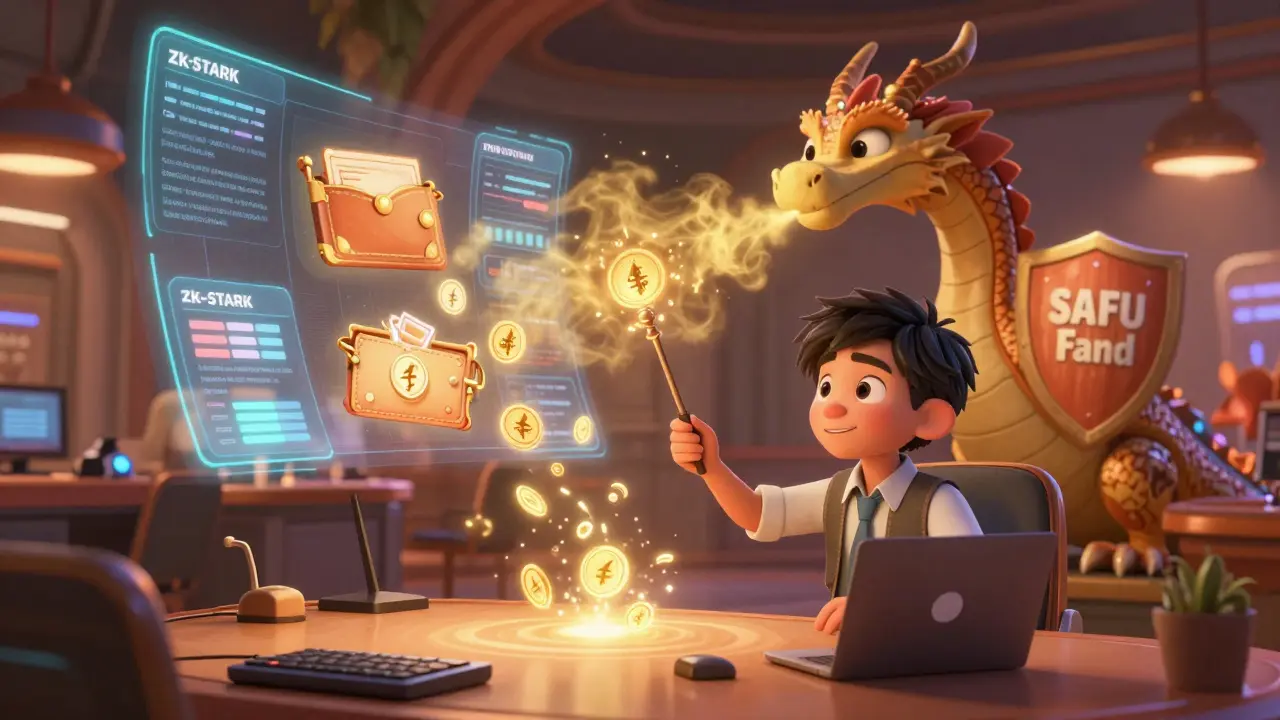
Security is where OKX impresses. 95% of user funds are stored in cold wallets. It maintains a $700 million Secure Asset Fund for Users (SAFU) to cover unexpected losses. And unlike many exchanges that just claim they’re “fully backed,” OKX uses zk-STARKs technology for Proof of Reserves. This means you can verify, mathematically, that your assets are fully backed - and they publish monthly audit reports through OKLink. As of March 2025, their transparent reserves stood at $30.8 billion. That’s not marketing fluff - it’s verifiable data.
Where OKX Falls Short
But OKX isn’t perfect. The biggest issue? Accessibility. You can’t trade on OKX if you’re in the United States, Canada, or several EU countries. The platform blocks full trading access in those regions due to regulatory pressure. Even in the UK, OKX isn’t registered with the Financial Conduct Authority - despite serving British customers. That’s a red flag for risk-averse traders.
Another problem: the interface. It’s powerful, but it’s not beginner-friendly. OpenExo’s usability tests showed new users took 27% longer to execute their first swap on OKX than on Binance. The learning curve is steep. You need to understand margin modes, funding rates, and leverage settings before you trade. OKX has an excellent Academy with tutorials, but it still takes 8-10 hours of learning before you’re comfortable.
Account freezes are another pain point. In Q3 2024, 178 users reported frozen accounts due to KYC issues - more than double Binance’s 89 cases. One user, James M., had his account locked for 17 days trying to withdraw $8,300 after completing KYC. Customer support responds via email in about 18 hours, and chatbots resolve 87% of simple queries. But for complex issues, you’re often stuck waiting.
Fiat On-Ramps Are Expensive
If you’re buying crypto with a credit card or bank transfer, expect to pay high fees. OKX uses third-party providers like MoonPay and Wyre, which charge 3.5-4.9% for fiat deposits. That’s almost three times higher than Coinbase’s 1.49% direct bank transfer rate. For large deposits, this eats into profits fast. The workaround? Buy BTC or USDT on a lower-fee exchange like Kraken or Coinbase, then transfer it to OKX for trading.
Advanced Features for Serious Traders
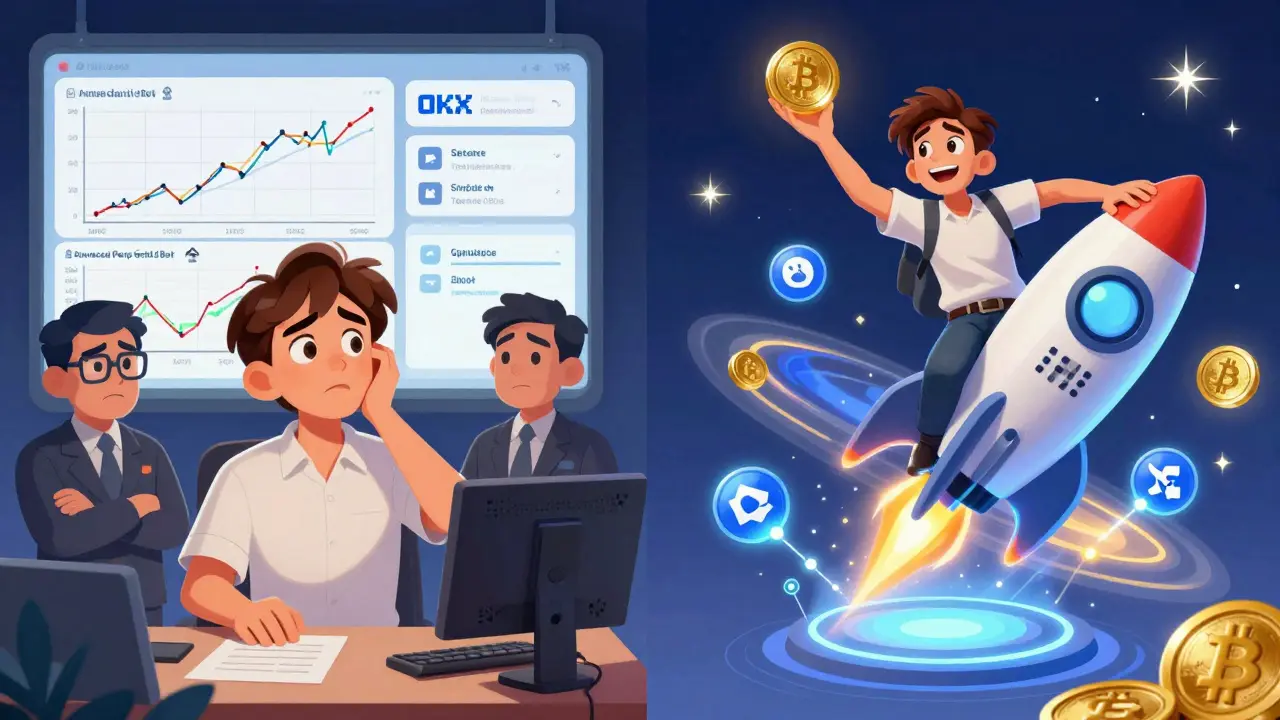
OKX keeps innovating. In November 2024, it launched Advanced Perp Grid - an automated bot designed specifically for perpetual swaps. Over 287,000 users have already adopted it, generating $4.2 million in monthly fee revenue. It lets you set price ranges and automatically buy low, sell high on leveraged positions. In January 2025, OKX introduced Cross-Margin Swap, letting you use 50+ different tokens (not just USDT or BTC) as collateral. That’s a feature only big institutions had before.
Looking ahead, OKX plans to integrate with Ethereum’s Proto-Danksharding upgrade in Q3 2025. That could slash swap transaction costs by 60-75%. They’re also replacing centralized price oracles with Chainlink’s decentralized feeds by Q2 2026. These aren’t just buzzwords - they’re technical upgrades that will make swaps cheaper and more secure.
Who Should Use OKX?
OKX is perfect for:
- Day traders who need low fees and deep liquidity
- Traders using leverage regularly (10x-125x)
- Users who want to move between spot, margin, and swaps without transferring funds
- Web3 users who want to stake, swap, and interact with DeFi in one place
It’s not for:
- Beginners who want a simple, clean interface
- Users in the US, Canada, or restricted EU countries
- People who rely on cheap fiat on-ramps
- Those who prioritize regulatory compliance over features
Final Verdict: Powerful, But Not for Everyone
OKX is a pro-grade platform built for traders who know what they’re doing. Its swap market is the most liquid outside of Binance, its fees are among the lowest, and its unified margin system gives you a real edge in capital efficiency. Add in the Web3 wallet, DeFi access, and upcoming upgrades, and you’ve got one of the most advanced crypto trading platforms available.
But if you’re new to trading, live in a restricted country, or hate complex interfaces, OKX will frustrate you. It’s not a beginner’s exchange. It’s a tool for those who want to trade like professionals - with deep liquidity, low costs, and full control over their capital.
Is OKX safe for trading perpetual swaps?
Yes, OKX is one of the safer exchanges for derivatives trading. It uses 95% cold storage, has a $700 million SAFU fund, and offers verifiable Proof of Reserves using zk-STARKs technology. Monthly audits are published on OKLink, allowing users to confirm asset backing. However, account freezes and KYC delays have been reported, so it’s not without operational risks.
Can I trade OKX if I live in the UK or US?
If you’re in the UK, you can access OKX’s trading platform, but the exchange is not registered with the FCA - meaning you have no regulatory protection under UK law. In the US, Canada, and several EU countries, full trading access is blocked. US residents can only use the non-custodial OKX Wallet for DeFi and staking, not spot or derivatives trading.
How do I start trading perpetual swaps on OKX?
First, complete KYC verification. Deposit crypto (BTC, USDT, etc.) into your OKX account. Go to the Derivatives section, select Perpetual Swaps, choose your pair (like BTC-USDT), and select your leverage (up to 125x). Choose unified margin mode to use your entire balance as collateral. Set your position size and order type, then confirm. Use OKX’s Academy tutorials to learn about funding rates and risk management before trading live.
What’s the difference between OKX and Binance for swap trading?
Binance has higher overall volume ($24.3B vs $20.7B), but OKX offers lower fees (0.05% vs 0.06% taker), better liquidity depth in altcoin swaps (SOL, ADA, DOT), and a unified margin system that saves capital. OKX also includes a built-in Web3 wallet and DeFi tools, which Binance lacks. Binance’s interface is simpler for beginners, but OKX gives advanced traders more control and efficiency.
Are OKX’s withdrawal fees high?
Withdrawal fees are dynamic and based on blockchain network conditions. As of December 2024, average BTC withdrawals cost $1.23 and ETH withdrawals cost $2.47. These are below industry averages for major exchanges. However, fiat deposit fees via third-party providers (MoonPay, Wyre) are high at 3.5-4.9%, so it’s better to buy crypto elsewhere and transfer it in.
Does OKX offer automated trading for swaps?
Yes. OKX launched Advanced Perp Grid in November 2024 - an automated bot designed specifically for perpetual swaps. It lets you set price grids and automatically open/close positions based on volatility and trends. Over 287,000 users have adopted it, and it’s generating $4.2 million in monthly fee revenue. It’s one of the most powerful swap automation tools available on any exchange.


Nelson Issangya
This is the real deal. I’ve been trading on OKX for over a year and the liquidity during the March crash saved my ass. Slippage was next to nothing when everyone else was getting rekt. If you’re serious about swaps, this is your playground.
Stop worrying about the US ban - if you’re outside those regions, just use it. No one’s forcing you to be a compliance robot.
Richard T
I like how they broke down the numbers. The unified margin thing is a game-changer. I used to have to juggle three accounts on Binance just to open a small position. Now I just click and go. Took me a week to get used to the UI, but once I did, I never looked back.
jonathan dunlow
Look, I get it - OKX isn’t for beginners. But let’s be real, if you’re trading 50x leverage on BTC, you’re not a beginner. You’re either a pro or you’re gonna get eaten alive. And honestly? That’s fine. The market doesn’t owe you a hand-holding tutorial. OKX gives you the tools, the depth, the speed - and if you can’t handle it, don’t blame the platform. Blame yourself for not doing the work. I spent 12 hours in their Academy before touching a live order. Was it worth it? Every single penny. The funding rate difference alone has added like $8k to my annual returns. And the Web3 wallet? I’m staking USDT at 14.5% and swapping into DeFi protocols without ever leaving the app. Binance can’t touch that. They’re still stuck in 2021. OKX is building for 2026. If you’re not on this train, you’re already behind.
Mariam Almatrook
One must observe, with a certain degree of gravitas, that the platform's operational architecture exhibits a marked divergence from the regulatory paradigms established by Western financial authorities. The absence of FCA registration, despite active solicitation of UK clientele, constitutes a profound ethical lacuna. Furthermore, the deployment of zk-STARKs, while technologically impressive, cannot obfuscate the fundamental lack of legal recourse afforded to users. One is compelled to question whether algorithmic transparency can substitute for institutional accountability. The very notion of 'self-custody' in the context of a centralized entity that freezes accounts for 17 days is, frankly, an oxymoron of the highest order.
Chris Mitchell
Low fees + deep liquidity = edge. That’s it. No fluff.
rita linda
I don’t care how deep the order book is if you’re not regulated. You’re playing with fire. The US and EU have rules for a reason. People lose everything on these platforms because they think ‘tech’ = safe. It’s not. It’s gambling with your life savings and calling it ‘DeFi’. And that Web3 wallet? It’s just a Trojan horse for rug pulls. I’ve seen it. People think they’re ‘earning yield’ but they’re just feeding their assets into a black hole with a 14.5% APY sticker. Don’t be that person.
Martin Hansen
OKX? Please. You’re telling me I should trust a platform that blocks Americans but lets anyone else in? That’s not innovation, that’s arrogance. You think you’re elite because you can navigate a complex UI? Nah. You’re just the type of trader who thinks complexity equals superiority. Meanwhile, I’m on Kraken, paying 0.1% more in fees, but I sleep at night knowing my money’s not sitting on some offshore server with a 17-day support wait. And don’t even get me started on those ‘advanced bots’ - you think you’re outsmarting the market? Nah, you’re just feeding the exchange more fees while you get rekt by whales who see your grid bot coming from a mile away.
Lore Vanvliet
OKX IS A GAME CHANGER!!! I’M CRYING RIGHT NOW BECAUSE MY FIRST 50X LONG ON ADA MADE ME $12K IN 3 HOURS 😭💸 I’VE NEVER BEEN SO HAPPY IN MY LIFE!!! THE LIQUIDITY IS LIKE A GODSEND AND THE FEE DIFFERENCE IS LIKE FINDING A $100 BILL IN YOUR OLD JACKET!!! I’M STAKING AT 14.5% AND SWAPPING TO DEFI AND I FEEL LIKE A GOD!!! 🙌🙌🙌 I LOVE OKX MORE THAN MY CAT!!!
Scott Sơn
I used to think Binance was king. Then I tried OKX. And now I feel like I’ve been living in a cave. The way the platform moves - it’s like watching a symphony. Every trade feels smooth, every order fills like silk. And that Advanced Perp Grid? It’s not a bot. It’s a psychic assistant. I set it and forget it. Came back after a weekend trip and made $3k while I was eating tacos in Mexico. Binance? Binance is like a rusty bike. OKX? It’s a Tesla with rocket boosters.
Frank Cronin
Wow. Another one of these ‘pro trader’ fanboy rants. Let me guess - you’re the guy who lost 80% in the 2022 crash and now thinks OKX is your salvation? The ‘unified margin’ is just a fancy way of saying ‘you can blow up faster’. And don’t even mention those ‘zk-STARKs’ audits. You think a math proof means your money’s safe? Newsflash: when they freeze your account for 17 days because your selfie didn’t have enough lighting, your ‘verifiable reserves’ don’t matter one bit. You’re not a trader. You’re a gambler with a spreadsheet.
Stanley Wong
I’ve used a bunch of exchanges and I gotta say OKX is definitely one of the more powerful ones if you know what you’re doing but I also see the downsides like the UI being overwhelming and the fiat fees being insane and the account freezes are definitely a concern I mean I had a friend whose account got locked for a week just because he used a new phone and they couldn’t verify his face properly and he had to wait 18 hours just to get a reply and it was just so frustrating and I think maybe they should simplify things a bit for new people but at the same time if you’re doing serious trading then yeah the depth and fees are hard to beat I just wish they had better support for regular folks not just pros
miriam gionfriddo
okx is the best but i think u missed something the web3 wallet is sus because i tried to swap usdt to shib and it took 47 mins and i lost 2% slippage and then my tx got stuck and i had to pay 3x gas to cancel it and the app crashed twice and i cried and now i hate okx i used to love it but now i think its just hype and they dont care about users just the fees
Adam Bosworth
I’ve been on OKX since 2023 and I’ve had 3 accounts frozen. 3. Not one. Not two. THREE. Each time for different dumb reasons - one because I used a VPN, one because my passport photo had a shadow, and one because I sent 0.001 BTC to my wallet from a friend’s account. They say ‘we’re secure’ but they’re just paranoid. And the support? Don’t even get me started. I’ve sent 12 emails. Zero replies. I just gave up. This isn’t a platform. It’s a black box with a fancy UI and a $700M SAFU fund that will never touch my account. You’re not trading. You’re donating to their legal team.
Uzoma Jenfrancis
I live in Nigeria and I use OKX daily. The fees are low, the execution is fast, and I can trade 24/7. The US and EU restrictions? That’s their problem. We don’t have access to Coinbase or Kraken here. OKX is the only real option. I don’t care about FCA registration. I care about getting my trades filled. This platform lets me feed my family. So I’m grateful.
Renelle Wilson
While I appreciate the detailed breakdown of OKX’s technical advantages, I believe it is essential to acknowledge the human impact of its operational policies. The account freezes, while statistically infrequent, represent profound disruptions in the lives of individuals who rely on these platforms for livelihoods. The disparity between the platform’s sophisticated infrastructure and its lack of responsive, compassionate customer service is a glaring contradiction. One might argue that technological excellence should be accompanied by ethical stewardship - particularly when users entrust their capital to a system that, despite its transparency, retains unilateral control over access. The absence of a dedicated human support channel for critical issues is not merely an inconvenience; it is a failure of duty of care.
Jerry Perisho
Unified margin is the real MVP. No more transferring funds. Just use your spot as collateral. Saves time, saves stress. And the funding rates? Lower than Bybit by a mile. Just avoid fiat deposits. Buy on Kraken, send to OKX. Done.
Manish Yadav
OKX is trash. USA banned it for a reason. People lose money here. I lost 5000$ in one day because I didn't know what funding rate is. They trick new people. No support. No help. Just take your money and run. Stay away.