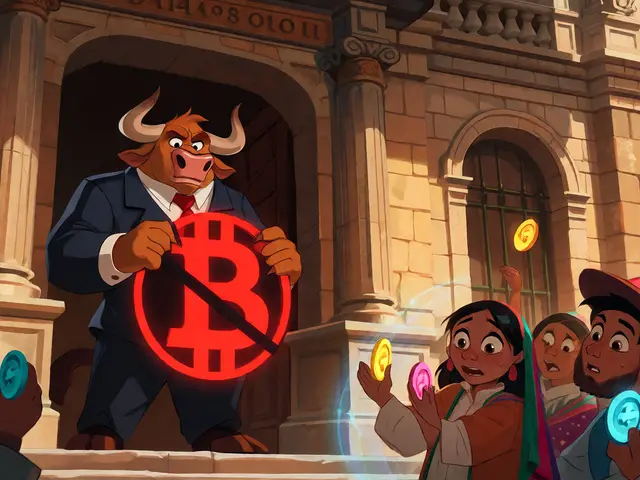
Imagine waking up to find your life savings frozen. Not because you did anything wrong in the traditional sense, but because the platform holding your digital assets just became a target for international authorities. For Russians navigating the cryptocurrency market in 2026, this isn't a hypothetical nightmare-it's a recurring reality. The landscape has shifted dramatically since the initial wave of sanctions. What was once a gray area of easy arbitrage is now a minefield of legal exposure and total fund loss.
If you are based in Russia or hold Russian citizenship, choosing the right crypto exchange is no longer just about fees or user interface. It is about survival. The question isn't just "which exchange pays the best?" but "which one won't land me on a watchlist or result in my funds vanishing overnight?" This guide breaks down exactly which platforms pose the highest risk, why the regulatory environment has tightened, and how to protect your capital from both domestic crackdowns and international freezes.
The New Reality: Why Old Habits Are Dangerous
For years, many Russian traders relied on offshore exchanges that didn't ask too many questions. You could deposit rubles via local bank transfers, convert them to USDT, and move on. But the rules have changed. In 2024 and 2025, we saw a coordinated effort by both Russian security services and Western regulators to close these loopholes. The Bank of Russia implemented stricter anti-money laundering (AML) monitoring, while the U.S. Treasury stepped up enforcement against entities facilitating sanctions evasion.
The core problem is dual pressure. Domestically, using unlicensed platforms can trigger criminal charges under Article 193.1 of the Russian Criminal Code for illegal currency transactions. Internationally, using sanctioned exchanges like Garantex or its successors can lead to your funds being frozen by global financial institutions that fear secondary sanctions. If your wallet interacts with a blacklisted address, even legitimate coins can become "tainted," making it nearly impossible to cash out through regulated channels later.
| Exchange Type | Risk Level | Main Threat | Regulatory Status |
|---|---|---|---|
| Sanctioned Offshore (e.g., Garantex successors) | Critical | Total fund freeze; criminal liability | Blacklisted by OFAC/EU |
| Unlicensed Domestic Gray Market | High | Police raids; lack of recourse | No Rosfinmonitoring license |
| Licensed Experimental Regime | Low | Limited access (qualified investors only) | Fully compliant |
| Major Global (Non-Sanctioned) | Medium-High | Account restrictions due to residency | Varies by jurisdiction |
Platforms to Avoid: The Blacklist
Let's be specific. If you see these names or their direct successors, proceed with extreme caution. The most notorious name is Garantex. Once the go-to hub for Russians wanting to bypass banking restrictions, it was designated by the U.S. Office of Foreign Assets Control (OFAC) in April 2022. The reason? It facilitated over $500 million in illicit transactions, including payments for ransomware groups like Hive.
You might think, "Okay, Garantex is gone." But the network evolved. Look out for Grinex and Exved. Investigations by Transparency International revealed that these platforms often share the same personnel and infrastructure as Garantex. They operate through complex layers of offshore entities registered in jurisdictions like Kyrgyzstan, UAE, and Hong Kong. While they promise fast transfers without paperwork, they lack the transparency required by Russian law.
Why avoid them specifically?
- Legal Exposure: Using these platforms can be interpreted as participating in sanctions evasion schemes. Police raids in late 2024 targeted users, not just operators.
- Fund Loss: During the March 2025 takedown efforts, thousands of users found their accounts frozen. Support teams went silent, leaving users with no way to withdraw their rubles or crypto.
- Taint Risk: Transactions from these exchanges are easily flagged by blockchain analytics firms like Chainalysis. If you send clean Bitcoin to a wallet associated with Grinex, your entire balance might be considered high-risk by other exchanges.
The Domestic Crackdown: Raids and Rosfinmonitoring
It’s not just Western sanctions causing trouble. Inside Russia, the Federal Service for Financial Monitoring (Rosfinmonitoring) has intensified its grip. The agency now shares data with international bodies like the FATF, meaning a suspicious transaction in Moscow can trigger alerts in London or Washington.
In October 2024, security services conducted coordinated raids across more than a dozen regions. They seized millions in cash and crypto from "droppers"-individuals who lend their bank cards to move money for others-and small exchange operators. The message was clear: the era of anonymous peer-to-peer (P2P) trading via Telegram bots is ending. If you use a P2P service that doesn’t verify counterparties strictly, you risk having your bank account blocked by banks like Alfa-Bank or Sberbank for suspicious activity.
A critical distinction exists between owning crypto and using it for payments. While owning digital assets is legal under Federal Law No. 114-FZ, using them to pay for goods domestically remains prohibited. Many unlicensed exchanges blur this line by offering "payment processing" services that look like crypto usage but are actually disguised currency conversions. Engaging with these services can lead to fines or criminal charges for large-scale violations.

Safe(er) Alternatives: The Licensed Path
So, where do you go? The safest route involves platforms operating under Russia’s "experimental legal regime." These are licensed exchanges that comply fully with Rosfinmonitoring requirements. However, there is a catch: access is restricted. To trade on these platforms, you often need to qualify as an "especially qualified investor," which typically requires holding at least 6 million rubles in assets.
This creates a dilemma for average users. If you don’t meet the wealth threshold, you’re left in the middle ground. Here, you must choose between two risky options:
- International Non-Sanctioned Exchanges: Platforms like Bybit or OKX still serve Russian users but have tightened KYC (Know Your Customer) procedures. They may restrict fiat withdrawals to Russian banks, forcing you to use P2P markets. The risk here is lower than sanctioned exchanges but higher than licensed ones.
- Compliant P2P Platforms: Some newer services focus entirely on P2P trading with strict verification. They act as escrow agents, reducing the risk of fraud from individual buyers/sellers. Ensure the platform itself is registered and transparent about its ownership.
When evaluating any alternative, check for these red flags:
- Does the company disclose its beneficial owners? If it’s hidden behind shell companies in Belize or Seychelles, be wary.
- Is there a physical office in a reputable jurisdiction? Virtual offices are common among fly-by-night operations.
- Do they require full identity verification? If you can sign up with just a phone number, the platform likely prioritizes volume over compliance, increasing your legal risk.
User Experiences: Lessons from the Front Lines
Don't just take regulatory theory at face value. Look at what happened to real people. On forums like Dvach and RuTracker, stories of lost funds are abundant. One user reported losing 1.2 million rubles when their Garantex-linked account was frozen during the 2025 enforcement wave. Another noted that despite daily messages to support for three weeks, they received no response.
A survey by CryptoSfera in September 2025 showed that 63% of users on high-risk platforms experienced sudden account freezes. The average loss per case was around 850,000 rubles. These aren't just technical glitches; they are systemic failures caused by regulatory pressure. When a platform is under investigation, liquidity dries up, and withdrawals stop.
Conversely, users on licensed platforms report slower onboarding (taking days instead of minutes) but greater peace of mind. The trade-off is speed versus security. In 2026, security should win.
Practical Checklist for Russian Crypto Users
Before you deposit your next paycheck into a crypto exchange, run through this checklist:
Can I use Binance if I am Russian?
Binance has exited the Russian market. You cannot open new accounts with Russian residency documents. Existing accounts were migrated to CommEX or similar entities, but functionality is limited compared to the original Binance experience. Check current terms carefully before assuming legacy access.
What happens if I receive money from a sanctioned exchange?
Your funds may be flagged as "tainted" by blockchain analysis tools. Other exchanges might refuse to accept deposits from your wallet, or your bank might block incoming transfers citing AML concerns. It complicates future transactions significantly.
Are Telegram-based exchanges safe?
Generally, no. Most Telegram-only exchanges lack proper licensing and regulatory oversight. They are prime targets for police raids and offer no legal recourse if the operator disappears with your funds. Stick to platforms with web interfaces and verifiable corporate structures.
Do I need to declare crypto income to the tax authority?
Yes. Profits from selling crypto are subject to personal income tax (NDFL). Failure to declare income, especially if detected through bank transaction patterns linked to exchanges, can lead to penalties and audits. Keep records of all trades.
What is the penalty for using unlicensed exchanges?
Penalties vary. For individuals, it can range from fines to criminal charges under Article 193.1 of the Criminal Code for large-scale illegal currency operations. Fines can reach up to 1 million rubles for first-time offenses under proposed amendments.
Final Thoughts: Adapt or Lose
The wild west days of crypto in Russia are over. The convenience of instant, anonymous swaps is being replaced by the friction of compliance. This is painful, but necessary. Using sanctioned or unlicensed exchanges is akin to playing roulette with your savings. The house always wins eventually.
Your strategy should shift toward preservation. Prioritize platforms with transparent ownership and regulatory licenses, even if they demand more documentation and higher entry barriers. Monitor news from Rosfinmonitoring and the Bank of Russia closely. And remember: if an exchange promises "sanction-proof" transfers with zero verification, it’s probably hiding something. In 2026, transparency is your best asset.