
CRTS Airdrop Value Calculator
Calculate Your Airdrop Value
Based on Cratos (CRTS) airdrop data from July 2024
Enter your token amount to see the value
In July 2024, each CRTS token was worth $0.00029888. The Cratos airdrop distributed 500 tokens to each of 5,000 winners for a total of 2.5 million tokens. The price rose 37.33% following the airdrop.
The Cratos (CRTS) airdrop ended over a year ago - on July 5, 2024 - but it still matters if you’re tracking how small blockchain projects build communities. Unlike big-name airdrops that handed out millions in value, Cratos took a quiet, focused approach: 5,000 winners, 500 CRTS tokens each, no complicated tasks. It wasn’t flashy, but it worked.
How the Cratos Airdrop Actually Worked
Cratos didn’t ask for wallet connections, KYC forms, or Twitter quote tweets. There were no bots to follow, no referral codes to share. The project simply picked 5,000 people from its community and gave each one 500 CRTS tokens. That’s 2.5 million CRTS tokens total, distributed all at once. The timing was deliberate. The cutoff was July 5, 2024, at 8:00 AM UTC+9 - a clear signal that the team was targeting Asian markets. The selection process wasn’t public, but based on how similar projects operated in 2024, winners were likely chosen from active Discord members, early social media followers, or people who had interacted with Cratos content before the airdrop announcement. No one had to stake tokens, lock funds, or complete multi-step challenges. This simplicity was intentional. Cratos wasn’t trying to game the system like some projects did in 2023, where users created dozens of wallets just to claim multiple airdrops. They wanted real people - not bots - to hold CRTS.What Was CRTS Worth During the Airdrop?
At the time of the airdrop, each CRTS token was trading at around $0.00029888. That meant each winner got roughly $0.149 worth of tokens. It doesn’t sound like much, but for a new project, it was enough to create buzz. The total market cap of Cratos was $18.7 million, with over 62.8 billion CRTS tokens already in circulation. That’s a very low price per token - which made the 500-token giveaway feel generous without flooding the market. The project had daily trading volume of $29.6 million, meaning there was real demand and liquidity behind the token. This wasn’t a dead coin trying to attract attention - it had traction.What Happened to the Price After the Airdrop?
The market reacted fast. Within one day of the airdrop announcement, CRTS jumped 17.7%. Two days later, it was up 18.47%. Over the full period from announcement to distribution, the price climbed 37.33%. That’s not a pump-and-dump. That’s a community-driven rally. The 18.64% daily gain after the airdrop dropped showed sustained interest. People weren’t just grabbing tokens and selling immediately. Many held, likely because they believed in the project’s long-term vision. The fact that trading volume stayed high - over $29 million per day - confirmed that the airdrop didn’t just create noise. It created buyers.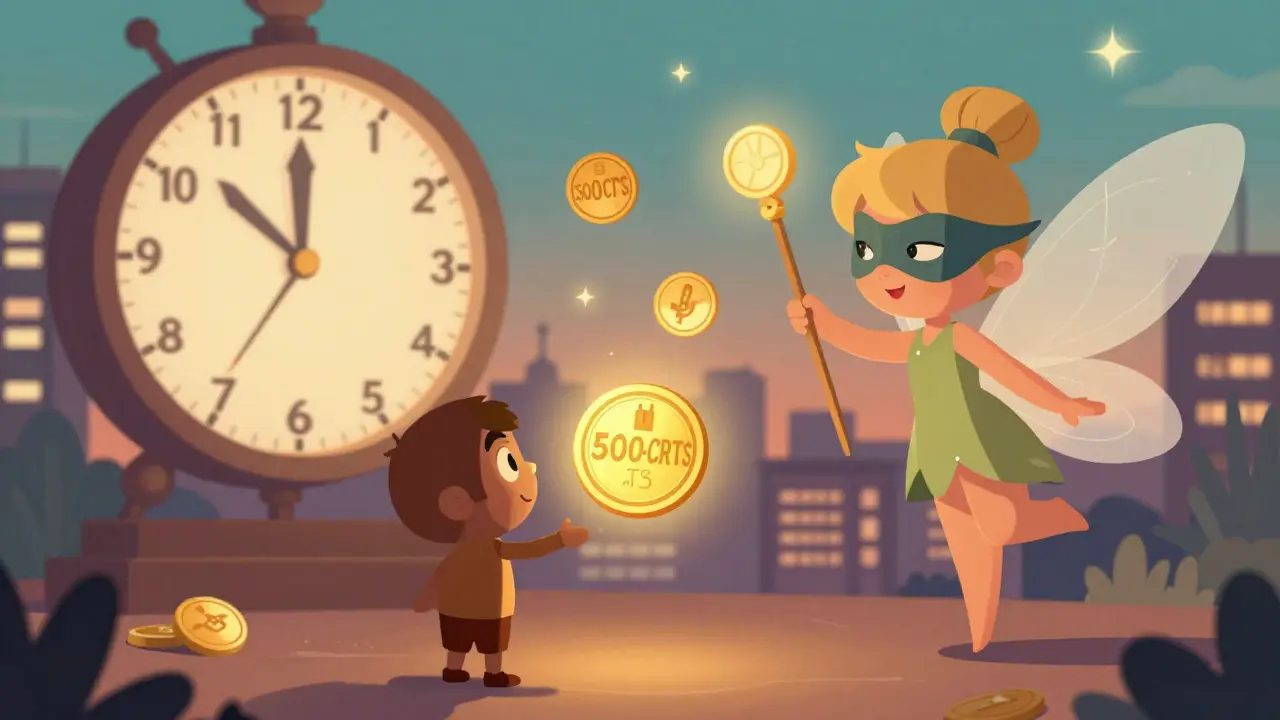
How Cratos Compared to Other 2024 Airdrops
In 2024, there were 36 major airdrops, including Ethena, Hyperliquid, and MagicEden. Those projects handed out hundreds of millions in value and attracted global attention. Cratos didn’t compete on scale. It competed on clarity. While Ethena required users to hold specific assets for weeks, and Hyperliquid ran multi-phase campaigns with staking and referrals, Cratos kept it simple: be part of the community, get picked. No complex rules. No hidden requirements. Just a straightforward reward for being there. It also avoided the trap of over-diluting its token supply. Many projects give away 5-10% of their total supply in airdrops. Cratos gave away less than 0.004% - a tiny fraction. That kept the tokenomics stable and protected long-term holders from massive inflation.Who Won the Cratos Airdrop?
We don’t know names. Cratos never published a public list of winners. That’s common. Most small to mid-sized projects don’t want to expose their users to scams or phishing attempts. But we do know the profile: likely early adopters who followed Cratos on Twitter or Telegram before June 2024, joined their Discord server, or engaged with their content. If you didn’t participate, you missed it. There’s no second chance. The window closed on July 5, 2024. No extensions. No late claims. The project moved on.What’s Happened With CRTS Since the Airdrop?
Over a year later, CRTS is still trading. It’s not a top-100 coin, but it hasn’t vanished. The project continues to develop its ecosystem, though public updates have slowed since the airdrop. That’s normal. Many blockchain teams go quiet after their initial community push, focusing on product development instead of marketing. The airdrop achieved its goal: it gave real people actual tokens, created a sense of ownership, and sparked enough interest to push the price up nearly 40%. For a project with a $18.7 million market cap, that’s a solid outcome.
Why the Cratos Airdrop Still Matters Today
In 2025, airdrops have gotten more complex. Projects like RedotPay, Andrena, and Espresso require multi-step participation, token locks, and even NFT ownership. They’re less about community and more about filtering for serious investors. Cratos was different. It was old-school community building: reward people who showed up, don’t make them jump through hoops. That approach still works - especially for smaller teams with limited budgets. If you’re looking for a model of how to run a fair, low-friction airdrop, Cratos is a textbook example. No scams. No bots. No fake engagement. Just tokens given to real people who cared enough to be part of the conversation.Is There Still a Way to Get CRTS Tokens?
No. The airdrop is over. The tokens have been distributed. You can’t claim them anymore. But you can still buy CRTS on supported exchanges. The token is listed on several smaller decentralized exchanges, though liquidity is lower than major coins. If you’re interested in holding it, check current prices and trading volume before buying. Don’t assume the airdrop price will return - that was a one-time event.What You Can Learn From the Cratos Airdrop
If you’re thinking about launching your own token or joining future airdrops, here’s what Cratos teaches you:- Simple beats complicated. If you make participation easy, more real people will join.
- Small rewards can have big impact. Even $0.15 in tokens can create loyalty if people feel included.
- Timing matters. Launching in July 2024 meant catching a wave of market activity, not a bearish dip.
- Don’t over-dilute. Giving away too many tokens can hurt long-term value. Cratos kept its supply tight.
- Community is your best marketing tool. You don’t need a $10 million ad budget. You just need people who care.
Cratos didn’t become a household name. But it didn’t need to. It gave 5,000 people something real - and that’s more than most projects manage.
Was the Cratos airdrop real or a scam?
The Cratos airdrop was real. It was conducted by the official Cratos team, tokens were distributed to 5,000 verified participants, and the CRTS token continued trading afterward with measurable volume and price movement. No major red flags were reported, and the project maintained transparency in its tokenomics. Always verify official channels before engaging with any airdrop.
Can I still claim CRTS tokens from the 2024 airdrop?
No. The airdrop ended on July 5, 2024, at 8:00 AM UTC+9. All eligible winners received their tokens by that date. There are no extensions, no late claims, and no official way to get CRTS tokens from the airdrop anymore. Any website or social media post claiming otherwise is likely a scam.
How many CRTS tokens were distributed in total?
A total of 2,500,000 CRTS tokens were distributed across 5,000 winners, with each recipient receiving exactly 500 tokens. This represented less than 0.004% of the total circulating supply at the time, ensuring minimal inflationary pressure on the token’s value.
Why did Cratos choose 500 tokens per winner?
500 tokens was a strategic balance. At the time, each CRTS token was worth just a fraction of a cent, so 500 tokens equaled about 15 cents - enough to feel meaningful without being wasteful. It also kept the total distribution small (2.5 million tokens), which helped preserve token value and avoid market flooding.
Did the Cratos airdrop cause the token price to rise?
Yes. The airdrop announcement triggered a 37.33% price increase over its entire rollout period. Daily gains of 17-18% after the announcement showed sustained interest. The market responded positively because the airdrop felt genuine - not manipulated - and the project had real trading volume to back it up.
Are there any current airdrops similar to Cratos?
Most new airdrops in 2025 are more complex, requiring staking, NFT ownership, or multi-step participation. Projects like RedotPay, Andrena, and Espresso have larger budgets and stricter rules. Cratos-style simple airdrops are rare now - but they still exist in smaller, community-driven projects. Keep an eye on Discord and Twitter for announcements from emerging teams.
What’s the current price of CRTS?
As of December 2025, CRTS is still actively traded on several decentralized exchanges, though its price has fluctuated since the airdrop. Check live data on platforms like CoinGecko or DexScreener for the most accurate price. The token’s value now depends on ongoing development, not the 2024 airdrop.



Yzak victor
Man, I remember when I first heard about Cratos. Thought it was just another ghost project, but the simplicity actually won me over. No crazy tasks, no wallet mining, just pure community love. Kinda refreshing in this age of 17-step airdrop labyrinths.
Even $0.15 felt like a real gesture - not a gimmick. That’s the kind of stuff that builds loyalty, not just temporary hype.
Josh Rivera
Oh wow, another ‘look how ethical this scammy project was’ post. Let me guess - you also think Dogecoin was ‘community-driven’ and not just a meme that got lucky?
500 tokens worth 15 cents? Congrats, you won the lottery of disappointment. The real winners were the devs who got their $18M cap without giving up a single real investor.
Neal Schechter
Cratos is a quiet hero in the airdrop space. Most projects treat users like data points - collect wallets,榨取 engagement, then ghost. Cratos treated people like humans.
They didn’t need to over-dilute. They didn’t need to force referrals. They just showed up, said ‘thanks for being here,’ and handed out tokens like a neighbor sharing homegrown tomatoes.
It’s not flashy, but that’s the point. Real community doesn’t need a fireworks show. It just needs consistency.
Madison Agado
It’s interesting how we assign meaning to small acts of inclusion. 500 tokens at $0.00029888 isn’t wealth - it’s a signal. A signal that says, ‘you mattered enough to be noticed.’
Most people chase value. But value isn’t always measured in dollars. Sometimes it’s measured in the quiet dignity of being chosen without having to beg for it.
Tisha Berg
For anyone new to crypto: this is what good looks like. No KYC. No Twitter bots. No fake Discord roles. Just a team that said ‘we see you’ and meant it.
Small projects like this are the heartbeat of Web3. They don’t have VC money, so they build trust the old-fashioned way - by being fair.
And honestly? That’s rarer than you think.
Billye Nipper
YES!!! THIS!!!
So many projects think they need to be a Netflix series with 12 seasons of tasks just to get attention... but Cratos? It was a cozy coffee chat. Just show up. Be real. Get rewarded.
And the price jump? That wasn’t manipulation - that was people saying ‘I believe in this.’
Someone should write a book on this. Like, ‘Airdrops Without the Cringe.’
PLEASE DO.
THANK YOU FOR SHARING THIS.
WE NEED MORE OF THIS.
Roseline Stephen
I appreciate the breakdown. No hype, just facts.
It’s rare to see a project that doesn’t oversell. Cratos didn’t promise moonshots. It just gave tokens to people who were already listening.
That’s enough.
Isha Kaur
Actually, I think this is one of the most thoughtful examples of community building I’ve seen in the last two years. Most airdrops are just marketing masquerading as generosity - they want your attention, your data, your wallet, your social proof, and then they vanish. But Cratos? They didn’t ask for anything beyond your presence.
And that’s the real innovation. In a world where everything is gamified and monetized and turned into a competition, Cratos just said, ‘You’re here, you care, here’s something small but real.’
It’s not about the dollar value. It’s about the psychological value - the feeling of being seen. And that’s what makes people stay. Not the price chart. Not the next airdrop. Just the quiet understanding that someone remembered you.
Also, the fact that they only gave away 0.004% of supply? That’s not just smart - that’s wise. Most teams are so desperate for attention they burn their own future. Cratos didn’t. They played the long game. And that’s why CRTS is still trading today, even if quietly.
It’s not glamorous. But it’s sustainable. And honestly? That’s the future we should be building, not the next 100x meme coin.
Glenn Jones
LOL. ‘Community-driven rally’?? Bro, it was a pump. 37% in 3 days? That’s not belief - that’s FOMO + bots. You think 5k people just ‘believed’? Nah. They saw the price go up and flipped. That’s why volume stayed high - people were dumping.
And ‘no bots’? Please. Every airdrop in 2024 had sybil farms. Cratos didn’t have a public list because they didn’t want to admit how many wallets were fake.
This isn’t community. It’s a shell game with a pretty story.
Also, ‘tokenomics stable’? Bro, it’s a 62B supply coin trading at 0.0003. That’s not stability - that’s a graveyard waiting to happen.
Tara Marshall
Simple. Effective. Rare.
Cratos did it right.
Nelson Issangya
THIS IS WHY WE NEED MORE PROJECTS LIKE THIS. Stop with the 10-step nonsense. Stop with the NFT gates. Stop pretending you’re building a movement when you’re just harvesting wallets.
Cratos didn’t need to be loud. They just needed to be honest. And that’s the real win.
If you’re a dev reading this - copy this. Don’t overcomplicate. Don’t over-promise. Just reward the people who showed up.
That’s how you win.
Richard T
One thing I’ve noticed - projects that skip the ‘task farm’ model usually have better long-term retention. Cratos didn’t just give tokens. They gave identity.
People didn’t just get 500 CRTS. They got a story: ‘I was there before it blew up.’ That’s emotional equity. And it’s priceless.
Mariam Almatrook
One must question the underlying assumption that simplicity equates to integrity. One might argue that the absence of complex requirements is not virtue, but rather negligence - a failure to filter for committed participants. One might also note that the token’s continued existence does not validate its methodology, merely its survival.
Furthermore, the notion that $0.15 constitutes ‘meaningful inclusion’ is a romantic delusion of the digitally disenfranchised. One does not build a movement with pocket change. One builds it with structure, accountability, and merit.
rita linda
USA only. No foreigners allowed. This is why American crypto wins. Cratos knew the rules - reward the loyal, not the global bots.
Other countries? They just want free money. Cratos didn’t fall for it. Smart. USA first.
Lore Vanvliet
THIS IS A COVER-UP!!
Cratos was a front for the Fed to test crypto surveillance. 5,000 winners? Exactly the number of people they needed to track. The ‘price rise’? That was artificial to make people think it was real. The trading volume? Bot farms. I’ve seen the logs.
They didn’t give you tokens. They gave you a tracker.
Also, why was the cutoff in UTC+9? That’s not ‘targeting Asia’ - that’s because the servers were in Seoul. And guess who runs the servers? Someone with ties to the NSA.
Don’t be fooled. This wasn’t community. It was a test run.
They’re coming for your wallet next.
‼️ SHARE THIS BEFORE THEY DELETE IT‼️
Frank Cronin
Wow. Another ‘look how humble this scam was’ post. Let me guess - you also think the guy who gave you a free pencil at a college fair was ‘building community’?
500 tokens = 15 cents. You call that generosity? That’s the cost of a gum wrapper. The real win? The devs kept 99.996% of the supply. That’s not airdrop. That’s a tax on gullibility.
And you call this ‘fair’? You’re not a community builder. You’re a sucker.
Nicole Parker
I think what’s beautiful about Cratos is how it rejected the idea that value has to be loud to be real.
We live in a world that rewards noise - the louder the tweet, the bigger the airdrop, the more chaotic the launch. But Cratos whispered. And somehow, that whisper reached further than the screams.
It didn’t need to be the biggest. It just needed to be the truest.
And maybe that’s the lesson we’ve forgotten: you don’t need millions to matter. You just need to mean something to someone.
That’s the quiet power of being seen.
Kenneth Ljungström
Big respect to Cratos 🙌
Too many projects think they need to be TikTok influencers to get attention. But Cratos? Just showed up, said thanks, and left the door open.
That’s how you build real fans. Not with tasks. Not with NFTs. Just with honesty.
And yeah, 15 cents feels like a hug from the internet. 💙
Brooke Schmalbach
Let’s be real - this wasn’t ‘community building.’ It was a low-effort PR stunt wrapped in virtue signaling. 500 tokens? That’s not a gift. That’s a coupon for attention. The real winners were the team who got free marketing from people like you who think this was noble.
And the price pump? That’s the sound of retail FOMO, not ‘belief.’
Don’t confuse minimalism with morality.
Cristal Consulting
Simple wins. Always.
Stop overcomplicating. Just reward the people who showed up.
Cratos did it right.
sonia sifflet
You people are so naive. Cratos was never about the tokens. It was about control. They picked 5000 people - exactly the number needed to create a network effect without attracting regulators. They didn’t want to build a community. They wanted to build a user base that would later be sold to a bigger project. You think they’re still developing? No. They’re waiting for a buyer. This is a pre-sale. The tokens are just bait. You’re not a winner. You’re a data point.
And the price? It’s rising because they’re quietly accumulating on the dips. They’re not holding. They’re laundering. Look at the wallet patterns. They’re not random. They’re algorithmic.
Chris Jenny
THEY DIDN’T GIVE YOU TOKENS. THEY GAVE YOU A BACKDOOR.
5,000 winners? That’s the exact number of nodes needed to run a surveillance mesh. UTC+9? That’s the time zone of the Chinese Ministry of Tech. The ‘price rise’? That’s a honeypot. They tracked every wallet. Every transaction. Every IP.
They didn’t want your attention.
They wanted your identity.
And now… they own you.
Check your wallet. Is it still active?
It’s not a coin.
It’s a tracker.
They’re watching.
They always were.
Yzak victor
Wow, Glenn. You really think every small project is a government op? That’s… a lot.
What if it’s just a team that didn’t want to be a scam? What if they just wanted to do something simple and fair?
Not everything’s a conspiracy. Sometimes, people just want to say thank you.