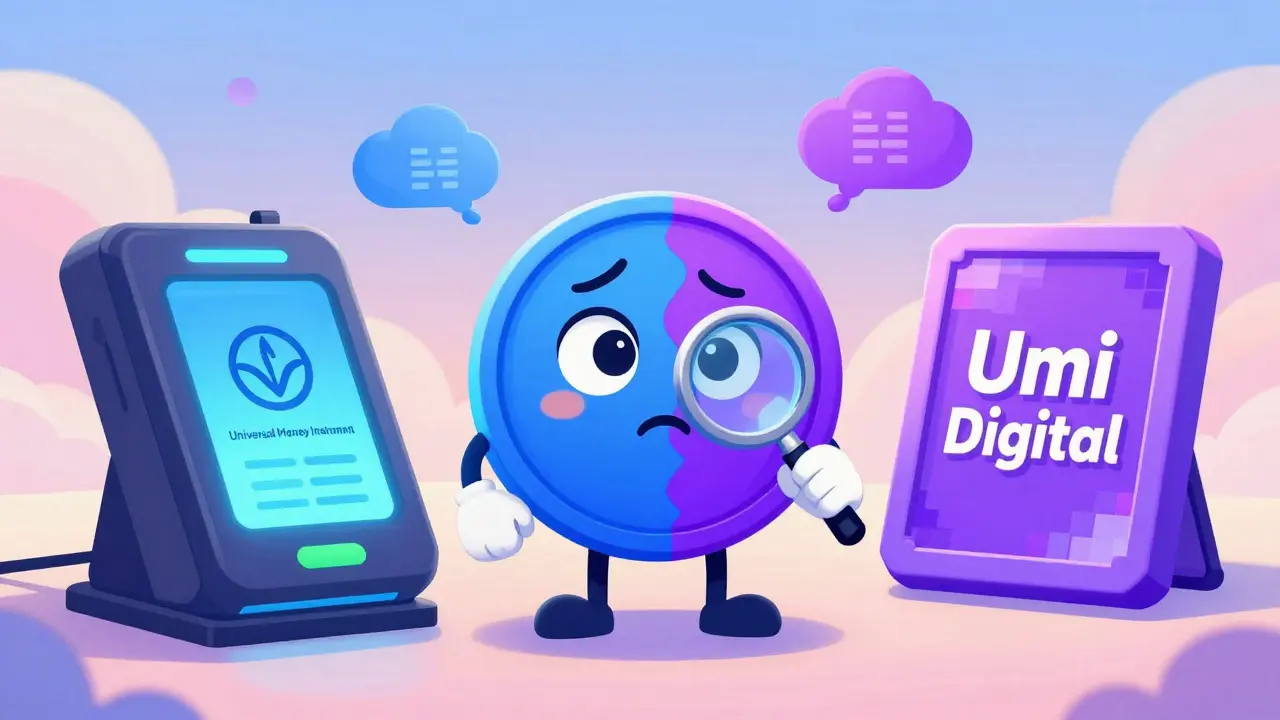
Searching for "UMI" in your wallet or on a chart can be confusing because two completely different projects use the same ticker. One is a proprietary payment chain promising instant transfers and massive staking yields. The other is an NFT-focused DeFi platform on Ethereum. If you are looking at a price of $0.000333 versus a different value entirely, you likely have the wrong token open. This guide breaks down exactly what each one is, how they work, and whether they are worth your attention in 2026.
The Two Faces of the UMI Ticker
Before diving into technical details, we need to separate the entities. The most prominent project associated with this ticker is Universal Money Instrument. It is a decentralized payment blockchain launched in 2020 that functions as a full-scale smart contract platform rather than just a simple coin. Its core promise is instant, fee-free global transfers. However, there is a second player: Umi Digital, which uses the same UMI symbol but operates on Ethereum, Polkadot, and Sora chains. Umi Digital focuses on NFT minting and cross-chain yield farming. Confusing these two leads to major errors in analysis, so always check the network address prefix or the specific exchange listing before buying.
Universal Money Instrument: How It Works
Universal Money Instrument (UMI) runs on a Proof-of-Authority (PoA) consensus mechanism. Unlike Bitcoin’s energy-intensive Proof-of-Work or Ethereum’s open Proof-of-Stake, PoA relies on a limited set of trusted master nodes and validator nodes to secure the network. This design choice allows for extreme speed. Reports indicate the network can process between 1,000 and 4,369 transactions per second. To put that in perspective, Bitcoin handles roughly 14 transactions per second, making UMI potentially hundreds of times faster for everyday payments. The code is open-source, and addresses begin with the prefix 'umi' followed by 62 characters.
The economic model is where things get interesting-and controversial. New UMI coins are not mined in the traditional sense. Instead, issuance happens exclusively through staking via smart contracts. Users place their coins into specific pools called "structures," such as the ROY Club or ISP Club. In return, they earn rewards that accrue every second, 24 hours a day. The whitepaper advertises returns of up to 40% per month. For context, typical high-yield savings accounts offer around 4-5% annually, and even aggressive DeFi protocols rarely sustain double-digit monthly yields without significant risk. This gap between advertised returns and market norms is the first red flag many analysts point to.
Umi Digital: The NFT and DeFi Angle
If you are interested in non-fungible tokens (NFTs), you might be looking at Umi Digital instead. Launched in August 2021, this project provides tools for NFT minting, marketplaces, and airdrops. Its native token, also called UMI, serves as the utility currency for paying fees and earning rewards within its ecosystem. Unlike Universal Money Instrument’s proprietary chain, Umi Digital builds on established networks like Ethereum. This means it benefits from the security and liquidity of those major blockchains but faces higher transaction costs unless using layer-2 solutions. As of early 2026, data suggests a maximum supply of 33 billion tokens, though circulating figures vary across trackers. Staking yields here are far more modest, with estimates around 2.67% annually, which aligns better with standard DeFi expectations.

Comparing the Two Tokens
To help you decide which one you are actually researching, here is a side-by-side look at their key attributes:
| Feature | Universal Money Instrument | Umi Digital |
|---|---|---|
| Primary Use Case | Instant payments & staking | NFT minting & DeFi farming |
| Blockchain Network | Proprietary PoA Chain | Ethereum, Polkadot, Sora |
| Total Supply | ~586 Million | 33 Billion |
| Staking Yield Claim | Up to 40% per month | ~2.67% per year |
| Transaction Speed | Up to 4,369 TPS | Dependent on underlying chain |
| Liquidity Status | Very Thin / Limited Exchanges | Moderate (Major DEXes) |
Risk Factors and Market Reality
While the technology behind Universal Money Instrument may function as advertised for fast transfers, the market reality tells a different story. Liquidity is extremely low. Major exchanges like Coinbase list the asset but often show zero 24-hour trading volume, meaning it can be difficult to sell large amounts without crashing the price. Data from CoinPaprika has even shown anomalous prices in the six-figure range due to decimal errors, highlighting how fragmented and unreliable the data sources are for this specific coin.
Expert opinions are mixed. Some Russian-language review sites give it high scores based on user satisfaction with the wallet app, which holds a 4.8-star rating on Google Play. However, financial analysts from platforms like FinanceObzor warn of rapid devaluation and label the reliability as "medium," explicitly advising against cooperation. The high staking returns are the main point of contention. Critics argue that promising 40% monthly returns resembles High-Yield Investment Programs (HYIPs) or pyramid schemes, especially when combined with withdrawal restrictions. For instance, users may only withdraw 10% of their staked amount per month, creating a lock-in effect that can trap capital if the token price drops sharply.

How to Get Started (If You Choose to)
If you decide to try Universal Money Instrument despite the risks, the process is straightforward but requires caution. First, download the official UMI Wallet mobile app. Next, create your personal wallet and generate your address. You will need to acquire UMI coins from one of the few supporting exchanges, such as BitGlobal or Bibox. Once you have coins, you can activate staking by selecting a structure like ROY Club in the app. Rewards start accruing immediately. Just remember the 10% monthly withdrawal limit when planning your cash flow. For Umi Digital, the path is different: you would interact with its dApps on Ethereum-based interfaces, using wallets like MetaMask, and stake via Uniswap or Polkaswap pairs.
Frequently Asked Questions
Is UMI crypto a scam?
It depends on which UMI you mean. Universal Money Instrument is a functioning blockchain with real technology, but its high-yield staking model carries significant risk similar to HYIPs. Umi Digital is a standard DeFi/NFT project with lower risk but lower returns. Neither is definitively labeled a fraud by regulators, but both require careful due diligence.
Where can I buy UMI tokens?
Universal Money Instrument is primarily available on smaller exchanges like BitGlobal and Bibox. It is listed on larger platforms like Coinbase but often has no active order book. Umi Digital is traded on decentralized exchanges like Uniswap and Polkaswap, as well as some centralized venues depending on regional availability.
What is the difference between PoA and PoS?
Proof-of-Authority (used by Universal Money Instrument) relies on a small group of trusted validators to approve blocks, allowing for very high speed and low cost. Proof-of-Stake (used by Ethereum) allows any holder to become a validator by locking up tokens, offering broader decentralization but generally slower processing speeds compared to optimized PoA chains.
Can I withdraw all my staked UMI at once?
For Universal Money Instrument, no. The protocol limits withdrawals to 10% of the total staked amount per month. This includes both principal and accrued rewards. Umi Digital follows standard DeFi rules, typically allowing flexible unstaking periods depending on the specific pool used.
Which UMI has a higher market cap?
Market caps fluctuate rapidly. However, due to thin liquidity, Universal Money Instrument's reported market cap is often near zero or highly inconsistent across trackers. Umi Digital, being on major chains, usually has a more stable and verifiable market capitalization, though both remain niche assets compared to giants like Bitcoin or Ethereum.