Signata (SATA) isn’t another meme coin or a flashy project with a big marketing budget. It’s a quiet, obscure cryptocurrency built on the Ethereum blockchain with a single goal: to handle digital identity and access control using smart contracts. If you’ve ever wondered what happens to a crypto project after its hype fades, SATA is a real-life example. Launched in 2021, it promised to let users verify their identity without handing over personal data to companies. But today, it’s barely trading, with almost no one paying attention.
What is Signata (SATA) actually used for?
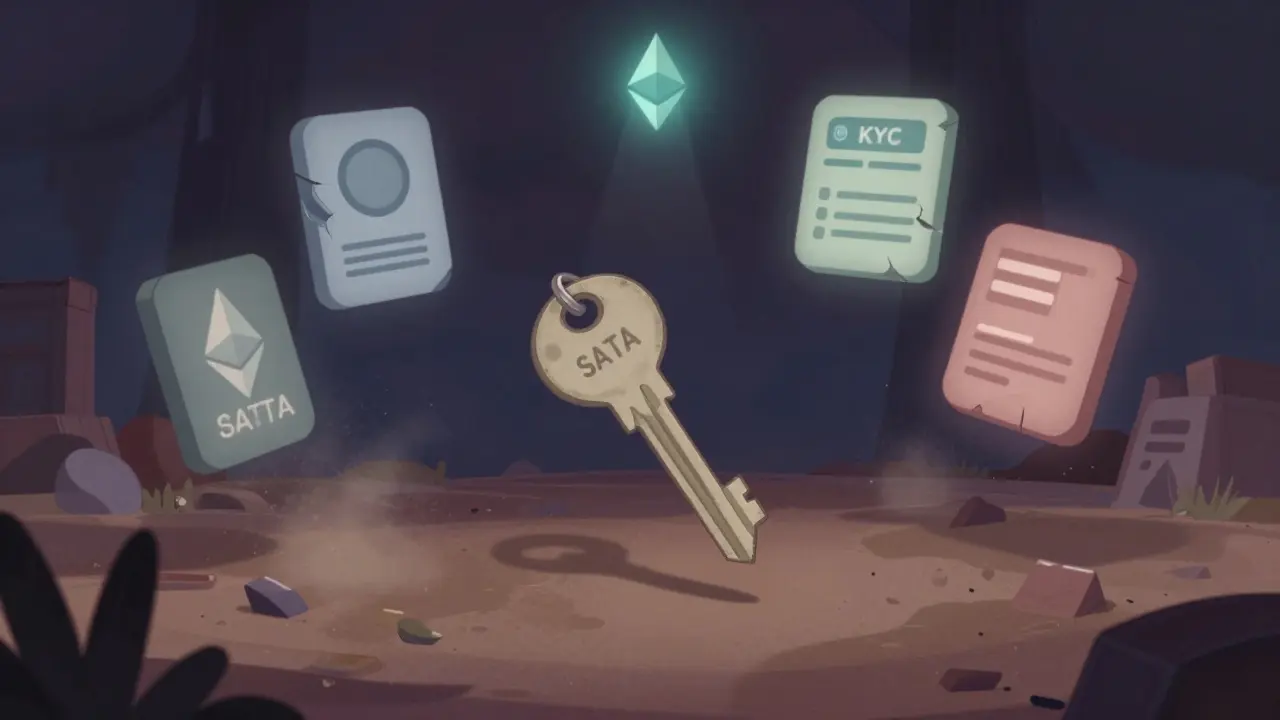
Signata’s core idea is simple: give people control over who can access their data. Instead of logging into a website with a password or a Google account, you’d use a SATA token to prove you’re you - through a hardware token or a smart contract. Think of it like a digital key that only you hold. The project planned to build a marketplace where developers could plug in pre-made identity verification tools, like age checks, KYC forms, or access permissions for private services.
But here’s the problem: no one’s using it. There are no public case studies, no enterprise partnerships, and no news about real companies adopting SATA for identity management. The website, signata.net, hasn’t had a major update in years. The whitepaper is still online, but it reads like a draft from 2021 that never got finished.
How many SATA tokens are out there?
The total supply of SATA is capped at 100 million tokens. That sounds like a lot - until you see how many are actually in circulation. Different data sources disagree wildly. CoinGecko says around 19.7 million are circulating. CoinMarketCap says 71.26 million. That’s a gap of over 50 million tokens. Why? No one knows for sure. It could be that some tokens are locked in contracts, held by the team, or just misreported.
The token contract address is 0x3ebb4a4e91ad83be51f8d596533818b246f4bee1. You can look it up on Etherscan. The contract hasn’t been updated since launch. No new features, no fixes, no upgrades. That’s a red flag. In crypto, if the code doesn’t change, the project usually isn’t moving forward.
What’s SATA’s price right now?
Prices for SATA are all over the place. That’s not normal. Most coins have one price across exchanges. SATA doesn’t. Here’s what you’ll see on different platforms as of February 2026:
- CoinGecko: $0.01642
- CoinMarketCap: $0.001821
- Liquidity Finder: $0.002213
That’s a difference of more than 8x between the highest and lowest prices. Why? Because SATA trades only on decentralized exchanges - mostly Uniswap V2, ApeSwap, and SushiSwap. These platforms don’t have deep liquidity. A few big wallets hold most of the supply. When one of them sells even a small amount, the price crashes. When they buy, it spikes. That’s why the 24-hour price range on CoinGecko was from $0.003418 to $0.01960 - a 475% swing in one day.
The all-time high was $0.7303 in January 2022. Today, SATA is worth less than 3% of that. If you bought at the peak, you’ve lost over 99% of your money. The all-time low was $0.001781 in April 2025. That’s almost where it is now. It’s stuck in a death spiral.
How much is Signata worth?
Market cap tells you how much the whole project is worth based on circulating supply. But SATA’s market cap is a joke. CoinGecko lists it at $70,395. CoinMarketCap says $129,570. That’s not even enough to pay for a single server for a year, let alone run a blockchain project.
The fully diluted valuation (FDV) - what the market cap would be if all 100 million tokens were traded - is around $1.8 million. That sounds bigger, but it’s meaningless. If no one’s buying, the FDV is just a number on a chart.
Compare that to real projects. Chainlink’s market cap is over $10 billion. Even small, obscure tokens like Aave or Uniswap are worth billions. SATA doesn’t even crack the top 5,000 coins by market cap. CoinGecko ranks it #7442. CoinMarketCap puts it at #2810. Either way, it’s buried.
Where can you buy SATA?
You can’t buy SATA on Coinbase, Binance, or Kraken. It’s not listed on any major centralized exchange. To get it, you need to use a decentralized exchange (DEX) like Uniswap V2. You’ll need Ethereum (ETH) to swap for SATA. The most common trading pair is SATA/WETH - SATA paired with Wrapped ETH.
Here’s how to add SATA to your wallet:
- Open MetaMask or another Ethereum-compatible wallet.
- Click "Add Token" and select "Custom Token".
- Paste the contract address: 0x3ebb4a4e91ad83be51f8d596533818b246f4bee1.
- Set the token symbol as SATA and decimals to 18.
- Confirm and save.
Once it’s in your wallet, you can trade it on Uniswap or ApeSwap. But be warned: the trading volume is tiny. On Uniswap, SATA/WETH trades about $500 per day. On other DEXs, it’s under $30. That means if you want to sell 10,000 SATA tokens, you might not find a buyer - or you’ll have to slash the price to get anyone to take them.
Who owns SATA?
Only 1,810 wallets hold SATA. That’s fewer than most small towns. And that’s not spread out. The top 10 wallets hold over 60% of all circulating tokens. That’s dangerous. One of those wallets could dump its entire holding overnight and crash the price. There’s no decentralization here - just concentration.
There’s no public team. No LinkedIn profiles. No Twitter accounts. No GitHub commits. No Telegram group with active members. The website has a contact form, but no one responds. The project seems abandoned.
Is Signata (SATA) worth investing in?
Let’s be blunt: no, it’s not.
If you’re looking for a long-term investment, SATA is a trap. The project has no traction. No users. No updates. No team. The technology might have been interesting in 2021, but identity solutions now are built into bigger chains like Polygon, Solana, and even Ethereum itself. Projects like Civic, Polygon ID, and SelfKey have real adoption. SATA has nothing.
Some people buy SATA hoping for a pump. Maybe someone will revive it. Maybe a whale will buy it all and flip it. But that’s gambling, not investing. With a 24-hour trading volume of $5 or $30, there’s no market. You’re not buying a coin - you’re buying a lottery ticket with no prize.
What’s the future of Signata?
There isn’t one. Not unless someone steps in to rebuild it from scratch. The code is old. The community is gone. The developers have vanished. The Ethereum blockchain keeps running, but SATA is just a ghost contract now.
If you’re a developer looking to build identity tools, don’t waste time on SATA. Use established protocols like ERC-725 or standards from the Sovrin Foundation. If you’re a trader, stay away. The risk of losing everything is too high, and the chance of a comeback is near zero.
SATA was a good idea that never got built. It’s a lesson in what happens when a crypto project runs out of money, motivation, or both. It’s not dead - but it’s not alive either. Just sitting there, quietly fading.
Is Signata (SATA) a scam?
It’s not a scam in the traditional sense - no one’s been arrested or sued for it. But it’s a failed project. The team stopped updating, the code hasn’t changed in years, and there’s zero community engagement. If you’re asking whether it’s worth your time or money, the answer is no. It’s abandoned.
Can I mine SATA tokens?
No. SATA is an ERC-20 token on the Ethereum blockchain. It was created and distributed at launch, not mined. You can only get it by buying it on a decentralized exchange like Uniswap or ApeSwap.
Why is SATA’s price so different on different sites?
Because SATA trades only on small decentralized exchanges with almost no liquidity. Each platform pulls price data from different trading pairs and volume sources. Some track Uniswap, others track SushiSwap. The tiny volume means one trade can swing the price wildly. That’s why CoinGecko and CoinMarketCap show such different numbers.
How do I store SATA safely?
Use a non-custodial wallet like MetaMask, Trust Wallet, or Coinbase Wallet. Never leave SATA on an exchange. Since it’s not listed on major platforms, you can’t withdraw it easily. Always double-check the contract address: 0x3ebb4a4e91ad83be51f8d596533818b246f4bee1. Scammers often create fake tokens with similar names.
Is there any chance SATA will rise in value again?
Unlikely. For SATA to recover, it would need a full team rebuild, a new roadmap, real partnerships, and a major marketing push. None of that is happening. The market has moved on. Identity solutions are now built into Layer 2 chains and bigger protocols. SATA is a relic - not a revival candidate.