Imagine a private club where your membership card isn’t plastic, but a digital asset on the Ethereum blockchain. That’s essentially what Friends With Benefits Pro (FWB) is. It’s not just another cryptocurrency designed for speculation; it’s a utility token that acts as both a governance key and an entry pass to a decentralized autonomous organization (DAO) focused on culture, creativity, and Web3 experimentation. If you’ve heard whispers about this token in crypto circles, you’re probably wondering what makes it different from standard coins like Bitcoin or Ethereum. The short answer: it’s built for community access, not just price appreciation.
Key Takeaways
- FWB Pro is an ERC-20 token on Ethereum serving as the membership credential for the Friends With Benefits DAO.
- The token was created in 2021 to replace the original FWB token after a security exploit on the Roll platform.
- Full membership typically requires holding at least 75 FWB tokens, granting access to exclusive Discord channels and events.
- Unlike traditional investment tokens, FWB’s primary value lies in its utility for community participation and governance.
- Market data can be inconsistent across exchanges due to low liquidity and multiple contract versions.
Origins of the Friends With Benefits Community
To understand the coin, you first need to understand the community behind it. The Friends With Benefits (FWB) group started in mid-2020 as a social experiment led by Trevor McFedries, also known by his stage name Yung Skeeter. McFedries is a well-known entrepreneur in the music and tech space, famous for co-creating the virtual pop star Miquela and founding the company Brud. He envisioned a digital-native community that could operate without traditional corporate structures.
Initially, the community launched as a chat group where access was controlled by holding a specific social token issued via the Roll platform, which allowed creators to mint their own tokens. This early version brought together artists, developers, writers, and other creatives who wanted to collaborate in a Web3 environment. However, this initial setup faced a critical setback that changed the project’s trajectory forever.
The Roll Exploit and Birth of FWB Pro
In March 2021, the Roll platform suffered a significant security breach. On March 14, 2021, attackers drained approximately $5.7 million worth of various creator tokens from Roll’s hot wallet, including the original FWB token. This incident highlighted the vulnerabilities of early social token infrastructure and left many holders stranded.
Rather than dissolving, the FWB community decided to rebuild. They migrated to a new smart contract, branding the new token as Friends With Benefits Pro (FWB Pro). This wasn’t just a cosmetic change; it was a necessary step to restore trust and functionality. CoinMarketCap explicitly notes that FWB Pro was created to address the Roll exploit, linking the old compromised contract to the new secure one. This transition marked FWB’s evolution from a simple social token experiment into a more robust DAO structure with its own treasury and governance mechanisms.

Token Characteristics and Supply Mechanics
Technically, FWB Pro operates as an ERC-20 token on the Ethereum mainnet. This means it follows the same standards as thousands of other Ethereum-based assets, allowing it to be stored in wallets like MetaMask and traded on decentralized exchanges. One of its defining features is its fixed supply model.
The total maximum supply of FWB Pro is capped at 1,000,000 tokens. According to data from major aggregators like Coinbase and Kraken, the circulating supply hovers around 597,000 tokens, representing roughly 60% of the total. The remaining tokens are held in the DAO’s treasury or allocated for future contributor rewards. Unlike inflationary tokens that continuously mint new units, FWB Pro does not plan to create additional tokens, making it a deflationary asset by design. This scarcity plays a role in its value proposition, though demand is driven primarily by utility rather than speculative hype.
| Attribute | Value |
|---|---|
| Blockchain | Ethereum |
| Token Standard | ERC-20 |
| Total Supply | 1,000,000 FWB |
| Circulating Supply | ~597,000 FWB |
| Minting | No (Fixed Supply) |
Utility: Membership and Governance Rights
So, what do you actually get when you hold FWB tokens? The core utility is membership. Holding a minimum threshold of tokens grants you access to the FWB ecosystem. Historically, full membership required holding at least 75 FWB tokens in your wallet. This requirement acts as a gatekeeper, ensuring that members have a stake in the community’s success.
This membership unlocks several privileges:
- Token-Gated Discord Access: You gain entry to private channels where community discussions, project collaborations, and governance signals take place.
- Event Participation: Members can attend exclusive online and in-person events, such as FWB Fest, which features music, talks, and workshops.
- Governance Voting: Holders can vote on proposals regarding the DAO’s treasury usage, funding opportunities, and strategic direction using platforms like Snapshot.
- Contributor Rewards: Active members who contribute value-whether through content creation, event organization, or development work-can earn additional FWB tokens from the treasury.
This model merges the concept of a private members’ club with crypto-native ownership. Instead of paying a yearly fee to a corporation, you buy into a community-owned entity where your influence scales with your holdings.
Market Data and Price Volatility
If you’re looking at FWB Pro from an investment perspective, caution is warranted. The token has experienced extreme volatility since its inception. During the peak of the 2021 bull market, FWB reached an all-time high of approximately $183.79 per token. At that time, full membership cost over $11,000, positioning FWB as an elite, high-barrier community.
However, like many social tokens, FWB faced a sharp decline during the subsequent crypto winter. By 2023 and 2024, prices had dropped significantly, often trading below $1. Current market data varies widely across exchanges due to low liquidity. For instance, while Coinbase might list one price, Kraken or Bybit may show slightly different figures based on their specific order books. Some aggregators even report discrepancies between text summaries and real-time widgets, highlighting the thin trading volume.
This volatility underscores a key risk: the cost of membership fluctuates dramatically. When prices are high, exclusivity increases, potentially stifling growth. When prices crash, accessibility improves, but the perceived value of the community may diminish. Investors should view FWB primarily as a utility asset for community engagement rather than a stable store of value.
Governance and Technology Stack
FWB Pro doesn’t rely on complex on-chain voting mechanisms embedded directly within the token contract. Instead, it leverages a stack of established Web3 tools to manage its operations efficiently.
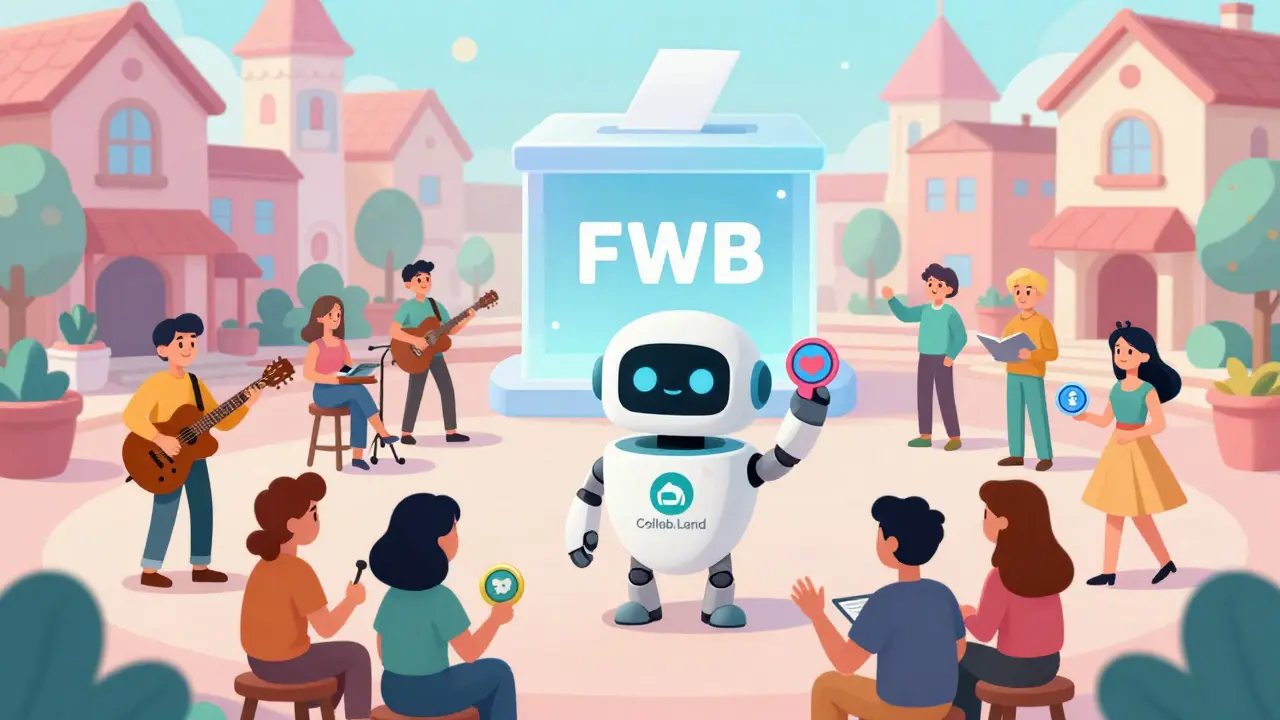
For token-gating, the DAO uses bots like Collab.Land to verify wallet holdings and automatically assign roles in Discord. For governance, they use Snapshot, an off-chain voting platform that reads Ethereum balances at a specific block height. This allows members to cast votes using cryptographic signatures without paying gas fees for every transaction. Treasury management is handled through multi-signature wallets, such as Gnosis Safe, requiring multiple trusted signers to approve large expenditures. This architecture balances security with usability, avoiding the congestion and costs associated with fully on-chain governance.
Comparison with Other Social Tokens
FWB isn’t alone in the social token space. It shares similarities with other community-driven projects but maintains distinct differences. For example, Bankless DAO (BANK) focuses on media and education, offering broader public access to most channels. In contrast, FWB emphasizes curated membership and cultural programming, resembling a digital Soho House more than an open forum. Other tokens like RAC (musician RAC’s community token) or WHALE focus on specific creator economies, whereas FWB aggregates diverse creative professionals under one umbrella.
Analysts from firms like Messari and Forefront have cited FWB as a flagship example of a “cultural DAO.” Its unique selling point lies in its heavy emphasis on in-person experiences and cross-industry collaboration, setting it apart from purely financial or technical DAOs.
Challenges and Future Outlook
Despite its innovative model, FWB faces ongoing challenges. The reliance on token price for membership affordability creates friction during bear markets. Additionally, regulatory scrutiny around social tokens remains a concern, as authorities may view them as unregistered securities depending on how they’re marketed and used. The DAO has responded by focusing on sustainable revenue streams, such as ticketed events and partnerships, to reduce dependence on token speculation.
Looking ahead, FWB’s long-term viability depends on its ability to maintain cultural relevance and deliver consistent value to its members. If it can stabilize its treasury and adapt its membership thresholds to remain inclusive without diluting quality, it could serve as a blueprint for future Web3 communities. For now, it remains a fascinating case study in the intersection of social identity, decentralized governance, and cryptocurrency utility.
Is FWB Pro a good investment?
FWB Pro is primarily a utility token for community access, not a traditional investment vehicle. Its price is highly volatile and tied to the popularity of the FWB DAO. While it reached highs of over $180 in 2021, it has since fallen significantly. Investors should only consider buying FWB if they intend to participate actively in the community and understand the risks of low liquidity and regulatory uncertainty.
How do I join the FWB community?
To join, you need to acquire FWB tokens on a supported exchange or DEX like Uniswap. Once you hold the required amount (typically 75 FWB for full membership) in an Ethereum wallet, you connect it to the FWB token-gating tool to receive Discord access. There may also be an application process to ensure community fit.
Why was FWB Pro created instead of using the original token?
The original FWB token was compromised during a security exploit on the Roll platform in March 2021. To protect holders and restore functionality, the community migrated to a new smart contract, branded as FWB Pro, which is separate from the hacked legacy token.
What is the total supply of FWB tokens?
The total maximum supply of FWB Pro is fixed at 1,000,000 tokens. Approximately 597,000 are currently in circulation, with the remainder held in the DAO treasury or reserved for contributors.
Who founded Friends With Benefits?
The FWB community was founded by Trevor McFedries (Yung Skeeter), a music executive and entrepreneur known for creating the virtual artist Miquela. He launched the initial social token experiment in 2020.