
Imagine uploading a file to the cloud and never having to pay another cent for it. No monthly subscriptions, no service providers watching your data, and no fear of a future quantum computer cracking your encryption. This is the promise of Autonomi, a decentralized network that uses the ANT token to power a permanent, peer-to-peer data storage ecosystem.
If you’ve been following crypto trends in 2026, you might have noticed ANT popping up on exchanges like BitMart and Uniswap. But what actually makes this project different from Filecoin or Arweave? The short answer is security. While most blockchain projects are still scrambling to prepare for quantum computing threats, Autonomi was built from the ground up with post-quantum cryptography. It’s not just a storage solution; it’s an attempt to create a sovereign internet layer where users retain absolute control over their information.
How the Autonomi Network Works
To understand why ANT matters, you first need to grasp how the underlying network operates. Traditional cloud storage relies on massive central servers owned by companies like Amazon or Google. If those servers go down, get hacked, or decide to censor your content, you lose access. Autonomi flips this model entirely.
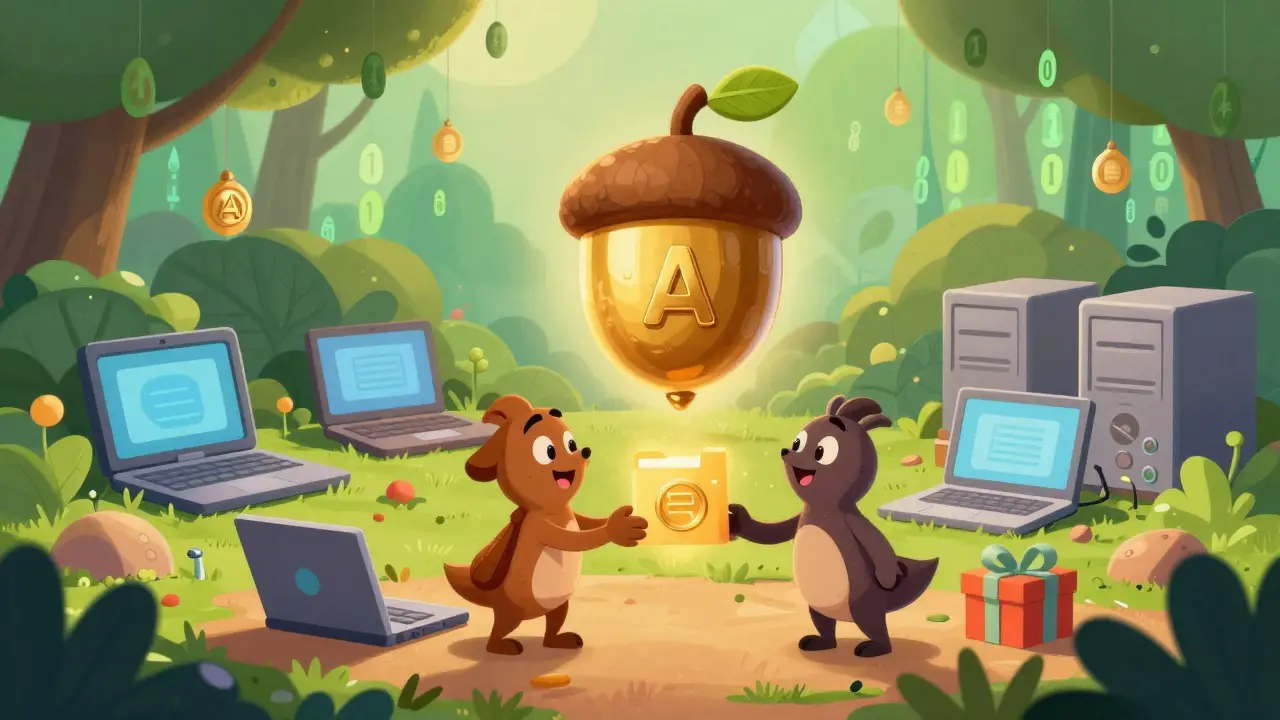
The network uses a Distributed Hash Table (DHT) to store data across everyday devices. Think about it: your old laptop, a Raspberry Pi sitting on a shelf, or even spare capacity in a data center can all become part of the network. There are no central servers. There are no user accounts. When you upload data, it is chunked, encrypted on your device using ChaCha20-Poly1305 encryption combined with BLAKE3 hashing, and then scattered across thousands of nodes globally.
Because the data is self-verifying and tamper-proof, the network doesn’t need to trust any single node. Retrieval is always free for the user. You only pay once to upload. This creates a permanent archive without recurring fees. The connectivity between these nodes is handled via QUIC NAT traversal technology, which allows true peer-to-peer communication without needing coordination servers. This means the network is resilient, autonomous, and incredibly hard to shut down.
Post-Quantum Security: The Real Differentiator
Here is where Autonomi separates itself from the crowd. Most cryptocurrencies and storage networks rely on classical cryptography-specifically elliptic curve cryptography (ECC). Experts warn that once sufficiently powerful quantum computers exist, they could break ECC, exposing private keys and stored data.
Autonomi does not take this risk. It implements post-quantum cryptography standards throughout its infrastructure. Specifically, it uses:
- ML-DSA-65 signatures (based on FIPS 204) for identity verification and node authentication.
- ML-KEM-768 key exchange (based on FIPS 203) to secure the transport protocol.
There are no classical fallback options. This design choice ensures that even if a quantum computer capable of breaking traditional encryption comes online tomorrow, your data on Autonomi remains safe. This "zero-knowledge" approach means the network operators never see your plaintext data. They don’t know what you’re storing, who you are, or where the data came from. For privacy advocates and developers building sensitive applications, this level of security is non-negotiable.

The Role of the ANT Token
You can’t use the network without the native currency. The ANT token serves as the utility and payment mechanism for the entire ecosystem. Think of it as the oil that keeps the engine running. Here is how it flows through the system:
- Paying for Storage: Users spend ANT tokens to upload data. Since storage is permanent, this is a one-time cost per upload size.
- Rewarding Providers: Node operators who contribute storage space and bandwidth are rewarded with ANT tokens by the network protocol.
- Powering Applications: Developers building on top of Autonomi-such as messaging apps, AI skill markets, or live coordination tools-use ANT for microtransactions.
- Agent Economy: As autonomous AI agents become more common, ANT facilitates agent-to-agent payments, allowing software entities to interact economically without human intervention.
This economic model aligns incentives. Providers are motivated to keep their nodes online and healthy because they earn ANT. Users are motivated to pay fairly because they get permanent, secure storage. The network grows organically as more participants join.
Tokenomics and Market Data
Before buying or interacting with ANT, it helps to look at the numbers. As of mid-2026, the token operates on the Arbitrum One network, an Ethereum Layer 2 solution. This choice provides faster transaction speeds and lower gas fees compared to the main Ethereum chain, making micro-payments for storage feasible.
| Metric | Value |
|---|---|
| Total Supply | 1.2 Billion ANT |
| Circulating Supply | 460 Million ANT |
| Blockchain | Arbitrum One (ERC-20 compatible) |
| Primary Use Case | Storage payments & node rewards |
| Market Rank (Approx.) | #1189 on CoinGecko |
The fully diluted valuation (FDV) sits around BTC 523 million, while the current market cap is approximately BTC 202 million based on the circulating supply. Price action has shown volatility typical of mid-cap crypto assets. In recent weeks, ANT saw a 4.9% increase over 24 hours and outperformed the broader Arbitrum ecosystem over the last seven days. However, it trades significantly below its all-time high, reflecting both market cycles and the growing pains of new infrastructure projects.
Where to Buy and Store ANT
Getting your hands on ANT requires a bit of navigation since it isn’t yet available on every major exchange. Currently, you can trade ANT on:
- Centralized Exchanges: Platforms like BitMart and Ourbit list ANT pairs, allowing you to buy directly with other cryptos or fiat (depending on regional availability).
- Decentralized Exchanges (DEX): You can swap tokens on Uniswap V3 on the Arbitrum network. This requires you to already have ETH or ARB on Arbitrum to perform the swap.
Note that major platforms like Crypto.com do not currently support ANT trading. Always verify listings before attempting to deposit funds.
Once you acquire ANT, you need a wallet that supports the Arbitrum network. MetaMask, Trust Wallet, or Rabby Wallet are popular choices. Make sure you add the Arbitrum network to your wallet settings so you can view your balance correctly. Never share your seed phrase, and consider using a hardware wallet for long-term storage of significant amounts.
Why This Matters for the Future
We are entering an era where AI and robotics will generate and consume vast amounts of data. Centralized tech giants currently control this flow. Autonomi aims to shift that power back to individuals. By providing a neutral, censorship-resistant, and quantum-safe layer, it enables developers to build applications that respect user sovereignty.
Whether you are a developer looking to host immutable records, a journalist protecting sources, or an investor betting on the next generation of decentralized infrastructure, Autonomi offers a compelling case. It’s not just about storing files; it’s about securing the digital foundation of a post-quantum world.
Is Autonomi (ANT) a good investment?
Investing in ANT carries risks like any cryptocurrency. Its value depends on the adoption of the Autonomi network. If more users store data and more nodes join, demand for ANT may rise. However, it is a mid-cap token with volatility. Always do your own research (DYOR) and never invest more than you can afford to lose.
How is Autonomi different from Filecoin?
Filecoin focuses on paying for storage over time with recurring costs. Autonomi charges a one-time fee for permanent storage. Additionally, Autonomi is built specifically with post-quantum cryptography (FIPS 204/203), whereas Filecoin relies on more traditional cryptographic methods that may be vulnerable to future quantum attacks.
Can I run a node on Autonomi?
Yes. You can run a node on various devices, including home PCs or Raspberry Pis, by contributing unused storage and bandwidth. Node operators are rewarded with ANT tokens. The network uses a distributed hash table to manage these resources efficiently.
Is my data safe from hackers on Autonomi?
Data is encrypted on your device before it leaves your local system. The network uses zero-knowledge architecture, meaning node operators cannot see your data. Combined with post-quantum encryption standards, this makes it extremely difficult for hackers to decrypt or tamper with stored information.
Which blockchain is ANT on?
The ANT token operates on the Arbitrum One network, which is an Ethereum Layer 2 scaling solution. This allows for fast and low-cost transactions compared to the main Ethereum network.




John Doe
Look, I get the hype about quantum safety, but let's be real for a second. You're telling me to trust a network of random people's old laptops with my most sensitive data? That sounds like a nightmare waiting to happen. If one node goes offline or gets hacked, what then? The encryption is fancy sure, but human error is still the biggest vulnerability in any system. I just don't see how this scales without massive centralization creeping back in.
Rob Aronson
The ML-DSA-65 and ML-KEM-768 implementations are actually quite robust if you look at the FIPS standards they reference. It’s not just marketing fluff; these are NIST-approved post-quantum algorithms designed specifically to resist Shor’s algorithm attacks. The DHT structure ensures redundancy, so single-node failure doesn’t compromise data integrity. Plus, the QUIC NAT traversal is a smart move for P2P connectivity without relying on centralized signaling servers. 🚀
Mekz Wheoki
Oh wow, another 'revolutionary' storage solution that promises the moon while delivering dust. Filecoin failed, Arweave is struggling, and now we have Autonomi? Please. The crypto space is full of vaporware projects using buzzwords like 'post-quantum' to attract desperate investors. I'll believe it when I see actual sustained uptime and adoption beyond a few degens running nodes on their basement servers. 😒
Fede Faith
I’ve been running a node on my spare Raspberry Pi for three months now, and honestly, the experience has been surprisingly smooth. The bandwidth usage is minimal during idle times, and the ANT rewards cover my electricity costs easily. It’s not going to make you rich overnight, but it’s a great way to contribute to a decentralized infrastructure while earning a little passive income. Just make sure your connection is stable!
Skm Shubham
This entire model is fundamentally flawed. Relying on consumer-grade hardware for permanent storage is a recipe for disaster. Hard drives fail, people lose power, ISPs throttle P2P traffic. The economic incentives might align theoretically, but in practice, the churn rate will be too high. You’re building a castle on sand. The tokenomics are also suspiciously similar to other failed projects. Do your own research before throwing money at this.
Kwon Bill
In many Asian markets, there’s a growing distrust of centralized cloud providers due to government surveillance concerns. Autonomi’s zero-knowledge architecture addresses this directly. The fact that it runs on Arbitrum One makes it accessible to users who already hold ETH or ARB, lowering the barrier to entry. This isn’t just tech; it’s a cultural shift towards digital sovereignty. We need more projects like this challenging the status quo.
Danna Charris
Straightforward and efficient. No fluff.
Josh Dodson
Hey guys! I think this is super cool idea. I tried setting up a node last week and it was kinda tricky at first but i got it working. The ant token price is moving nicely too. Just remeber to backup your seed phrase!! dont share it with anyone. Its important for security. Hope everyone enjoys the decentralization journey! 🌟
Suman Patil
The integration of AI agents into the economy is what really excites me here. Imagine autonomous bots paying each other in ANT for compute or storage resources without human intervention. This creates a self-sustaining ecosystem that could scale exponentially. The jargon-heavy documentation might scare some off, but the underlying tech stack is solid. Let’s build something amazing together! 💪
Kumaran sowkarpet
From an Indian perspective, where internet censorship is a real concern, this kind of technology is vital. Being able to store data permanently without fear of takedown notices is huge for journalists and activists. The cost efficiency compared to AWS S3 is also appealing for startups. Keep up the good work team! 👍
Mauricio Contreras Loredo
Yeah right, another crypto project promising to save the world from Big Tech. I’m all for decentralization, but let’s not pretend this solves everything. The user experience is still clunky, and buying ANT requires navigating multiple exchanges. Until it’s as easy as clicking a button on Google Drive, it’s not ready for mainstream adoption. But hey, keep dreaming! 😂
sreeja boora
It is imperative that national security interests are considered in such deployments. Unregulated decentralized networks can harbor malicious content and evade lawful interception protocols. While technological innovation is commendable, it must operate within the framework of existing legal statutes. Users should be aware of potential regulatory scrutiny in their respective jurisdictions.
Grace Newman
Have you considered the possibility that the 'post-quantum' claims are merely a smokescreen for a larger surveillance apparatus? Who controls the root keys? Who audits the node operators? In a truly free society, no entity should have such power over our digital lives. This feels like a Trojan horse for corporate control disguised as liberation. Be vigilant.
Abby Sivertsen
I hear your concerns, but the open-source nature of the code allows anyone to audit it. Transparency is key here. Unlike centralized clouds where you have to trust the company’s word, here you can verify the encryption yourself. It’s empowering to take control of your own data. Give it a chance before dismissing it entirely. 🤝
Benjamin Eisen
Im curious about the long term viability of the token. With only 460m circulating out of 1.2b total, inflation could be a issue. Also how do they prevent sybil attacks on the node network? Seems like someone could spin up thousands of fake nodes to drain rewards. Just wondering if theres any proof of stake or reputation mechanism involved?
Kenneth Riley
You clearly don't understand basic economics. The burn mechanism tied to storage fees offsets inflation. And sybil attacks are mitigated by the requirement for actual storage capacity and bandwidth contribution, which costs money to maintain. It’s not free energy. Stop spreading FUD based on ignorance. The math works. Deal with it.
ravi mahla
Haha, nice try buddy. But seriously, the volatility is scary. One bad tweet and the price drops 20%. Not exactly a safe haven for savings. Maybe for the brave souls who love gambling though. Good luck to those jumping in early! 📉
Mark Brunschwiler
We are living in a simulation where data is currency. Autonomi offers a way to hoard this currency outside the bank. Is it real? Does it matter? The act of storing data is an act of defiance against entropy. Join the resistance or fade into oblivion. Your choice defines your soul.
Terry Hyland
This is exactly what the elites want us to use. Decentralized networks make it impossible for authorities to track criminal activity. By promoting this, you are undermining social order. Stick to regulated services that comply with laws. Freedom is not chaos. Think about the consequences of unchecked anonymity.
Tim Lefebvre
Ive been using uniswap to swap arb for ant and its pretty seamless. Gas fees are low so its worth it. Just make sure you add the arbitrum rpc correctly in metamask or youll lose funds. Took me a bit to figure that out but now im set. Happy staking!
Monica Pathammavong
Typical amateur analysis. You’re ignoring the technical debt inherent in DHTs. Data retrieval latency increases exponentially as the network grows unless sharding is implemented perfectly. Has anyone seen benchmarks for large file downloads? Probably not because they’re too busy pumping the token. Wake up sheeple.
JEVON HALL
Great breakdown of the tech specs. The focus on post-quantum crypto sets this apart from legacy projects. Im watching the market cap closely. If adoption picks up, the FDV looks attractive. Always DYOR tho. 📈💎
Dr Lynea LaVoy
As a developer, the API access for building apps on top of this is intriguing. The ability to host immutable records securely could revolutionize supply chain tracking. I’d love to see more SDK examples for integrating ANT payments into web3 dApps. The community support seems responsive so far.
Matthew Malone
Another American-led initiative trying to dominate global data infrastructure. While I appreciate the innovation, we must ensure it doesn’t become another tool for US hegemony. True decentralization means equal participation from all nations, not just Silicon Valley startups. Stay critical.
aaliyah zahid
Love the vision of a sovereign internet layer. It’s refreshing to see projects prioritizing privacy over profit. The sarcastic comments aside, this tech has real potential. Let’s collaborate and build a better future together. Diversity of thought strengthens the network. ✨