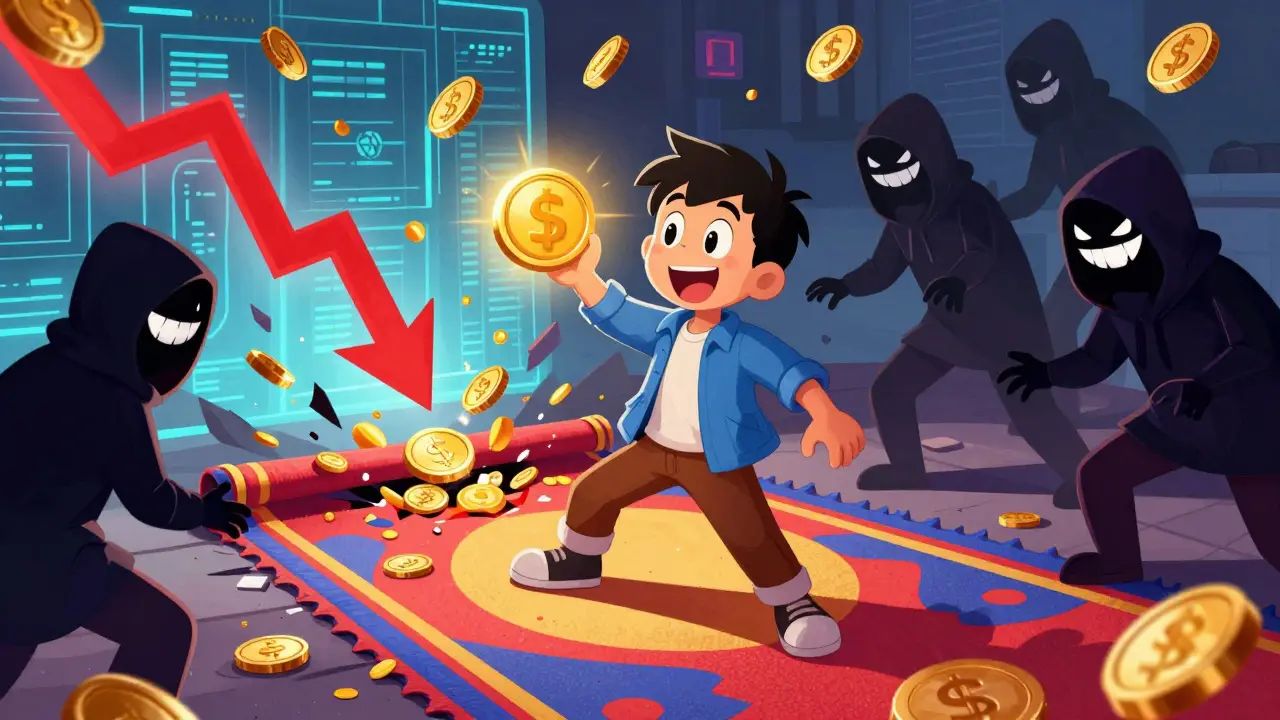
You pour money into a new token. The price skyrockets. You’re about to cash out your profits when the chart flatlines. You try to sell, but the transaction fails. Within minutes, the project’s social media goes silent, the website vanishes, and your investment is worth zero. This isn’t just bad luck; it’s a rug pull.
In the fast-moving world of decentralized finance (DeFi), rug pulls are the most common and devastating type of fraud. They happen when developers abandon a project and steal investor funds. Unlike traditional scams that might take months to unfold, a rug pull can wipe out millions of dollars in seconds. Understanding how these scams work is not just helpful-it’s essential for survival in crypto.
Defining the Rug Pull: More Than Just a Scam
A rug pull is a specific type of exit scam unique to the cryptocurrency ecosystem. The term comes from the idiom "pulling the rug out from under someone," describing the sudden removal of support that causes investors to fall. In technical terms, it occurs when the creators of a cryptocurrency or DeFi protocol drain the liquidity pool-the reserve of assets that allows users to trade the token-and disappear with the funds.
According to data from Solidus Labs, rug pulls account for the largest share of crypto crimes. In 2023 alone, over 300,000 scam tokens were created, defrauding approximately 2 million people globally. This number exceeds the combined victims of major centralized exchange collapses like FTX and Celsius. The sheer volume suggests that rug pulls are not rare anomalies but a systemic risk inherent in permissionless blockchain environments where anyone can launch a token without approval.
The core mechanism relies on anonymity and speed. Developers create a token, market it aggressively to build hype, attract buyers, and then execute a pre-planned exit strategy. Because blockchain transactions are irreversible, once the funds are moved to the developers' wallets, they are gone forever. There is no customer support line to call and no chargeback option.
Hard vs. Soft Rug Pulls: Two Different Playbooks
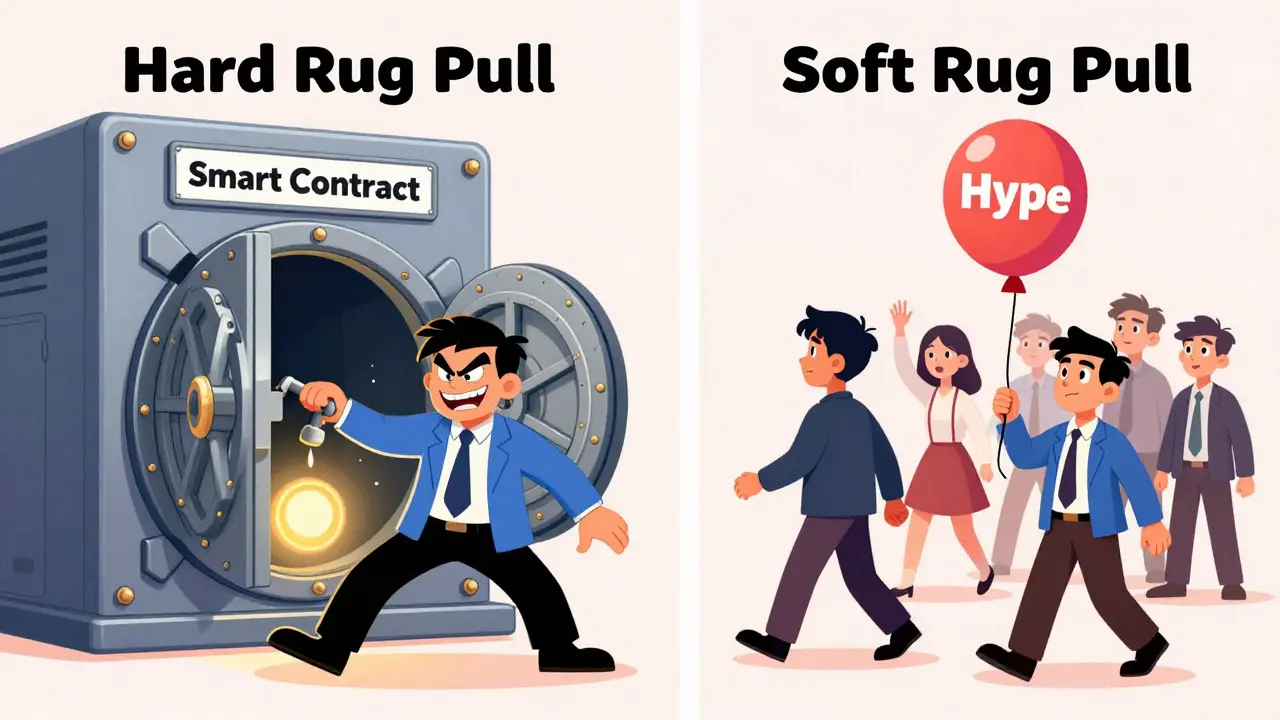
Not all rug pulls look the same. Experts generally categorize them into two main types: hard rug pulls and soft rug pulls. Knowing the difference helps you spot the warning signs before you invest.
Hard Rug Pulls are technically malicious. These involve code manipulation from the start. The developers embed hidden functions in the smart contract that allow them to steal funds or prevent selling. Common tactics include:
- Liquidity Stealing: The developer removes the liquidity tokens from the decentralized exchange (DEX). Without liquidity, there is no market for the token, making it impossible to sell.
- Honeypot Tokens: The code allows buying but blocks selling. Investors see the price rising and rush in, only to find they cannot exit their positions.
- Unlimited Minting: The developer creates billions of new tokens out of thin air, diluting the value of existing holdings to near zero before dumping their own stash.
The infamous $SQUID token incident in November 2021 is a classic example of a hard rug pull. Inspired by the TV show *Squid Game*, the token surged in popularity. However, the developers had coded a "blacklist" function that prevented anyone except themselves from selling. When the panic set in, the team drained over $3 million in liquidity and vanished.
Soft Rug Pulls rely on psychological manipulation rather than code exploits. The smart contract might be perfectly fine, but the developers have no intention of building a sustainable project.
- Pump and Dump: The team uses bots and paid influencers to artificially inflate the price. Once retail investors buy in at the peak, the developers sell their large holdings, crashing the price.
- Abandonment: After raising enough capital through presales or early trading, the team simply stops working on the project. They delete their Telegram groups, ghost their community, and leave the token to die naturally due to lack of interest.
Soft rug pulls are harder to detect because they don’t violate any code rules. They exploit human greed and FOMO (fear of missing out). According to Coinbase’s 2023 security report, about 32% of rug pulls are purely promotional deceptions without technical hacks.
| Feature | Hard Rug Pull | Soft Rug Pull |
|---|---|---|
| Mechanism | Malicious Smart Contract Code | Marketing Deception & Abandonment |
| Selling Ability | Often blocked by code | Allowed, but price crashes due to dump |
| Detection Difficulty | High (requires code audit) | Medium (requires sentiment analysis) |
| Speed of Loss | Instant (seconds/minutes) | Gradual (days/weeks) |
| Example | $SQUID Token | Many meme coins with anonymous teams |
Red Flags: How to Spot a Rug Pull Before It Happens
You don’t need to be a programmer to identify high-risk projects. Most rug pulls follow a predictable pattern of red flags. If you see three or more of these signs, walk away immediately.
- Anonymous Teams: Legitimate projects usually have doxxed (publicly identified) founders. If the team hides behind pseudonyms like "Dev1" or "CryptoKing," and you can’t find their LinkedIn profiles or past work history, treat it as high risk. Solidus Labs found that 92% of rug pull cases involved anonymous development teams.
- Unlocked Liquidity: Liquidity is the fuel that keeps a token tradable. In safe projects, developers lock this liquidity in a smart contract for a set period (e.g., 6 months or 1 year). If the liquidity is unlocked, the developer can withdraw it at any time. Check tools like BscScan or Etherscan to verify lock status.
- No Third-Party Audit: Reputable security firms like CertiK, OpenZeppelin, or Hacken audit smart contracts for vulnerabilities. If a project claims to be "audited" but provides no link to a public report, or if the audit was done by an unknown firm, be skeptical. About 83% of rug pull projects lacked proper third-party audits.
- Unrealistic Promises: Be wary of guaranteed returns, especially those exceeding 10,00% APY (Annual Percentage Yield). Sustainable growth doesn’t happen overnight. High yields often indicate a Ponzi structure where new investor money pays old investors until the scheme collapses.
- Excessive Developer Holdings: Look at the token distribution. If the developers hold more than 15-20% of the total supply, they have enough power to crash the market by selling their tokens. Healthy projects distribute tokens fairly among the community, treasury, and team.
The Role of Smart Contracts and Audits
Smart contracts are self-executing codes on the blockchain. In DeFi, they manage liquidity pools, staking rewards, and token transfers. While they remove the need for intermediaries, they also introduce complexity that scammers exploit.
A standard audit checks for bugs and logic errors. However, auditors cannot always predict malicious intent. A developer can write code that passes an audit but includes a hidden backdoor-for example, a function that only activates under specific conditions known only to the creator. This is why relying solely on an audit certificate is insufficient.
To mitigate this, many platforms now use "proxy contracts" that allow updates to the logic without changing the address. While useful for upgrades, this feature can be abused by developers to alter rules mid-game. Always check if the contract ownership is renounced. If ownership is renounced, no one-not even the developer-can change the contract code. This is a strong signal of trustworthiness, though not a guarantee against soft rug pulls.
Tools for Protection: Verifying Projects Safely
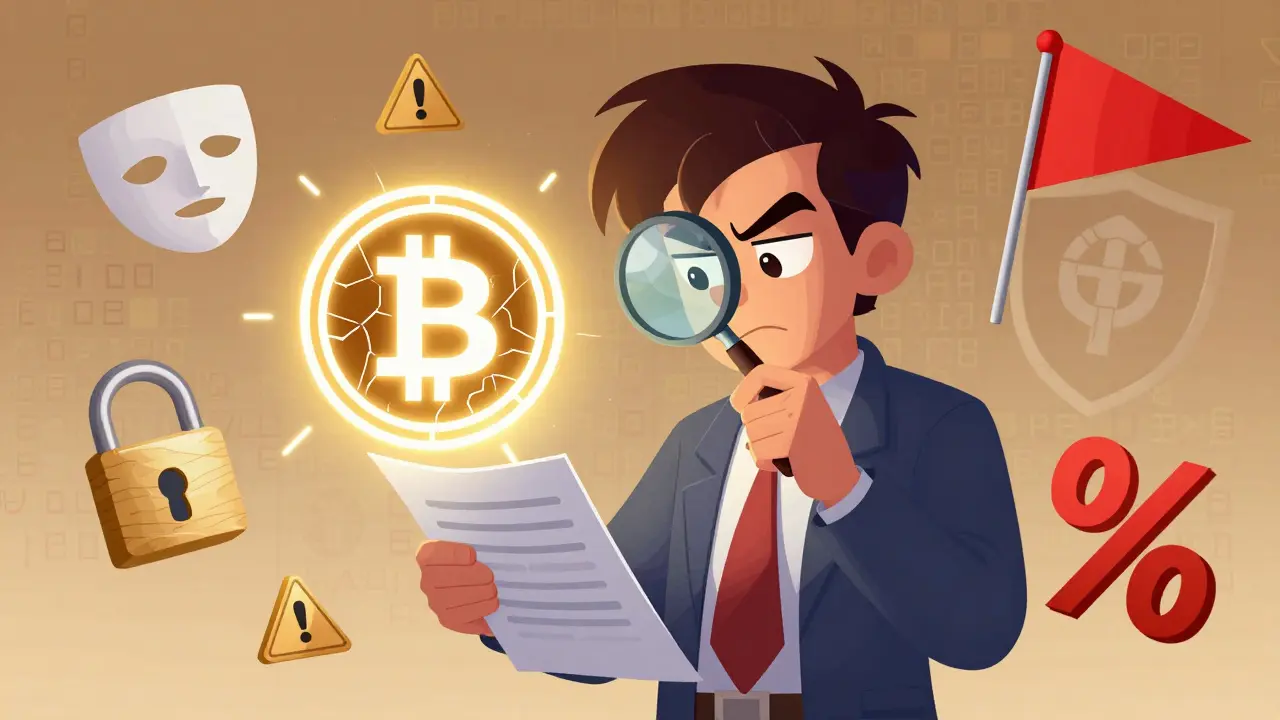
Don’t rely on gut feeling. Use data-driven tools to verify projects before investing. Here is a practical checklist:
- RugDoc.io: A community-driven platform that reviews DeFi projects. It provides detailed reports on contract risks, team reputation, and economic models. As of late 2023, it tracked over 12,000 active projects.
- Honeypot.is: A simple tool where you paste a token contract address to check if it’s a honeypot (buy-only token). It simulates a buy and sell transaction to test functionality.
- BscScan / Etherscan: Blockchain explorers that let you view transaction history. Look for large transfers from the deployer wallet to other wallets shortly after launch, which may indicate insider dumping.
- CoinHunters: An AI-powered scanner that detects suspicious patterns in real-time, such as unusual gas fees or rapid liquidity changes.
Spending 45-60 minutes researching a project using these tools can save you thousands of dollars. Remember, if a deal seems too good to be true, it almost certainly is.
Regulatory Landscape and Future Outlook
The crypto industry is evolving rapidly, and so are the regulations. In the European Union, the Markets in Crypto-Assets (MiCA) regulation, effective in 2024, mandates stricter disclosures for crypto issuers. This could significantly reduce anonymous rug pulls by requiring teams to reveal their identities and financial backing.
In the United States, the SEC has increased enforcement actions against fraudulent schemes. Cases like Flokinomics ($11 million settlement in 2023) show that regulators are targeting promoters who manipulate markets. However, enforcement is reactive. By the time a case is resolved, victims have already lost their funds.
Technological solutions are also emerging. Protocols like Unicrypt offer automated liquidity locking services, making it easier for legitimate projects to prove their commitment. Additionally, new token standards propose mandatory disclosure fields for liquidity locks and team verification.
Despite these advances, experts warn that rug pulls will not disappear entirely. MIT’s Digital Currency Initiative notes that while better tools can reduce incidents by 60-70%, the permissionless nature of DeFi means some level of risk will always exist. The burden of due diligence remains primarily on the investor.
Can I recover my money if I get rug pulled?
In most cases, no. Because blockchain transactions are irreversible and anonymous, recovering stolen funds is extremely difficult. Law enforcement agencies rarely prioritize individual small-scale losses unless part of a larger coordinated effort. Always assume any money sent to a smart contract is gone forever if the project turns out to be a scam.
Are rug pulls illegal?
Yes, rug pulls constitute fraud and theft under most legal jurisdictions. However, prosecuting these crimes is challenging due to the cross-border nature of the internet and the anonymity provided by cryptocurrencies. Developers often operate from countries with weak regulatory frameworks or use complex mixing services to hide their identities.
How do I know if liquidity is locked?
You can verify liquidity locks by checking the project’s official announcements for links to locking services like Unicrypt or Team.Finance. Then, go to those service websites and enter the token’s contract address. If the liquidity is locked, you will see the unlock date. If no record exists, assume the liquidity is unlocked and easily removable by the developer.
Is every anonymous project a rug pull?
Not necessarily, but anonymity significantly increases risk. Some legitimate privacy-focused projects or early-stage experiments may have anonymous teams. However, for typical DeFi or meme coins, a doxxed team with verifiable track records is a standard requirement for trust. If a project offers high rewards but hides its identity, proceed with extreme caution.
What is the difference between a rug pull and a hack?
A rug pull is an intentional act by the project creators to steal funds. A hack involves an external attacker exploiting a vulnerability in the code. In a rug pull, the insiders betray the community. In a hack, the community is victimized by outsiders. Both result in loss of funds, but the perpetrators and methods differ.