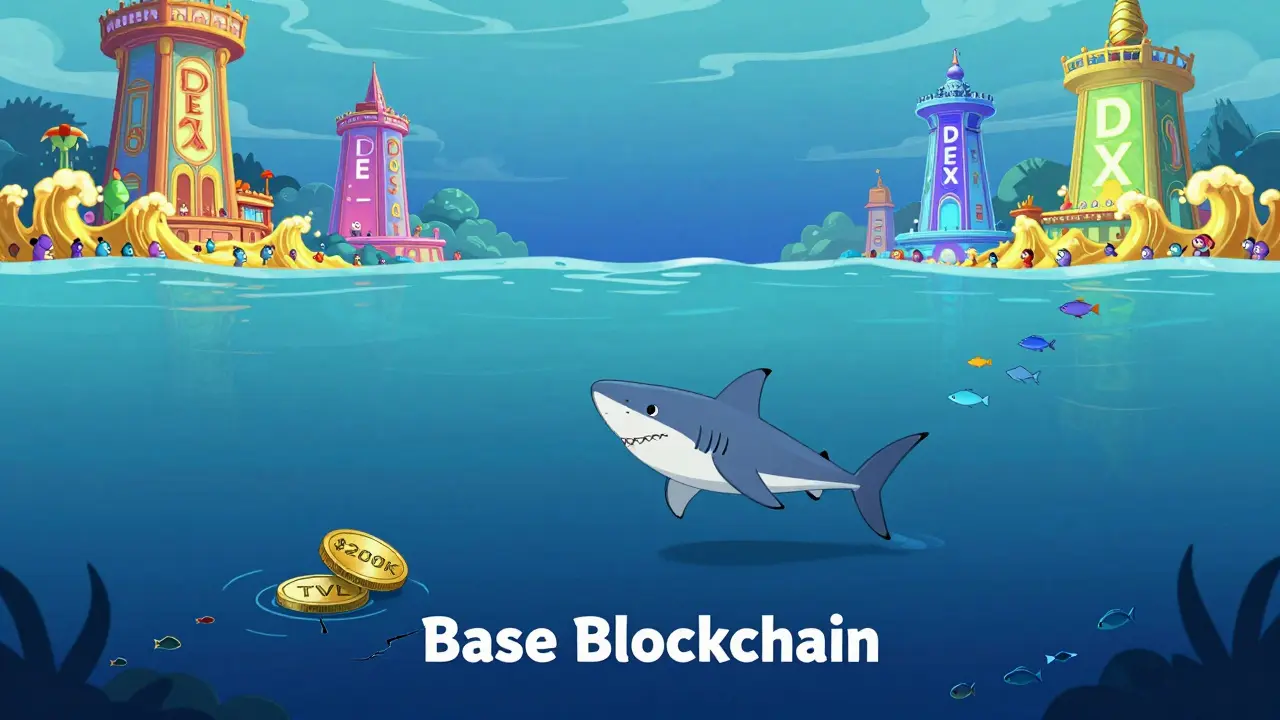
When you hear about a new crypto exchange called SharkSwap on the Base blockchain, it’s easy to get excited. After all, Base is backed by Coinbase, and Ethereum Layer 2 solutions promise faster, cheaper trades. But here’s the reality: SharkSwap isn’t a thriving exchange - it’s barely alive. If you’re thinking of using it, you need to know what you’re getting into before you send any funds.
What Is SharkSwap, Really?
SharkSwap is a decentralized exchange (DEX) built on Base, Coinbase’s Layer 2 network. It uses the same automated market maker (AMM) model as Uniswap - meaning there’s no order book. Instead, you trade directly against liquidity pools filled by users. On paper, that sounds fine. But unlike Uniswap or PancakeSwap, SharkSwap doesn’t have enough people using it to make trading reliable.
As of late 2025, its total value locked (TVL) sat at just $200,000. For comparison, Uniswap holds over $3 billion. That’s a 15,000x difference. This isn’t a small startup - it’s a ghost town. Most trading pairs have next to no liquidity. If you try to swap more than $100, chances are your trade will fail, or you’ll get a terrible price because the pool is empty.
Why SharkSwap’s Performance Is So Poor
There’s a reason nobody uses SharkSwap: it offers nothing new. It looks like a copy of Uniswap V2 - same interface, same 0.3% fee, same basic features. There are no staking rewards, no yield farming, no NFT marketplace, no advanced trading tools. Even PancakeSwap, which runs on BNB Chain, gives users up to 12% APY on staking. SharkSwap? Nothing.
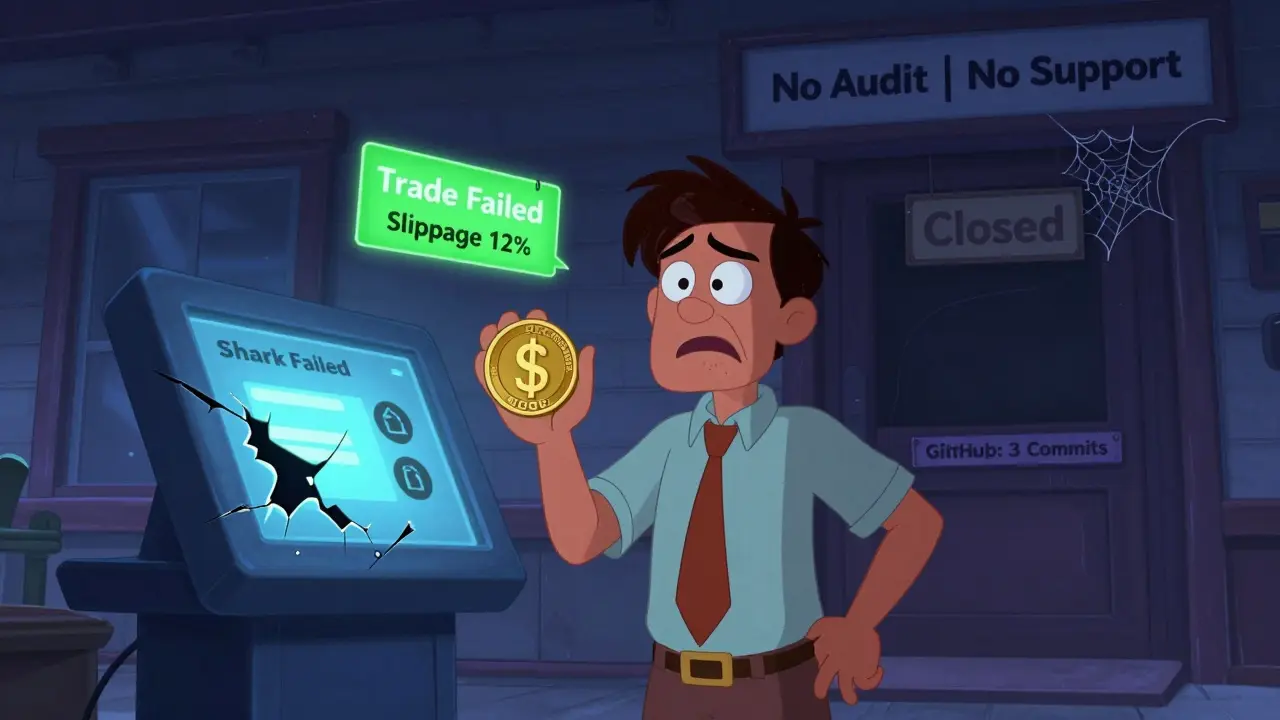
Transaction speeds are faster than Ethereum mainnet - about 2 seconds per swap instead of 15. But that advantage disappears when you’re stuck waiting 10 minutes because your trade keeps failing due to slippage. Users report needing to set slippage tolerance as high as 12% just to get a $200 swap to go through. That’s not efficiency - that’s desperation.
And here’s the kicker: there’s no proof the code is safe. No public audit from OpenZeppelin, CertiK, or any reputable firm. That’s not normal. Even obscure DEXs usually get audited to gain trust. SharkSwap has zero documentation. If something goes wrong - a hack, a bug, a drained pool - you have no recourse.
The Data Doesn’t Lie: Traffic, Volume, and User Trust
CoinMarketCap lists SharkSwap as “Untracked.” That means its daily trading volume is below $50,000 - too low to be measured reliably. In October 2025, its monthly volume was likely under $1 million. Uniswap does over $37 billion in a single month.
On Reddit, there are only three comments about SharkSwap in a major crypto thread. One user tried to swap $200 in USDC to DAI - failed three times. Another wrote: “Avoid - liquidity pools are practically empty.” Trustpilot has zero reviews. CoinGecko has seven comments total since launch. Five of them describe failed trades.
Even the number of unique wallets interacting with SharkSwap is tiny - around 1,200 in the last 90 days. Uniswap has over 2 million. PancakeSwap has 850,000. This isn’t a niche product. It’s a dying project.
What You Can’t Do on SharkSwap
- No transaction history export - You can’t download your trade logs. To file taxes, you have to manually trace every swap on a blockchain explorer. That takes 25 minutes per trade.
- No customer support - Contact forms don’t respond. Emails go unanswered. There’s no live chat, no Discord, no Twitter support account.
- No cross-chain swaps - You can’t move assets from Ethereum, Solana, or Polygon into SharkSwap. It’s locked to Base.
- No integrations - Aggregators like 1inch and Matcha won’t list it because they require at least $5 million in TVL. SharkSwap doesn’t come close.
These aren’t minor inconveniences. They’re deal-breakers for anyone serious about trading crypto.
Is SharkSwap a Scam?
It’s not officially labeled a scam. But CryptoLegal.uk’s October 2025 update lists SharkSwap under “Emerging DEX Platforms with Unverified Contracts” - a warning category for projects with red flags like no audits, low liquidity, and no transparency. CoinDesk’s security report also flagged dozens of similar Base-based DEX forks that mimic known scam code patterns.
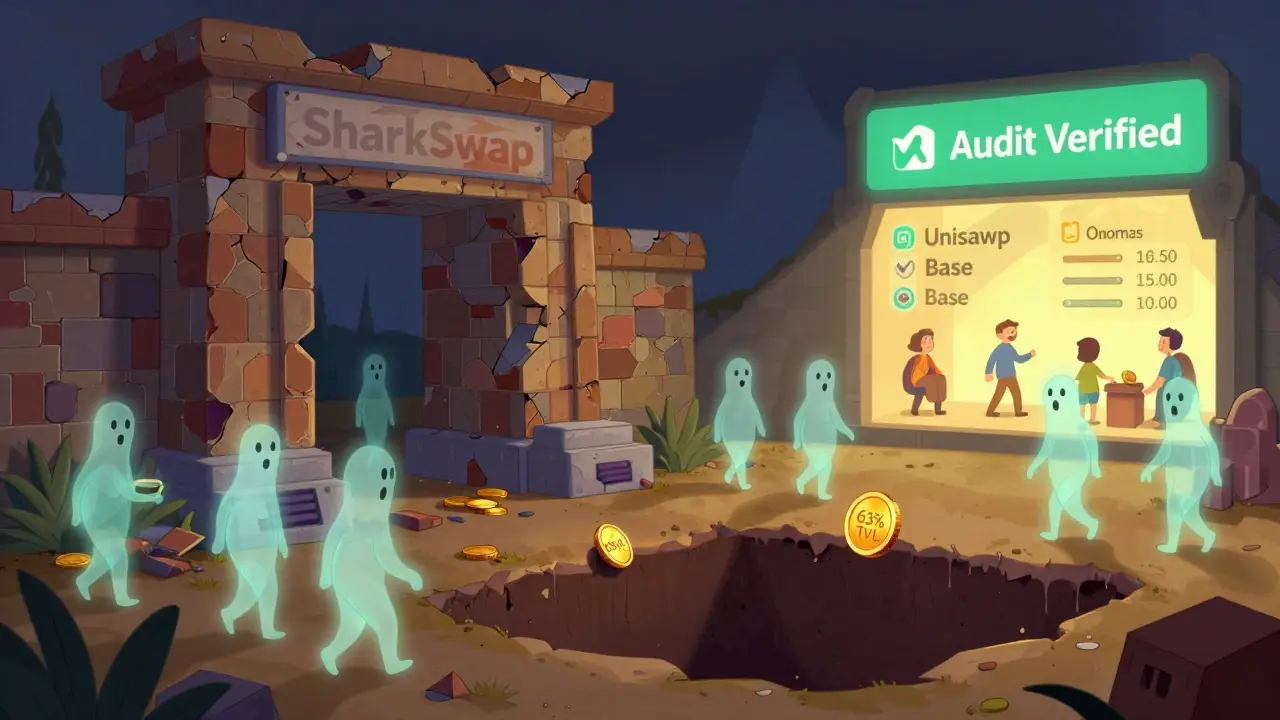
There’s no evidence of fraud - no stolen funds, no rug pull, no exit scam. But there’s also no evidence this project is being actively maintained. GitHub shows only three commits in the last 90 days. No roadmap updates since August 2025. TVL has dropped 63% since July 2025.
Industry analysts at Messari predict over 70% of untracked DEXs will shut down by mid-2026. SharkSwap isn’t just low on users - it’s on life support.
How Long Will SharkSwap Last?
DexCircle’s October 2025 review says it plainly: “Absent dramatic liquidity injections, SharkSwap will likely become inactive within 6-9 months.” That’s not speculation - it’s math. With TVL shrinking, no developer activity, and zero user growth, there’s no path forward.
If you’re holding tokens on SharkSwap, you’re not investing - you’re gambling on a dead project. If you’re thinking of adding liquidity, you’re risking your capital on a pool that may vanish overnight. There’s no insurance. No backup. No community to rally and save it.
What Should You Use Instead?
If you want to trade on Base, use Uniswap V3 on Base. It has deep liquidity, full audit reports, a proven track record, and active development. You’ll pay slightly higher gas fees than SharkSwap - maybe $0.05 instead of $0.02 - but your trades will go through. Your funds will be safe. Your tax records will be automatic.
If you’re looking for higher yields, try PancakeSwap on BNB Chain. It offers staking, farming, and NFT integration. It’s not perfect, but it’s alive.
There’s no reason to use SharkSwap unless you’re testing it out with pocket change - and even then, why risk it? There are better, safer, and faster alternatives on the same blockchain.
SharkSwap doesn’t solve a problem. It doesn’t innovate. It doesn’t even keep up. In a space where liquidity is everything, it’s already lost.
Is SharkSwap safe to use?
SharkSwap has no public smart contract audits from trusted firms like OpenZeppelin or CertiK. Without an audit, there’s no guarantee the code is secure. While there’s no confirmed hack yet, the lack of transparency and minimal user activity make it a high-risk platform. Only use it with funds you can afford to lose.
Can I trade large amounts on SharkSwap?
No. With a TVL of only $200,000, liquidity pools are extremely shallow. Trades over $500 often fail or result in over 5% slippage. Even with slippage tolerance set to 12%, many users report multiple failed attempts before a small swap succeeds. It’s not designed for serious trading.
Why is SharkSwap listed as “Untracked” on CoinMarketCap?
CoinMarketCap only tracks exchanges with consistent daily trading volume above $50,000. SharkSwap’s volume is below that threshold, so it’s labeled “Untracked.” This means its data isn’t verified, and it’s excluded from rankings. It’s a sign the platform lacks real usage.
Does SharkSwap have customer support?
No. Testing shows no functional support channels. Contact forms go unanswered. There’s no Discord, no Telegram, no email reply. If you run into issues, you’re on your own.
Should I add liquidity to SharkSwap?
Not unless you’re okay with losing your funds. With TVL dropping 63% since July 2025 and no developer activity, liquidity providers are unlikely to earn fees. More likely, your tokens will be stuck in a pool that gets abandoned. Other DEXs offer better rewards and far more safety.
Is SharkSwap built on Ethereum?
No. SharkSwap runs on Base, which is a Layer 2 solution built on Ethereum. It uses Ethereum’s security but processes transactions faster and cheaper. However, it’s not directly on Ethereum mainnet, so you can’t interact with it using Ethereum-only wallets without bridging to Base first.


Dominic Taylor
SharkSwap’s TVL is a ghost town, but honestly? That’s the crypto ecosystem for you. Most DEXs die within 18 months if they don’t bring something novel. Uniswap V3 on Base is the real play-deep liquidity, audited contracts, and real dev activity. SharkSwap? It’s a skeleton with a fancy UI. No audits, no roadmap, no community. Just vibes.
Shelley Dunbrook
How poetic. A DEX built on Coinbase’s Layer 2… that Coinbase itself refuses to acknowledge. It’s like a startup named ‘ApplePay Lite’ and then wondering why no one uses it. The irony is almost elegant.
Aman Kulshreshtha
Bro, I tried swapping 50 USDC on SharkSwap last week. Failed three times. Set slippage to 15%. Still got rekt. Then I went to Uniswap V3 on Base-done in 8 seconds, fee was $0.03. Why do people even try this? It’s like trying to run a marathon in flip-flops.
Leona Fowler
If you’re considering adding liquidity, ask yourself: Do you want to fund a graveyard? The math is simple: low TVL + no audits + zero dev activity = high probability of total loss. There are safer, higher-yield options on Base. Don’t confuse hope with strategy.
Neil MacLeod
This isn’t a DEX-it’s a digital tombstone. SharkSwap is the crypto equivalent of a Blockbuster Video in 2024. The UI is pretty, the branding is cute, but the whole thing is held together by duct tape and wishful thinking. If you’re not trading with pocket change, you’re just donating to a dead project.
Misty Williams
People who use SharkSwap are either reckless, ignorant, or both. There is no justification for risking capital on a project with zero audits, no support, and a TVL smaller than my coffee budget. This isn’t innovation-it’s negligence dressed up as DeFi.
Anand Makawana
SharkSwap’s architecture is fundamentally flawed: no incentive mechanisms, no governance, no tokenomics. Without yield farming or staking rewards, liquidity providers have zero reason to participate. The platform is a static snapshot of a failed economic model. It’s not a DEX-it’s a liquidity vacuum.
Mohammed Tahseen Shaikh
Stop wasting time. SharkSwap is a dumpster fire with a whitepaper. You think you’re ‘supporting decentralization’? Nah. You’re just feeding a zombie. Uniswap V3 on Base is free, faster, and audited. If you’re still using this, you’re either trolling or you need to go back to Crypto 101.
Sarah Terry
Only trade on SharkSwap if you’re okay losing money. Seriously. The risks aren’t theoretical-they’re documented. Failed swaps, no support, no audits. It’s not worth the $0.02 gas fee. Use Uniswap. You’ll thank yourself later.
Shayne Cokerdem
base is the future but sharkswap? lol. they probably coded this in a weekend and called it a day. if you’re not using uniswap v3 on base, you’re doing crypto wrong. also, who names a dex sharkswap? sounds like a kids’ cartoon.
kavya barikar
Transparency matters. No audit, no support, no history. Without these, even the most promising tech becomes a liability. Choose platforms that respect your capital. Not every new project deserves your trust.
aravindsai pandla
SharkSwap’s decline is predictable. It lacks community governance, developer engagement, and economic incentives. Liquidity pools aren’t just about capital-they’re about confidence. Without trust, the entire system collapses. This is a lesson in DeFi fundamentals.
namrata singh
I felt so hopeful when I first saw SharkSwap. A Base DEX? Perfect! But then I tried to swap $50… and it took 12 minutes to fail. I cried a little. Then I switched to Uniswap. My trades now finish before I finish my tea. Don’t make the same mistake. Your wallet will thank you.
Andrea Zaszczynski
Wait, so you’re telling me this thing doesn’t even have a Discord? No Telegram? No Twitter? How is this still live? I’ve seen better support on a pizza delivery app. This isn’t DeFi-it’s a ghost app with a blockchain label.
Cordany Harper
Base has real potential. But SharkSwap? It’s not a competitor-it’s a cautionary tale. If you’re building on Base, you need to add value. Not just copy Uniswap’s UI and call it a day. The market rewards innovation, not imitation.
DarShawn Owens
Just wanted to say I used SharkSwap once. Got a weird slippage, lost $3. Didn’t even get a refund. Then I used Uniswap V3 on Base-smooth, fast, no drama. I’m never going back. Don’t be like me. Learn from my mistake.
Andy Green
Uniswap V3 on Base is clearly superior. But you’re all ignoring the real truth: SharkSwap was probably a honeypot. Zero audits? No team? No updates? That’s not incompetence-that’s a trap. You’re not losing money-you’re being harvested.
Zion Banks
Coinbase is hiding this. They don’t want you to know SharkSwap is a decoy. Why? To suck in retail investors so they can manipulate Base’s metrics. This isn’t a DEX-it’s a front for a centralized exit scam. Wake up, sheep.
Annette Gilbert
Wow. You actually wrote a 1500-word essay on a DEX with $200k TVL? I’m impressed. Truly. The dedication to documenting a dead project is almost admirable. Like writing an obituary for a rock you found in your backyard.
John Alde
It’s important to understand that liquidity isn’t just about numbers-it’s about network effects. A DEX needs users, developers, and third-party integrations to survive. SharkSwap has none. Even if the code were perfect, the ecosystem around it is barren. That’s why it’s failing. Not because of bad tech, but because of bad strategy.
manoj kumar
Everyone’s overcomplicating this. SharkSwap = scam. No audits. No team. No volume. No support. End of story. If you’re still debating this, you’ve been in crypto too long. Go trade Solana. Or better yet-go outside.
JOHN NGEH
I’ve been watching SharkSwap since launch. It’s quiet. Too quiet. No updates, no tweets, no GitHub commits. I don’t think anyone’s even logged in since August. It’s not broken-it’s abandoned. And that’s scarier than any hack.
Jenni Moss
Don’t give up on Base! Just don’t use SharkSwap. Use Uniswap V3. It’s faster, safer, and actually maintained. You can do better. You deserve better. Your trades deserve better.
vu phung
SharkSwap’s only advantage is lower gas fees-but if your trade fails 5 times, you’ve already paid more in failed txs than you’d save. It’s a false economy. Stick with Uniswap. Your time is worth more than $0.01.
Lorna Gornik
sharkswap 😭 so sad. i thought it was gonna be the one. no audits, no dev, no love. just vibes and ghosts. uniswap v3 on base all the way 🙌