
Remember the wild west days of crypto? Back then, you could launch a token from your garage and sell it to anyone without much oversight. That era is officially over in Europe. If you are operating in or targeting customers within the European Union, Markets in Crypto-Assets Regulation (MiCA) is the comprehensive legal framework that governs how crypto assets are issued, traded, and managed across all 27 member states. It is not just a set of guidelines; it is the law.
By now, you have likely heard whispers about MiCA. But with the full regulatory framework having become applicable on December 30, 2024, the dust has settled enough for us to see what actually works and what does not. We are now well into 2026, and the landscape looks drastically different than it did in 2023. The question is no longer "will this happen," but rather "how do you survive and thrive under these new rules?"
The End of Regulatory Fragmentation
Before MiCA, if you wanted to run a crypto exchange in Europe, you had a nightmare on your hands. You needed to navigate 27 different national regulations. Germany’s BaFin had one rulebook, France’s AMF had another, and Italy’s CONSOB had yet another. This fragmentation caused chaos. According to impact assessments by the European Commission back in 2020, nearly 98% of market participants cited lack of legal clarity as their biggest headache.
MiCA solves this by creating a single passporting system. Here is how it works: if you get authorized as a Crypto-Asset Service Provider (CASP) in an entity licensed to provide services like custody, trading, or exchange of crypto assets within the EU in one member state, say Ireland, you can operate across the entire EU without needing separate licenses in France, Spain, or Poland. This harmonization was the primary goal, and it has largely succeeded in cleaning up the mess.
However, getting that initial license is not a walk in the park. The minimum capital requirements alone can scare off small players. You need at least €150,000 for pure custody services, but if you offer multiple services-like trading and advisory-you are looking at €730,000 in minimum capital. For a startup trying to bootstrap its way to success, that is a significant barrier to entry.
Three Buckets for Your Tokens
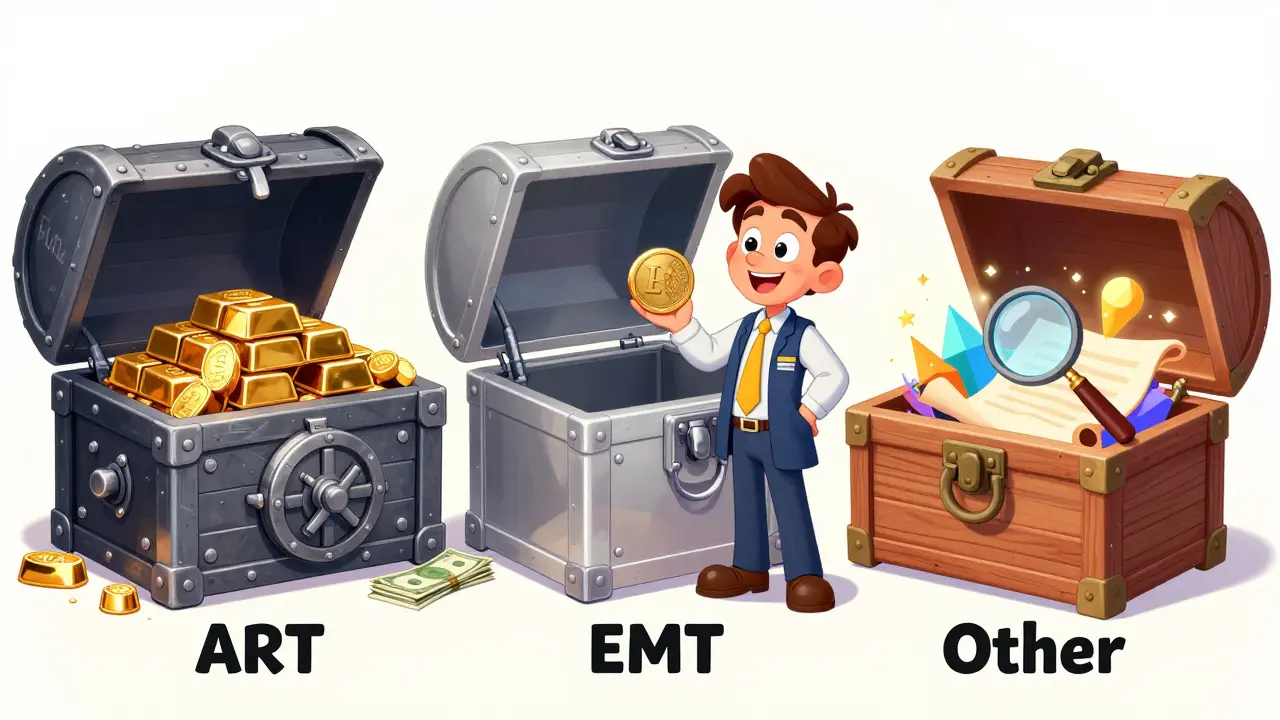
MiCA does not treat all crypto assets equally. The regulators decided that risk varies depending on what the token actually represents. They split everything into three distinct categories, each with its own rulebook.
- Asset-Referenced Tokens (ARTs): These are tokens that try to maintain a stable value by referencing a basket of currencies or other assets. Think of them as complex stablecoins. Under Title III of MiCA, issuers must keep 100% of the value in reserve, plus a 2% buffer. Furthermore, they need a liquid reserve ratio of 3:1, meaning for every euro of liabilities, they need high-quality liquid assets backing them. At least 60% of those reserves must be cash or central bank deposits.
- E-Money Tokens (EMTs): These are simpler. They peg to a single fiat currency, like the Euro. Title IV dictates that only authorized credit institutions or electronic money institutions can issue these. No tech startups here unless they partner with a bank.
- Other Crypto-Assets: This is the catch-all bucket for Bitcoin, Ethereum, utility tokens, and anything else that doesn’t fit the first two categories. The main requirement here is transparency. Issuers must publish a white paper detailing the technology, risks, and governance structure. If you lie in that white paper, you face fines up to 15% of your annual turnover.
This classification system forces companies to be honest about what they are selling. You cannot call your speculative meme coin a "stablecoin" anymore and expect investors to trust it without rigorous proof of reserves.
| Token Type | Value Reference | Issuer Requirement | Reserve Rules |
|---|---|---|---|
| Asset-Referenced Token (ART) | Basket of assets/currencies | CASP Authorization | 100% + 2% buffer; 60% cash/reserves |
| E-Money Token (EMT) | Single fiat currency | Bank/E-money Institution License | Full backing in referenced fiat |
| Other Crypto-Asset | Market-driven | White Paper Publication | No specific reserve mandate |
The Stablecoin Crackdown
If there is one area where MiCA bites hard, it is stablecoins. Remember the Libra/Diem proposal from Meta in 2019? That sparked fears that private companies could create global currencies that undermined central banks. MiCA was partly designed to prevent that.
Algorithmic stablecoins are completely banned. If your stability mechanism relies on code and incentives rather than actual cash reserves, you cannot operate in the EU. This killed off several experimental projects overnight. For ARTs, the rules are strict. During the first six months of operation, issuers must maintain 120% reserve coverage. Yes, you read that right. You need more money in the vault than people have claimed.
Critics argue this stifles innovation. Stuart Alderoty, Ripple’s Chief Legal Officer, pointed out that the heavy-handed approach creates disproportionate barriers compared to jurisdictions like Switzerland. And he might have a point. A PwC survey in 2023 showed that 23% of stablecoin issuers considered moving operations outside the EU because of these strict rules. However, the European Central Bank argues that these robust redemption mechanisms address 78% of the vulnerabilities found in previous stablecoin analyses. Safety comes at a cost, and right now, the EU is choosing safety over speed.
What It Means for Exchanges and Users
For everyday users, MiCA should mean safer interactions. When you buy Bitcoin on a MiCA-compliant exchange, you know that firm has passed stringent checks on IT security, business continuity, and anti-money laundering protocols. ESMA reported that in late 2024, 68% of initial licensing applications were rejected due to inadequate risk management frameworks. That means the weak links are being filtered out.
But there is a downside. Consolidation. Chainalysis data from early 2025 shows that the number of active crypto service providers in the EU dropped by 45%, from 5,200 to 2,850. Many smaller firms simply could not afford the compliance costs, which average between €250,000 and €500,000 for medium-sized CASPs. The result is a more concentrated market. The top 10 MiCA-authorized exchanges now control 67% of EU trading volume. Less competition often means higher fees, and indeed, some Spanish exchanges reported a 22% increase in transaction fees to cover compliance overhead.
On the flip side, institutional money is flooding in. Euroclear reported a 210% year-over-year increase in institutional custody arrangements for MiCA-compliant assets in 2024. Big banks and pension funds want to play, but they will not touch unregulated platforms. So while retail traders might grumble about fewer choices, the overall market cap of compliant firms has grown by 32%.
Navigating the Compliance Maze
If you are a business owner, your to-do list is long. First, you need to apply to your National Competent Authority (NCA). Whether that is BaFin in Germany or AMF in France, expect a wait time of 9 to 12 months. Do not start marketing until you have that license in hand.
Second, prepare your white paper. It is not just a PDF you upload to GitHub. Annex I of MiCA requires detailed disclosures on project objectives, technology, tokenomics, and risk assessments. Make sure your legal team reviews every word.
Third, integrate with the upcoming Anti-Money Laundering Authority (AMLA). Launching fully in 2026, AMLA will supervise the largest cross-border firms. If you process over €100 million monthly, you are already on their radar. You need real-time transaction monitoring systems that can flag suspicious activity instantly. Article 63 of MiCA makes this mandatory.
Finally, watch out for marketing rules. Article 30 restricts how you can promote crypto assets to retail investors. You cannot use misleading performance projections or hide risks in fine print. Conflicts with national consumer protection laws are common, so local legal advice is essential.
Looking Ahead: DeFi and NFTs
MiCA is not static. The European Commission submitted its report on NFTs in late 2024, proposing a risk-based approach that would bring about 15% of NFTs under MiCA’s scope based on liquidity and fungibility metrics. If an NFT behaves like a financial instrument, it will be regulated like one.
Decentralized Finance (DeFi) is next. ESMA is consulting on bringing certain decentralized applications under MiCA using a "significant influence" test. This could affect 28% of current DeFi protocols. The idea is that if a foundation or developer group has enough control over a protocol, they can be held liable as a CASP. This is a hotly debated topic, as it challenges the core ethos of decentralization.
By 2027, analysts predict the EU’s share of the global crypto market will grow from 14% to 22%. The region is betting that clear rules will attract sustainable growth rather than speculative bubbles. Whether that bet pays off depends on how agile regulators remain as new technologies, like AI-integrated crypto products, emerge.
Does MiCA apply to me if I am not based in the EU?
Yes, if you target consumers in the EU. MiCA has extraterritorial reach. Any Crypto-Asset Service Provider offering services to EU residents must comply, regardless of where the company is headquartered. This prevents "regulatory arbitrage" where firms move offshore to avoid rules.
Are algorithmic stablecoins completely banned?
Yes. MiCA explicitly prohibits stablecoins that rely solely on algorithmic mechanisms to maintain their value without adequate reserves of high-quality assets. Only Asset-Referenced Tokens (ARTs) and E-Money Tokens (EMTs) with strict reserve requirements are permitted.
How much does it cost to get a MiCA license?
The direct licensing fees vary by country, but the indirect costs are substantial. Minimum capital requirements range from €150,000 to €730,000. Additionally, compliance infrastructure, legal fees, and operational adjustments typically cost between €250,000 and €500,000 for medium-sized firms.
Will MiCA regulate Decentralized Finance (DeFi)?
Partially. While purely non-custodial DeFi protocols are currently outside the direct scope, ESMA is exploring a "significant influence" test. If a foundation or development team exerts control over a protocol, they may be classified as a CASP and required to comply with MiCA rules.
What happens if I violate MiCA rules?
Penalties are severe. Fines can reach up to 15% of your annual turnover. Additionally, you may face temporary bans on providing services, public censure, and even criminal liability for senior managers involved in serious breaches like market abuse or fraud.



Steven Jacobowitz
Look, I get the hype around MiCA being this great unifier but let me tell you something about regulatory arbitrage. It’s not dead. You think moving to Switzerland or Singapore is hard? No. The EU is creating a gold-plated cage and everyone with actual capital is just walking out the door. I’ve seen three friends leave their startups in Berlin for Dubai because the compliance overhead was eating their runway alive. This isn’t protection, it’s strangulation.
Matthew Malone
Finally some sense. Europe always needed a slap on the wrist to stop them from becoming the playground for global criminals. If they want to play by strict rules, fine. But don't expect us to care when their exchanges collapse under the weight of bureaucracy. American markets are already ahead because we focus on innovation, not paperwork.
Kelly Tenney
I really appreciate how clear this breakdown is! It helps so much to understand the different token categories. I’m trying to figure out if my small project needs to apply for CASP status or if I can just publish a whitepaper. Does anyone know if there’s a grace period for existing projects that launched before 2024?
Dr Lynea LaVoy
Kelly, the grace period ended quite a while ago for most provisions. If you were operating as a CASP without authorization, you’re likely already in violation unless your NCA gave specific transitional arrangements. For new issuers of 'Other Crypto-Assets', you need the whitepaper approved before offering to the public. It’s best to consult a local legal expert immediately rather than guessing.
Caralee Robertson
i mean its kinda crazy how much money they want for licenses. 730k euros?? thats insane for a startup. i guess only the big banks will survive now. feels like they are pushing out the little guys on purpose
Sylvia Mossman
Exactly! It’s a consolidation scheme disguised as consumer protection. They want to kill competition so the top 10 exchanges can raise fees without anyone blinking. I paid 22% more in fees last month on my Spanish exchange compared to what I was paying two years ago. Thanks for nothing, Brussels!
Sylvia Mossman
And don’t even get me started on the stablecoin rules. Banning algorithmic stablecoins entirely is just lazy regulation. There were valid models out there that didn’t rely on dumb cash reserves. Now we have fewer options and higher risk concentration in bank-backed tokens. Brilliant.
Meg Gran
its ironic how they claim to protect consumers but actually just protect incumbents. the whole 'safety over speed' argument is just code for 'we want to control the narrative'. i doubt any real innovation will happen in eu crypto now. its a graveyard
JEVON HALL
Hey folks 😊 Just wanted to add that while the costs are high, the institutional inflow is real. Euroclear saw a 210% jump in custody deals. So maybe it’s not all bad? Big money likes safety 🏦💰
dan kaffeman
Oh please. Institutional money is just slow, boring, and heavily regulated. That’s why they need MiCA. Retail traders want freedom and upside, not hand-holding from pension funds. The EU is turning crypto into another stock market with extra steps. Disgusting.
dan kaffeman
You people are so naive thinking this brings safety. It brings monopoly. And when the next crisis hits, these 'safe' banks will be too big to fail while your assets are frozen. Enjoy your 22% fee hikes, suckers.
Alexis Abster
Wow, the negativity here is palpable! But hey, look on the bright side! At least we won’t have another FTX-style collapse in Europe anytime soon. The rigorous checks on IT security and AML protocols are genuinely impressive. I feel safer knowing my exchange has €730k in minimum capital behind it. Isn’t that comforting? 🌟
Greg Lewis
you talk about safety but who watches the watchers? the ncas are staffed by bureaucrats who dont understand blockchain tech. they approve licenses based on forms not code. its a theater of compliance. i bet half the approved casps are just shell companies for old finance bros
Yogendra Dwivedi
I think we should try to find common ground here. While the barriers are high, the clarity MiCA provides is valuable for long-term stability. Perhaps the solution isn’t to reject the framework but to advocate for better support for smaller players within it. Has anyone looked into cooperative licensing models?
Erik Kirana
🙄 Typical idealistic nonsense. Cooperative licensing? Good luck getting BaFin to accept that. The system is designed to exclude you. Read the fine print on Article 30 regarding marketing restrictions. It’s basically censorship for retail investors. Stay woke. 📉
Brad Ranks
The drama around DeFi regulation is going to be epic. ESMA’s 'significant influence' test is vague enough to catch almost anyone. If you hold keys to a multisig wallet for a protocol, are you a CASP? Who knows? Lawyers are feasting right now.
verna kennedy
It is quite amusing how many developers suddenly realize they need lawyers. The pretense of decentralization was always thin. MiCA just peeled back the layer. Those who cannot adapt will perish. Simple as that.
Alexander DeVries
Let’s stay focused on the facts. The EU market share is predicted to grow to 22% by 2027. That’s significant. Whether you like the rules or not, the region is positioning itself as the standard-bearer for global crypto regulation. Other countries are watching closely. We should prepare accordingly.