
Imagine you sign a check for $100. If someone intercepts it and tries to cash it twice, the bank rejects the second attempt because the first one is already recorded. In blockchain networks, a similar mechanism prevents fraud, but instead of a bank ledger, we use a cryptographic value called a nonce. This number ensures that every transaction is unique and can only be executed once. Without it, hackers could copy valid signed transactions and broadcast them repeatedly to drain your wallet or manipulate smart contracts.
The term "nonce" stands for "number used once." It is not just a random string; it is a specific counter or identifier embedded in the transaction data before signing. When you send a token on Ethereum, your wallet generates a nonce based on how many transactions you have previously sent from that address. This value becomes part of the digital signature. If an attacker tries to reuse that exact same signature later, the network sees the nonce has already been used and rejects the transaction as invalid. This simple concept is the backbone of transaction replay protection.
What Is a Nonce in Simple Terms?
A nonce is a sequential integer associated with each account address. On major platforms like Ethereum, the current nonce is stored in the blockchain's world state. If you have sent five transactions from your wallet, your next transaction must use nonce 5 (if starting from 0) or 6 (if starting from 1). The network nodes track this count rigorously. If you try to send two transactions simultaneously, they are queued based on their nonce values. The one with the lower nonce is processed first, ensuring a strict order of operations.
This differs slightly from mining nonces. In Bitcoin mining, the nonce is a random 32-bit number miners tweak to find a hash that meets the difficulty target. While both prevent reuse, the transaction nonce focuses on user-level uniqueness, whereas the mining nonce focuses on consensus validation. For most users interacting with wallets and dApps, the transaction nonce is the critical security feature to understand.
How Nonces Stop Replay Attacks
A replay attack occurs when a malicious actor captures a valid signed transaction and rebroadcasts it to the network. Since the transaction was validly signed by the owner, the network might accept it again, effectively double-spending the assets. Nonces break this cycle. Because the signature includes the nonce, changing the nonce changes the entire signature. Therefore, a transaction signed with nonce 4 cannot be reused for nonce 5.
- Uniqueness: Each transaction must have a distinct nonce value for a given sender.
- State Tracking: Nodes maintain a record of the last used nonce for every address.
- Signature Binding: The nonce is hashed together with other transaction fields (value, gas limit, recipient) to create the signature.
If an attacker sends a transaction with a previously used nonce, the node checks its local state, sees the mismatch, and drops the packet without even adding it to the mempool. This happens at the protocol level, meaning no software update or user action is required to stop the basic form of replay attacks.
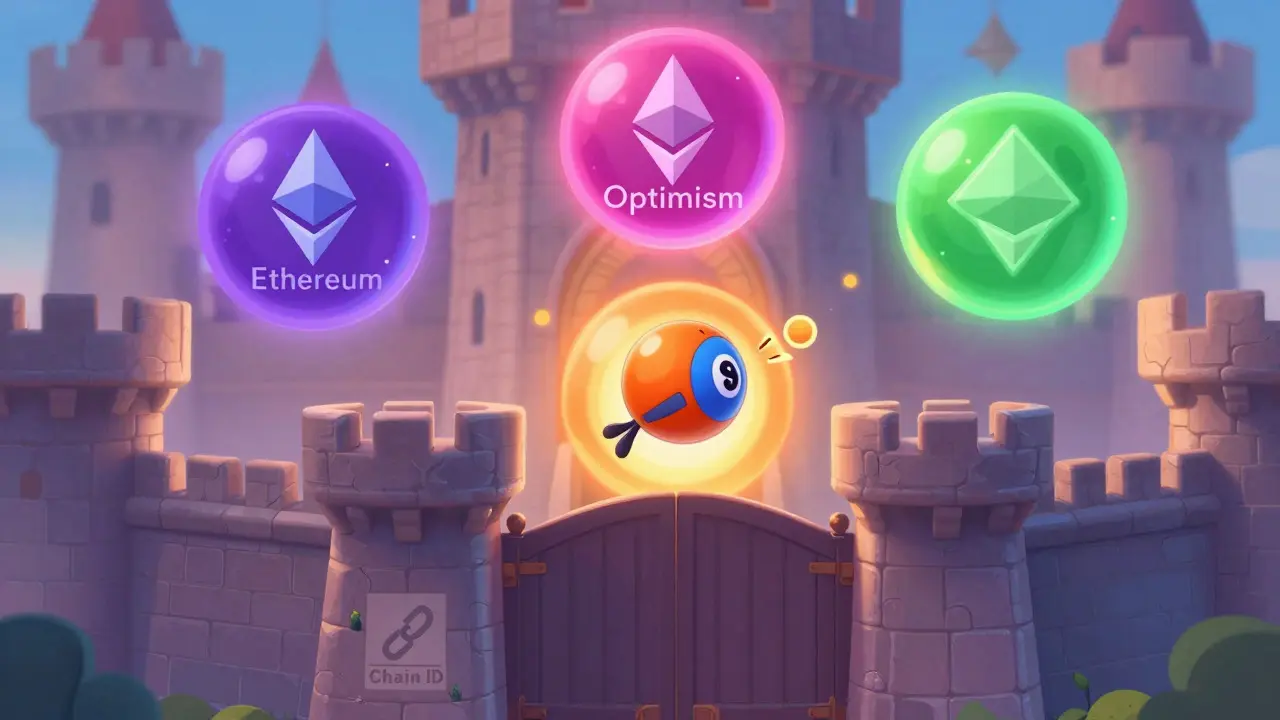
The Role of Chain ID in Multi-Chain Security
Before 2017, a significant vulnerability existed: if a transaction was signed on Ethereum mainnet, it could technically be replayed on the Ethereum Classic fork because the underlying data structure was identical. To fix this, developers introduced EIP-155, which added a Chain ID to the transaction format. Now, the signature includes both the nonce and the chain ID.
This means a transaction signed for Ethereum Mainnet (Chain ID 1) will fail verification on Optimism (Chain ID 10) or Polygon PoS (Chain ID 137), even if the nonce matches. This dual-layer protection is crucial today as users move assets across multiple Layer 2 networks and sidechains. Without Chain IDs, cross-chain replay attacks would be rampant, allowing funds intended for one network to be drained from another.
| Nonce Type | Context | Purpose | Example Value |
|---|---|---|---|
| Transaction Nonce | User Wallet / EVM | Ordering and Replay Prevention | Sequential (0, 1, 2...) |
| Mining Nonce | Proof-of-Work Consensus | Hash Difficulty Targeting | Random 32-bit Integer |
| Application Nonce | Smart Contracts (ERC-1271) | Preventing Signature Reuse in dApps | Custom Counter per User |
Smart Contract Nonces: The Hidden Layer
While the base protocol handles standard transfers, complex interactions with smart contracts often require an additional layer of protection known as application nonces. Many decentralized applications (dApps) allow users to sign messages rather than full transactions. These messages might authorize a third party to spend tokens on their behalf. If these messages don't include a unique nonce, an attacker could capture the signature and execute the authorized action multiple times.
Best practices dictate that smart contracts should maintain a mapping of `address => uint256` to track the last used nonce for each signer. When a user signs a message, the contract verifies that the nonce in the signature matches the expected next value. This pattern is seen in popular standards like ERC-2612 for Permit signatures, where a token transfer can be approved via a single signature, protected by a per-user nonce to ensure it only works once.

Common Pitfalls and Vulnerabilities
Despite the robustness of nonce systems, implementation errors still occur. One common issue is "nonce starvation." If you send a transaction with a high gas price that gets stuck in the mempool, subsequent transactions with higher nonces may be blocked until the first one is mined or replaced. This isn't a security breach, but it halts your ability to interact with the network.
Another risk arises in custom smart contracts that forget to increment the nonce. If a developer writes a function that accepts a signature but fails to check or update the internal nonce counter, the function becomes vulnerable to infinite replay. Auditors look closely for this missing state change. Additionally, predictable nonces in authentication protocols can weaken security, though in blockchain contexts, the sequential nature is actually a feature for ordering, not a weakness, provided the state is correctly maintained by the consensus layer.
Best Practices for Users and Developers
For regular users, managing nonces is mostly automatic. However, understanding the basics helps when troubleshooting. If your transaction is pending, check your current nonce on a block explorer. You can manually set the nonce to skip stuck transactions or replace them with a higher gas price. Always verify the Chain ID in your wallet settings to avoid sending funds to the wrong network, which renders the nonce useless for recovery purposes.
For developers building on Solidity or other EVM languages, follow these guidelines:
- Always include the nonce in the signed payload.
- Use `require(msg.sender == tx.origin)` cautiously, as it restricts flexibility but adds safety against front-running.
- Implement reentrancy guards alongside nonce checks for functions that modify external state.
- Test edge cases where nonces might collide during parallel execution.
As blockchain ecosystems evolve toward multi-chain interoperability, the importance of combining nonces with Chain IDs and domain separators will only grow. The goal remains the same: ensuring that a signature is valid for exactly one specific action, on one specific network, at one specific time.
Can I reset my transaction nonce?
No, the nonce is a permanent counter tied to your address. It starts at 0 and increases by 1 for every confirmed transaction. You cannot decrease it or reset it to zero. If you want to start fresh, you must use a new wallet address.
What happens if I send two transactions with the same nonce?
The second transaction will replace the first one in the mempool if it has a higher gas price. If it has a lower or equal gas price, it will likely be ignored. Only one transaction with a specific nonce can ever be included in a block.
Do all blockchains use nonces for replay protection?
Most EVM-compatible chains use nonces. Bitcoin uses sequence numbers in SegWit outputs for similar purposes. Other chains like Solana use blockhashes and recent slot numbers to achieve the same effect of preventing stale transactions from being replayed indefinitely.
Is a nonce the same as a salt?
Not quite. A salt is a random value added to a password before hashing to prevent rainbow table attacks. A nonce is a value used once to ensure uniqueness in a communication or transaction. While both add randomness or uniqueness, their primary purposes differ significantly.
Why did Ethereum introduce Chain IDs?
Ethereum introduced Chain IDs via EIP-155 after the DAO hard fork created Ethereum Classic. Without Chain IDs, a transaction signed on one chain could be replayed on the other, causing unintended fund transfers. Chain IDs bind the signature to a specific network.


Teri W
Finally someone who explains this with a shred of dignity! Most crypto writers act like we are all illiterate children who need the 'check' analogy beaten into our skulls. It is so refreshing to see a piece that respects the reader's intelligence while still being accessible. We need more of this moral clarity in tech writing.
Leah Humphrey
Meh. The EVM state transition function handles the nonce validation at the protocol layer, which is standard for any Turing-complete virtual machine. The article spends too much time on the 'why' and not enough on the gas cost implications of nonce management during congestion events. It’s a bit surface-level for anyone actually deploying contracts.
Rod Sidoroff
You clearly have never deployed to mainnet without a dedicated RPC node. If you are relying on public endpoints, your nonce tracking is garbage anyway because of mempool latency. The real issue isn't the concept of the nonce, it is the infrastructure required to manage it correctly at scale. Most retail users don't understand why their transactions get stuck, they just blame the blockchain. It is a failure of expectation management, not cryptography.
Jay Johhnston
I think there is a lot of value in breaking down these concepts for a broader audience. Not everyone reading this is a Solidity developer; many are just trying to understand how their funds are secured. The distinction between mining nonces and transaction nonces is often confused, so clarifying that is helpful.
Niall O'Rourke
but really the whole thing is just a counter right? why do we need such fancy words for a simple integer increment. it feels like overcomplicating things for no reason. the chain id part makes sense though since forks are annoying
Jillian Groskreutz
Oh, wonderful, another post that assumes 'nonce' is a magic spell rather than a state variable. And please, stop conflating application-layer nonces (like ERC-2612) with protocol-level account nonces. They serve different purposes and have different failure modes. If you are going to write about security, at least be precise about the scope of the protection mechanism. It is embarrassing how sloppy most technical journalism has become.
Carmene Jackson
Ugh, I remember when my wallet got stuck in a nonce loop last year. It felt like my soul was being drained through the screen. You just sit there watching the pending transaction icon spin, wondering if you’ll ever see your ETH again. It’s one of those moments where you realize technology is just a series of hope-based interactions. Anyway, good read, but make sure to mention that some wallets now auto-adjust gas to skip stuck nonces, it saves so much headache.
Jade Brown
Let’s dissect this: the 'replay attack' narrative is slightly overstated for modern multi-chain environments. With domain separators and EIP-155, the primary risk has shifted from cross-chain replay to intra-chain signature malleability or poor contract design. The article touches on this but buries the lede. A true threat model analysis would look at how nonces interact with meta-transactions and relayers, which is where the real friction lies in UX vs Security trade-offs.
Stephanie Millar
It is quite fascinating how a simple number can hold so much power in a decentralized system. In the UK, we are still catching up with the US in terms of dApp adoption, but understanding these basics is crucial for anyone looking to invest safely. The table comparing the different types of nonces was particularly useful for visual learners.
miranda gamboa
This is super helpful! I’ve been struggling with the concept of why we need both a nonce and a chain ID. It makes so much sense now that the signature binds them together. For anyone else new to this, think of it like a unique ticket stub that only works for one specific show (chain) and one specific seat (nonce). Once used, it’s void. Keep learning, folks!
Uday N M
Good technical overview. However, note that Indian developers building on Polygon and other L2s face significant latency issues with nonce synchronization due to network instability. This is a practical concern that theoretical articles often ignore. Infrastructure matters as much as the cryptographic primitive.
Patrick Pat
Sure, it’s just a counter. But have you tried debugging a smart contract where the nonce check fails because of a reentrancy bug? It’s not exactly a walk in the park. The 'simple' nature of the nonce is precisely what makes it so brittle when implemented incorrectly in complex DeFi protocols. Don’t sleep on the complexity of state management.
Claudio Perrone
nonces are basically the fingerprint of your digital soul. without them we are just ghosts signing checks in the void. its poetic really. i miss the days when we could just trust people to pay once. now we need math to tell us the truth. beautiful and sad at the same time